@Fogo Official I’ve learned to judge a chain the way you judge a piece of infrastructure you can’t afford to romanticize. Not by the stories people tell when the market is calm, but by what the system does when everyone is clicking at once, when the mempool becomes a crowd, when price feeds disagree for a few heartbeats, and when the human on the other side of the screen is trying not to get slipped into a bad fill. That’s the emotional center of Fogo for me: it’s a Solana-based architecture with an execution posture that feels more like an exchange engine learning how to be a public network than a public network trying to cosplay an exchange.
The first thing that changes when you live inside a chain like this is your relationship with time. In trading, a “moment” isn’t poetry, it’s risk. Fogo’s whole reason to exist is that the smallest delays become fairness problems, not just performance problems. When a network can keep blocks moving in the tens-of-milliseconds range and aim for confirmations around the low-single-second range, it doesn’t just feel “fast.” It feels less ambiguous. When things feel unclear, people stop trusting the system. You start wondering if you were simply slow, if someone blocked you, or if others saw a different version of the market. Fogo focuses on keeping that uncertainty low, and you can feel it in daily conversations—less hoping, more confidence.But speed is the least interesting part of the story unless you understand where it comes from. Fogo’s execution character is inseparable from the fact that its core client work is derived from Firedancer—the Jump Crypto validator implementation built with low-level performance assumptions that feel native to modern market infrastructure. Firedancer’s design focus on high-performance primitives and restrictive, security-minded architecture isn’t an aesthetic choice; it’s a set of constraints that push you toward predictable behavior under load. Fogo’s own repository is blunt about what it is: a fork of Firedancer, living in that same lineage.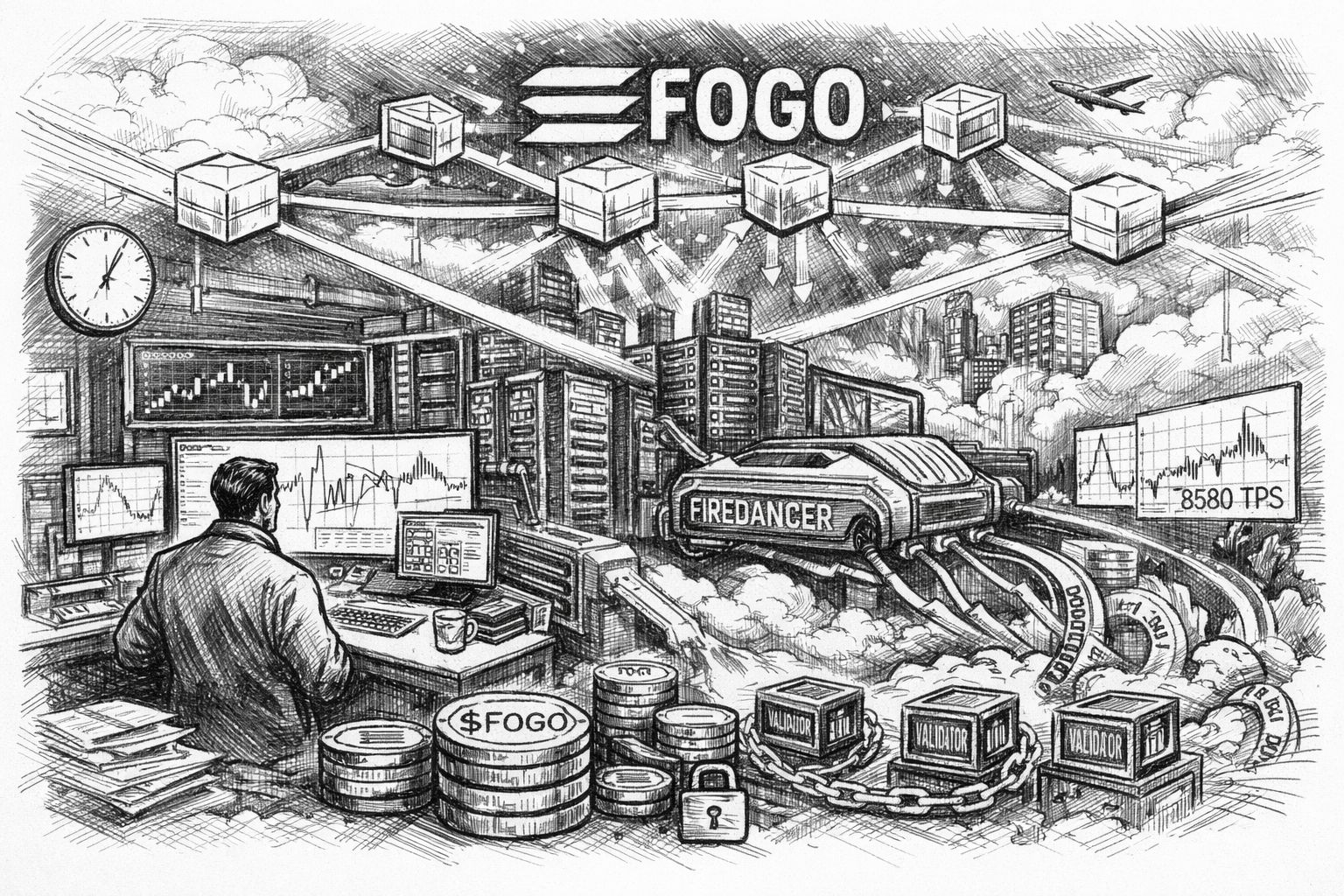
There’s a psychological detail here that people miss if they only look at numbers. When a chain is built around a single canonical high-performance client approach, you trade one kind of risk for another. You reduce the chaos of multiple implementations drifting in subtle ways, but you also concentrate the responsibility. That concentration is uncomfortable in a healthy way. It forces a culture where releases, fixes, and operational discipline aren’t optional—they’re moral obligations, because the blast radius is real. You can see that operational cadence in Fogo’s own release history: a drumbeat of versions that read like the kinds of changes you ship when you’re thinking about nodes failing to converge, stake-weight edge cases, and network-path fixes rather than cosmetic upgrades.
When I say “living inside the ecosystem,” I mean I pay attention to the boring moments that tell you whether a system respects its users.A bug that stops nodes from agreeing isn’t just a tech problem. It’s a moment when people can’t close trades, can’t move collateral, and can’t be sure what’s actually happening. Fogo’s documentation has releases explicitly framed around fixing conditions that could block consensus progress and tightening behavior around leader-path compute limits and stake-weight handling. That tells me the team is spending its attention budget where it actually counts: the thin edge where a fast chain can become an unreliable one if you stop being paranoid.
What makes this especially relevant right now is that Fogo’s “recent” isn’t just social noise—it’s a concrete transition into public reality. The project’s public mainnet and token events clustered tightly around mid-January 2026, which is when systems stop being ideas and start being obligations. The Fogo blog explicitly tied claimability of $FOGO to January 15, 2026, and third-party reporting around the launch period tracked the network going live alongside the token’s market debut. I care about that date because it’s when people stopped interacting with a promise and started interacting with finality.
Token reality matters here, not as a price chart, but as a behavioral engine. $FOGO isn’t a decorative badge; it’s positioned as the native asset used for fees, staking security, and governance, which means it’s part of how the chain defends itself and how participants signal long-term alignment. � When you add token distribution mechanics, you also add a second layer of emotional weather: the fear of dilution, the suspicion of insider advantage, the quiet resentment that can grow when unlocks surprise people. I prefer when the supply picture is legible. Current tokenomics tracking puts total supply at 10,000,000,000 and circulating around 3.77B (roughly 37.7% unlocked), which gives you a concrete frame for thinking about how much of the network’s economic weight is already “in the wild” versus still scheduled to arrive.
Fogo’s own tokenomics communication during that January window leaned into staged distribution and explicit allocations—again, not because allocations are exciting, but because clarity reduces the kinds of conspiracy thinking that can poison a young ecosystem. In my experience, most communities don’t fracture because of bad intentions; they fracture because of information gaps that invite the worst interpretations. When a chain wants serious users—people who run size, people who build venues, people who need predictable execution—those users don’t demand perfection. They demand that you tell the truth early, especially about supply and incentives. 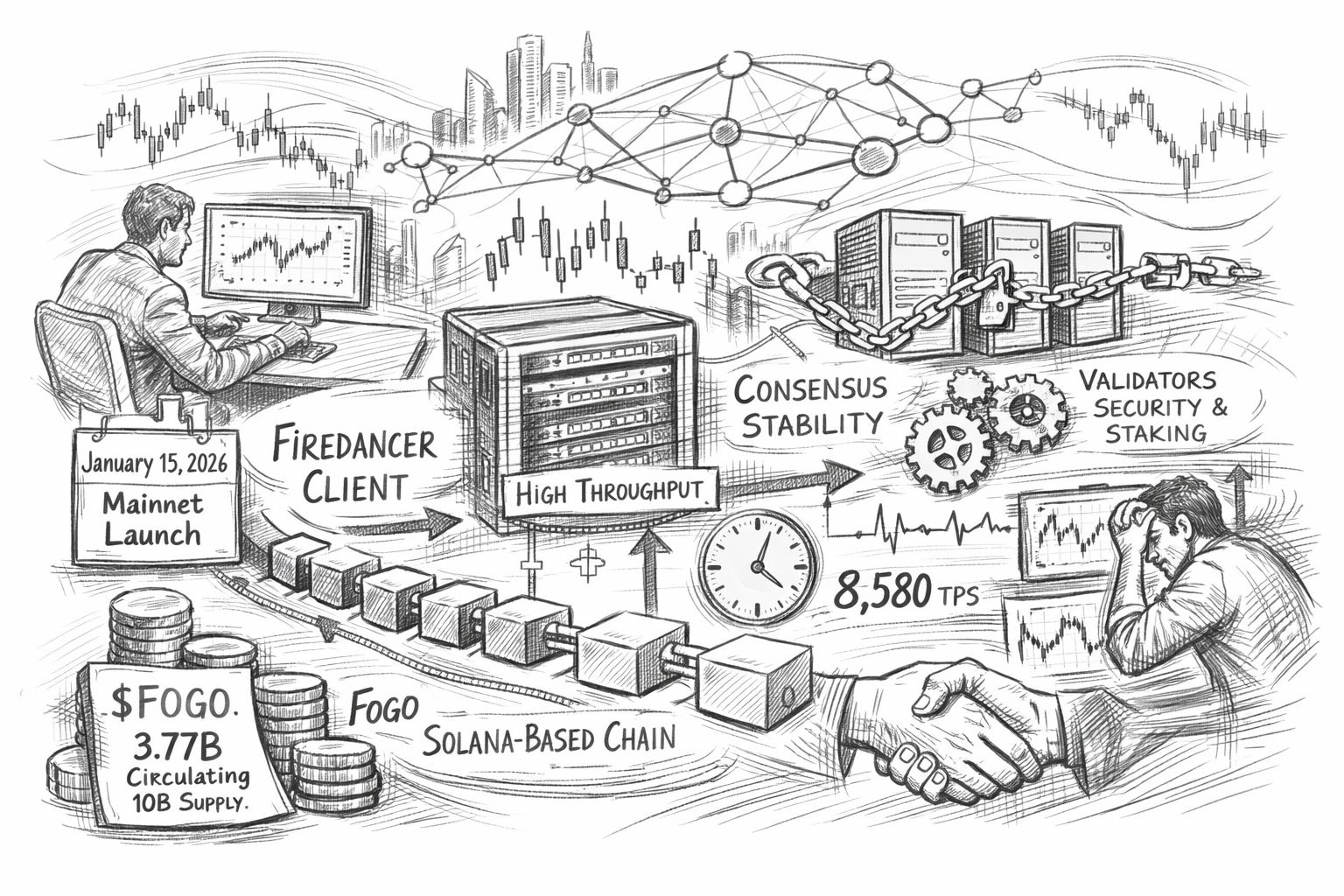
Now, the part of the title that matters most to me is “Solana-based architecture,” because it implies a certain mental model of how data moves. In SVM-style execution, the system is always negotiating parallelism: what can run at once, what must wait, what can be safely re-ordered, what must be serialized to preserve the illusion that the world has a single coherent state. Under load, mistakes here aren’t loud; they’re subtle. A user doesn’t feel “a scheduling decision.” They feel a trade that lands one slot later than expected, a liquidation that triggers a fraction earlier than their mental model allowed, a transfer that confirms but with a different downstream outcome because dependent state changed in the gap. This is where client design stops being a developer preference and becomes a human trust contract.
That’s why I keep coming back to the idea of a Firedancer-derived client as more than a throughput strategy. It’s a philosophy about where you pay your costs. You pay them in engineering rigor, in low-level optimization work that most chains never touch, in careful control over the network path, in conservative fixes that look boring on social media but prevent catastrophic edge cases. Firedancer itself describes a design built from the ground up for speed with a security-conscious architecture, and Fogo’s choice to stand on that foundation is basically a statement that the chain wants “performance” to be a reliability trait, not a marketing adjective.
You can see the ecosystem trying to validate that claim with measurements, which I treat carefully because performance numbers are easy to weaponize. Still, there’s signal in independent telemetry when it comes from a consistent methodology. Chainspect has publicly posted performance highlights that put Fogo’s peak throughput in the mid-thousands TPS range, including a noted jump to 8,580 TPS in early February 2026. I don’t read that as a trophy; I read it as an operational question: can the chain sustain that without turning into a casino of reorg anxiety and validator instability?
The way users actually experience that question is simple: do they feel safe placing intent on-chain? When I’m sending a trade, I’m not just sending bytes. I’m placing a small piece of my future into a machine that will interpret it. If the machine is slow, I feel exposed. If it’s inconsistent, I feel cheated. If it’s fast but fragile, I feel like I’m driving a race car with loose bolts. Fogo’s recent cadence—mainnet launch in January 2026, rapid client releases focused on consensus-path correctness, and a token distribution reality that can be modeled rather than guessed—reads to me like an ecosystem trying to earn the right kind of confidence: the quiet kind that comes from not being surprised.
And I keep noticing how much of Fogo’s narrative, when you strip away the slogans, is really about reducing the emotional tax of using a decentralized venue. Not making people “believe,” but making it easier for them to act without fear. If you’ve ever watched someone freeze during volatility because they don’t trust the system to reflect reality quickly enough, you understand why latency is a human factor. If you’ve ever watched someone accuse a venue of unfairness because state propagation felt mysterious, you understand why client determinism and network behavior become social stability tools.
So when I look at where Fogo is today, I think in concrete anchors. There’s a public mainnet date—January 15, 2026—that marks the start of real accountability. There’s a supply frame—10B total, ~3.77B circulating—that lets serious participants reason about incentive drift and future unlock pressure without turning everything into rumor.There’s an engineering cadence visible in releases that prioritize consensus safety and network-path hardening, the kind of work that rarely trends but often decides whether a chain survives its first true stress event. And there’s a measurable performance posture, with third-party telemetry suggesting the network can push high throughput in practice, which is meaningful only insofar as it remains stable when it matters.
In the end, I don’t think the most important thing Fogo is building is speed. I think it’s building a different relationship between the user and the machine—one where execution feels less like a gamble and more like a contract. That kind of reliability is invisible when it works, and that’s the point. Invisible infrastructure is the highest standard because it refuses applause and accepts responsibility instead. If Fogo succeeds, a trader won’t feel the client lineage or the release notes or the token schedule in the moment they act. They’ll just feel something rarer in crypto: the calm sense that the system will do what it said it would do, even when everything else is loud.