Risk never leaves the market. It only changes shape.
In 2025, traders are no longer chasing raw performance. They are asking where the risk lives. That shift is subtle but important. After years of bridge failures, validator outages, and unstable fee spikes, the conversation moved from “how fast?” to “how controlled?” This is where Plasma’s risk-structured design becomes relevant.
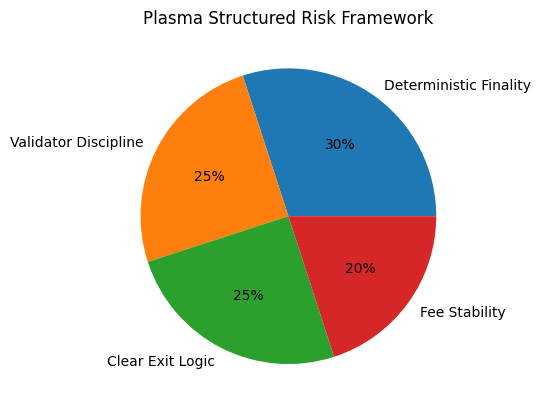
Let’s simplify it. Structured risk means the system clearly defines what can fail, how it fails, and how recovery works. In many networks, risk is hidden inside complexity. When stress arrives, behavior becomes unpredictable. Plasma takes a different route. Its architecture limits variables through deterministic finality and bounded validator coordination.
Deterministic finality simply means once a transaction is confirmed, it cannot be reversed. There is no probabilistic waiting period. That removes one major uncertainty. For traders, uncertainty equals hidden cost. For investors, uncertainty equals long-term instability.
Why is this trending now? Because real-time data in late 2024 and early 2025 showed increasing volatility clusters across multiple chains. Transaction bursts during macro events created congestion. Networks with flexible but complex execution models experienced inconsistent fee behavior. Plasma’s design philosophy focuses on predictable settlement, not elastic promises.
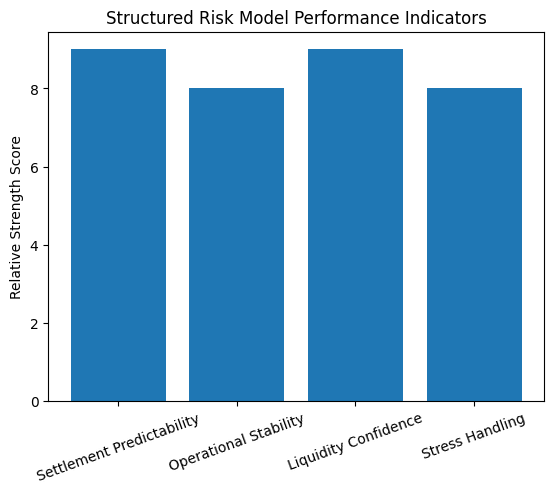
Structured risk also affects liquidity providers. Market makers calculate exposure based on expected settlement time and fee range. If those variables swing widely, spreads widen. If they remain stable, spreads tighten. Plasma’s emphasis on execution clarity indirectly supports liquidity confidence.
Progress in this area has been steady rather than loud. Throughout 2024, development updates centered around validator stability, settlement guarantees, and execution transparency instead of feature expansion. That might sound boring. But boring systems often survive longer.
Personally, I pay attention to how a network behaves under pressure, not during calm. Many systems look strong when volume is low. The real test comes during sudden capital movement. Structured systems bend within limits. Unstructured systems improvise.
Plasma’s architecture assumes stress will occur. That assumption shapes design decisions. Validators follow deterministic rules. Exit paths are defined clearly. Settlement logic does not depend on optimistic assumptions. This does not eliminate risk. It organizes it.
There is also a psychological dimension. Traders operate differently when they trust system behavior. When confirmation times are stable, position sizing becomes rational. When fee volatility is controlled, risk models remain accurate. Structured risk reduces behavioral overreaction.
From an investment standpoint, risk structure supports capital durability. Institutional capital in 2025 increasingly favors predictable infrastructure. Regulatory frameworks reward clarity. Infrastructure that explains its risk model openly tends to integrate more smoothly with compliance environments.
SEO terms like deterministic settlement, validator discipline, predictable execution, and structured risk are becoming central in infrastructure discussions. Plasma aligns with that language naturally because its model emphasizes boundaries rather than expansion.
Philosophically, I believe markets reward systems that admit limits. Unlimited flexibility sounds attractive but often hides fragility. Structured systems accept constraints. And constraints create resilience.
Trust grows from repeatable behavior. If risk is visible and managed within defined parameters, participants adapt rationally. If risk is hidden and reactive, participants withdraw capital quickly.
Plasma does not promise immunity from volatility. No system can. What it appears to offer is a framework where volatility interacts with rules, not improvisation. That distinction builds confidence over time.
In crypto, innovation often moves faster than reflection. But the infrastructure that lasts is rarely the one that moves fastest. It is the one that understands where its weaknesses are and designs around them.
Structured risk is not exciting. It does not trend on social feeds. But it determines whether capital stays or leaves during stress.
In the end, traders look for opportunity. Investors look for durability. Both ultimately rely on systems that behave consistently when pressure arrives.
Risk will always exist. The question is whether it is chaotic or structured. Plasma’s approach suggests it prefers structure over spectacle. And in long cycles, structure tends to outlast noise.