

Imagine a blockchain that doesn’t feel like a “blockchain.” No confusing wallets. No impossible fees. No slow waits. No complicated gamer hurdles. Now imagine a digital world where AI, gaming, payments, brands, and daily life all connect in one smooth flow. That’s the idea behind Vanar — a next-generation Layer 1 chain that isn’t trying to impress tech geeks, but instead wants to bring normal everyday people into Web3 without them even realizing they’re using a blockchain.
The story starts with a project called Virtua. Back in the early days, Virtua was focused on gaming and entertainment. But the team saw something bigger. They realized that for millions or even billions to step into Web3, the entire infrastructure needed to be rebuilt. Not just a new app or a new coin — but a whole new foundation. And so, with massive community approval, Virtua transformed into Vanar. The token changed to VANRY, the vision multiplied, and the mission became something far more ambitious than “just an L1.” Vanar wanted to become the engine of an intelligent digital universe.
What makes Vanar fascinating is the simplicity of its goal. It’s built for people, not for nerds. Everything is designed to be fast, low-cost, clean, and extremely easy to use. You click, things happen instantly. You play a game, it feels smooth. You buy something, it clears instantly. You store your digital items, and you don’t even think twice. Fees are tiny — sometimes fractions of a cent — so even a school kid buying a $1 digital item isn’t punished by crypto costs. It feels like using a normal app, but behind the curtain, Vanar is doing the heavy lifting.
This is where things get interesting. Vanar is completely EVM-compatible, but also built with its own enhancements. It’s not a copy-paste chain. It has its own AI-native infrastructure — something extremely rare in blockchain. Most blockchains treat AI like a plugin. Vanar treats AI like a core organ. With modules like Neutron and Kayon, the chain can compress huge files into tiny on-chain seeds, run advanced reasoning, let smart contracts “think” better, and allow apps to store and process intelligent data. This means an AI game, an AI assistant, or an AI marketplace can run natively on Vanar without being limited by old blockchain rules.
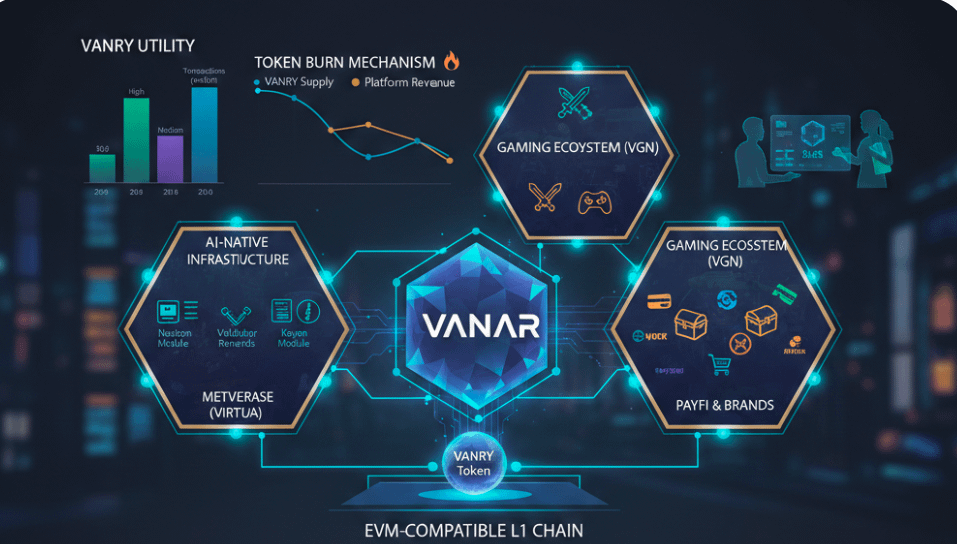
In the middle of all this is the VANRY token — the fuel for everything. It pays for transactions, powers apps, rewards validators, and connects the ecosystem. What makes it different is that many of Vanar’s products, especially the AI ones, actually use VANRY in real life. For example, myNeutron, Vanar’s AI-powered assistant, already has a subscription system where parts of the revenue are converted into VANRY and burned. This creates a real cycle where demand grows as the platform grows. It’s not just “hype tokenomics,” it’s real utility.
But Vanar isn’t just AI. It has a huge gaming ecosystem called VGN, where players own digital assets that actually belong to them. Items can be traded, used, or earned in ways traditional gaming companies would never allow. For gamers, Vanar’s speed is crucial — no delays, no laggy transactions, no crazy gas fees. The chain feels like it’s built for high-action environments where every second matters.
Then there’s the Virtua Metaverse — Vanar’s digital world where people can hang out, attend events, shop, own land, and interact with brands. It isn’t a vague concept like many other metaverses. It’s a practical, visually rich experience directly powered by Vanar. Everything you own is on-chain, everything you do is proven, and the world feels alive.
And Vanar isn’t stopping there. It’s moving into PayFi — blockchain payments for real merchants. Imagine paying for groceries, games, or online services with blockchain speed but without the usual blockchain headache. The goal is to make crypto feel invisible, just like how people use “internet” without ever thinking about servers or cables. That’s how Vanar wants to operate — quietly powering the economy behind the scenes.
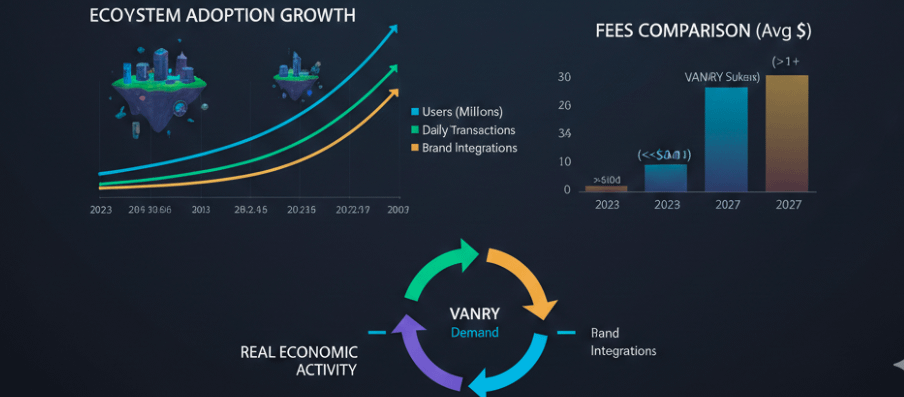
Even brands are being drawn into the Vanar ecosystem, using its tools for loyalty programs, promotions, and digital experiences. Big companies often don’t want to build on complicated blockchains. Vanar gives them a simple, friendly, plug-and-play system where they can launch Web3 features without learning the crypto world from scratch.
Of course, no project is perfect. Vanar still has to fight for adoption. Real-world use isn’t easy. Big chains like Solana and Ethereum already dominate the space. Regulations can slow down innovation. And building a chain that mixes AI, gaming, payments, and consumer apps is incredibly complex. But the team seems to understand that real adoption takes time and real products — not flashy words.
The future for Vanar looks promising if it continues executing. More users mean more VANRY demand. More AI features mean more revenue burning. More gaming means more daily transactions. More brands mean more real-world visibility. If Vanar becomes a place where millions play games, buy digital items, use AI tools, and shop with blockchain, then the VANRY token could become more tied to actual economic activity than most L1 tokens today.
In a world filled with overhyped blockchains, Vanar stands out as a project trying to build something that genuinely solves everyday problems. Not just for traders. Not just for devs. But for the next 3 billion people who will one day use Web3 without even knowing what Web3 means.
