

Over $19 billion liquidated in worst crypto crash since COVID (2:06)
The World Uncertainty Index (WUI) hit a new all-time high (ATH) and surpassed levels previously seen during the Sep. 11 attacks in 2001, the Iraq War in 2003, the global financial crisis in 2008, and the coronavirus pandemic in 2020.
The WUI is an indicator that measures how much uncertainty is discussed in a country’s reports by counting the frequency of the word “uncertainty” and its variants in country reports published by the Economist Intelligence Unit (EIU).
The more often the word "uncertainty" is mentioned in EIU country reports, the higher the country’s uncertainty index.
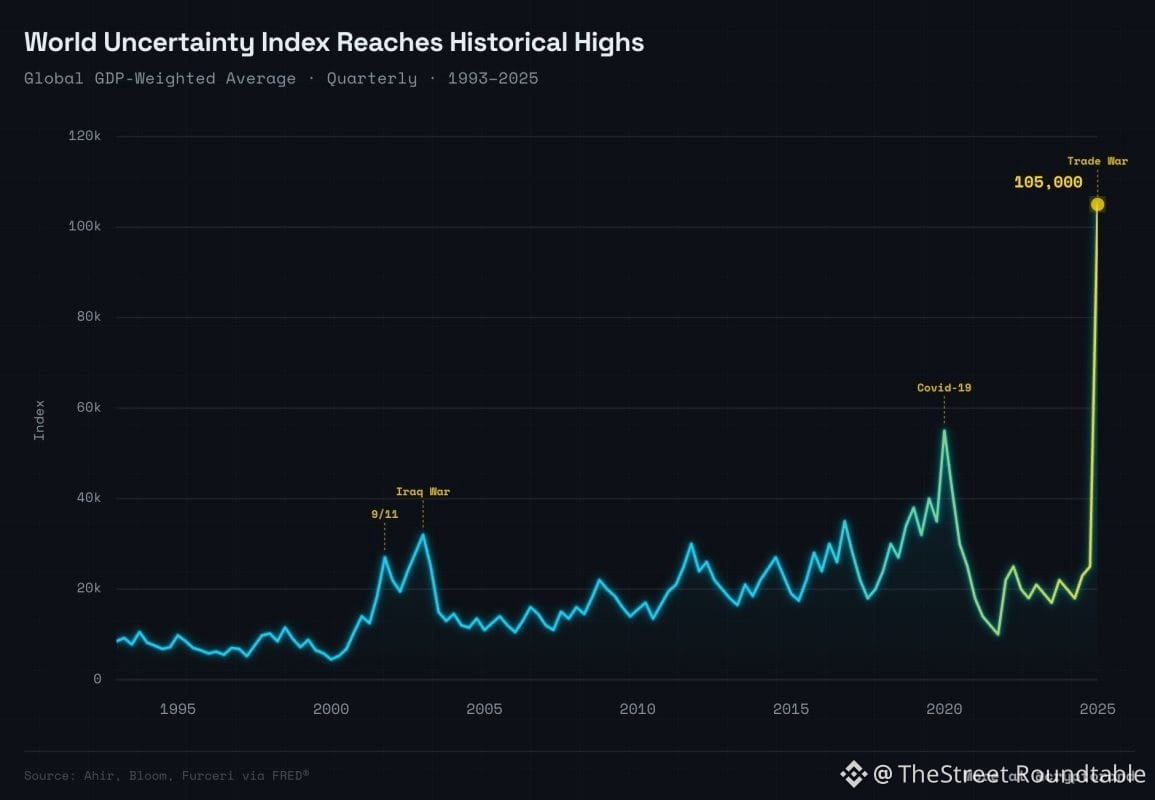 Source: FRED
Higher uncertainty generally translates into lower investment, slower economic growth, and increased financial volatility.
Last year, the WTI hit its ATH of 106,862.2 during Q3 and remained only slightly below 100,000 during Q4.
The global tariff tensions, geopolitical conflicts in Eastern Europe, West Asia, and Latin America, the weakening dollar, and the threat to the Federal Reserve's independence during the Donald Trump administration are the primary factors behind the uncertainty.
Related: Treasury Secretary Bessent reveals new plan to finance U.S. government
U.S. market rallying amid record 'uncertainty'
But it might seem strange why a metric indicating uncertainty has been hitting record highs while nearly all the major market indicators are performing exceedingly well on the charts.
Whether it's the NASDAQ Composite (above 24,000 points), the Nasdaq 100 (above 26,000 points), or the S&P 500 (above 7,000 points), nearly every market benchmark has been hitting new record highs.
Meanwhile, the U.S. dollar index—an index of the value of the USD relative to a basket of foreign currencies—is at its lowest point at around 95.
So, the U.S. market is rallying higher while the general public is losing faith in the fiat currency.
The dollar debasement has driven traders to flock to precious metals like gold and silver. Gold surpassed $5,500 per ounce and silver surpassed $100 per ounce to hit new record prices recently.
But unlike precious metals, Bitcoin (BTC) has failed to leverage the dollar debasement trade of late.
More News:
White House meets crypto and banking executives as Bitcoin crashes
Trump selects pro-crypto candidate to lead Federal Reserve
157-year-old bank warns U.S. dollar is 'overvalued'
Is Bitcoin trading in line with 'uncertainty' index?
Bitcoin maximalists argue the cryptocurrency is "digital gold," as, like the bullion, it is also scarce and acts as a hedge against inflation and dollar debasement.
The argument stood until early October last year when Bitcoin surpassed the $126,000 price mark to reach its ATH. But the Oct. 10 crash sent the crypto market plummeting, and Bitcoin is yet to recover from the shock.
While the U.S. dollar index kept tanking, Bitcoin couldn't take advantage of it, reflecting thinner demand from both institutional and retail investors.
While many commentators would read it as "uncertainty" around Bitcoin, senior analysts have diverging views on its future.
Geoffrey Kendrick, Standard Chartered’s head of digital assets research, recently warned BTC could fall to $50,000 before rebounding to $100,000 by the end of the year. The $100,000 target is a downgrade from the earlier target of $150,000, though.
JPMorgan analysts led by managing director Nikolaos Panigirtzoglou are, however, bullish on Bitcoin, believing it could eventually hit $266,000.
At the time of writing, Bitcoin was trading at $67,826.43.
Related: Cathie Wood just made her biggest stock purchase of 2026
