
The crypto market lately has slipped back into a familiar state. Volatility everywhere, narratives switching by the hour, and my emotions… slowly going numb. I look at prices, I look at TVL, I watch the numbers dance, and I don’t feel that old excitement anymore. And in one unusually quiet moment, I catch myself asking: after all these years of repeating “blockchain will change the world,” how many things have actually changed the human experience instead of just polishing dashboards?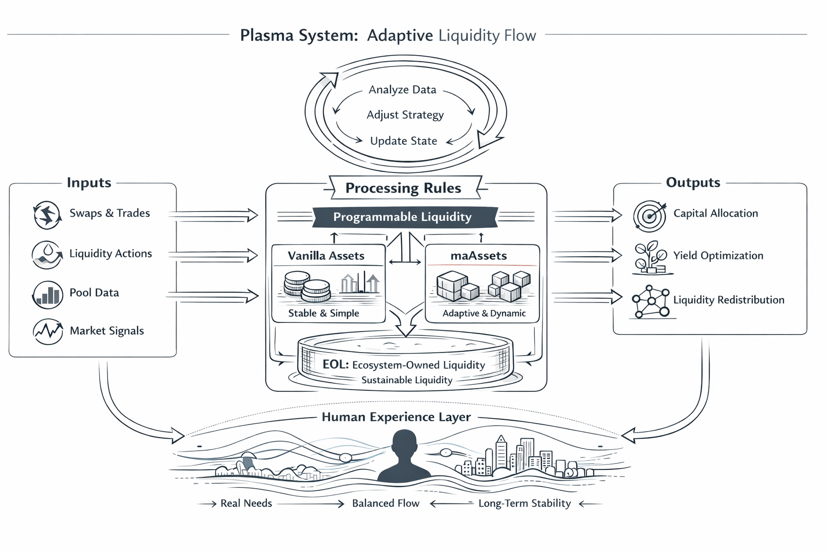
DeFi was once painted as a landscape of financial freedom. But once you’re inside, it feels different. It’s like a massive machine that never stops running, getting more complex, and drifting further away from people. Liquidity is chopped into fragments, each chain a separate world, capital moving mainly by yield incentives rather than real demand. Users get lost in wallets, bridges, swaps, farms, approvals, confirmations. There’s an irony in it. A system meant to liberate people ends up forcing people to adapt to the machine.
The problem isn’t only risk or security. It’s the way data and value flow through the system. Today’s DeFi feels like a water network assembled in a hurry. High pressure in a few spots, congestion everywhere else, and when something breaks, the whole structure shakes. Capital isn’t designed to adapt, it just reacts. When incentives appear, it floods in. When incentives disappear, it drains out. No memory, no attachment, no sense of long-term rhythm.
In that context, I happened to read about Plasma. Not in the way you get swept up by a story, but in a slow, cautious way. What made me pause wasn’t a grand promise, but how they talk about data flow and system mechanics. Plasma doesn’t begin with “faster, bigger, cheaper.” It starts with a simpler question: how do data and liquidity move through a system without breaking it?
The most interesting part, to me, is that the input data isn’t anything mystical. It comes from very ordinary DeFi reality: every swap, every time users add or withdraw liquidity, every shift in pool states, every spike in slippage, every moment a trading pair suddenly loses depth. Liquidity demand isn’t just a number, it’s a signal of where attention concentrates, where flow is being squeezed, where the system is “breathing hard.” If you watch long enough, those traces repeat. They become rhythm, pattern, signal.
Then comes the processing rules. Programmable Liquidity, as I understand it, is when the system doesn’t just observe, it responds according to rules. It doesn’t throw rewards at whatever looks hot. It reads state, reads demand, then allocates. Some capital should remain as Vanilla Assets, simple, easy to price, low friction. Some capital should be transformed into maAssets to fit the role, the context, the system’s circulation. Vanilla is like raw material. maAssets are like a standardized form that can move through the pipes, so coordination doesn’t shatter everything into even smaller fragments.
And the key question is where the output goes. If data is only read for reporting, it’s still a cold dashboard. But if it produces action, it becomes a mechanism. Here, Plasma seems to want to route liquidity like a disciplined flow, sending capital to where it’s needed most, then letting it return when pressure eases, like circulation. As state changes, new data is generated. The system reads again, adjusts again. A feedback loop. It sounds simple, but DeFi has been missing exactly this kind of disciplined simplicity.
EOL also shows up as a foundation meant to reduce those violent jolts. I’ve seen too many projects rely entirely on rented liquidity. When markets are good, everything looks healthy. When markets turn, liquidity leaves faster than confidence. EOL isn’t magic, but it acknowledges a hard truth: a system that wants to survive long-term needs a base that isn’t fully pulled around by short-term emotion, so when external capital contracts, the system still has “breath” to keep operating and self-correcting.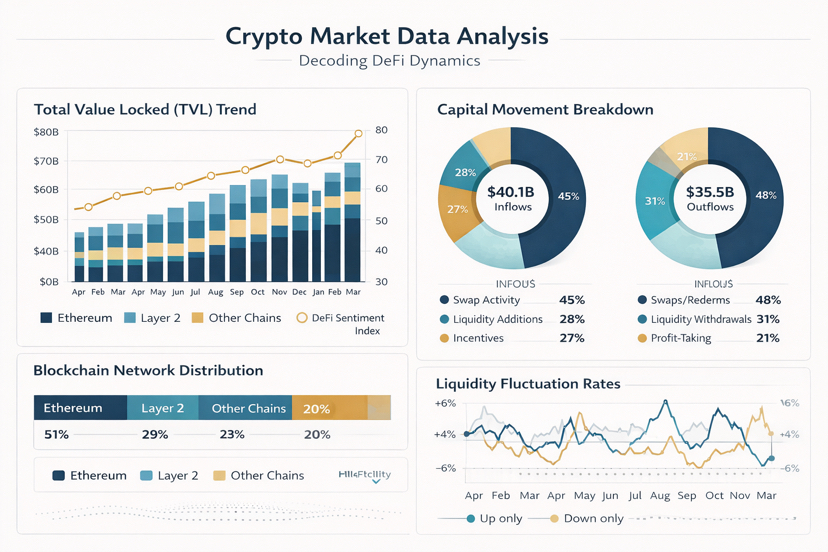
My personal feeling is pretty clear. I got tired of DeFi because it felt emotionally cold. Everything is correct, optimized, but missing a heartbeat. Reading Plasma didn’t give me hype. No “wow” moment. Just a quiet thought: yeah, that makes sense. It feels more like reading a blueprint than watching a pitch. Blockchain here isn’t trying to look flashy, it’s trying to learn how to run steadily. And then I realized, what kept me reading wasn’t a roadmap or numbers, but the sense that Plasma is trying to make this system… less soulless.
Of course, reality is always harsh. Any self-adjusting mechanism carries risk. A complex system that falls out of rhythm can amplify its own mistakes. Plasma will almost certainly face hard phases, moments when the market won’t be patient enough to wait for the logic to prove itself. But the direction matters. It doesn’t start from numbers, it starts from experience. It doesn’t start from promises, it starts from flow structure.
Maybe blockchain doesn’t need more speed. It needs more heartbeat. DeFi doesn’t lack yield formulas, it lacks breath. If blockchain can become something closer to human life, like an organism learning to breathe, Plasma might not be perfect, but at least it’s putting the lungs in the right place to start breathing. $XPL #Plasma @Plasma
