

I noticed something last month that I can’t unsee now: the people who actually use stablecoins the most are rarely “crypto users” in the cultural sense. They’re shop owners settling suppliers, freelancers getting paid across borders, families topping up relatives, small desks moving liquidity between venues. And almost all of them share the same quiet frustration—everything works right up until the moment the network gets busy, fees spike, transactions hang, and “instant digital dollars” starts behaving like a delayed bank wire with extra steps. That’s the exact problem Plasma is trying to solve—on purpose, and at the base layer.
Plasma XPL is built around a simple promise: stablecoin rails shouldn’t collapse when volume arrives. The part that makes Plasma stand out is how directly it targets the friction stablecoin users experience every day, instead of treating it like an annoying side effect that wallets and apps should patch over later. At its core, Plasma is a Layer 1 EVM compatible blockchain that is purpose built for high-volume, low-cost global stablecoin payments, with an explicit focus on USD₮ flows. It’s not trying to be a general “everything chain.” It’s making a narrower claim: stablecoins should be first-class citizens of the protocol, and the chain should behave predictably in the exact moments users care most—when the network is busy, when payments matter, and when the cost of being “slow” is real.
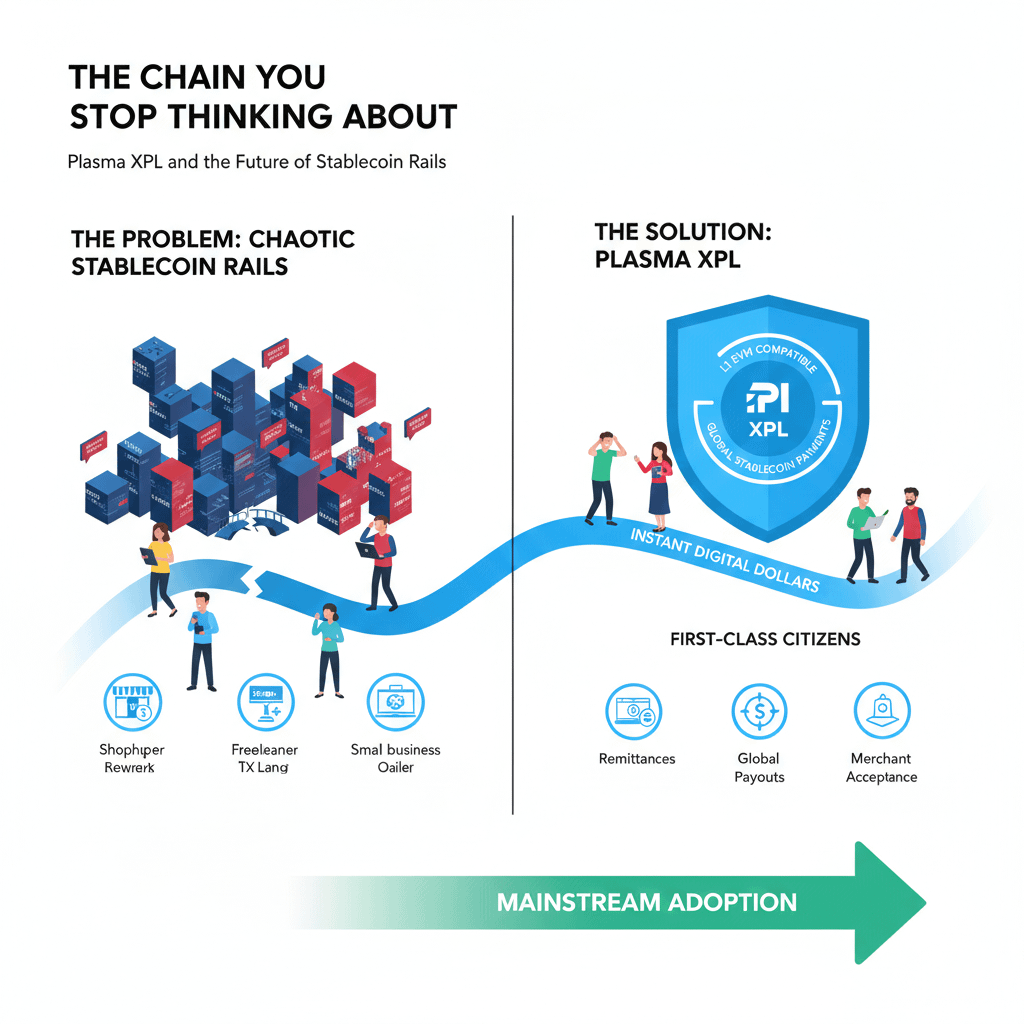
What Plasma is responding to is the reality that stablecoin pain isn’t philosophical. It’s operational, and it shows up in small, ordinary moments. A stablecoin transfer that costs unpredictable gas—especially during congestion—stops feeling like money and starts feeling like a specialized transaction you need to plan around, breaking the “money illusion” instantly. Onboarding also collapses into “buy gas first,” because if the first step to send $20 is “acquire the native token,” you’ve already lost the mainstream user. And the most fragile flows are usually the most common ones: high-frequency, low-value transfers like micropayments, merchant change, salary fragments, and repeated payouts—exactly the kind of behavior that gets priced out on general-purpose networks. Plasma calls remittances, micropayments, global payouts, merchant acceptance, and dollar access out as first-order use cases, which is really Plasma admitting what stablecoins already are for many people: banking for anyone with a phone, at scale.
Plasma’s own documentation is unusually clear about what it says it’s optimizing for at the protocol level: stablecoin-native contracts (zero-fee USD₮ transfers, custom gas tokens, and a confidential payments module described as in progress), a high-performance consensus layer (PlasmaBFT, described as a pipelined implementation of Fast HotStuff), a modular EVM execution layer built on Reth, and a “Bitcoin-native” bridge direction framed as trust-minimized with a verifier set that decentralizes over time. If you step back, this is Plasma’s underlying argument: stablecoins are already the most adopted crypto product, but they’re still treated like apps riding on chains rather than the thing the chains should be designed around.
The consensus angle matters because stablecoin payment networks don’t just need “high TPS” as a marketing phrase; they need low latency under load, deterministic finality that is good enough for commerce (so “paid” actually means paid), and predictable performance during demand spikes. HotStuff-style consensus and pipelining are widely studied approaches to improving throughput and responsiveness in BFT systems, and Plasma’s framing is straightforward: if stablecoin transfers are your main workload, you architect consensus around that workload, not around generalized smart contract diversity. That same “payments-first” logic shows up again in the execution choice—Plasma describes its environment as fully EVM compatible and built on Reth, a high-performance, modular Ethereum execution client written in Rust. The practical effect is twofold: developers can migrate more easily with Solidity contracts and familiar tooling, and at the same time performance engineering becomes a first-class concern because the execution layer is modular enough to tune without breaking compatibility.
That’s also why the stablecoin-native contract set is positioned as “protocol-governed UX.” Plasma describes protocol-maintained contracts tailored for stablecoin applications—scoped, security-audited, and designed to work cleanly with smart-account standards like ERC-4337 and EIP-7702. The philosophy is subtle but important: instead of telling every wallet and app to reinvent gas abstraction in slightly different (and slightly risky) ways, Plasma wants standardized building blocks that behave consistently at the chain level. The tradeoff is real—consistent UX and easier integrations on one side, governance and coordination questions on the other—who decides sponsorship rules, limits, eligibility, and how quickly the system opens. Plasma doesn’t hide this; it stresses that these contracts are tightly scoped and managed, with the intent to integrate deeper over time.
The feature people feel first is the one that removes the most common friction: zero-fee USD₮ transfers. Plasma documents a relayer system where USD₮ transfers can be executed without the end user holding XPL or paying upfront gas, with the paymaster funded by the Plasma Foundation and sponsorship applied at execution time in a transparent, rate-limited way rather than as an open-ended subsidy. The technical choices it mentions are what make it feel like infrastructure instead of a gimmick: sponsorship restricted to standard token transfer calls (transfer/transferFrom) rather than arbitrary calldata, identity-aware controls referenced through lightweight verification (like zkEmail) plus rate limits to reduce spam, authorization-based transfers built around signed authorizations with references to EIP-3009 style structures, and a relayer API design that reads like an actual service—base URL, API key auth, per-address and per-IP rate limiting, and endpoints for submission, status, limits, and health checks. This maps to how gasless stablecoin UX works in the broader EVM world: the user signs an off-chain authorization and a relayer pays to execute it on-chain, which is exactly the kind of design that makes stablecoins behave like what users already expect—send value, done, no side-quests.
Custom gas tokens sit right next to that same idea. Plasma describes a protocol-maintained ERC-20 paymaster that lets approved tokens be used for gas instead of XPL, and the reason this matters is because “custom gas” is easy to promise and hard to do safely. Plasma’s stance is effectively: keep it scoped, keep it audited, keep it protocol-maintained, and avoid the world where every app ships its own paymaster with its own risk profile. In practice, this means stablecoin-centric apps can operate without forcing users into the native-token onboarding loop—either because certain transfers are sponsored (like USD₮ sends) or because gas can be paid in a token the user already holds.
Then there’s the confidential payments direction, which Plasma describes as under active research. The goal is to shield amounts, recipients, and memo data while preserving composability and allowing regulatory disclosures, framed as opt-in and intended to be implemented in Solidity without custom opcodes or alternate VMs. It’s ambitious, but it’s also honest—Plasma isn’t pretending it’s fully shipped; it’s signaling where stablecoin rails may need to go if they’re going to support payroll, treasury flows, and business settlement without leaking everything by default. The Bitcoin-native direction is another hinge point: Plasma describes a trust-minimized Bitcoin bridge that moves BTC into the EVM environment in a non-custodial way, secured by a verifier network that decentralizes over time. Read simply, two ideas are bundled together—Bitcoin as an anchoring layer for verification, and programmable BTC inside the same environment as stablecoin settlement for collateral, BTC-backed stablecoins, and cross-asset flows.
Plasma also goes straight at something most chains avoid saying out loud: payments don’t win on elegance. They win on distribution—wallet routes, ramps, stablecoin supply, merchant rails, and liquidity incentives. Plasma’s mainnet beta announcement stated it expected $2B in stablecoins active from day one with capital deployed across 100+ DeFi partners (Aave, Ethena, Fluid, Euler and others), and it described how it tried to engineer that: a deposit campaign where over $1B in stablecoin liquidity was committed quickly to vaults tied to public sale allocation mechanics, a public sale structure via Echo/Sonar designed around time-weighted deposits and broader participation, and an argument that the hard part is distribution—country-by-country integrations, local markets, and connecting digital dollars to real-world cash networks. Whether someone agrees with the strategy or not, Plasma is openly treating distribution as a core protocol problem, not a marketing afterthought.
When it comes to XPL, Plasma’s docs are explicit. XPL is described as the native token that secures the system, pays validators, and aligns incentives as stablecoin adoption scales. The initial supply at mainnet beta launch is 10,000,000,000 XPL, with allocation set as 10% (1,000,000,000 XPL) for the public sale, 40% (4,000,000,000 XPL) for ecosystem and growth with an initial portion unlocked at launch for incentives, liquidity, and exchange integrations and the rest unlocking over three years, 25% (2,500,000,000 XPL) for the team with a one-year cliff followed by monthly unlocks, and 25% (2,500,000,000 XPL) for investors on the same schedule as the team. On issuance, Plasma documents a validator rewards schedule that starts at 5% annual inflation, decreases by 0.5% per year down to 3%, and only activates when external validators and stake delegation go live; to limit long-term dilution, the docs reference EIP-1559-style fee burning where base fees are burned. The model is recognizable: inflation funds the security budget, and fee burn offsets as usage grows.
Funding and backers are framed as part of the “payments plumbing” reality too. Plasma announced raising $24M across Seed and Series A, led by Framework and Bitfinex/USD₮0, with participation from trading firms and other investors, and it highlighted involvement from figures like Paolo Ardoino and Peter Thiel. Mainstream outlets framed the same point more bluntly: Plasma is trying to build stablecoin infrastructure with enough capital, relationships, and regulatory awareness to operate like real payments plumbing, not a weekend DeFi experiment. If stablecoins are becoming regulated, distribution-heavy, and politically relevant, the teams that win may be the ones structured to survive that reality.
This is also why the explorer layer matters more than it sounds. Plasma’s public explorers show standard chain telemetry: blocks, transactions, accounts, contracts, token transfers. Rails only become real when wallets connect, transfers clear, blocks keep arriving, infrastructure has uptime, and developers can inspect and debug. That’s when the narrative stops being a pitch and starts being a system. But the hardest question is still the simplest one: can Plasma stay stable when it gets the exact traffic it’s built for? The hardest test for any payments-optimized chain isn’t peak TPS in a lab; it’s what happens on ordinary days when a region hits currency stress and stablecoin demand spikes, when an exchange rail pauses and flows reroute, when arbitrage intensifies and mempools heat up, and when bots probe any subsidy surface they can find. Plasma’s design acknowledges those realities directly—tight scoping on paymaster sponsorship, identity and rate-limit gating, and an emphasis on predictable behavior over unlimited generality—yet it still faces the unavoidable fork: stay too foundation-managed and risk feeling controlled, open too quickly and risk being abused. That balance—between openness and operational integrity—is the real stablecoin-rail problem, not TPS.
Plasma isn’t trying to convince anyone that stablecoins are the future; stablecoins already won that argument in practice. Plasma’s pitch is smaller and sharper: treat stablecoin payments like critical infrastructure, not like an app running on somebody else’s congested computer. And the more I watch how stablecoins are used in the real world, the more that framing feels inevitable. People don’t want a “blockchain experience.” They want the transfer to go through—quietly, immediately, without a lecture about gas, and without the system changing its personality the moment volume shows up. If Plasma can hold that line when it’s busy—when the network is loud, when the flows are messy, when demand is real—then it won’t feel like a new chain at all. It’ll feel like something far more important: the part of the internet where money simply moves, and nobody has to think about it twice. And I’ll say it the simplest way I can, because this is what I actually mean: I don’t want a chain that looks good on quiet days. I want one that stays calm on the loud days. If Plasma can do that, it won’t need an explanation—the first time someone sends USD₮ in the middle of chaos and nothing strange happens, they’ll understand it immediately, because it will finally feel like money again.

