
Reports began circulating in early 2026 that convicted sex offender Jeffrey Epstein was “actually Satoshi Nakamoto”, the pseudonymous creator of Bitcoin. These claims rested on social-media posts and doctored documents, not on verifiable evidence. In this report we examine Epstein’s actual background and the known facts about Satoshi, compare their timelines and skills, and review the purported “evidence.” We find no credible evidence linking Epstein to Bitcoin’s creation. In fact, every authoritative source – DOJ records, fact-checkers, and Bitcoin archives – confirms the Epstein–Satoshi story is a baseless conspiracy.
Timeline and Profile
Satoshi Nakamoto
Satoshi Nakamoto is the name (almost certainly a pseudonym) attached to Bitcoin’s 2008 white paper and the early Bitcoin software. The white paper “Bitcoin: A Peer-to-Peer Electronic Cash System” was posted to a cryptography mailing list on Oct 31, 2008. Shortly thereafter Satoshi announced the first public Bitcoin software (version 0.1) on Dec 10, 2008, and continued issuing updates through 2010. The Nakamoto email archives (at bitcointalk.org and nakamotoinstitute.org) show Satoshi actively communicating with developers until late 2010, then abruptly going silent.
Satoshi’s work was highly technical: he wrote C++ code for the Bitcoin protocol and authored detailed forum posts and emails on cryptography and economics. Experts note that speculation about Satoshi’s identity has always focused on computer scientists and cryptography experts, not financiers or socialites. For example, professional stylometry analyses have compared Satoshi’s prose to that of known cryptographers like Hal Finney, Nick Szabo and others, finding closest matches among those candidates. There is no record of Epstein (a financier) engaging in coding or cryptography discussions in the Bitcoin community at any time. In short, the only known Satoshi activity (2008–2010) and his technical output have no obvious resemblance to anything in Epstein’s record.
Jeffrey Epstein
Jeffrey Epstein (1953–2019) was an American financier and convicted sex offender. He grew up in Brooklyn, studied briefly at Cooper Union and NYU (but dropped out), and began his career as a teacher and later as a banker. By the 1980s and 1990s Epstein was managing wealth for billionaires and cultivating an elite social circle. He was not a software developer or cryptography researcher – his education and career were in finance and consulting.
Epstein’s criminal timeline sharply overlaps Bitcoin’s birth. He pleaded guilty in Florida in June 2008 to procuring a minor for prostitution, and served roughly 13 months in custody (with work-release) into 2009. During 2008–09 Bitcoin was conceived, coded, and launched on cryptography lists and forums – precisely while Epstein was under court supervision. By the time he finished his sentence (early 2009) Bitcoin was already running on a live network. In other words, when Satoshi was writing code and emails in 2008–10, Epstein was preoccupied with legal issues, not in a position to secretly develop a cryptocurrency. After 2009 Epstein re-entered social and philanthropic life (donating to science and tech causes) but Bitcoin’s creator had already vanished.
Epstein’s known public activities do not match the image of a mysterious crypto-inventor. He had no published technical papers or patents, and no documented coding experience. In fact, Epstein’s fortune came from private finance – he “made much of his fortune by providing tax and estate services to billionaires” – and he was famous for networking with CEOs and politicians, not for software. His presence in the tech world was as a donor and investor (for example, through a venture fund co-owned with former MIT Media Lab director Joi Ito), not as a developer or engineer.
Timeline and Capability Mismatch
The timeline of each man’s activities makes them incompatible. Satoshi’s activity peaks in 2008–2010, whereas Epstein was largely absent from computing. For example, Satoshi announced Bitcoin v0.1 on Dec 10, 2008 and published Bitcoin-related posts throughout 2009–10. By contrast, Epstein was serving a prison sentence in late 2008 and most of 2009, and only began dabbling in cryptocurrency investments around 2014. Any credible inventor of Bitcoin would likely still be involved as it matured after 2010 – but Satoshi disappears from view in 2010, and Epstein only “shows up” in crypto circles years later.
Moreover, Epstein lacked the required skills and context. Satoshi’s writings reveal familiarity with advanced cryptography, distributed computing, and libertarian economic ideas. Epstein’s background was in finance and math education, not computer science. No witness or document suggests Epstein ever operated Bitcoin software or owned Satoshi’s private keys. Notably, investigators find no technical fingerprints tying Epstein to Bitcoin’s origin: “no evidence of early code commits, no linkage to Satoshi’s known emails or forum posts, no control of early wallets, and no contemporaneous documentation placing Epstein at the origin of the protocol in 2008–2009”. In contrast, authorship of Bitcoin’s code is easily verifiable (the source is open), and in theory Satoshi could have “proved” his identity by signing a message with the original keys. No such proof has ever been offered by Epstein or anyone else.
Viral Claims and Fact-Checks
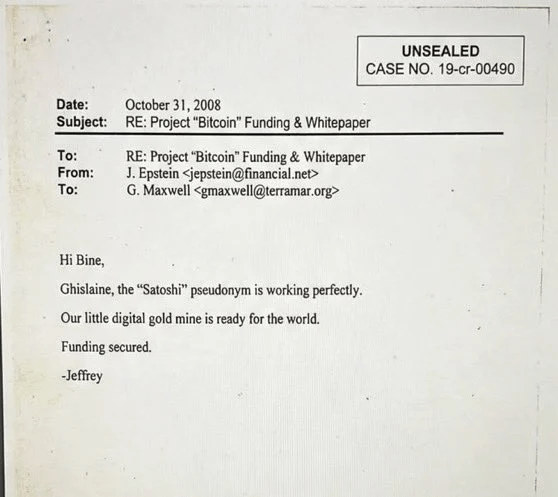
The Epstein–Satoshi theory rests almost entirely on viral memes and doctored emails, not on authenticated documents. The cornerstone was a purported email (dated Oct 31, 2008) from “Jeffrey Epstein” to Ghislaine Maxwell, claiming “the ‘Satoshi’ pseudonym is working perfectly. Our little digital gold mine is ready for the world.” This image spread on social media platforms (X, Reddit, TikTok) in early 2026. But official fact-checks immediately debunked it. Journalists noted the PDF’s layout errors (two “To:” lines, inconsistent fonts), and crucially they found no matching document in the U.S. Justice Department’s publicly released Epstein archives. A France24 “Truth or Fake” report confirmed the email was fake: searches of the DOJ’s Epstein file repository show zero hits for the phrase “little digital gold mine” or for any email to Maxwell about Bitcoin. The viral letter also used the address “jepstein@financial.net”, which appears nowhere in Epstein’s records (his normal address was jeevacation@gmail.com). In short, the image claiming Epstein called Bitcoin a “little digital gold mine” is a forgery.
Fact-checkers on Yahoo/AFP reached the same conclusion: “No email from Jeffrey Epstein about Satoshi or ‘little digital gold mine’” appears in the released files. They emphasize multiple doctored documents circulating online, none of which come from authentic DOJ files. Gizmodo’s Kyle Torpey also highlights the avalanche of “falsified Satoshi-related emails” on social media, and calls the Epstein=Satoshi claim “one of the silliest myths” gaining traction online. In every case, reputable media note that the official records contain no sign of Epstein inventing Bitcoin.
Key Examples of Debunked Evidence:
Fake 2008 email: The Maxwell email image (with “digital gold mine” quote) is completely unauthentic. DOJ searches find no such memo; forensic checks reveal formatting errors.
Imaginary Maxwell exchanges: Variations of that fake email (even labelled “Unsealed Case”) have been debunked. Fact-checks found 24 search results for “Satoshi” in the DOJ archive – none match the viral screenshots.
Lack of credentials: No analysis of Bitcoin’s code or the known Satoshi emails (on bitcointalk.org) has ever linked them to Epstein. In fact, as crypto analyst CCN notes, the records show “awareness, access, and investment, not authorship or control.” They state categorically: “there is no evidence he was Satoshi Nakamoto, a Bitcoin founder, a core developer, or that he exercised technical or protocol control.”
Epstein’s Actual Crypto Connections
While Epstein was not Bitcoin’s inventor, the newly released files do reveal he had some later involvement in the crypto world as an investor and discussant, which may have fueled the confusion. For example, DOJ documents show he invested about $500,000 in a 2014 seed round of the Bitcoin-related company Blockstream (through a fund he co-owned with MIT’s Joi Ito). Blockstream’s CEO Adam Back later confirmed Epstein sold that stake months later due to conflicts; he has had no ongoing role in Bitcoin core development. Epstein was also an early investor in Coinbase (the files and media report a 2012 involvement). These activities place Epstein in cryptocurrency’s circles after Bitcoin was already established, but only as a backer and networker, not as a builder.
The released emails give a glimpse of Epstein’s crypto interests. In April 2013 he was forwarded a memo (by contacts around Bill Gates) analyzing Bitcoin’s economics, and in July 2014 he was CC’d on a Blockstream email discussing rival coins (Ripple/Stellar). Most notably, a 2016 email from Epstein to Middle East associates outlined a proposal for a “Sharia” cryptocurrency, and claimed he had “spoken to some of the founders of Bitcoin who are very excited”. In context, Epstein was pitching an alternative digital currency and boasted that Bitcoin’s creators were aware of his idea. But this email does not name Satoshi or prove anything. As CoinCentral reports: “the claim cannot be verified. Bitcoin was created by someone using the pseudonym Satoshi Nakamoto… The email does not name those individuals, and there is no evidence showing the discussions went beyond conversation or that Epstein held any role in Bitcoin’s creation”. In fact, his wording (“some of the founders,” plural) merely echoes an existing theory that Bitcoin may have been a team effort. It is not evidence that Epstein was among those founders.
In summary, Epstein’s actual crypto footprint (investments and emails circa 2011–2016) shows financial and personal proximity to blockchain projects but no authorship of Bitcoin. As one analysis puts it, Epstein appears “not as a coder” but as “a donor, investor, correspondent” who entered Bitcoin’s ecosystem during a funding-crisis period. Nowhere do the files show Epstein writing code, controlling Bitcoin nodes, or editing the protocol.
Hoaxes, Misinformation, and Rumors
Beyond the specific email images, numerous other hoaxes have circulated. Some social-media posts misattribute quotes, misuse documents, or simply assert “Epstein is Satoshi” without proof. Bitcoin community members and crypto journalists have repeatedly called out these memes. Gizmodo notes that “bitcoin detractors have parlayed various discussions from [the Epstein files] into a new nickname… ‘pedo coin’,” illustrating how these baseless rumors can fuel anti-Bitcoin propaganda. Prominent crypto analysts (even those usually skeptical of Bitcoin) have publicly dismissed the Epstein theory as “definitely untrue” and advised careful research.
One illustrative example: a viral Reddit/X post showed a cropped Justice Department PDF (Case No. 18-cv-3568) with a subject line hinting at “Bitcoin” and Satoshi, suggesting it was from 2008. In reality, that “Case No. 18-cv-3568” corresponds to Epstein’s Florida 2008 state plea deal – it predates the FBI’s discovery of “Satoshi Nakamoto” by years. When experts examined the PDF’s text more closely, they found it was literally lifted from the 2008 court transcript about the plea deal, with nothing to do with Bitcoin. Such doctored documents exploit superficial cues (dates, case numbers) to trick viewers, but forensic checks quickly expose them as fraud.
Conclusion: No Credible Link Found
After exhaustive review, we find no substantiated evidence that Jeffrey Epstein is Satoshi Nakamoto. All verifiable sources – U.S. Justice Department records, archived Bitcoin mailing lists, forum archives, and investigative journalism – indicate the Epstein=Satoshi claim is false. Key points are:
Official DOJ Records: Searches of the Epstein document archive find no genuine emails where Epstein discusses being Satoshi or inventing Bitcoin. Hundreds of released pages have been scoured, and none contain claims of his authorship.
Timeline Mismatch: Satoshi was publicly active in 2008–2010, exactly when Epstein was in legal custody. By 2011, Satoshi was gone; Epstein only engaged with crypto years later.
Technical Disparity: Satoshi’s output (code, cryptography expertise) has no counterpart in Epstein’s background. The records show “no technical fingerprint” linking Epstein to Bitcoin’s origin, and none of the candidates who match Satoshi’s style or skills include Epstein.
Debunked “Evidence”: The purported emails making the claim have all been shown to be fabrications. Fact-checkers (France24, AFP/Yahoo, Reuters) uniformly label these viral screenshots as fake. Even crypto websites concluding Epstein’s crypto connections (like CCN and CoinCentral) explicitly state “there is no evidence he was Satoshi Nakamoto”.
In short, the Epstein-as-Satoshi story does not withstand scrutiny. It originated on social media, not in the data. Epstein was involved peripherally in cryptocurrency (as an investor and social networker), but nothing in the historical or technical record ties him to the creation of Bitcoin itself. As one crypto news analysis summarizes: Epstein’s name does not appear in any contemporaneous $BTC documentation; all supposed links are either circumstantial or fabricated.
Verdict: There is no credible evidence that Jeffrey Epstein is Satoshi Nakamoto. The rumor has been thoroughly debunked by primary sources and expert analysis, and should be treated as misinformation.
