
I started paying closer attention to decentralized storage not during a bull market, but during a routine operational review. A protocol outage had nothing to do with price volatility or user demand. It failed because incentives drifted. Nodes were technically online, but not meaningfully serving data. Nothing broke in the spectacular sense. The system simply stopped being reliable.
That moment reframed how I evaluate storage protocols. Storage, like settlement or payments, only matters when it works under pressure. That perspective is what makes Walrus worth examining, not as a speculative asset, but as infrastructure designed for long term use.
Decentralized storage promises resilience, censorship resistance, and redundancy. In practice, many systems struggle with a simpler problem: aligning rewards with actual service.
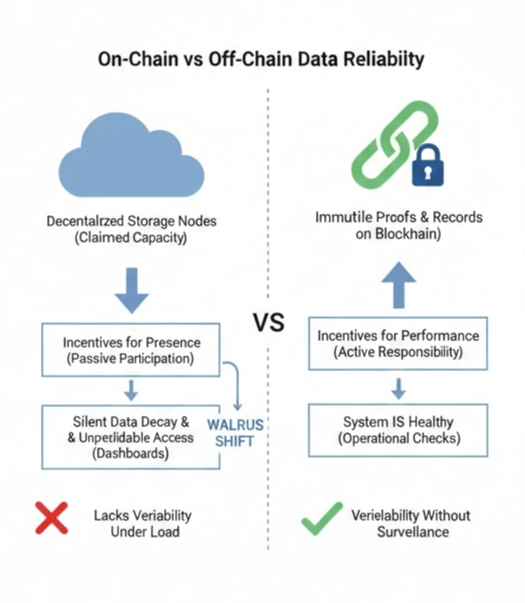
It is easy to incentivize capacity. Under heavy load, incentiving uptime and providing correct replication and transferring real world data becomes more difficult. Many networks provide incentives for nodes to claim to store data, rather than for proving to users that the data can be served reliably on demand. As time passes, this results in silent decay; the data exists but the ability to access it becomes unpredictable. Incentives drift away from user outcomes.
For consumer experimentation, this is tolerable. For regulated finance, it is not.
Institutions care less about ideology and more about guarantees. If storage backs tokenized assets, compliance records, or audit trails, then failure modes must be explicit, measurable, and correctable.
Walrus approaches storage as an operational system, not a marketplace for unused disk space. Its core design ties rewards directly to behaviors that indicate network health.
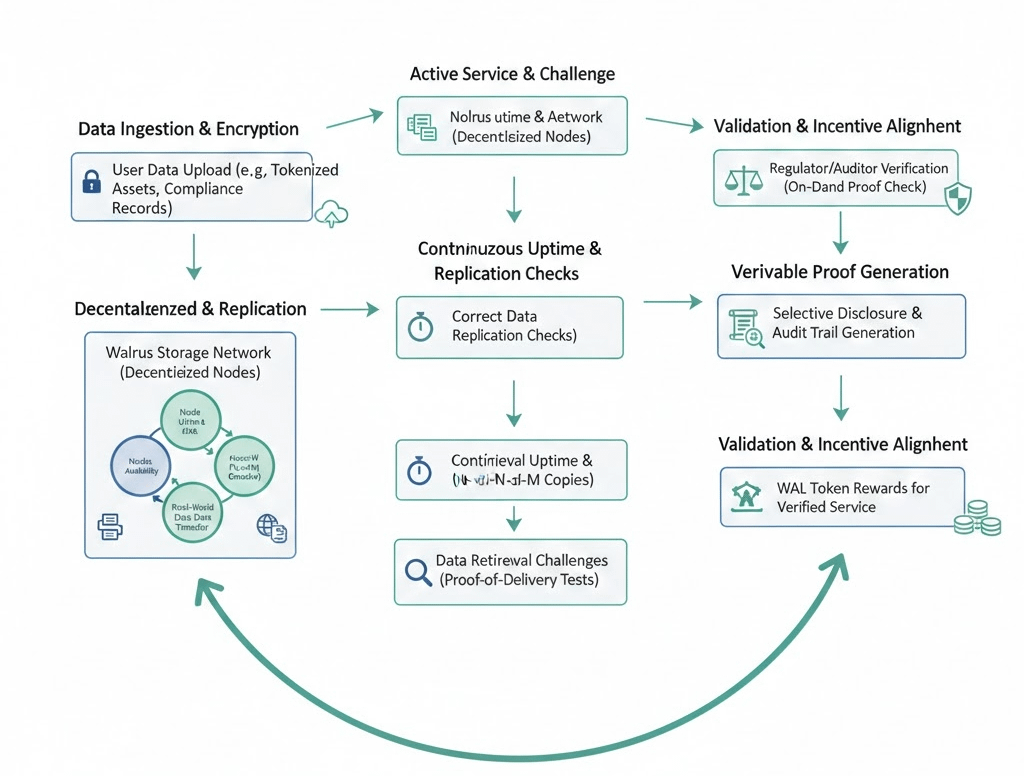
Uptime matters. Providers must remain available, not intermittently connected. Correct replication matters. Data must exist in the required number of independent locations. Serving data under challenge matters. Nodes are periodically tested to prove they can retrieve and deliver real data, not just claim to host it.
This incentive model reads less like a whitepaper and more like an operations checklist. That is intentional. You do not design incentives this tightly unless you expect sustained usage and failure scenarios.
Design reveals assumptions.
Walrus assumes the network will be stressed. It assumes concurrent access, adversarial conditions, and long lived data obligations. This is not a system optimized for idle capacity waiting for hypothetical demand. It is optimized for durability.
That matters for secondary markets and regulated environments. Asset issuers need confidence that historical records will remain accessible years later. The confidence of investors in disclosures and proofs should not depend on an unformly supported or robust system of infrastructure, while regulators expect verifiability without necessarily exposing all of the documentation of general process.
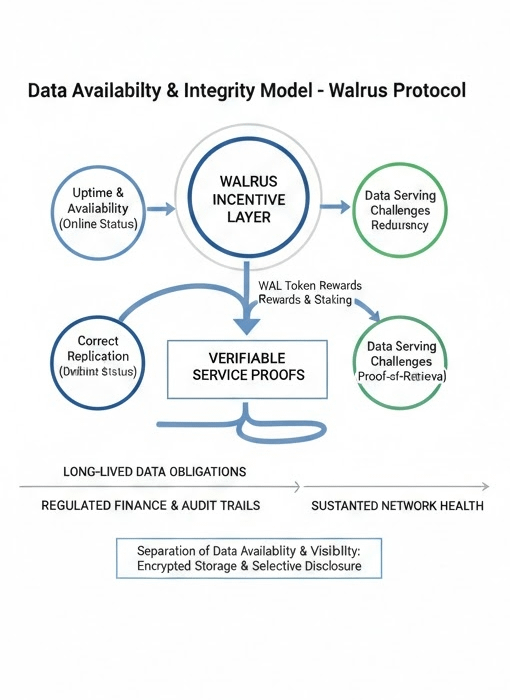
The architecture of Walrus inherently recognizes these needs by placing a greater emphasis on predictable rather than novel behavior. This helps mitigate the risk of infrastructures appearing healthy within dashboards but not being able to support the needs of real world demand.
Sustainability in crypto is often discussed in terms of emissions or token velocity. In infrastructure, sustainability means something else: can the system continue operating correctly when incentives tighten?
Walrus’ reward structure discourages passive participation. Storage providers are compensated for ongoing service, not one time setup. This reduces the risk of networks that look healthy on dashboards but fail under real demand.
From a treasury perspective, this simplicity matters. Fewer reward edge cases mean cleaner accounting. Fewer abstractions mean lower operational risk. For large institutions, these details determine whether a system is usable at all.
From an investor or operator perspective, the WAL token functions as a coordination tool rather than a speculative instrument.
Its primary roles are straightforward. It compensates storage providers for verifiable service, enables staking to align operators with long-term network health, and supports governance around protocol parameters and upgrades.
Supply and emissions are structured to reward sustained contribution rather than short-term participation. Staking encourages operators to internalize risk: misbehavior or poor service directly affects returns. Governance focuses on operational parameters, not marketing direction.
This design reduces reflexivity. The token exists to support the system, not to distract from it.
Decentralized storage often raises concerns about data exposure. Walrus addresses this by separating data availability from data visibility.
Encrypted storage, selective disclosure, and verifiable proofs allow institutions to demonstrate compliance without making sensitive information public. This is critical for financial use cases where auditability and confidentiality must coexist.
Automation plays a role here. Proof generation and verification reduce reliance on manual processes. This lowers operational costs and reduces human error, two factors regulators care about more than decentralization slogans.
For issuers, reliable storage underpins trust. Tokenized assets, disclosures, and lifecycle events depend on durable data access.
For investors, infrastructure quality affects systemic risk. Storage failures rarely cause immediate losses, but they undermine confidence over time.
For regulators, systems like Walrus offer something rare: verifiability without surveillance. Proofs can be checked without broad public exposure, aligning with privacy and compliance requirements simultaneously.
This combination is what moves decentralized systems from experimentation to integration.
Most failures are not dramatic. They are slow, quiet, and operational. Incentives drift. Nodes degrade. Data becomes harder to retrieve.
Walrus does not eliminate risk. No system does. What it does is make risk visible and measurable. That is the difference between speculation and infrastructure.
Speculation comes and goes. Infrastructure either holds or it does not.
Projects like Walrus matter because they focus on the unglamorous middle: the years between launches and headlines, where systems are judged by reliability rather than attention. In that sense, decentralized storage is not about disruption. It is about continuity.
When storage quietly does its job, day after day, under real use, that is when decentralized systems stop being ideas and start becoming part of the financial landscape.
One of the quiet failures in decentralized systems is mistaking presence for performance. Storage nodes exist, dashboards look healthy, yet real data retrieval under load becomes unreliable. The issue is not technology, but incentives.
Walrus addresses this by rewarding verifiable service rather than theoretical capacity. Providers earn by staying online, replicating data correctly, and proving they can deliver it when challenged. This shifts the system from passive participation to active responsibility.
The design is intentionally unexciting. Fewer abstractions mean fewer hidden risks. Clear incentives mean predictable behavior. Over time, that predictability matters more than novelty.
For long lived data, compliance records, and financial infrastructure, durability is the feature. Walrus treats storage as something that must endure pressure, not attract attention, and that design choice is what makes it relevant beyond speculation.

