


Photo by: ROUTE 2 FI
Compiled by: TechFlow
Editor's note: The RWA track has always maintained a high level of attention. However, the current asset categories in the track are mainly real-world bonds. LandX provides another option-bulk agricultural commodity. Through the combination of DeFi and RWA, users can obtain investment returns from bulk agricultural commodity targets while revitalizing farmers' income on the other side. The project provides a target independent of crypto assets, and related tokens will be released soon. This article provides a comprehensive introduction to LandX's product model, economic model and future development, which is worthy of attention.
LandX Finance is a blockchain protocol that aims to bring real-world assets (RWAs) to the decentralized finance (DeFi) space through perpetual commodity vaults. By bringing farming RWAs on-chain, the protocol can provide investors with yield opportunities and exposure to uncorrelated asset classes.
As the name LandX suggests, they are bridging the gap between farmland owners and crypto investors through a blockchain-based perpetual commodity library.
The LandX protocol facilitates agreements between borrowers (farmers) and investors. The vault acts as a blockchain-based token that trades at a market-determined principal price. Holders of staked tokens will receive a daily yield on the underlying commodity in perpetuity.
Over the past year, we have seen tremendous growth in real-world assets (RWAs) in DeFi. This space will absorb the next trillion dollars into the crypto market.
LandX plays a vital role in integrating a $15 trillion asset class (farmland) into DeFi.
According to forecasts, the total locked value (TVL) of RWA on the chain will be between $16-20 trillion by 2040. Today’s TVL in DeFi is only $50 billion.
What are the benefits of LandX? Is it needed in DeFi?
Currently, DeFi native and institutional investors have no way to get exposure to farmland commodities. Therefore, LandX was created to enable crypto native investors to diversify their digital asset portfolios and gain sustainable sources of yield that are only available off-chain. LandX achieves this by connecting digital assets to real-world farmland and agricultural production, and providing on-chain users with the opportunity to earn real yields.
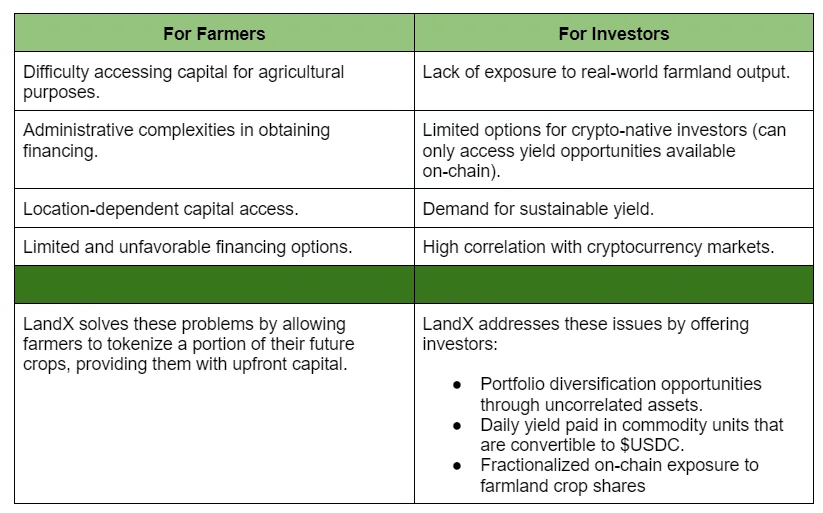
On the one hand, farmers often face financial difficulties. This problem is caused by various factors, such as the difficulty of obtaining agricultural financing, cumbersome administrative processes, location dependence... Therefore, the available options are often unfavorable.
On the other hand, DeFi investors currently have no access to the production of real-world farmland. Therefore, most portfolios in the crypto market are still highly correlated with the overall crypto market (and also have a strong correlation with US stocks). In addition, most market participants usually look for sustainable sources of income on the chain.
Farmers need funds to purchase additional farmland, new equipment, and improve their facilities. These efforts directly contribute to local food security, but cannot be accomplished due to lack of liquidity. LandX solves farmers' financing difficulties by providing advance funding in exchange for a portion of future farm production.
In short, farmers use LandX to convert a portion of their future harvest into tokens to receive advance funding. At the same time, crypto investors can directly access the output of the underlying farmland. LandX's commodity pool provides these investors with daily returns paid in units of the underlying commodity.
Many DeFi applications drive unsustainable returns, often through inflationary tokens and aggressive marketing strategies to attract liquidity providers. These practices may result in short-term gains but often lack long-term viability.
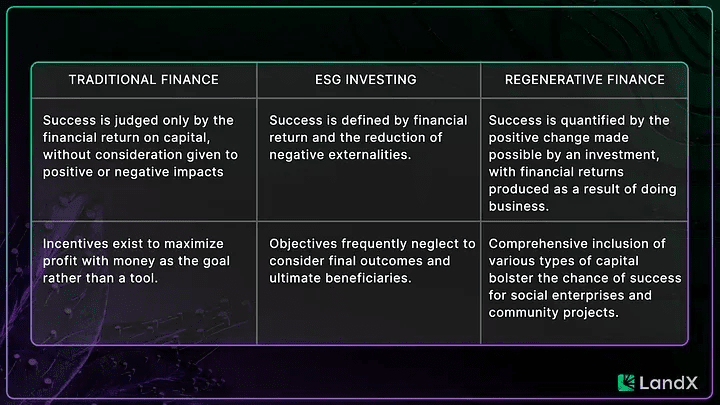
LandX takes a different approach, focusing on sustainable yield and regenerative finance. The platform uses capital as a tool to invest in real-world yield opportunities while addressing systemic issues to rebuild the natural environment. This approach aims to create a lasting and meaningful impact in DeFi and the environment.
In summary, here are the problems LandX solves:
Token Introduction
LandX mainly uses three types of tokens, xTokens, cTokens and governance token LNDX.
First, let’s look at xTokens.
xTokens — DeFi Diversification
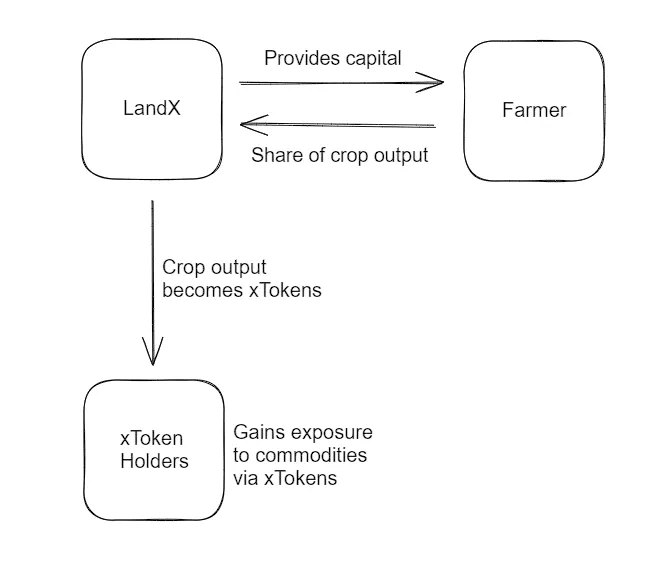
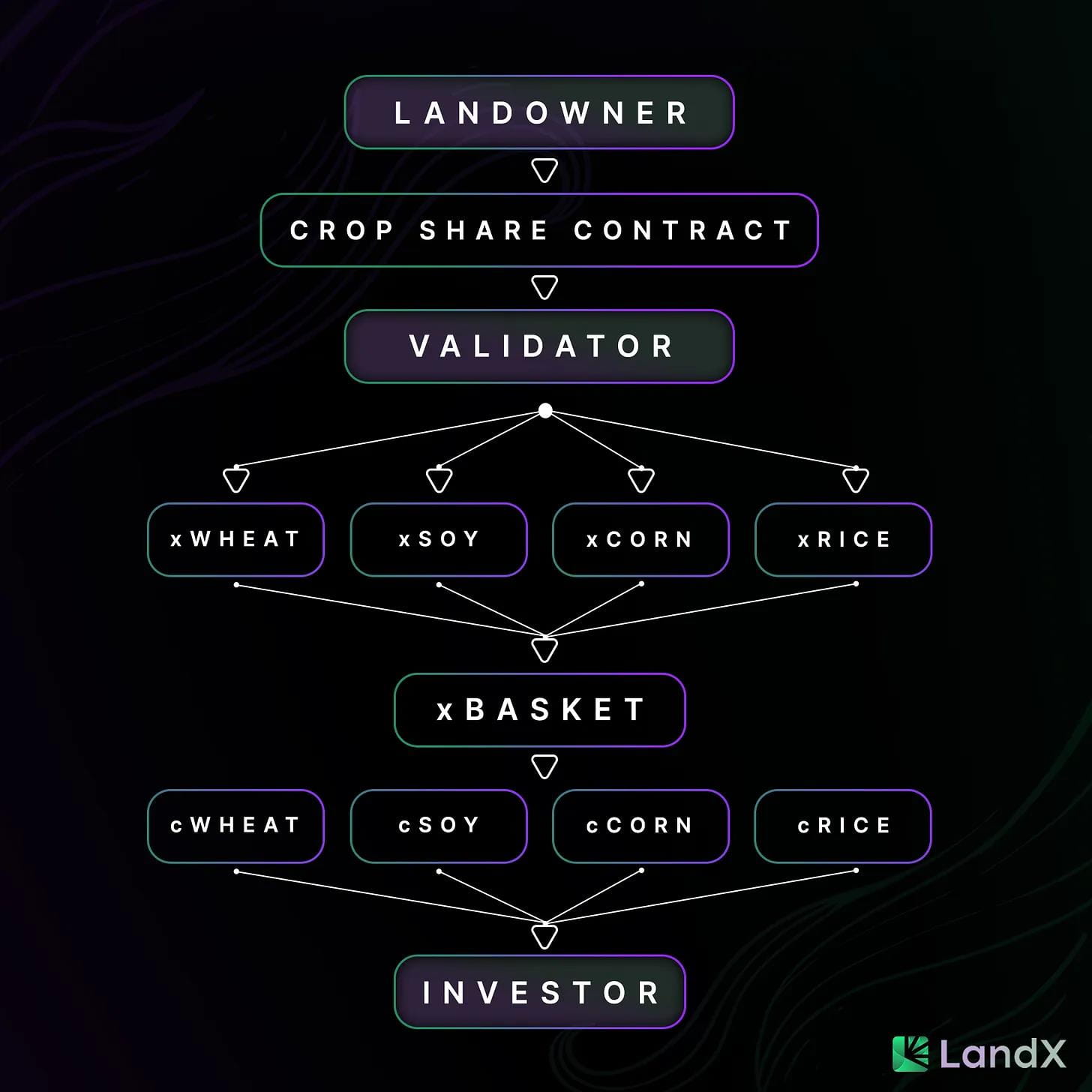
LandX ensures that crop output is converted into xTokens.
The actual crops produced are represented on-chain in the form of cTokens. xTokens are the fragmented debt obligations that farmers must provide to LandX for their share of the crop.
This is illustrated in the figure below.
Farmers receive xTOKENs equal to their agreed share of the crop (e.g. if a farmer pledges 1000 kg of soybeans per year, they will receive 1000 xSoy tokens).
To combat potential farm yield or cash uncertainty, the LandX platform requires farmers to keep 12 months of farm yield share payments on the platform and also requires a 12-month security deposit from each farmer.
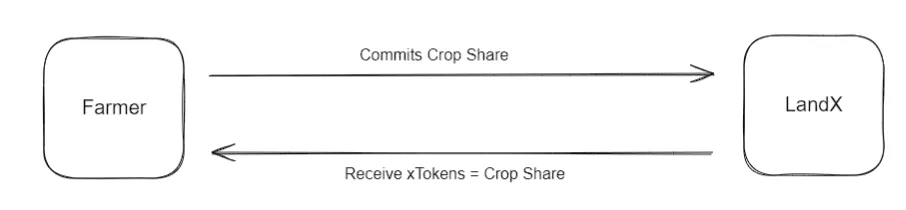
After going through an extensive qualification process, farmers commit to a percentage of their annual harvest through a legal contract (called a lien). In return, they receive xTokens equal to the agreed-upon share of the crop. These tokens are then sold to interested investors, providing farmers with upfront funding.
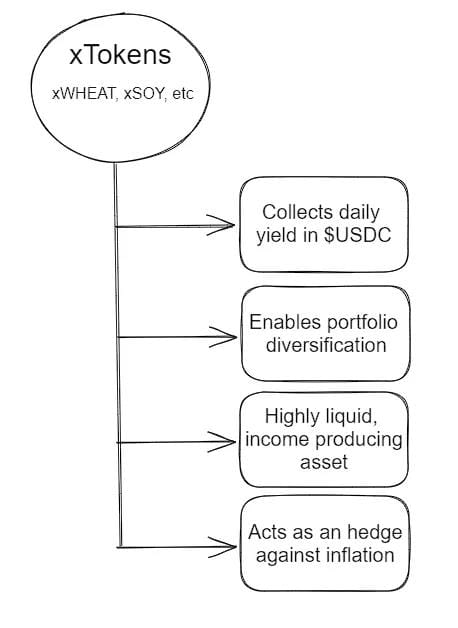
xTOKEN benefits investors in a number of ways:
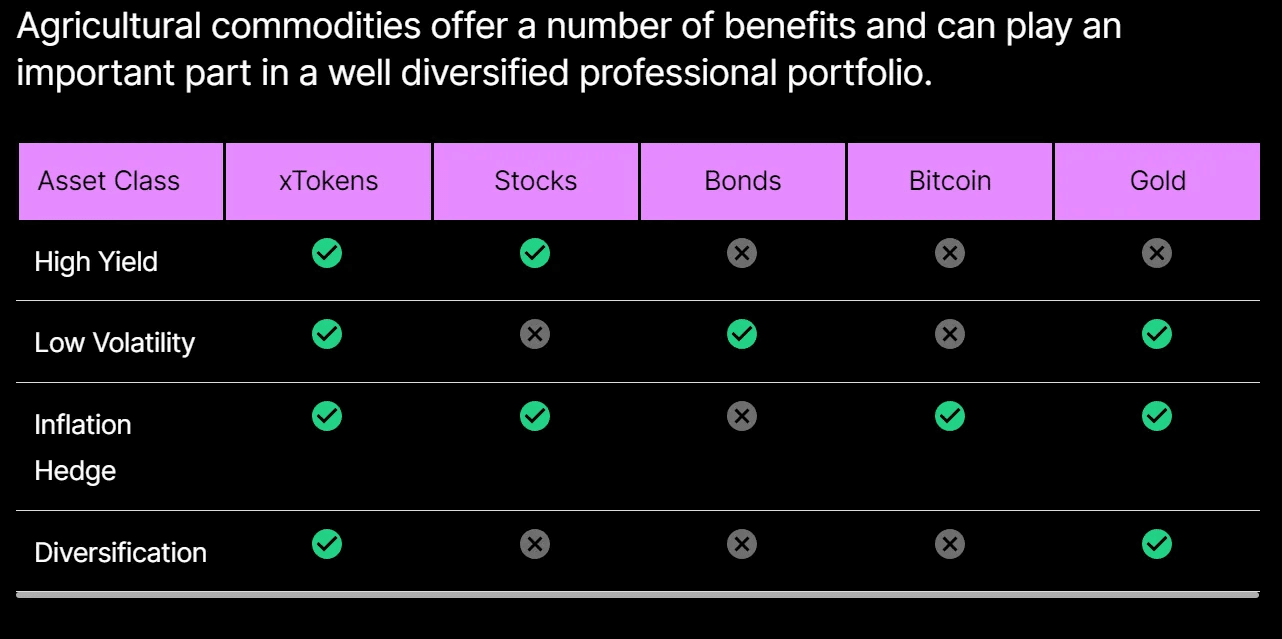
Fighting Inflation: xTOKEN provides exposure to crop output from farmland, which has historically been a reliable inflation hedge.
Liquid, income-generating assets: xTOKENs make the Farmland Commodity Vault tradable on decentralized exchanges for 365 days.
Earn daily yield in USDC: Collateralized xTokens generate cTokens daily. cTokens can be redeemed for USDC through a vault accessible in the LandX dApp.
Portfolio Diversification: xTOKENs offer diversification that is uncorrelated with crypto, stocks, and traditional vaults.
cTokens — Commodity Collateral
Each xTOKEN entitles its owner to receive 1 kg of commodity revenue (CY) per year in perpetuity, payable in the form of cTokens.
cTokens can be sold at the protocol level for USDC at the current market price provided by the Chainlink oracle.
If someone holds xWHEAT, they will receive 0.0027 kg of wheat per day, which is equivalent to 1 kg/year. CY is paid out in units of the underlying commodity (kg) per day. When xTOKEN holders want to claim their rewards, their CY value is converted to USDC and given to the holder.
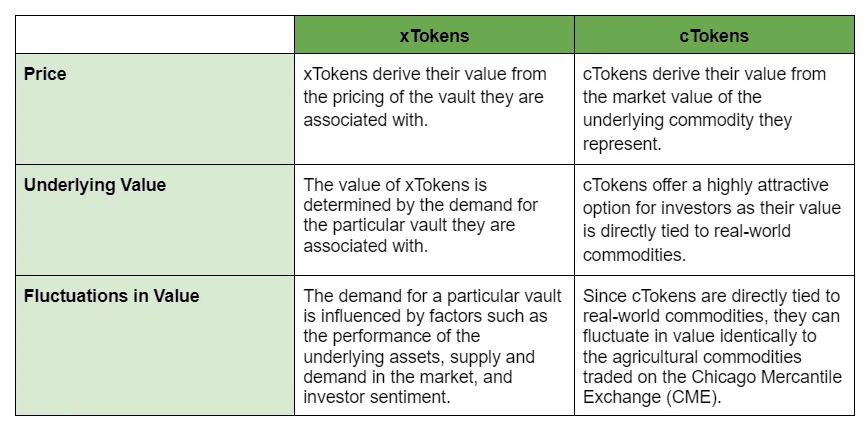
To make this completely clear, let’s look at the difference between xTokens and cTokens:
xTokens vs. cTokens
xTokens generate real yield payments in the form of cTokens, a commodity token that represents one kilogram of wheat, soybeans, rice, or corn. For example, one cWheat is equal to the current market price of 1 kilogram of wheat.

xTokens are tradable on the open market.
cTokens are redeemable for $USDC in the LandX dApp. They are not tradable on the open market.
LNDX Token
xTOKEN represents the Perpetual Commodity Vault and LNDX is the native token of the LandX protocol. The price of LNDX is driven by speculation and the performance of LandX as a company. Its price is also affected by the demand to participate in the LandX system.
Here’s how LNDX ties into the protocol:
The LNDX token receives a portion of the protocol’s revenue. Therefore, it represents the intrinsic value of LandX to a certain extent.
LNDX holders vote on the platform’s governance decisions, future updates, etc. This is an important component of the LandX DAO.
LNDX stakers are eligible to become validators on LandX. Validators are responsible for bringing farmers into the protocol and receive commissions in return. There are other conditions for becoming a validator.
Investment Case Examples
An investor wants to buy $1 million worth of xSOY. In exchange for their investment, they will receive 100,000 xSOY tokens at a price of $10 each. These xSOY tokens represent 100,000 kilograms of soybeans per year.
In addition to having a commodity vault of 100,000 kg of soybeans per year, holders will also receive an annual percentage yield (APR) of approximately 9% as CY.
LandX controls the supply of xSoy (and other xTokens) by controlling the supply of tokenized farmland on the platform. Because of this ability to control supply, LandX sets a target asset appreciation rate (currently 10%) for the xToken vault.
In summary, investors receive:
9% of commodity output
10% target asset appreciation rate
Additionally, investors will be able to capture any potential appreciation in the underlying commodity prices due to global warming, soil erosion and rising energy prices impacting commodity prices.
If soybeans appreciate 15% over the next year and the investor sells their $1 million position, they will make a profit of approximately $230,500 (23.05%).
If soybeans fall 15% in price over the next year and the investor sells their $1 million position, they will only realize a loss of 9.5%, or $95,000.
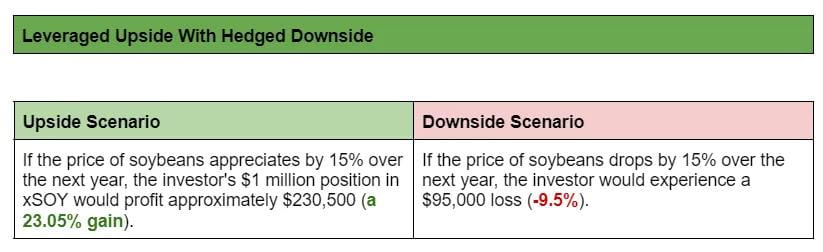
This is an asymmetric opportunity in an asset class that is currently inaccessible to blockchain investors. If the price goes up, you will gain appreciation and gains in xSOY. If the price goes down, some of your losses in xSOY value will be offset by the daily gains you receive.
The value of xTokens comes from the actual yield they generate and their price appreciation.
The supply of xTokens is controlled by the speed at which new farmland is added. New farmers mint xTokens equal to their contractually obligated share of the farmland. LandX carefully controls the supply of new xTokens by managing the speed of addition and only providing xTokens backed by new farmland when demand warrants it.
LandX determines a target asset appreciation rate and evaluates it every 3 months. Currently, this target appreciation rate is set at 10% per year in line with actual inflation.
The low volatility that underpins xTokens and the appreciating price trajectory make xTokens an ideal building block for the DeFi space.
They are backed by real-world production of staple crops such as soybeans, rice, ropes, wheat, etc., and are naturally able to withstand price fluctuations in both directions.
xBasket (LandX’s index token, composed of equal parts of each xToken) presents an automatically compounding commodity vault, whose price is formed by appreciating xTokens and the yield they generate, with a target annual percentage yield of 18.8%.
LandX’s Impact
Many DeFi applications promote unsustainable returns through inflated tokens and marketing funds to stimulate liquidity.
LandX builds sustainable returns through regenerative finance. Capital is used to invest in real-world return opportunities and solve systemic problems to rebuild the natural environment.
The LandX protocol is a bridge between real-world assets and blockchain technology. Farmers are able to enter into agreements with investors worldwide and gain access to capital for business expansion and long-term food security efforts. LandX creates a solid legal and financial framework that connects farmers and investors in an entirely new way.
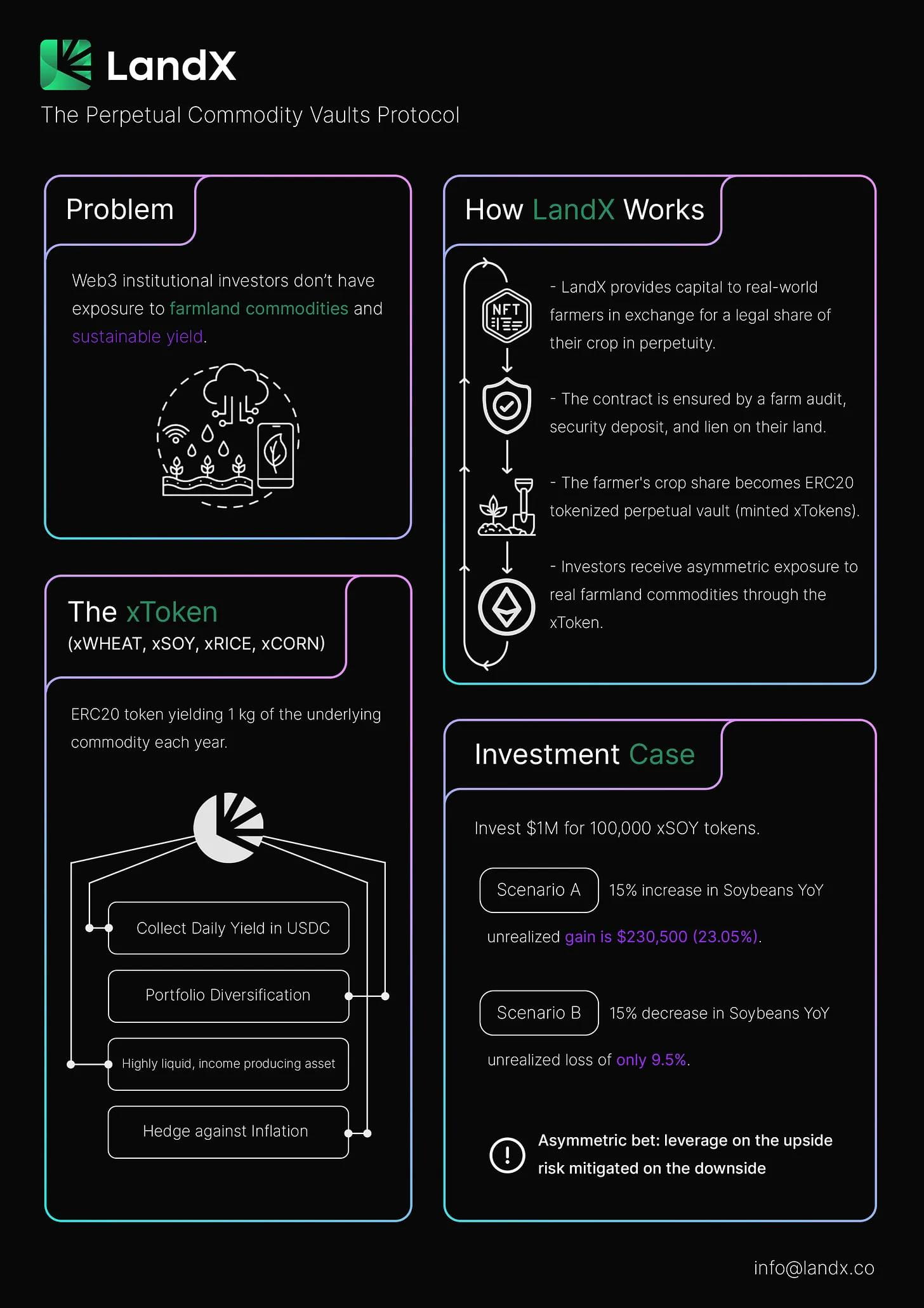
Let’s summarize what we’ve covered so far in this article with this infographic:
Why choose agricultural commodities?
In the current economic environment characterized by crisis and soaring inflation rates, agricultural products offer investors an attractive safe haven and unique investment opportunities.
Land has consistently proven to be a sustainable asset, outperforming inflation by at least 2% per year. In addition, the availability of arable land – land that can produce high-quality crops – is decreasing due to erosion and industrialization.
According to the World Bank, the per capita arable land area has fallen below 20 hectares. Europe, for example, is currently facing a shortage of agricultural products and fertilizers from countries such as Russia, Ukraine and the Netherlands. Coupled with global warming and a growing world population, key commodities such as wheat, soybeans, rice and corn are expected to see increased demand, driving up their value.
Unlike finite resources such as gold, arable land is a productive asset that not only holds its value against inflation but also generates income for its owner through the sale of agricultural products.
Agricultural commodities such as rice, corn, soybeans and wheat have been traded for thousands of years. Rice futures have provided farmers and investors with a means to hedge against agricultural and political uncertainty, a system that still exists today for a variety of agricultural commodities.
Despite its clear hedging value in times of turmoil, agriculture remains relatively undervalued in the contemporary financial landscape. Amid speculation surrounding growth stocks and digital assets such as Bitcoin, LandX recognizes that agricultural commodities have significant potential when combined with the instant, trustless and decentralized attributes of blockchain technology.
LandX Token Economics
LandX is structured as a decentralized autonomous organization (DAO) where voting rights belong to holders of the LNDX governance token.
LNDX Token Model and Governance
LandX offers something relatively unique in the DeFi market; real yield from real production. This is in stark contrast to most governance tokens built around zero-sum token economics.
LNDX value accumulation ensures that stakeholders’ interests are aligned with the project. Validators are required to stake LNDX tokens as part of their commitment to the LAND protocol.
Traders and investors in the crypto market seek volatility, and LNDX is the best way to gain exposure to LandX. While xTokens are expected to maintain a strong correlation with their underlying assets, LNDX may fluctuate with the cryptocurrency market and the overall success of LandX.
LNDX token holders earn a percentage of platform fees from xToken earnings.
These platform fees create utility and demand for LNDX due to current and future value allocations. LNDX is priced based on future earnings potential, which makes it highly volatile and attractive as an altcoin investment.
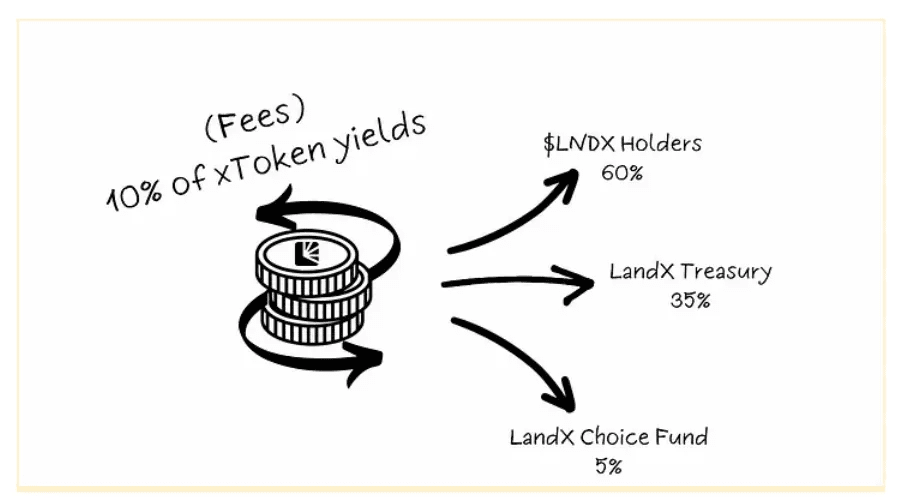
The platform fee is set at 3% of the initial financing amount provided to farmers, 0.25% of the agricultural product share payment, and a 10% tax on the USDX output received. The fees collected are distributed in the form of USDC as follows:
60% to LNDX token holders
35% to LandX Treasury
5% to LandX Choice
Fee percentages and distribution percentages may change based on market conditions via DAO proposals and voting. Estimating potential valuations can be assessed using existing DeFi protocols and their TVL relative to the market cap of their governance tokens.
LandX’s circulating supply is 5.4 million LNDX, of which 2.4 million are held by the treasury.
At a price of $0.50 per LNDX, the initial market capitalization is approximately $2.7 million.
Considering the cash reserves of over $6 million, the intrinsic token value could rise significantly.
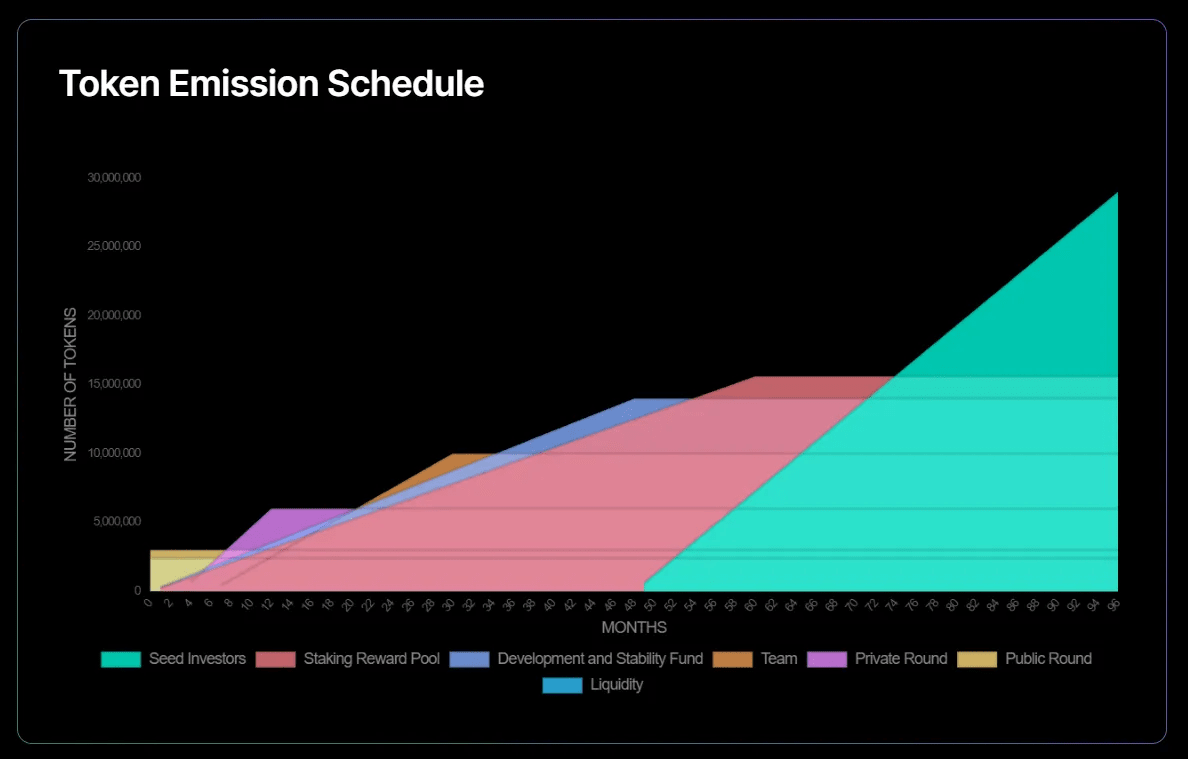
Seed investors’ tokens will be fully locked up over 4 years and unlocked in installments over an additional 4 years, reducing immediate market impact.
The fully diluted value (FDV) should be adjusted accordingly as more than 40 million LNDX will be released starting in year 4.
55% of the tokens at launch are held by the community, demonstrating widespread adoption of the circulating supply.
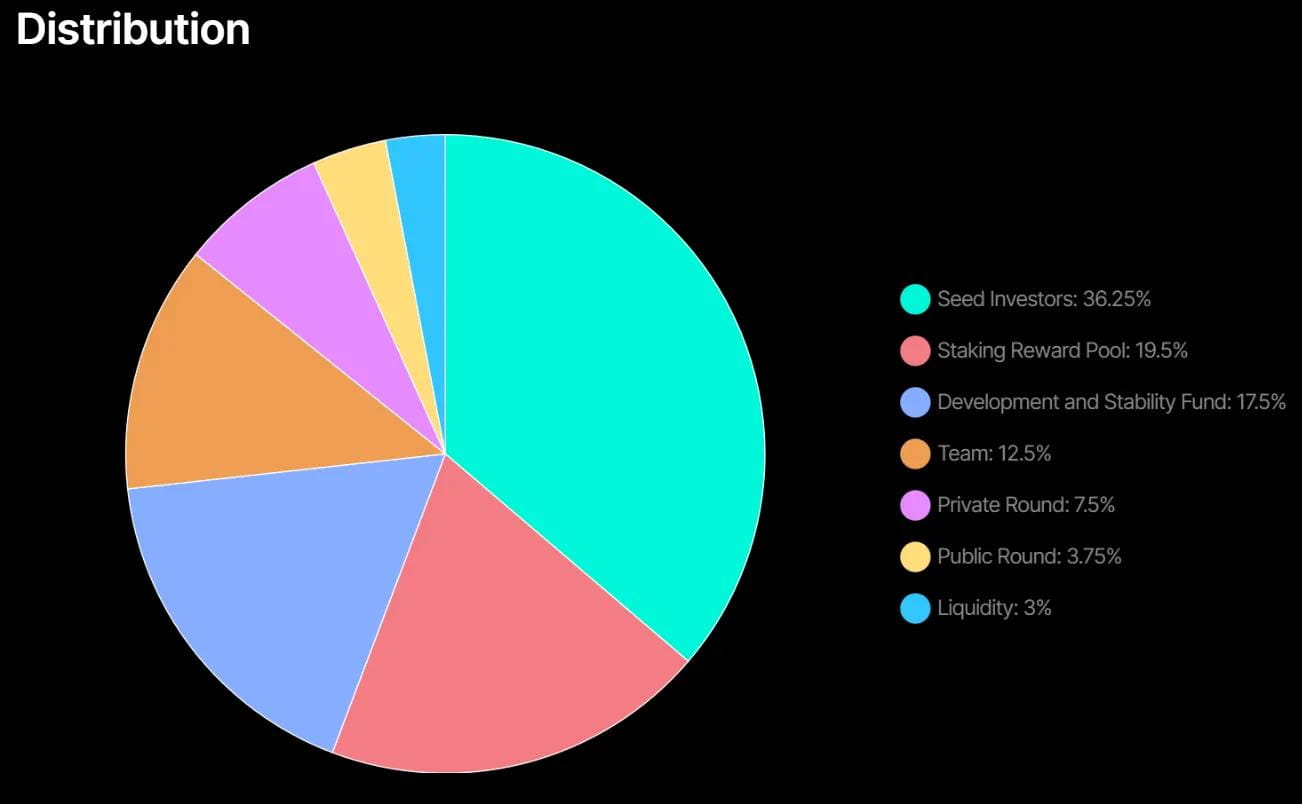
The distribution of 38 million tokens (47.5% of the total supply) is as follows:
Seed
$0.189 per token.
29 million tokens (36.25% of total supply).
4 years unlocked.
Private
$0.23 per token.
6 million tokens (7.5% of total supply).
Unlocked in 9-month installments.
Public
$0.50 per token.
3 million tokens (3.75% of total supply).
Unlock now.
The remaining 42 million (52.5% of total supply) are distributed as follows:
Team
10 million tokens
24 months unlocked.
Staking Reward Pool
15.6 million tokens (19.5% of total supply)
60 month vesting.
Liquidity
2.4 million tokens (3% of total supply)
Unlock now.
Development and Stabilization Fund
14 million tokens (17.5% of total supply)
48 month vesting.
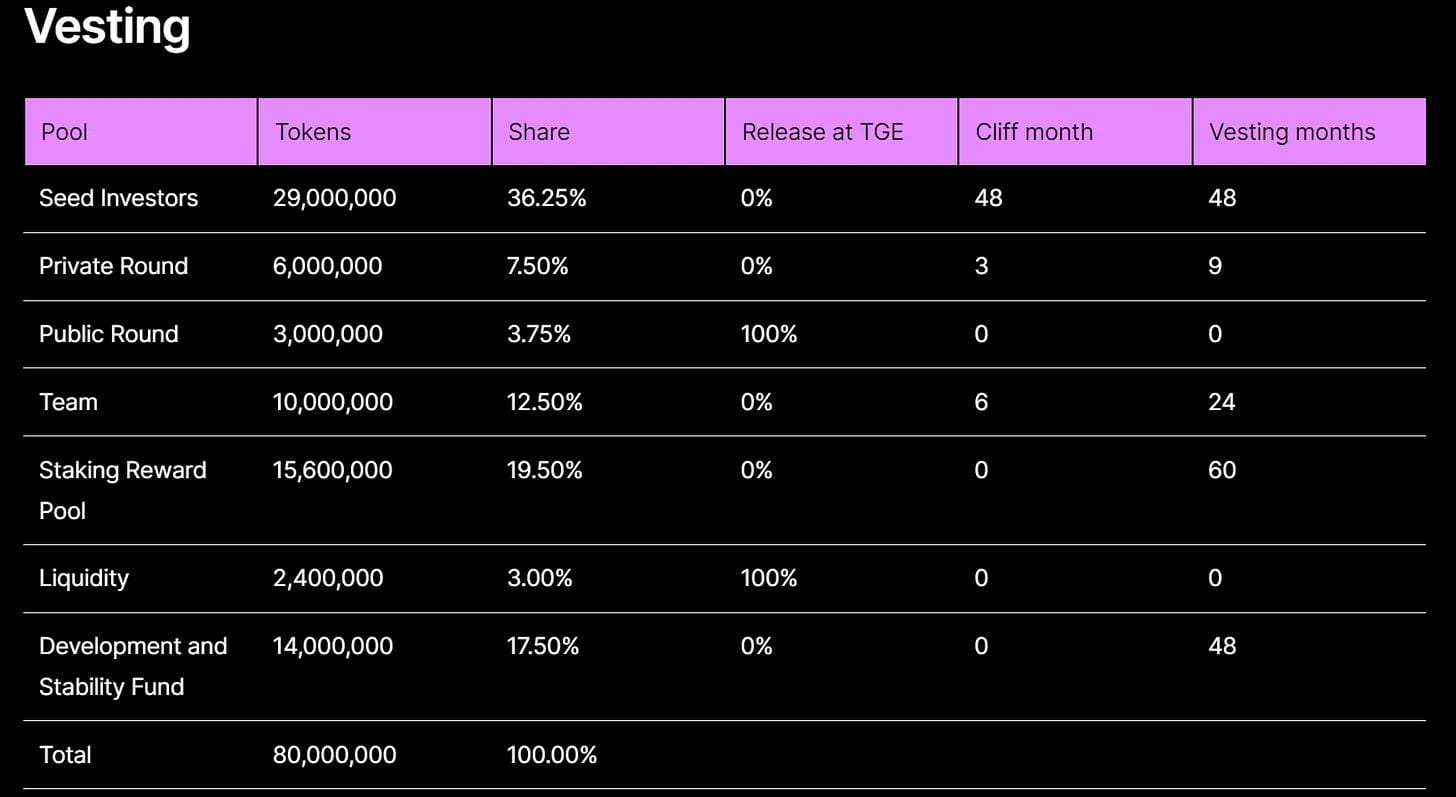
The staking rewards are huge and will be distributed to stakers of LNDX tokens over a period of 5 years.
Liquidity funds will be used to create a 24/7 trading venue between decentralized and centralized exchanges.
Staking LNDX Tokens
Holders who are willing to lock up their tokens for a long period of time will receive a higher percentage of staking rewards and voting rights.
3 months, 1x voting rights and staking rewards
12 months, 2x voting power and staking rewards
48 months, 4x voting rights and staking rewards
All stakers will receive veLNDX, a non-transferable token that will act as a receipt for their deposit.
Who are LandX’s customers?
Currently, there are two target markets that will serve as LandX’s ideal customers:
DAO Treasury seeks to diversify crypto investments to hedge against bear market cycles
Crypto-native investment funds seeking yield and inflation hedge
DAO Treasury
DAO treasuries have accumulated a huge amount of capital, currently managed by decentralized autonomous organizations, exceeding $10 billion. Here are the top ten treasuries:
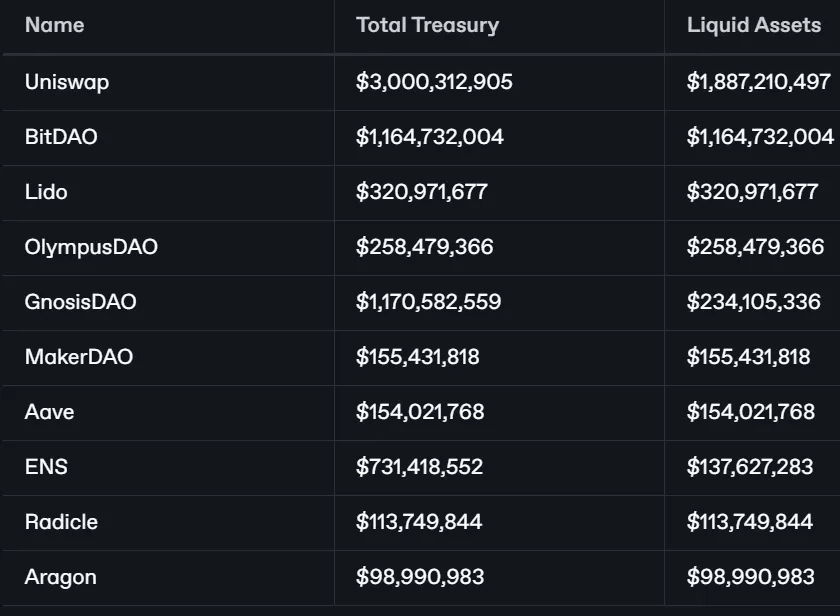
LandX is looking for partners who want to diversify their portfolios, and DAOs are an ideal client who have strong balance sheets but too many crypto assets.
Crypto-native investment funds
In the crypto industry, there are many different types of investment funds that have grown from the success of the industry. Many funds now manage multi-billion dollar portfolios of digital assets, such as Alameda Research, Multicoin Capital, Paradigm, and Wintermute.
business model
As LandX expands its business scope and integrates with various DeFi applications, it seeks to further diversify its revenue sources. This includes short-term lending/borrowing opportunities, automatic compounding of earnings, etc.
Income Stream
LandX generates revenue through a variety of channels that are critical to the functioning and growth of its ecosystem:
Transaction Fees: LandX charges transaction fees for activities such as trading commodities and xTokens on its internal marketplace. These fees contribute to the platform’s revenue.
Validator Commission: Validators play a key role in the process of onboarding farmers, managing contracts, and ensuring the security of landowner commitments. LandX pays validators a commission, typically a percentage of the financing amount brought in by farmers.
Revenue Sharing: The $LNDX governance token is a key element of the LandX ecosystem. Token holders earn protocol fees, further incentivizing participation in governance decisions and the growth of the LandX platform.
LandX’s native token, $LNDX, is the core of its economic model and revenue generation:
Protocol Fees: $LNDX token holders earn a portion of the protocol revenue, which includes transaction fees and other platform-related fees. This provides a direct financial incentive to hold and stake $LNDX tokens.
Governance: $LNDX holders also have voting rights in the platform governance. They participate in decisions related to protocol upgrades, rule changes, and other key matters, influencing the direction of the ecosystem.
Cost allocation
LandX charges a 3% fee on farmland financing and a 0.25% fee on regular crop share payments. These fees are allocated as follows:
60% to $LNDX stakers.
35% goes to LandX Labs for operations.
5% goes to the LandX Choice Fund, which supports regenerative agriculture initiatives, education for land operators, SDG target certification, ESG projects, agricultural monitoring technology, and sustainable farming tools and equipment.
route map
LandX has released a roadmap that identifies 3 core goals that will guide its progress:
Bringing investing in tokenized farmland commodities to all crypto-native investors.
Providing a secure, stable and intuitive platform to access all services and products.
Positively impact every farm we work with and encourage regenerative practices.
LandX's growth strategy includes expanding the scope of farmland share opportunities. This expansion will allow the protocol to accommodate a wider range of agricultural assets, providing farmers and investors with more diversified options.
The next step for LandX is to integrate with DeFi applications to enable functions such as short-term lending.
The fundraiser has been completed, with a total of $8.38 million raised. The next steps are to launch the mainnet and move towards the following goals:
Integrate with more networks.
Launch of xBasket Index.
Enhanced security and transparency measures.
Expanded product range to include xUSD and xNFTs.
Establish LandX DAO.
Risk and Audit
Similar to other RWA platforms, LandX implements several safeguards and transparency measures to mitigate counterparty risk and protect the interests of the different participants.
Margin against uncertainty: LandX addresses uncertainty in agricultural production by requiring landowners to maintain a security margin equivalent to 12 months of agricultural production. This margin acts as a safeguard against uncertainty in potential agricultural production or cash flows, providing a buffer for landowners and investors.
Centralized Platform Risks: As a centralized platform that handles real assets, LandX carries the inherent risks associated with such a project. However, it actively works to minimize these risks through a strong legal structure and transparency.
Transparency and On-Chain Records: LandX is committed to transparency. Every aspect of the platform, including land details, harvest records, lien documents, payment history, and commodity yields, is recorded on-chain. This ensures an immutable and verifiable record of all activity, enhancing accountability and trust.
Yield Reserve and Staking Mechanism: To further protect the interests of investors, yield reserves are locked in smart contracts. These reserves are paid to stakers in the traditional DeFi staking manner, and the staking yield cycle exceeds 14-18 months. This extended cycle provides stability and security in the face of unexpected challenges.
Transparency for Farmers and Land: LandX provides transparency about farmers and land. Information about the actual land, including its location and historical agricultural production, is stored in NFTs and immutable IPFS records. These details are accessible on the platform, ensuring clarity for all participants.
Validators: Validators play a vital role in the LandX ecosystem. They are responsible not only for introduction but also for timely collection of farm shares. Validators have an incentive to ensure that farm shares are paid out on time, as their stake will be affected if the farmers they introduce fail to meet their obligations.
Preventing Collusion: Collusion between farmers and validators is prevented through legally binding agreements. Farmers make commitments to LandX, and violating them carries legal consequences. As trusted third parties, validators undergo a rigorous vetting process, minimizing the risk of collusion.
in conclusion
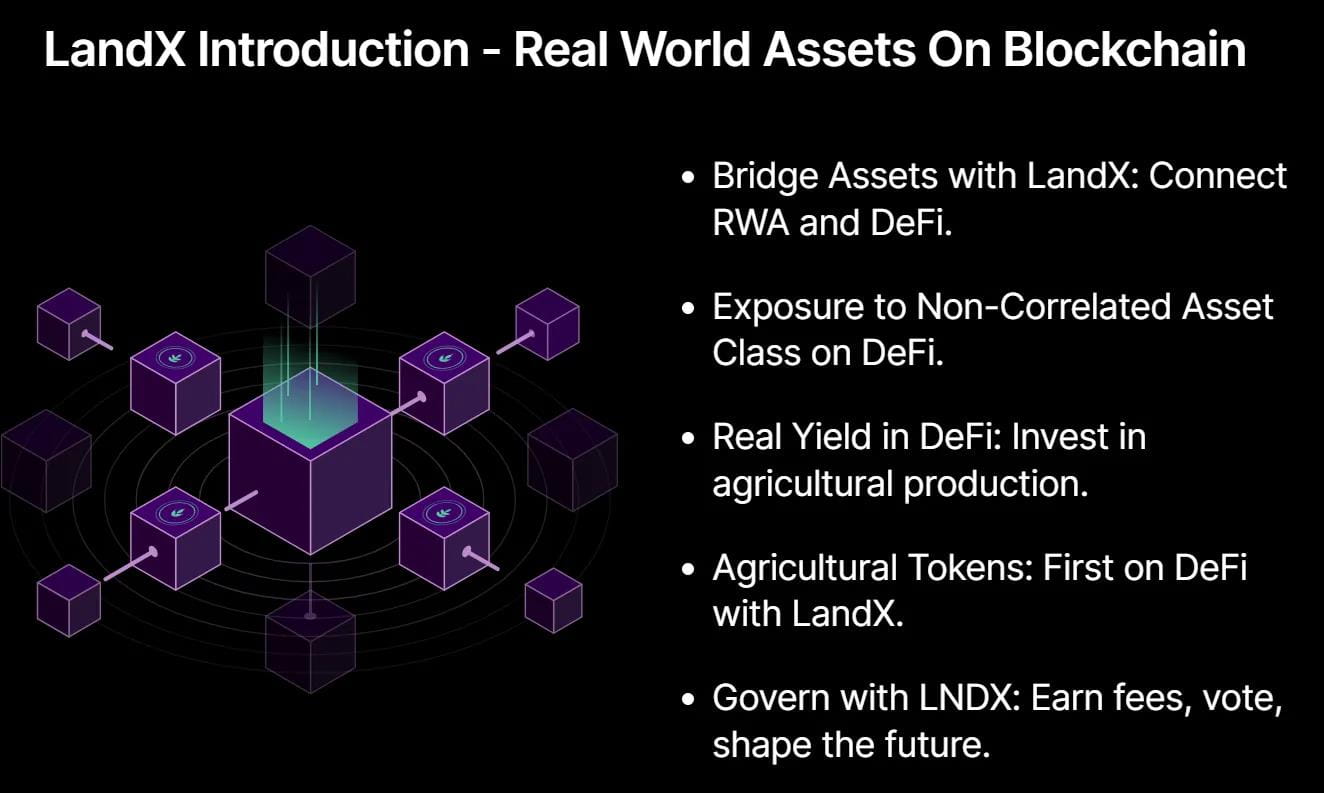
LandX bridges the gap between real-world assets and decentralized finance. With LandX, you can gain exposure to asset classes that are unrelated to crypto and DeFi (e.g., the rapid crash of cryptocurrencies on December 11 had no impact on agricultural commodities).
LandX offers you the opportunity to invest in RWA with the potential upside of LNDX tokens due to good token economics. The team’s commitment and strategy make me optimistic about LandX’s future growth prospects, and the LandX Foundation’s reserve of over $6 million lays the foundation for exponential growth.