

Author: Chase Devens, Messari Analyst; Translation: Golden Finance 0xjs
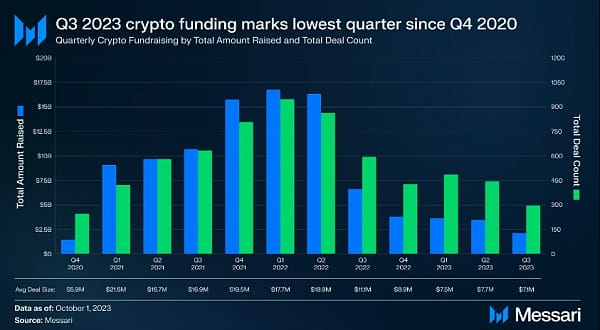
The current bear market is perhaps best reflected in the cryptocurrency industry’s funding data. Q3 2023 was no exception, continuing the downward trend we have witnessed for multiple quarters since the beginning of 2022, with Q3 hitting a new low in overall funding and deal count since Q4 2020. Funding totaled less than $2.1 billion across 297 deals, down 36% from the previous quarter.
Financing round analysis
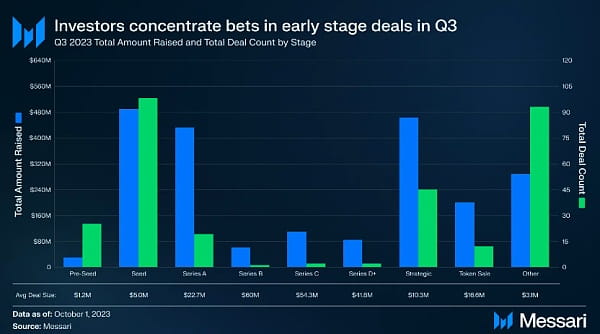
Breaking down Q3 deals by funding round, we can see that most deals are concentrated in the early stages. Seed rounds accounted for the largest total, raising $488 million in 98 deals. The trend in deal counts shows that over the past three years, there has been a clear shift in deal focus from late-stage projects to early-stage projects.
The share of early-stage deals (pre-seed, seed, and series A) increased from 37% in Q4 2020 to 48% in Q3 2023. Meanwhile, late-stage deals (series B or higher) dropped from 8% in Q4 2020 to 1.4% in Q3 2023. This suggests that investors are strategically positioning themselves in the bear market, trying to fund projects that can offer greater multiples in the new bull market.
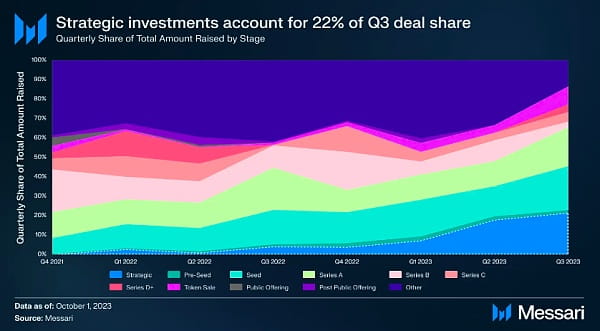
There was also a large amount of strategic investment in the third quarter, including corporate and private equity transactions, such as the $200 million investment in Islamic Coin. Strategic financing transactions have steadily increased during the bear market. At the peak of the bull market, in the fourth quarter of 2021, strategic rounds accounted for only 0.2% of total financing. In the third quarter of 2023, this share rose to 22%, indicating that severe market conditions forced projects to conduct short-term bridge rounds or eventually be acquired by larger projects.
Financing track analysis
Track Trends
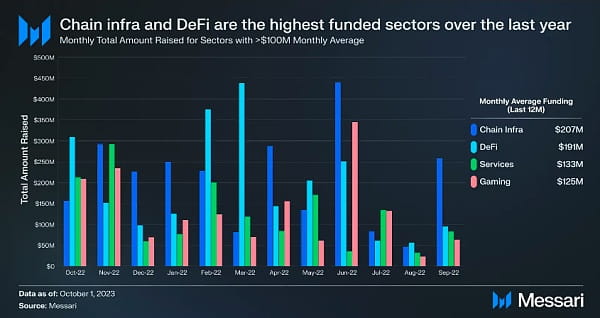
The distribution of track financing in the third quarter of 2023 is similar to the pattern seen in the past 12 months. The public chain infrastructure, DeFi and gaming sectors have been the most well-funded sectors during this period. The service sector, which includes business functions such as marketing, incubators, security and legal services, is the only other track to raise more than $100 million on average in the past 12 months. While other sectors are also important to the growth of the entire crypto industry, these four sectors continue to attract the attention of most investors.
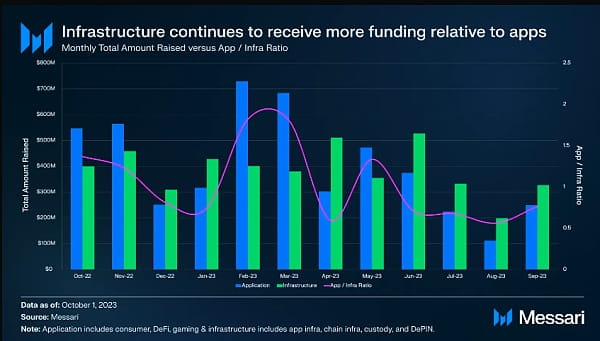
Another notable trend over the past year is that infrastructure projects have received more funding relative to user-facing applications. This is best demonstrated by categorizing the consumer, DeFi, and gaming sectors into “Applications” and the application infrastructure, public chain infrastructure, custody, and DePIN sectors into “Infrastructure.”
When looking at the share of funding per category, we see a subtle shift away from user-facing applications and towards infrastructure projects. This relationship is supported by continued funding of infrastructure projects compared to the application category. However, this trend may not last long as more and more investors begin to realize that without successful user-facing crypto applications, infrastructure investments are unlikely to achieve the returns they expect.
Leading the track
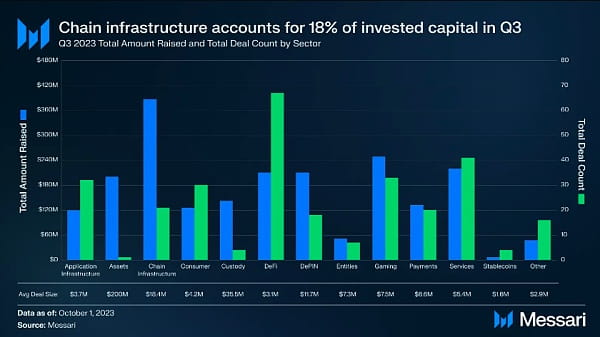
Financing in the third quarter was relatively scattered across various tracks. Public chain infrastructure accounted for 18%, while DeFi led in terms of transaction volume with 67. Finally, the gaming sector attracted nearly $250 million in investment in the quarter.
Public chain infrastructure
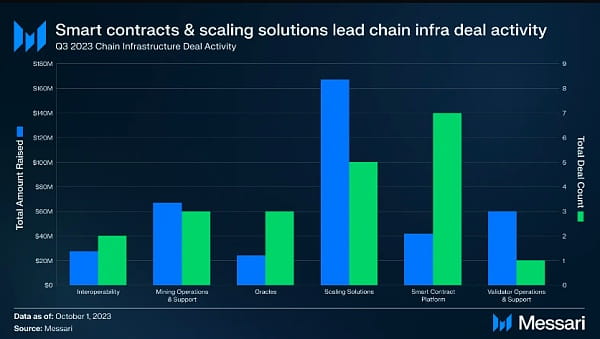 Despite only 21 deals, the public chain infrastructure track accounted for the largest share of funding in Q3. A third of these deals occurred in the smart contract platform subcategory, one of which was Fhenix’s $7 million financing for building fully encrypted smart contracts.
Scaling solutions accounted for 43% of the funds raised in this track. This represents a continued shift in funding from smart contract platforms to scaling solutions. Funding raised by scaling solutions exceeded that of smart contract platforms for the first time in Q1 2022, when Polygon raised $450 million for its suite of scaling solutions. In three of the past four quarters, the ratio of funding invested in scaling solutions to funding invested in smart contract platforms exceeded the previous highest ratio in Q1 2022. The ratio even reached 7 times in Q4 2022, mainly due to less investment activity in the smart contract platform category in that quarter.
More than 40% of the $387 million raised in public chain infrastructure in Q3 2023 came from the sale of approximately 116 million OP tokens by the Optimism Foundation in late September. Other prominent deals in this space include Flashbots’ $60 million Series B funding round to continue developing SUAVE, and Bitmain’s $54 million strategic investment in Core Scientific, a leading Bitcoin mining company.
DeFi
DeFi was the sector with the most funding in Q3, with 68 deals. Investments in this sector were concentrated in the exchange category, which accounted for 38% of all investment capital, with 33 deals. Overall, DeFi projects raised $210 million, with an average deal size of $3 million.
Binance Labs is an active investor in the DeFi space, with seven deals in Q3, including $10 million strategic investments each in Helio Protocol (a liquidity staking platform on BNB Chain) and Radiant Capital (a money market on LayerZero). The largest DeFi deal of the quarter came from a $16.5 million Series A round for Brine, an order book DEX built on Starkware.
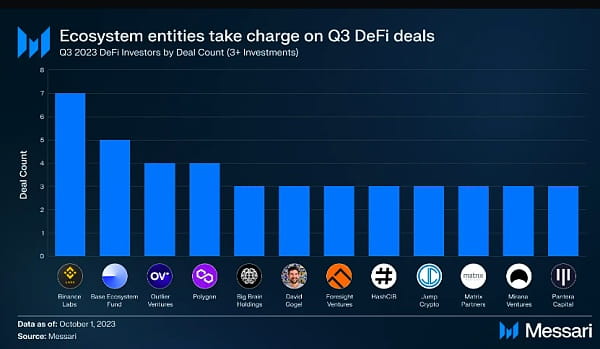
Three of the top four DeFi investors in terms of transaction volume in Q3 were ecosystem entities. Binance Labs, Base Ecosystem Fund, and Polygon completed 16 transactions in total.
game
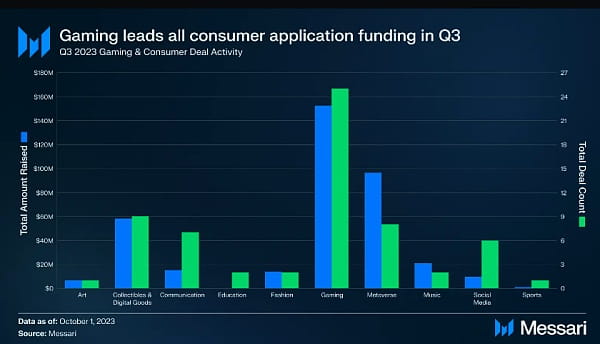
The gaming sector saw some early-stage deals, helping it become the third most funded sector in Q3, with 33 deals raising $249 million. Compared to other user-facing consumer sectors, gaming accounted for 67% of funding in Q3.
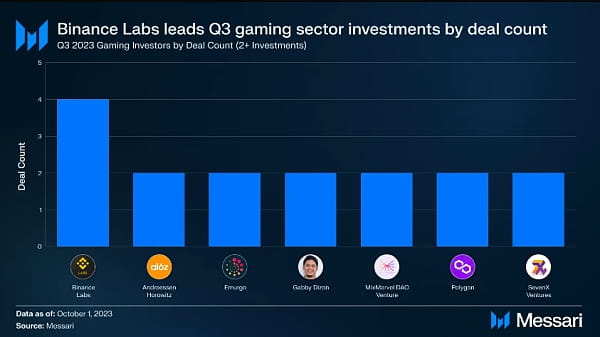
Most deals in the gaming sector came from long-tail investors. Only seven entities had deals with two or more projects, while 104 investors made single-project investments within the sector.
The largest deal in the gaming space was a $54 million Series A for Futureverse, a platform that combines AI and metaverse worlds. Other metaverse gaming projects in the space, such as Mocaverse and Mahjong Meta, also received funding during the quarter. Finally, Proof of Play raised a $33 million seed round from lead investors a16z and Greenoaks. The on-chain gaming studio, founded by Amitt Mahajan, one of the original co-creators of the popular Zynga game Farmville, hopes that blockchain-based games can replicate the growth trajectory of early free-to-play mobile games.
Investor Analysis
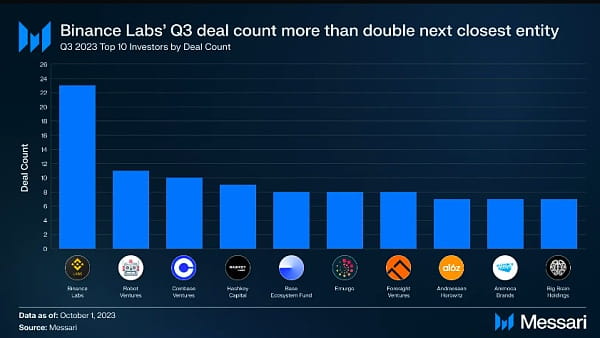 The top ten most active investors in the crypto industry made 98 investments in the third quarter of 2023. Despite this activity, they only accounted for 7% of all investor transactions, indicating that crypto investment is still dominated by a larger tail of investors.
Binance Labs was by far the most active investor: its 23 deals in Q3 were more than double those of the second-place investor, Robot Ventures. As we highlighted in August, Binance Labs has been actively investing through 2023, with a focus on the DeFi and gaming sectors. In addition, projects that are developing zero-knowledge and privacy technologies are also investment targets for Binance Labs. Notably, 12 of Binance Labs’ 23 deals were to projects participating in its accelerator program. But even if these projects are excluded, Binance Labs’ other 11 investments still put it on par with Robot Ventures in terms of Q3 deal activity.
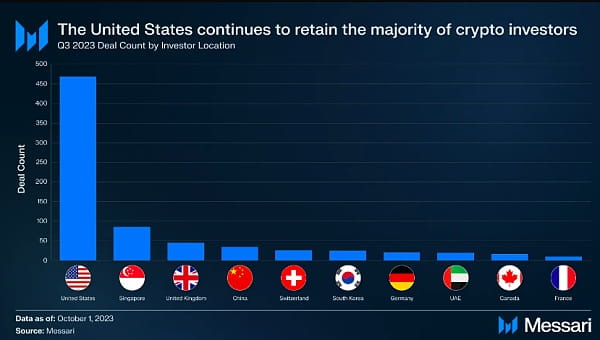 Finally, 54% of active investors in Q3 2023 are located in the United States. This figure is consistent with the quarterly average of the past four years (55%). Despite the gradual departure of project founders from the United States in favor of more regulatory compliant jurisdictions, the United States remains home to the majority of crypto professional investors.