


Written by: Kyle Liu, Investment Manager at Bing Ventures
Introduction: Sequencer is used to solve scalability and performance limitations in the Ethereum network. Its introduction aims to reduce the burden on the Ethereum main chain by batch processing and sorting on-chain transactions, and shifting most of the computing and data storage work to Layer2. The ceiling of a decentralized sorter lies in the underlying protocol and network environment it relies on. Although decentralized sequencers can improve the security and resilience of the system, there are still some limitations and challenges.
The sequencer is the core component of the Rollup network and is responsible for key operations such as receiving transactions, sorting transactions, executing transactions, and submitting transaction data. If a single sequencer of the network fails or becomes unavailable, the entire network stops processing transactions. However, many existing Rollup solutions only have a single sequencer, making them far less decentralized than some centralized alternative Layer 1 solutions. Therefore, the importance of decentralized sorters is self-evident, and potential decentralized sorter solutions should effectively enhance the decentralized nature of the system through improvements in design and implementation.
Importance of sorters
Existing rollup solutions include rollup based on zero-knowledge proof (ZK) and rollup based on optimistic execution. These solutions have better designs than monolithic Layer 1 solutions in improving scalability. However, they also have some problems:
Problems with Zero-Knowledge Proof (ZK) Rollup:
Computational complexity: Using ZK proofs to verify the correctness and legality of transactions requires significant computing resources and time. This can lead to delays in transaction processing and high computational costs.
Dependence on verifiability: ZK Rollup relies on external verifiability, that is, an external supervisor is required to verify the correctness of the ZK proof. This may introduce trust issues and centralization risks.
Problems with optimistically executed Rollups:
Reversibility: Optimistically executed Rollup adopts optimistic assumptions during transaction execution, that is, assuming that all transactions are valid and conflict-free. But if there are conflicting or invalid transactions, the entire system may need to be rolled back and re-executed, resulting in some uncertainty and processing time delays.
Front-loading operations (MEV): Optimistically executed Rollups may face front-loading operations problems, that is, the abuse of transaction execution order, leading to transaction manipulation and unfair transaction prioritization.
These issues limit the performance and security of existing Rollup schemes and may affect user experience and usability. The key to solving these problems is to improve Rollup's performance and decentralization by introducing new designs such as sequencers. The main function of the sequencer is to improve throughput and compress transaction data. The sequencer can sort incoming transactions, thereby improving the efficiency and throughput of transaction processing. By sorting transactions according to certain rules, conflicts and competition between transactions can be reduced and the processing capacity of the overall system can be improved. The sequencer can also compress transactions, packaging multiple transactions into a single transaction, thereby reducing the size of the transaction data. This compression can reduce the cost of on-chain storage and transmission and improve overall system efficiency.
Problems with centralized sorters
Most existing Rollup solutions operate their own centralized sorters because this is more convenient and less expensive. However, the disadvantages of centralized orderers are also obvious, which may lead to issues such as censorship of transactions, charging excessive fees, prioritizing transactions in transaction execution (front-end operations), or generating poor MEV (maximizing extractable value).
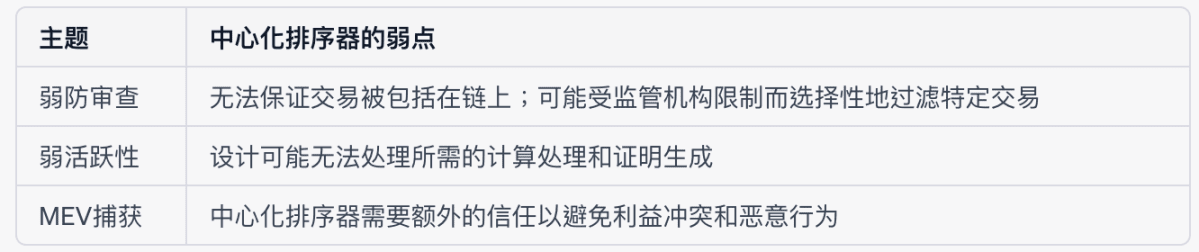
We believe that the key to solving the centralized sorter problem is to promote technological innovation and explore decentralized sorter solutions. As mentioned previously, while current centralized orderers play an important role in improving throughput and performance, we should actively pursue alternatives that are more secure, more censorship-proof, and more decentralized. These solutions may require trade-offs between security, performance, and decentralization, and are difficult to design and implement, but they are expected to solve the problems faced by current centralized orderers.
 The road to decentralization
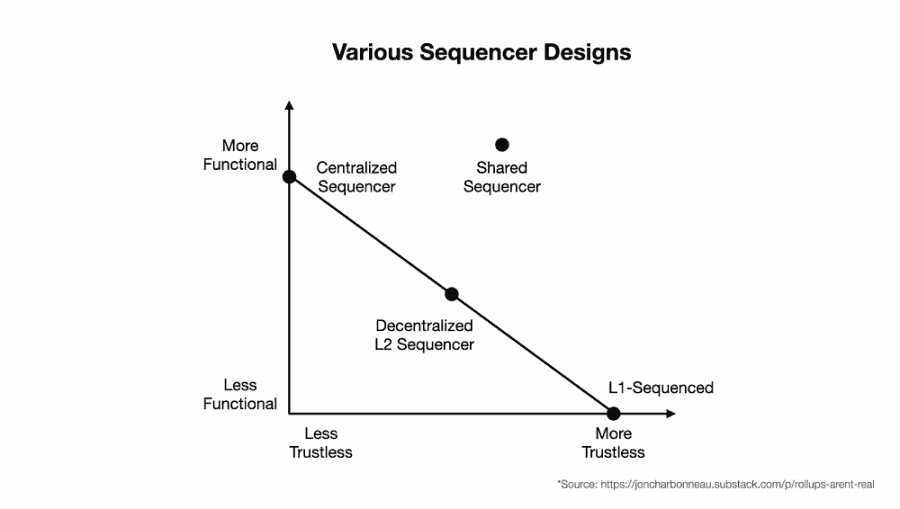
At present, decentralized sorter technology still needs to be improved. Possible directions include more effective sorting algorithms, more efficient verification mechanisms, and more intelligent sorter designs. Below, we summarize some of the routes we consider useful attempts to take. There is no doubt that decentralized sorter technology will continue to improve and evolve over time. This could include higher throughput, faster confirmations, lower latency, and greater security and composability.
Proof of Authority (POA): This scheme authorizes a group of entities to take turns acting as sequencers in the PoA system. It effectively improves censorship resistance and has the lowest latency, but still presents the risk of a single point of failure.
Based on Rollups: This scheme allows anyone to submit L2 batches to the Data Availability Layer (DA), which then decides on the final block (proposer). It has the advantage of inheriting the liveness and censorship resistance of the DA layer, but may leak earnings and be affected by MEV, and the confirmation speed is slower.
Decentralized Validator Technology (DVT): This scheme distributes ordering responsibilities to a cluster, with each node in the cluster signing independent attestations using a partial share of their validator key. This approach is flexible and can be combined with other solutions, but will add some latency.
Shared sequencer: This scheme allows multiple Rollup selections into a shared sequencer, which is capable of processing transactions on chain A and chain B simultaneously, and provides strong economic security and real-time censorship resistance to the ordering layer. A shared sequencer has the network effects of multiple chains, but is still limited by the data and transaction ordering throughput of L1.
Build a new sorter set: This approach creates a decentralized set of sorters permissionlessly by using a token incentive mechanism. It has the advantage of increasing the utility of the token, but there may be delays, and implementation barriers may be difficult for less well-known Rollups.
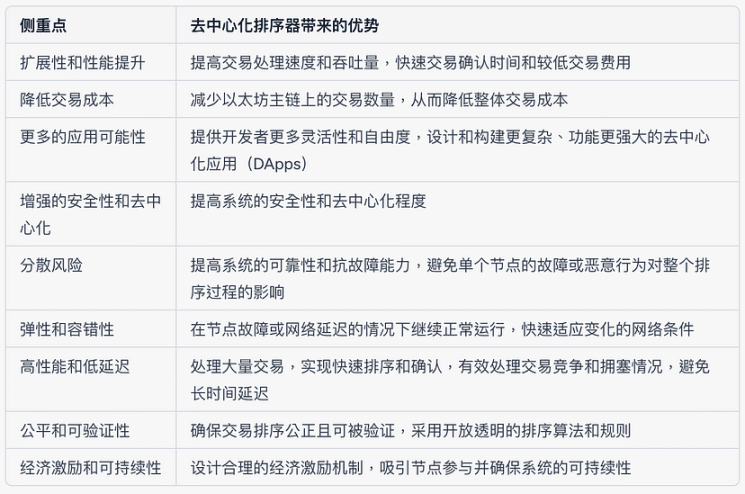
Although decentralized sorters have many advantages, the various current solutions have their own trade-offs, each with pros and cons.
 potential opportunities
Now let’s jump out of it. Can a decentralized sequencer solve Ethereum’s problems once and for all? Has it already buried some hidden dangers for Ethereum in some places?
First of all, for decentralized sorter solutions that rely on the underlying blockchain protocol (L1), their performance and scalability are naturally limited by the L1 protocol itself. If the underlying protocol has bottlenecks in transaction processing and consensus, then even if the sequencer is highly decentralized and responsive, the performance of the entire system will be limited.
Secondly, the impact of the network environment on the decentralized sorter is also an important consideration. The synchronization and stability of the network will directly affect the activity and security of the sequencer. In an asynchronous network, the sequencer loses activity and cannot process transactions in a timely manner. In situations where network synchronization is strong, the sequencer can remain active more reliably.
So, this means that as decentralized sorters develop, their related infrastructure will become potential investment opportunities. This includes technology providers offering sequencer services, security audit firms, cross-chain solution providers, and governance and engagement platforms, among others. These infrastructures will hopefully improve the issues we mentioned. It should be emphasized that decentralized sorters are a solution explored by the Ethereum community to improve system performance and scalability, but it is not the only solution. Other technologies and improvements will emerge in the future to further improve the performance of the Ethereum network:
Multi-chain interoperability: With the emergence of various blockchains and Layer 2 solutions, multi-chain interoperability will become an important aspect of decentralized orderers. Future orderers may need to be able to process transactions on multiple chains simultaneously and implement atomic composability to provide a smoother user experience and greater functionality.
Prevent MEV and improve user protection: Future sequencers may take steps to reduce the impact of MEV and provide better user protection mechanisms. This may include the use of random ordering mechanisms, reasonable transaction fee mechanisms, and better privacy protection measures.
Enhanced governance and participation mechanisms: To ensure the fairness and security of decentralized sorters, future sequencers may introduce stronger governance and participation mechanisms. This can be achieved through voting by token holders, election of validators, and decentralized decision-making by participants. A more open and transparent governance mechanism can promote community participation and promote the development of the system.
All in all, we expect more business model innovation to emerge as decentralized sorters develop. This could include different transaction fee models, orderer-based data services, on-chain applications, etc. Innovative business models will provide more economic incentives for sequencers, thereby promoting their widespread application and sustainable development.