
Techandtips123
6.5k Posts

Techandtips123
 Square Verified+
Report
Block User
✅ PROMO - @iamdkbc ✅ Data Driven Crypto On-Chain Research & Analysis. X @Techandtips123

2025 Blockchain 100 — Independent Researcher

Traders League Badge Beginner

Top Voices
Occasional Trader
5.6 Years
21 Following
60.4K+ Followers
74.0K+ Liked
4 Badges
Posts
All
Quotes
Videos
Live
PINNED
Article
Deep Dive : The Nvidia Vera Rubin NarrativeThe global technology sector is undergoing a massive infrastructure upgrade cycle. Artificial intelligence models require unprecedented computing power to function. Hardware designers must constantly innovate to meet these demands. The newest inflection point in this cycle is the Nvidia Vera Rubin platform. This architecture is the direct successor to the Blackwell generation. Vera Rubin represents a fundamental redesign of how modern data centers process information.
The entire platform centers around a newly engineered processing unit. This central component is the Rubin graphics processing unit. The Rubin chip uses a new generation of high bandwidth memory known as HBM4. This advanced memory architecture delivers extraordinary speeds. A single Rubin processor provides up to 288 gigabytes of HBM4 memory. The data transfer bandwidth reaches an astonishing 22 terabytes per second. This massive increase in memory speed is critical for running complex artificial intelligence tasks.
The Rubin processor requires a vast supporting cast of specialized hardware to function. Leading the charge is the Vera central processing unit, which handles complex data orchestration and host system management. Packed with 88 distinct custom Olympus ARM cores and 176 threads of spatial multithreading, Vera’s sole job is to keep the Rubin processors constantly fed with data so they never sit idle.
To connect these powerful chips without creating a massive communication bottleneck, the architecture uses the NVLink 6 switch. This interconnect provides direct physical pathways, delivering an incredible 3.6 terabytes per second of bandwidth per individual processor.
This blazing-fast connection allows dozens of separate chips to function seamlessly as a single computing brain. Nvidia packages these components into massive flagship rack systems known as the NVL72, where a single rack contains 72 Rubin processors, 36 Vera processors, and a total memory capacity hitting 20.7 terabytes.
Scaling beyond a single rack introduces severe physical bottlenecks. Connecting entire server farms requires advanced external networking hardware, and scaling up to 576 processors requires new systems like the Kyber NVL1152. Nvidia addresses these network limits with the Spectrum-X Ethernet system and co-packaged optics.
These components provide the massive scale-out fabric necessary for artificial intelligence factories. Because traditional copper cables degrade data signals rapidly over short distances at these extreme speeds, the architecture must transition to silicon photonics, using optical lasers to transmit data while reducing power consumption and lowering network latency.
The deployment of the Vera Rubin platform forces a massive shift across the entire technology sector, requiring complete supply chain mobilization. The rollout demands novel custom silicon designs, entirely new optical connective tissue, and unprecedented levels of physical cloud compute capacity, meaning investors cannot capture this shift by simply buying a single hardware stock.
This deployment requires a structured approach to the infrastructure stack. Positioning for this catalyst requires understanding exactly how capital flows from the end users down to the base component manufacturers.
❍ Core Company Profiles: The Vera Rubin Connection
>> NBIS (Nebius) Nebius serves as the direct physical deployment layer for the Vera Rubin architecture. The company buys the finished NVL72 racks and HBM4 components to build supercomputing clusters. Investors must care about Nebius because it translates raw Nvidia hardware into rentable cloud capacity. They act as the immediate end customer for the physical components. Their explosive revenue growth serves as a direct proxy for early stage Vera Rubin market demand. If Vera Rubin is a massive commercial success, Nebius captures the immediate rental revenue.
>> CRWV (CoreWeave) CoreWeave acts as an aggressive aggregator of Vera Rubin platforms. The firm secures massive debt to purchase the newest Rubin processors and networking switches. CoreWeave matters to this narrative because it pushes the architectural shift forward much faster than traditional public clouds. They convert the raw silicon innovations of Vera Rubin into recurring rental agreements for artificial intelligence laboratories. The company is actively building new global data centers specifically designed to house the extreme power density of these massive new server racks.
>> AVGO (Broadcom) Broadcom is the fundamental silicon bedrock supporting the Vera Rubin ecosystem. The company designs the custom accelerators and the Tomahawk networking switches required to bind tens of thousands of processors together. Investors must focus on Broadcom because massive Vera Rubin systems simply cannot function without these high speed networking chips. They provide a highly stable and mature way to profit from the physical transition. Broadcom collects immense revenue regardless of which cloud provider ultimately wins the compute war.
>> COHR (Coherent) Coherent provides the critical optical connective tissue required for Vera Rubin data speeds. The Rubin architecture moves data so fast that traditional copper cables fail over short distances. Coherent manufactures the necessary indium phosphide lasers and co-packaged optics. Investors should focus on Coherent because their components are an absolute physical requirement to build massive Vera Rubin server farms. Nvidia directly invested two billion dollars into Coherent specifically to secure this exact supply chain.
>> LITE (Lumentum) Lumentum supplies the high power continuous wave lasers essential for Vera Rubin scale up networking. The company physically enables the massive optical connections between individual processors. Lumentum is crucial to the catalyst because they hold the specific manufacturing capacity required to overcome severe optical supply bottlenecks. Nvidia also deployed a matching two billion dollar investment into Lumentum to guarantee access to these critical laser components for future infrastructure rollouts.
I. Positioning in the 3-Layer Stack
The deployment of the $NVDA Vera Rubin architecture requires a massive and highly complex supply chain. The five profiled companies provide structured exposure across three very distinct layers of a singular value chain. Evaluating these stocks requires a deep understanding of exactly where they sit within this hierarchy. Risk profiles behave very differently depending on the specific layer occupied. Profit margins face completely different structural pressures across each vertical level. Stack position sets the foundational frame that every other financial metric must be read through.
Layer 1 represents the pure Silicon foundation. Broadcom dominates this space. Broadcom designs custom artificial intelligence accelerators for hyperscale clients like Google and Meta. These custom chips serve as highly efficient alternatives to standard off the shelf graphics processing units. Broadcom builds the essential networking switches that physically connect these diverse processors. The company straddles both compute generation and physical networking design. This specific position is highly insulated from downstream volatility. Broadcom collects immense revenue regardless of which software application succeeds in the consumer market.
Layer 2 represents the Interconnect and Photonics segment. Coherent and Lumentum jointly occupy this critical space. These companies manufacture the optical transceivers and laser components that allow massive processor clusters to function as a single synchronized machine. They do not build the core computational processing chips. They do not operate the physical cloud data centers. They simply manufacture and sell the connective tissue. This layer currently faces a severe physical supply constraint regarding indium phosphide components. Indium phosphide is the base material required to manufacture the specific lasers used in high speed data transfer. This physical bottleneck is the direct cause of sharp recent margin expansion for both companies. The fundamental physics of data transfer at Vera Rubin speeds mandate specialized optical solutions.
Layer 3 represents the Compute and Cloud segment. Nebius and CoreWeave operate exclusively at this top level. These specialized neoclouds purchase the hardware produced by the lower foundational layers. They assemble the diverse components into finished compute capacity. They then rent this capacity out to enterprise clients. This layer sits closest to the actual algorithmic model training work. It is the most capital intensive tier of the entire stack. It is the least mature regarding pure operating profitability. Nebius and CoreWeave act as the primary end customers for the products designed by Broadcom, Coherent, and Lumentum. Positioning at this layer carries the absolute highest operational risk.
The structural reality of this three layer stack dictates overall investment strategy. The silicon and interconnect layers collect their payment upfront during the initial infrastructure buildout phase. They bear very little long term risk regarding the ultimate commercial viability of the end user applications. The compute layer pays heavily for physical capacity today in exchange for projected rental margins tomorrow.
II. Top-Line Growth Momentum
Revenue growth metrics provide a highly clear picture of current momentum within the supply chain. Growth rates must be analyzed relative to the base size of the specific company being evaluated. Raw percentages can obscure the actual scale of capital flowing through a business.
The tabulated data reveals a stark inverse relationship between the base size of the company and its headline growth rate. The newest and smallest infrastructure providers post the most explosive percentage numbers. Nebius achieved a massive 684 percent year over year revenue increase in its most recent quarter. CoreWeave delivered a staggering 112 percent growth on a much larger multibillion dollar base. These figures highlight the massive influx of capital pouring into Layer 3 of the infrastructure stack. Technology startups are aggressively booking compute capacity for future use. This drives immediate top line expansion for the specialized neocloud operators.
Broadcom presents a vastly more complex growth narrative. The company reported a 48 percent total year over year growth rate on its blended corporate book. This blended figure vastly understates the actual momentum of its specific artificial intelligence operations. The dedicated artificial intelligence segment within Broadcom grew at an incredible 143 percent year over year. This isolated segment growth perfectly matches the explosive acceleration seen in Layer 3 providers like CoreWeave. The market must parse these segments to understand the real hardware demand curve.
The photonics providers in Layer 2 show strong but varying momentum profiles. Lumentum reported impressive 90 percent year over year growth in the latest quarter. Coherent posted a more modest 21 percent increase during a similar period. This specific growth is heavily dictated by complex supply chain mechanics and manufacturing capacity constraints. The demand for optical transceivers outstrips the current global manufacturing supply. Their top line growth reflects their physical ability to produce units rather than any lack of end customer demand.
III. Operating Margin Trajectory
Revenue growth indicates general market momentum. Operating margins reveal the actual quality and long term sustainability of that specific growth. The fundamental unit economics behave drastically different depending on precise stack positioning. Fast growth often requires destroying near term profitability to secure future market share.
This specific parameter serves as the clearest statistical illustration of the entire layering thesis. The financial profiles of these individual companies directly reflect their physical operational roles. Broadcom operates with a highly mature and incredibly stable margin of 67 percent. The company incurs massive research and development costs upfront to design new chips. Selling high end networking chips at scale produces immense profit. Broadcom collects massive cash flows immediately upon physical product delivery to the end user.
CoreWeave presents a genuine and severe margin deterioration story. The company saw its adjusted operating margin collapse to a mere one percent. This represents a massive drop from 17 percent in the previous year. This severe contraction ties directly to massive front loaded capital expenditures. CoreWeave borrows tens of billions of dollars to purchase raw hardware and build vast physical data centers. The aggressive depreciation schedules and surging interest expenses drag down current profitability. Corporate management characterizes this current period as the absolute low point of their margin cycle.
Nebius displays highly similar financial dynamics. The company achieved a strong 45 percent adjusted EBITDA within its specific artificial intelligence cloud segment. The broader group operating income remains distinctly negative. Nebius currently navigates an intense hypergrowth capital expenditure phase. Building the physical infrastructure required to house massive new server clusters drains operating capital rapidly.
The Layer 2 photonics companies show real and highly profitable early stage margin inflections. Lumentum expanded its margin by an incredible 2,140 basis points year over year. Coherent maintains a steady climb toward 20.3 percent. This margin expansion is heavily driven by structural supply constraints across the broader tech industry. The global market lacks sufficient indium phosphide fabrication capacity. This deep shortage grants Coherent and Lumentum immense pricing power over their clients. Customers must pay significant premium rates to secure the optical transceivers necessary for their network deployments.
IV. Backlog and Revenue Visibility
Backlog metrics determine exactly how much of a company's future growth narrative is already contractually secured. This contrasts sharply with revenue that remains entirely speculative. High revenue visibility drastically reduces investment risk during turbulent macro market cycles.
CoreWeave and Broadcom provide the most rigorous and highly quantified backlog disclosures among the evaluated group. CoreWeave boasts a staggering 99.4 billion dollar forward revenue backlog. The company provides specific timelines for actual realization. They expect 36 percent fulfillment within two years. They project 75 percent fulfillment within four years. This massive contractual foundation allows CoreWeave to secure its vast debt financing.
Broadcom offers similarly transparent visibility to its investors. The company holds a 73 billion dollar backlog specifically tied to its artificial intelligence segment alone. The total performance obligations across the entire diversified corporate business reach an incredible 164.6 billion dollars. This unmatched forward visibility proves that the hyperscaler infrastructure buildout remains highly durable. The spending plans of major technology firms are completely well funded for the next several years.
Nebius showcases deep visibility despite its significantly smaller current revenue base. The company holds roughly 21.3 billion dollars in formal remaining performance obligations. The total contracted deal value stretches between 46 and 50 billion dollars. This massive value is largely anchored by binding agreements with Microsoft and Meta. These long term contracts extend deep into the year 2031.
A notable transparency gap exists within Layer 2. Coherent and Lumentum discuss their backlog with immense qualitative confidence. Coherent cites record backlog numbers stretching deep into calendar year 2028. Neither company publishes a comprehensive company wide dollar figure for their forward obligations. Investors must treat this total lack of numerical disclosure as a specific transparency gap.
V. Recent Catalysts
Trailing financial metrics only tell a small portion of the corporate story. Recent structural milestones and aggressive corporate actions heavily dictate short term momentum. These events validate long term operational strategies and signal shifts in the broader market landscape.
Two distinct patterns run across all five profiled companies. The first pattern is massive and deliberately directed capital intervention by Nvidia. Nvidia is aggressively taking direct equity stakes at multiple vertical levels of the infrastructure stack simultaneously. The hardware giant acquired a 9.3 percent equity stake in Nebius at the top compute layer. This formalizes a tight operational bond between the chip designer and the physical data center operator.
Simultaneously, Nvidia deployed four billion dollars directly into the middle Layer 2. They injected two billion dollars into Coherent. They injected two billion dollars into Lumentum. These targeted investments were immediately paired with multi year procurement commitments for advanced laser components. This specific behavior clearly outlines a strategy of total supply chain capture. Nvidia uses its massive corporate balance sheet to lock down the critical physical production capacity required for future rollouts.
The second major pattern involves aggressive global operational scaling. CoreWeave executed a major physical expansion into Europe by signing a strategic colocation deal with Conapto. This vital agreement places new compute capacity across two completely renewable powered data campuses in Stockholm. CoreWeave also signed a massive 335 million dollar storage agreement with Backblaze. This deal serves to offload lower tier data management tasks. This frees up premium server capacity for highly lucrative algorithmic training workloads.
Broadcom secured massive long term corporate stability by extending its custom chip partnership with Apple through the year 2031. This single contract firmly locks in roughly 20 percent of Broadcom corporate revenue for years. Lumentum responded directly to the optical supply bottleneck by rapidly acquiring a fifth indium phosphide fabrication facility in North Carolina. These diverse catalysts demonstrate a global supply chain moving rapidly to accommodate unprecedented physical scaling demands.
VI. Valuation Matrix
Valuation accurately contextualizes raw growth. Evaluating overall enterprise value against forward revenue projections provides a critical analytical filter. It determines whether a fundamentally high quality business actually represents a viable investment at its current market trading price.
The comprehensive valuation matrix reveals deep nuances beneath the headline numbers. Nebius and CoreWeave screen as the absolute cheapest assets relative to their sheer top line growth rates. Nebius carries an exceptionally low 0.021 comparative ratio. CoreWeave sits at a highly attractive 0.046 ratio. These metrics contain severe operational caveats.
The incredible 684 percent growth rate posted by Nebius occurs off an incredibly tiny baseline revenue figure. This specific rate of mathematical acceleration will fundamentally never repeat as the base denominator scales upward over time. CoreWeave appears exceptionally cheap on an enterprise value basis until structural debt is fully contextualized. Tens of billions of dollars in highly structured physical facility debt must be added back into the core calculation.
Broadcom appears relatively expensive when evaluating its purely blended corporate growth. The stock commands a massive 1.9 trillion dollar enterprise value. It currently trades at roughly 19 times forward revenue estimates. Applying the blended 48 percent growth rate yields a ratio of 0.40. The valuation becomes far more reasonable when isolated strictly to its artificial intelligence segment. The 143 percent segment growth rate drops the comparative ratio down to a highly attractive 0.13.
The middle optics layer presents a sharply split valuation dynamic. Coherent trades at a relatively modest 7.5 times forward revenue. Lumentum trades at a significantly richer 18.3 times forward revenue. This distinct premium valuation for Lumentum reflects the broader market rewarding its sharper near term margin expansion.
VII. Customer Concentration
Customer concentration represents a highly critical risk parameter. Heavy reliance on a small cluster of massive enterprise buyers creates severe operational vulnerability. Sudden strategic shifts within those client organizations can destroy smaller service providers.
This specific metric transitioned from an abstract theoretical risk into a quantified stock moving reality in early July. A prominent financial news report revealed that Meta Platforms was quietly developing its own internal cloud computing business. This massive initiative was internally designated as Meta Compute. The project aims to sell excess hardware capacity directly to outside enterprises.
The public market reaction was immediate and incredibly violent. Nebius stock plunged by as much as 17 percent in a single trading session. CoreWeave shares plummeted roughly 14 percent simultaneously. Neither company experienced any actual physical change to their underlying business fundamentals on that specific day. The brutal selloff was entirely driven by the sudden realization of deep concentration risk. Nebius and CoreWeave rely heavily on hyperscalers like Microsoft and Meta to consume their rented server capacity.
The stack layering thesis provided total insulation against this exact market event. Broadcom, Coherent, and Lumentum remained essentially untouched by the massive Meta Compute headlines. The physical hardware layers remain completely agnostic to the final operator of the data center. Meta must purchase custom silicon to build their systems. They must buy Tomahawk switches. They must procure optical transceivers regardless of whether they use the compute internally or rent it out commercially.
Coherent stands out as the most effectively diversified entity within the evaluated group. Historical corporate filings indicate no single customer accounts for more than 16 percent of their total revenue. Lumentum carries slightly more risk in this area. Broadcom maintains a highly stable but very notable concentration. Apple currently commands a 20 percent share of their sales.
❍ Investment Horizon and Timing
Understanding when the Vera Rubin catalyst impacts specific stock prices requires mapping the investment horizon for each distinct layer. These five companies do not move on the exact same timeline. Knowing when to enter and exit is just as important as knowing what to buy.
Layer 1 is a long term structural hold. Broadcom sits at the absolute foundation of the physical buildout. Their timeline stretches three to five years into the future. They possess massive multi year backlogs extending deep into 2031. Investors holding Broadcom should largely ignore short term quarter to quarter volatility in the cloud rental market. The thesis relies on the continuous multi year compounding of global data center upgrades.
Layer 2 is a distinct 12 to 24 month momentum trade. Coherent and Lumentum are currently experiencing extreme margin expansion purely due to a physical supply squeeze. The shortage of indium phosphide fabrication capacity will not last forever. Market analysts project that optical supply chain constraints will resolve over a multi year timeline as new fabrication plants come online. Investors should ride the pricing power wave now but prepare to exit once global manufacturing capacity catches up to hyperscaler demand.
Layer 3 is a highly volatile 6 to 12 month tactical trade. Nebius and CoreWeave operate at the very tip of the spear. Their valuations are wildly sensitive to immediate news headlines and hyperscaler spending decisions. The Meta Compute incident proved that a single press rumor can erase a month of gains in one afternoon. Investors in the compute layer must actively monitor the daily news cycle and adjust their positions rapidly based on short term capital flows.
❍ The Positioning Playbook
The research clearly outlines the "what" and the "why" of the Vera Rubin architecture. This final section provides the explicit framework on exactly "how" to execute this trade. Investors must align their specific risk tolerance with the correct vertical layer of the technology stack.
>> The Decision Matrix
If you want maximum leverage to early infrastructure spending and can tolerate massive daily price swings: Pick the Compute Layer. Buy NBIS or CRWV. These stocks provide direct exposure to the massive capital influx pouring into early cloud capacity. You must be willing to accept negative operating margins and extreme customer concentration risk in exchange for triple digit top line growth.If you want to capitalize on physical supply chain shortages with strong near term pricing power: Pick the Interconnect Layer. Buy COHR or LITE. These companies hold the specific optical components that the entire industry desperately needs right now. You must accept slightly less transparent backlog reporting in exchange for rapid margin expansion.If you want a highly mature balance sheet that collects massive cash flows regardless of who wins the cloud war: Pick the Silicon Layer. Buy AVGO. This is the lowest risk method to play the Vera Rubin catalyst. You accept lower headline growth percentages in exchange for a pristine 67 percent operating margin and deep contractual visibility.
>> Leading Indicators to Watch
Trailing financial metrics only tell you what already happened. To position yourself correctly for the next massive price movement, you must track forward looking indicators.
🟢 Indium Phosphide Pricing and Supply: The entire Layer 2 margin thesis rests on the current scarcity of indium phosphide substrates and advanced lasers. Track industry reports on wafer shipments and EML laser capacity. If supply catches up to demand faster than anticipated, the pricing power of Coherent and Lumentum will evaporate quickly.🔴 Hyperscaler Capital Expenditure Guidance: Nebius and CoreWeave rely entirely on massive tech companies continuing to spend billions of dollars on compute capacity. You must listen to the quarterly earnings calls of Microsoft, Google, and Meta. If these massive players announce any reduction in their future capital expenditure budgets, Layer 3 stocks will suffer immediate and violent selloffs.🟢 Nvidia Procurement Announcements: Watch where Nvidia deploys its corporate balance sheet. Their massive direct investments into Coherent, Lumentum, and Nebius explicitly signaled where they saw the biggest supply chain chokepoints. Any future announcements regarding Nvidia pre-paying for capacity or taking new equity stakes will immediately reprice the chosen supplier.
Deep Dive : The Nvidia Vera Rubin Narrative
The global technology sector is undergoing a massive infrastructure upgrade cycle. Artificial intelligence models require unprecedented computing power to function. Hardware designers must constantly innovate to meet these demands. The newest inflection point in this cycle is the Nvidia Vera Rubin platform. This architecture is the direct successor to the Blackwell generation. Vera Rubin represents a fundamental redesign of how modern data centers process information.
The entire platform centers around a newly engineered processing unit. This central component is the Rubin graphics processing unit. The Rubin chip uses a new generation of high bandwidth memory known as HBM4. This advanced memory architecture delivers extraordinary speeds. A single Rubin processor provides up to 288 gigabytes of HBM4 memory. The data transfer bandwidth reaches an astonishing 22 terabytes per second. This massive increase in memory speed is critical for running complex artificial intelligence tasks.
The Rubin processor requires a vast supporting cast of specialized hardware to function. Leading the charge is the Vera central processing unit, which handles complex data orchestration and host system management. Packed with 88 distinct custom Olympus ARM cores and 176 threads of spatial multithreading, Vera’s sole job is to keep the Rubin processors constantly fed with data so they never sit idle.
To connect these powerful chips without creating a massive communication bottleneck, the architecture uses the NVLink 6 switch. This interconnect provides direct physical pathways, delivering an incredible 3.6 terabytes per second of bandwidth per individual processor.
This blazing-fast connection allows dozens of separate chips to function seamlessly as a single computing brain. Nvidia packages these components into massive flagship rack systems known as the NVL72, where a single rack contains 72 Rubin processors, 36 Vera processors, and a total memory capacity hitting 20.7 terabytes.
Scaling beyond a single rack introduces severe physical bottlenecks. Connecting entire server farms requires advanced external networking hardware, and scaling up to 576 processors requires new systems like the Kyber NVL1152. Nvidia addresses these network limits with the Spectrum-X Ethernet system and co-packaged optics.
These components provide the massive scale-out fabric necessary for artificial intelligence factories. Because traditional copper cables degrade data signals rapidly over short distances at these extreme speeds, the architecture must transition to silicon photonics, using optical lasers to transmit data while reducing power consumption and lowering network latency.
The deployment of the Vera Rubin platform forces a massive shift across the entire technology sector, requiring complete supply chain mobilization. The rollout demands novel custom silicon designs, entirely new optical connective tissue, and unprecedented levels of physical cloud compute capacity, meaning investors cannot capture this shift by simply buying a single hardware stock.
This deployment requires a structured approach to the infrastructure stack. Positioning for this catalyst requires understanding exactly how capital flows from the end users down to the base component manufacturers.
❍ Core Company Profiles: The Vera Rubin Connection
>> NBIS (Nebius) Nebius serves as the direct physical deployment layer for the Vera Rubin architecture. The company buys the finished NVL72 racks and HBM4 components to build supercomputing clusters. Investors must care about Nebius because it translates raw Nvidia hardware into rentable cloud capacity. They act as the immediate end customer for the physical components. Their explosive revenue growth serves as a direct proxy for early stage Vera Rubin market demand. If Vera Rubin is a massive commercial success, Nebius captures the immediate rental revenue.
>> CRWV (CoreWeave) CoreWeave acts as an aggressive aggregator of Vera Rubin platforms. The firm secures massive debt to purchase the newest Rubin processors and networking switches. CoreWeave matters to this narrative because it pushes the architectural shift forward much faster than traditional public clouds. They convert the raw silicon innovations of Vera Rubin into recurring rental agreements for artificial intelligence laboratories. The company is actively building new global data centers specifically designed to house the extreme power density of these massive new server racks.
>> AVGO (Broadcom) Broadcom is the fundamental silicon bedrock supporting the Vera Rubin ecosystem. The company designs the custom accelerators and the Tomahawk networking switches required to bind tens of thousands of processors together. Investors must focus on Broadcom because massive Vera Rubin systems simply cannot function without these high speed networking chips. They provide a highly stable and mature way to profit from the physical transition. Broadcom collects immense revenue regardless of which cloud provider ultimately wins the compute war.
>> COHR (Coherent) Coherent provides the critical optical connective tissue required for Vera Rubin data speeds. The Rubin architecture moves data so fast that traditional copper cables fail over short distances. Coherent manufactures the necessary indium phosphide lasers and co-packaged optics. Investors should focus on Coherent because their components are an absolute physical requirement to build massive Vera Rubin server farms. Nvidia directly invested two billion dollars into Coherent specifically to secure this exact supply chain.
>> LITE (Lumentum) Lumentum supplies the high power continuous wave lasers essential for Vera Rubin scale up networking. The company physically enables the massive optical connections between individual processors. Lumentum is crucial to the catalyst because they hold the specific manufacturing capacity required to overcome severe optical supply bottlenecks. Nvidia also deployed a matching two billion dollar investment into Lumentum to guarantee access to these critical laser components for future infrastructure rollouts.
I. Positioning in the 3-Layer Stack
The deployment of the $NVDA Vera Rubin architecture requires a massive and highly complex supply chain. The five profiled companies provide structured exposure across three very distinct layers of a singular value chain. Evaluating these stocks requires a deep understanding of exactly where they sit within this hierarchy. Risk profiles behave very differently depending on the specific layer occupied. Profit margins face completely different structural pressures across each vertical level. Stack position sets the foundational frame that every other financial metric must be read through.
Layer 1 represents the pure Silicon foundation. Broadcom dominates this space. Broadcom designs custom artificial intelligence accelerators for hyperscale clients like Google and Meta. These custom chips serve as highly efficient alternatives to standard off the shelf graphics processing units. Broadcom builds the essential networking switches that physically connect these diverse processors. The company straddles both compute generation and physical networking design. This specific position is highly insulated from downstream volatility. Broadcom collects immense revenue regardless of which software application succeeds in the consumer market.
Layer 2 represents the Interconnect and Photonics segment. Coherent and Lumentum jointly occupy this critical space. These companies manufacture the optical transceivers and laser components that allow massive processor clusters to function as a single synchronized machine. They do not build the core computational processing chips. They do not operate the physical cloud data centers. They simply manufacture and sell the connective tissue. This layer currently faces a severe physical supply constraint regarding indium phosphide components. Indium phosphide is the base material required to manufacture the specific lasers used in high speed data transfer. This physical bottleneck is the direct cause of sharp recent margin expansion for both companies. The fundamental physics of data transfer at Vera Rubin speeds mandate specialized optical solutions.
Layer 3 represents the Compute and Cloud segment. Nebius and CoreWeave operate exclusively at this top level. These specialized neoclouds purchase the hardware produced by the lower foundational layers. They assemble the diverse components into finished compute capacity. They then rent this capacity out to enterprise clients. This layer sits closest to the actual algorithmic model training work. It is the most capital intensive tier of the entire stack. It is the least mature regarding pure operating profitability. Nebius and CoreWeave act as the primary end customers for the products designed by Broadcom, Coherent, and Lumentum. Positioning at this layer carries the absolute highest operational risk.
The structural reality of this three layer stack dictates overall investment strategy. The silicon and interconnect layers collect their payment upfront during the initial infrastructure buildout phase. They bear very little long term risk regarding the ultimate commercial viability of the end user applications. The compute layer pays heavily for physical capacity today in exchange for projected rental margins tomorrow.
II. Top-Line Growth Momentum
Revenue growth metrics provide a highly clear picture of current momentum within the supply chain. Growth rates must be analyzed relative to the base size of the specific company being evaluated. Raw percentages can obscure the actual scale of capital flowing through a business.
The tabulated data reveals a stark inverse relationship between the base size of the company and its headline growth rate. The newest and smallest infrastructure providers post the most explosive percentage numbers. Nebius achieved a massive 684 percent year over year revenue increase in its most recent quarter. CoreWeave delivered a staggering 112 percent growth on a much larger multibillion dollar base. These figures highlight the massive influx of capital pouring into Layer 3 of the infrastructure stack. Technology startups are aggressively booking compute capacity for future use. This drives immediate top line expansion for the specialized neocloud operators.
Broadcom presents a vastly more complex growth narrative. The company reported a 48 percent total year over year growth rate on its blended corporate book. This blended figure vastly understates the actual momentum of its specific artificial intelligence operations. The dedicated artificial intelligence segment within Broadcom grew at an incredible 143 percent year over year. This isolated segment growth perfectly matches the explosive acceleration seen in Layer 3 providers like CoreWeave. The market must parse these segments to understand the real hardware demand curve.
The photonics providers in Layer 2 show strong but varying momentum profiles. Lumentum reported impressive 90 percent year over year growth in the latest quarter. Coherent posted a more modest 21 percent increase during a similar period. This specific growth is heavily dictated by complex supply chain mechanics and manufacturing capacity constraints. The demand for optical transceivers outstrips the current global manufacturing supply. Their top line growth reflects their physical ability to produce units rather than any lack of end customer demand.
III. Operating Margin Trajectory
Revenue growth indicates general market momentum. Operating margins reveal the actual quality and long term sustainability of that specific growth. The fundamental unit economics behave drastically different depending on precise stack positioning. Fast growth often requires destroying near term profitability to secure future market share.
This specific parameter serves as the clearest statistical illustration of the entire layering thesis. The financial profiles of these individual companies directly reflect their physical operational roles. Broadcom operates with a highly mature and incredibly stable margin of 67 percent. The company incurs massive research and development costs upfront to design new chips. Selling high end networking chips at scale produces immense profit. Broadcom collects massive cash flows immediately upon physical product delivery to the end user.
CoreWeave presents a genuine and severe margin deterioration story. The company saw its adjusted operating margin collapse to a mere one percent. This represents a massive drop from 17 percent in the previous year. This severe contraction ties directly to massive front loaded capital expenditures. CoreWeave borrows tens of billions of dollars to purchase raw hardware and build vast physical data centers. The aggressive depreciation schedules and surging interest expenses drag down current profitability. Corporate management characterizes this current period as the absolute low point of their margin cycle.
Nebius displays highly similar financial dynamics. The company achieved a strong 45 percent adjusted EBITDA within its specific artificial intelligence cloud segment. The broader group operating income remains distinctly negative. Nebius currently navigates an intense hypergrowth capital expenditure phase. Building the physical infrastructure required to house massive new server clusters drains operating capital rapidly.
The Layer 2 photonics companies show real and highly profitable early stage margin inflections. Lumentum expanded its margin by an incredible 2,140 basis points year over year. Coherent maintains a steady climb toward 20.3 percent. This margin expansion is heavily driven by structural supply constraints across the broader tech industry. The global market lacks sufficient indium phosphide fabrication capacity. This deep shortage grants Coherent and Lumentum immense pricing power over their clients. Customers must pay significant premium rates to secure the optical transceivers necessary for their network deployments.
IV. Backlog and Revenue Visibility
Backlog metrics determine exactly how much of a company's future growth narrative is already contractually secured. This contrasts sharply with revenue that remains entirely speculative. High revenue visibility drastically reduces investment risk during turbulent macro market cycles.
CoreWeave and Broadcom provide the most rigorous and highly quantified backlog disclosures among the evaluated group. CoreWeave boasts a staggering 99.4 billion dollar forward revenue backlog. The company provides specific timelines for actual realization. They expect 36 percent fulfillment within two years. They project 75 percent fulfillment within four years. This massive contractual foundation allows CoreWeave to secure its vast debt financing.
Broadcom offers similarly transparent visibility to its investors. The company holds a 73 billion dollar backlog specifically tied to its artificial intelligence segment alone. The total performance obligations across the entire diversified corporate business reach an incredible 164.6 billion dollars. This unmatched forward visibility proves that the hyperscaler infrastructure buildout remains highly durable. The spending plans of major technology firms are completely well funded for the next several years.
Nebius showcases deep visibility despite its significantly smaller current revenue base. The company holds roughly 21.3 billion dollars in formal remaining performance obligations. The total contracted deal value stretches between 46 and 50 billion dollars. This massive value is largely anchored by binding agreements with Microsoft and Meta. These long term contracts extend deep into the year 2031.
A notable transparency gap exists within Layer 2. Coherent and Lumentum discuss their backlog with immense qualitative confidence. Coherent cites record backlog numbers stretching deep into calendar year 2028. Neither company publishes a comprehensive company wide dollar figure for their forward obligations. Investors must treat this total lack of numerical disclosure as a specific transparency gap.
V. Recent Catalysts
Trailing financial metrics only tell a small portion of the corporate story. Recent structural milestones and aggressive corporate actions heavily dictate short term momentum. These events validate long term operational strategies and signal shifts in the broader market landscape.
Two distinct patterns run across all five profiled companies. The first pattern is massive and deliberately directed capital intervention by Nvidia. Nvidia is aggressively taking direct equity stakes at multiple vertical levels of the infrastructure stack simultaneously. The hardware giant acquired a 9.3 percent equity stake in Nebius at the top compute layer. This formalizes a tight operational bond between the chip designer and the physical data center operator.
Simultaneously, Nvidia deployed four billion dollars directly into the middle Layer 2. They injected two billion dollars into Coherent. They injected two billion dollars into Lumentum. These targeted investments were immediately paired with multi year procurement commitments for advanced laser components. This specific behavior clearly outlines a strategy of total supply chain capture. Nvidia uses its massive corporate balance sheet to lock down the critical physical production capacity required for future rollouts.
The second major pattern involves aggressive global operational scaling. CoreWeave executed a major physical expansion into Europe by signing a strategic colocation deal with Conapto. This vital agreement places new compute capacity across two completely renewable powered data campuses in Stockholm. CoreWeave also signed a massive 335 million dollar storage agreement with Backblaze. This deal serves to offload lower tier data management tasks. This frees up premium server capacity for highly lucrative algorithmic training workloads.
Broadcom secured massive long term corporate stability by extending its custom chip partnership with Apple through the year 2031. This single contract firmly locks in roughly 20 percent of Broadcom corporate revenue for years. Lumentum responded directly to the optical supply bottleneck by rapidly acquiring a fifth indium phosphide fabrication facility in North Carolina. These diverse catalysts demonstrate a global supply chain moving rapidly to accommodate unprecedented physical scaling demands.
VI. Valuation Matrix
Valuation accurately contextualizes raw growth. Evaluating overall enterprise value against forward revenue projections provides a critical analytical filter. It determines whether a fundamentally high quality business actually represents a viable investment at its current market trading price.
The comprehensive valuation matrix reveals deep nuances beneath the headline numbers. Nebius and CoreWeave screen as the absolute cheapest assets relative to their sheer top line growth rates. Nebius carries an exceptionally low 0.021 comparative ratio. CoreWeave sits at a highly attractive 0.046 ratio. These metrics contain severe operational caveats.
The incredible 684 percent growth rate posted by Nebius occurs off an incredibly tiny baseline revenue figure. This specific rate of mathematical acceleration will fundamentally never repeat as the base denominator scales upward over time. CoreWeave appears exceptionally cheap on an enterprise value basis until structural debt is fully contextualized. Tens of billions of dollars in highly structured physical facility debt must be added back into the core calculation.
Broadcom appears relatively expensive when evaluating its purely blended corporate growth. The stock commands a massive 1.9 trillion dollar enterprise value. It currently trades at roughly 19 times forward revenue estimates. Applying the blended 48 percent growth rate yields a ratio of 0.40. The valuation becomes far more reasonable when isolated strictly to its artificial intelligence segment. The 143 percent segment growth rate drops the comparative ratio down to a highly attractive 0.13.
The middle optics layer presents a sharply split valuation dynamic. Coherent trades at a relatively modest 7.5 times forward revenue. Lumentum trades at a significantly richer 18.3 times forward revenue. This distinct premium valuation for Lumentum reflects the broader market rewarding its sharper near term margin expansion.
VII. Customer Concentration
Customer concentration represents a highly critical risk parameter. Heavy reliance on a small cluster of massive enterprise buyers creates severe operational vulnerability. Sudden strategic shifts within those client organizations can destroy smaller service providers.
This specific metric transitioned from an abstract theoretical risk into a quantified stock moving reality in early July. A prominent financial news report revealed that Meta Platforms was quietly developing its own internal cloud computing business. This massive initiative was internally designated as Meta Compute. The project aims to sell excess hardware capacity directly to outside enterprises.
The public market reaction was immediate and incredibly violent. Nebius stock plunged by as much as 17 percent in a single trading session. CoreWeave shares plummeted roughly 14 percent simultaneously. Neither company experienced any actual physical change to their underlying business fundamentals on that specific day. The brutal selloff was entirely driven by the sudden realization of deep concentration risk. Nebius and CoreWeave rely heavily on hyperscalers like Microsoft and Meta to consume their rented server capacity.
The stack layering thesis provided total insulation against this exact market event. Broadcom, Coherent, and Lumentum remained essentially untouched by the massive Meta Compute headlines. The physical hardware layers remain completely agnostic to the final operator of the data center. Meta must purchase custom silicon to build their systems. They must buy Tomahawk switches. They must procure optical transceivers regardless of whether they use the compute internally or rent it out commercially.
Coherent stands out as the most effectively diversified entity within the evaluated group. Historical corporate filings indicate no single customer accounts for more than 16 percent of their total revenue. Lumentum carries slightly more risk in this area. Broadcom maintains a highly stable but very notable concentration. Apple currently commands a 20 percent share of their sales.
❍ Investment Horizon and Timing
Understanding when the Vera Rubin catalyst impacts specific stock prices requires mapping the investment horizon for each distinct layer. These five companies do not move on the exact same timeline. Knowing when to enter and exit is just as important as knowing what to buy.
Layer 1 is a long term structural hold. Broadcom sits at the absolute foundation of the physical buildout. Their timeline stretches three to five years into the future. They possess massive multi year backlogs extending deep into 2031. Investors holding Broadcom should largely ignore short term quarter to quarter volatility in the cloud rental market. The thesis relies on the continuous multi year compounding of global data center upgrades.
Layer 2 is a distinct 12 to 24 month momentum trade. Coherent and Lumentum are currently experiencing extreme margin expansion purely due to a physical supply squeeze. The shortage of indium phosphide fabrication capacity will not last forever. Market analysts project that optical supply chain constraints will resolve over a multi year timeline as new fabrication plants come online. Investors should ride the pricing power wave now but prepare to exit once global manufacturing capacity catches up to hyperscaler demand.
Layer 3 is a highly volatile 6 to 12 month tactical trade. Nebius and CoreWeave operate at the very tip of the spear. Their valuations are wildly sensitive to immediate news headlines and hyperscaler spending decisions. The Meta Compute incident proved that a single press rumor can erase a month of gains in one afternoon. Investors in the compute layer must actively monitor the daily news cycle and adjust their positions rapidly based on short term capital flows.
❍ The Positioning Playbook
The research clearly outlines the "what" and the "why" of the Vera Rubin architecture. This final section provides the explicit framework on exactly "how" to execute this trade. Investors must align their specific risk tolerance with the correct vertical layer of the technology stack.
>> The Decision Matrix
If you want maximum leverage to early infrastructure spending and can tolerate massive daily price swings: Pick the Compute Layer. Buy NBIS or CRWV. These stocks provide direct exposure to the massive capital influx pouring into early cloud capacity. You must be willing to accept negative operating margins and extreme customer concentration risk in exchange for triple digit top line growth.If you want to capitalize on physical supply chain shortages with strong near term pricing power: Pick the Interconnect Layer. Buy COHR or LITE. These companies hold the specific optical components that the entire industry desperately needs right now. You must accept slightly less transparent backlog reporting in exchange for rapid margin expansion.If you want a highly mature balance sheet that collects massive cash flows regardless of who wins the cloud war: Pick the Silicon Layer. Buy AVGO. This is the lowest risk method to play the Vera Rubin catalyst. You accept lower headline growth percentages in exchange for a pristine 67 percent operating margin and deep contractual visibility.
>> Leading Indicators to Watch
Trailing financial metrics only tell you what already happened. To position yourself correctly for the next massive price movement, you must track forward looking indicators.
🟢 Indium Phosphide Pricing and Supply: The entire Layer 2 margin thesis rests on the current scarcity of indium phosphide substrates and advanced lasers. Track industry reports on wafer shipments and EML laser capacity. If supply catches up to demand faster than anticipated, the pricing power of Coherent and Lumentum will evaporate quickly.🔴 Hyperscaler Capital Expenditure Guidance: Nebius and CoreWeave rely entirely on massive tech companies continuing to spend billions of dollars on compute capacity. You must listen to the quarterly earnings calls of Microsoft, Google, and Meta. If these massive players announce any reduction in their future capital expenditure budgets, Layer 3 stocks will suffer immediate and violent selloffs.🟢 Nvidia Procurement Announcements: Watch where Nvidia deploys its corporate balance sheet. Their massive direct investments into Coherent, Lumentum, and Nebius explicitly signaled where they saw the biggest supply chain chokepoints. Any future announcements regarding Nvidia pre-paying for capacity or taking new equity stakes will immediately reprice the chosen supplier.
The entire platform centers around a newly engineered processing unit. This central component is the Rubin graphics processing unit. The Rubin chip uses a new generation of high bandwidth memory known as HBM4. This advanced memory architecture delivers extraordinary speeds. A single Rubin processor provides up to 288 gigabytes of HBM4 memory. The data transfer bandwidth reaches an astonishing 22 terabytes per second. This massive increase in memory speed is critical for running complex artificial intelligence tasks.
The Rubin processor requires a vast supporting cast of specialized hardware to function. Leading the charge is the Vera central processing unit, which handles complex data orchestration and host system management. Packed with 88 distinct custom Olympus ARM cores and 176 threads of spatial multithreading, Vera’s sole job is to keep the Rubin processors constantly fed with data so they never sit idle.
To connect these powerful chips without creating a massive communication bottleneck, the architecture uses the NVLink 6 switch. This interconnect provides direct physical pathways, delivering an incredible 3.6 terabytes per second of bandwidth per individual processor.
This blazing-fast connection allows dozens of separate chips to function seamlessly as a single computing brain. Nvidia packages these components into massive flagship rack systems known as the NVL72, where a single rack contains 72 Rubin processors, 36 Vera processors, and a total memory capacity hitting 20.7 terabytes.
Scaling beyond a single rack introduces severe physical bottlenecks. Connecting entire server farms requires advanced external networking hardware, and scaling up to 576 processors requires new systems like the Kyber NVL1152. Nvidia addresses these network limits with the Spectrum-X Ethernet system and co-packaged optics.
These components provide the massive scale-out fabric necessary for artificial intelligence factories. Because traditional copper cables degrade data signals rapidly over short distances at these extreme speeds, the architecture must transition to silicon photonics, using optical lasers to transmit data while reducing power consumption and lowering network latency.
The deployment of the Vera Rubin platform forces a massive shift across the entire technology sector, requiring complete supply chain mobilization. The rollout demands novel custom silicon designs, entirely new optical connective tissue, and unprecedented levels of physical cloud compute capacity, meaning investors cannot capture this shift by simply buying a single hardware stock.
This deployment requires a structured approach to the infrastructure stack. Positioning for this catalyst requires understanding exactly how capital flows from the end users down to the base component manufacturers.
❍ Core Company Profiles: The Vera Rubin Connection
>> NBIS (Nebius) Nebius serves as the direct physical deployment layer for the Vera Rubin architecture. The company buys the finished NVL72 racks and HBM4 components to build supercomputing clusters. Investors must care about Nebius because it translates raw Nvidia hardware into rentable cloud capacity. They act as the immediate end customer for the physical components. Their explosive revenue growth serves as a direct proxy for early stage Vera Rubin market demand. If Vera Rubin is a massive commercial success, Nebius captures the immediate rental revenue.
>> CRWV (CoreWeave) CoreWeave acts as an aggressive aggregator of Vera Rubin platforms. The firm secures massive debt to purchase the newest Rubin processors and networking switches. CoreWeave matters to this narrative because it pushes the architectural shift forward much faster than traditional public clouds. They convert the raw silicon innovations of Vera Rubin into recurring rental agreements for artificial intelligence laboratories. The company is actively building new global data centers specifically designed to house the extreme power density of these massive new server racks.
>> AVGO (Broadcom) Broadcom is the fundamental silicon bedrock supporting the Vera Rubin ecosystem. The company designs the custom accelerators and the Tomahawk networking switches required to bind tens of thousands of processors together. Investors must focus on Broadcom because massive Vera Rubin systems simply cannot function without these high speed networking chips. They provide a highly stable and mature way to profit from the physical transition. Broadcom collects immense revenue regardless of which cloud provider ultimately wins the compute war.
>> COHR (Coherent) Coherent provides the critical optical connective tissue required for Vera Rubin data speeds. The Rubin architecture moves data so fast that traditional copper cables fail over short distances. Coherent manufactures the necessary indium phosphide lasers and co-packaged optics. Investors should focus on Coherent because their components are an absolute physical requirement to build massive Vera Rubin server farms. Nvidia directly invested two billion dollars into Coherent specifically to secure this exact supply chain.
>> LITE (Lumentum) Lumentum supplies the high power continuous wave lasers essential for Vera Rubin scale up networking. The company physically enables the massive optical connections between individual processors. Lumentum is crucial to the catalyst because they hold the specific manufacturing capacity required to overcome severe optical supply bottlenecks. Nvidia also deployed a matching two billion dollar investment into Lumentum to guarantee access to these critical laser components for future infrastructure rollouts.
I. Positioning in the 3-Layer Stack
The deployment of the $NVDA Vera Rubin architecture requires a massive and highly complex supply chain. The five profiled companies provide structured exposure across three very distinct layers of a singular value chain. Evaluating these stocks requires a deep understanding of exactly where they sit within this hierarchy. Risk profiles behave very differently depending on the specific layer occupied. Profit margins face completely different structural pressures across each vertical level. Stack position sets the foundational frame that every other financial metric must be read through.
Layer 1 represents the pure Silicon foundation. Broadcom dominates this space. Broadcom designs custom artificial intelligence accelerators for hyperscale clients like Google and Meta. These custom chips serve as highly efficient alternatives to standard off the shelf graphics processing units. Broadcom builds the essential networking switches that physically connect these diverse processors. The company straddles both compute generation and physical networking design. This specific position is highly insulated from downstream volatility. Broadcom collects immense revenue regardless of which software application succeeds in the consumer market.
Layer 2 represents the Interconnect and Photonics segment. Coherent and Lumentum jointly occupy this critical space. These companies manufacture the optical transceivers and laser components that allow massive processor clusters to function as a single synchronized machine. They do not build the core computational processing chips. They do not operate the physical cloud data centers. They simply manufacture and sell the connective tissue. This layer currently faces a severe physical supply constraint regarding indium phosphide components. Indium phosphide is the base material required to manufacture the specific lasers used in high speed data transfer. This physical bottleneck is the direct cause of sharp recent margin expansion for both companies. The fundamental physics of data transfer at Vera Rubin speeds mandate specialized optical solutions.
Layer 3 represents the Compute and Cloud segment. Nebius and CoreWeave operate exclusively at this top level. These specialized neoclouds purchase the hardware produced by the lower foundational layers. They assemble the diverse components into finished compute capacity. They then rent this capacity out to enterprise clients. This layer sits closest to the actual algorithmic model training work. It is the most capital intensive tier of the entire stack. It is the least mature regarding pure operating profitability. Nebius and CoreWeave act as the primary end customers for the products designed by Broadcom, Coherent, and Lumentum. Positioning at this layer carries the absolute highest operational risk.
The structural reality of this three layer stack dictates overall investment strategy. The silicon and interconnect layers collect their payment upfront during the initial infrastructure buildout phase. They bear very little long term risk regarding the ultimate commercial viability of the end user applications. The compute layer pays heavily for physical capacity today in exchange for projected rental margins tomorrow.
II. Top-Line Growth Momentum
Revenue growth metrics provide a highly clear picture of current momentum within the supply chain. Growth rates must be analyzed relative to the base size of the specific company being evaluated. Raw percentages can obscure the actual scale of capital flowing through a business.
The tabulated data reveals a stark inverse relationship between the base size of the company and its headline growth rate. The newest and smallest infrastructure providers post the most explosive percentage numbers. Nebius achieved a massive 684 percent year over year revenue increase in its most recent quarter. CoreWeave delivered a staggering 112 percent growth on a much larger multibillion dollar base. These figures highlight the massive influx of capital pouring into Layer 3 of the infrastructure stack. Technology startups are aggressively booking compute capacity for future use. This drives immediate top line expansion for the specialized neocloud operators.
Broadcom presents a vastly more complex growth narrative. The company reported a 48 percent total year over year growth rate on its blended corporate book. This blended figure vastly understates the actual momentum of its specific artificial intelligence operations. The dedicated artificial intelligence segment within Broadcom grew at an incredible 143 percent year over year. This isolated segment growth perfectly matches the explosive acceleration seen in Layer 3 providers like CoreWeave. The market must parse these segments to understand the real hardware demand curve.
The photonics providers in Layer 2 show strong but varying momentum profiles. Lumentum reported impressive 90 percent year over year growth in the latest quarter. Coherent posted a more modest 21 percent increase during a similar period. This specific growth is heavily dictated by complex supply chain mechanics and manufacturing capacity constraints. The demand for optical transceivers outstrips the current global manufacturing supply. Their top line growth reflects their physical ability to produce units rather than any lack of end customer demand.
III. Operating Margin Trajectory
Revenue growth indicates general market momentum. Operating margins reveal the actual quality and long term sustainability of that specific growth. The fundamental unit economics behave drastically different depending on precise stack positioning. Fast growth often requires destroying near term profitability to secure future market share.
This specific parameter serves as the clearest statistical illustration of the entire layering thesis. The financial profiles of these individual companies directly reflect their physical operational roles. Broadcom operates with a highly mature and incredibly stable margin of 67 percent. The company incurs massive research and development costs upfront to design new chips. Selling high end networking chips at scale produces immense profit. Broadcom collects massive cash flows immediately upon physical product delivery to the end user.
CoreWeave presents a genuine and severe margin deterioration story. The company saw its adjusted operating margin collapse to a mere one percent. This represents a massive drop from 17 percent in the previous year. This severe contraction ties directly to massive front loaded capital expenditures. CoreWeave borrows tens of billions of dollars to purchase raw hardware and build vast physical data centers. The aggressive depreciation schedules and surging interest expenses drag down current profitability. Corporate management characterizes this current period as the absolute low point of their margin cycle.
Nebius displays highly similar financial dynamics. The company achieved a strong 45 percent adjusted EBITDA within its specific artificial intelligence cloud segment. The broader group operating income remains distinctly negative. Nebius currently navigates an intense hypergrowth capital expenditure phase. Building the physical infrastructure required to house massive new server clusters drains operating capital rapidly.
The Layer 2 photonics companies show real and highly profitable early stage margin inflections. Lumentum expanded its margin by an incredible 2,140 basis points year over year. Coherent maintains a steady climb toward 20.3 percent. This margin expansion is heavily driven by structural supply constraints across the broader tech industry. The global market lacks sufficient indium phosphide fabrication capacity. This deep shortage grants Coherent and Lumentum immense pricing power over their clients. Customers must pay significant premium rates to secure the optical transceivers necessary for their network deployments.
IV. Backlog and Revenue Visibility
Backlog metrics determine exactly how much of a company's future growth narrative is already contractually secured. This contrasts sharply with revenue that remains entirely speculative. High revenue visibility drastically reduces investment risk during turbulent macro market cycles.
CoreWeave and Broadcom provide the most rigorous and highly quantified backlog disclosures among the evaluated group. CoreWeave boasts a staggering 99.4 billion dollar forward revenue backlog. The company provides specific timelines for actual realization. They expect 36 percent fulfillment within two years. They project 75 percent fulfillment within four years. This massive contractual foundation allows CoreWeave to secure its vast debt financing.
Broadcom offers similarly transparent visibility to its investors. The company holds a 73 billion dollar backlog specifically tied to its artificial intelligence segment alone. The total performance obligations across the entire diversified corporate business reach an incredible 164.6 billion dollars. This unmatched forward visibility proves that the hyperscaler infrastructure buildout remains highly durable. The spending plans of major technology firms are completely well funded for the next several years.
Nebius showcases deep visibility despite its significantly smaller current revenue base. The company holds roughly 21.3 billion dollars in formal remaining performance obligations. The total contracted deal value stretches between 46 and 50 billion dollars. This massive value is largely anchored by binding agreements with Microsoft and Meta. These long term contracts extend deep into the year 2031.
A notable transparency gap exists within Layer 2. Coherent and Lumentum discuss their backlog with immense qualitative confidence. Coherent cites record backlog numbers stretching deep into calendar year 2028. Neither company publishes a comprehensive company wide dollar figure for their forward obligations. Investors must treat this total lack of numerical disclosure as a specific transparency gap.
V. Recent Catalysts
Trailing financial metrics only tell a small portion of the corporate story. Recent structural milestones and aggressive corporate actions heavily dictate short term momentum. These events validate long term operational strategies and signal shifts in the broader market landscape.
Two distinct patterns run across all five profiled companies. The first pattern is massive and deliberately directed capital intervention by Nvidia. Nvidia is aggressively taking direct equity stakes at multiple vertical levels of the infrastructure stack simultaneously. The hardware giant acquired a 9.3 percent equity stake in Nebius at the top compute layer. This formalizes a tight operational bond between the chip designer and the physical data center operator.
Simultaneously, Nvidia deployed four billion dollars directly into the middle Layer 2. They injected two billion dollars into Coherent. They injected two billion dollars into Lumentum. These targeted investments were immediately paired with multi year procurement commitments for advanced laser components. This specific behavior clearly outlines a strategy of total supply chain capture. Nvidia uses its massive corporate balance sheet to lock down the critical physical production capacity required for future rollouts.
The second major pattern involves aggressive global operational scaling. CoreWeave executed a major physical expansion into Europe by signing a strategic colocation deal with Conapto. This vital agreement places new compute capacity across two completely renewable powered data campuses in Stockholm. CoreWeave also signed a massive 335 million dollar storage agreement with Backblaze. This deal serves to offload lower tier data management tasks. This frees up premium server capacity for highly lucrative algorithmic training workloads.
Broadcom secured massive long term corporate stability by extending its custom chip partnership with Apple through the year 2031. This single contract firmly locks in roughly 20 percent of Broadcom corporate revenue for years. Lumentum responded directly to the optical supply bottleneck by rapidly acquiring a fifth indium phosphide fabrication facility in North Carolina. These diverse catalysts demonstrate a global supply chain moving rapidly to accommodate unprecedented physical scaling demands.
VI. Valuation Matrix
Valuation accurately contextualizes raw growth. Evaluating overall enterprise value against forward revenue projections provides a critical analytical filter. It determines whether a fundamentally high quality business actually represents a viable investment at its current market trading price.
The comprehensive valuation matrix reveals deep nuances beneath the headline numbers. Nebius and CoreWeave screen as the absolute cheapest assets relative to their sheer top line growth rates. Nebius carries an exceptionally low 0.021 comparative ratio. CoreWeave sits at a highly attractive 0.046 ratio. These metrics contain severe operational caveats.
The incredible 684 percent growth rate posted by Nebius occurs off an incredibly tiny baseline revenue figure. This specific rate of mathematical acceleration will fundamentally never repeat as the base denominator scales upward over time. CoreWeave appears exceptionally cheap on an enterprise value basis until structural debt is fully contextualized. Tens of billions of dollars in highly structured physical facility debt must be added back into the core calculation.
Broadcom appears relatively expensive when evaluating its purely blended corporate growth. The stock commands a massive 1.9 trillion dollar enterprise value. It currently trades at roughly 19 times forward revenue estimates. Applying the blended 48 percent growth rate yields a ratio of 0.40. The valuation becomes far more reasonable when isolated strictly to its artificial intelligence segment. The 143 percent segment growth rate drops the comparative ratio down to a highly attractive 0.13.
The middle optics layer presents a sharply split valuation dynamic. Coherent trades at a relatively modest 7.5 times forward revenue. Lumentum trades at a significantly richer 18.3 times forward revenue. This distinct premium valuation for Lumentum reflects the broader market rewarding its sharper near term margin expansion.
VII. Customer Concentration
Customer concentration represents a highly critical risk parameter. Heavy reliance on a small cluster of massive enterprise buyers creates severe operational vulnerability. Sudden strategic shifts within those client organizations can destroy smaller service providers.
This specific metric transitioned from an abstract theoretical risk into a quantified stock moving reality in early July. A prominent financial news report revealed that Meta Platforms was quietly developing its own internal cloud computing business. This massive initiative was internally designated as Meta Compute. The project aims to sell excess hardware capacity directly to outside enterprises.
The public market reaction was immediate and incredibly violent. Nebius stock plunged by as much as 17 percent in a single trading session. CoreWeave shares plummeted roughly 14 percent simultaneously. Neither company experienced any actual physical change to their underlying business fundamentals on that specific day. The brutal selloff was entirely driven by the sudden realization of deep concentration risk. Nebius and CoreWeave rely heavily on hyperscalers like Microsoft and Meta to consume their rented server capacity.
The stack layering thesis provided total insulation against this exact market event. Broadcom, Coherent, and Lumentum remained essentially untouched by the massive Meta Compute headlines. The physical hardware layers remain completely agnostic to the final operator of the data center. Meta must purchase custom silicon to build their systems. They must buy Tomahawk switches. They must procure optical transceivers regardless of whether they use the compute internally or rent it out commercially.
Coherent stands out as the most effectively diversified entity within the evaluated group. Historical corporate filings indicate no single customer accounts for more than 16 percent of their total revenue. Lumentum carries slightly more risk in this area. Broadcom maintains a highly stable but very notable concentration. Apple currently commands a 20 percent share of their sales.
❍ Investment Horizon and Timing
Understanding when the Vera Rubin catalyst impacts specific stock prices requires mapping the investment horizon for each distinct layer. These five companies do not move on the exact same timeline. Knowing when to enter and exit is just as important as knowing what to buy.
Layer 1 is a long term structural hold. Broadcom sits at the absolute foundation of the physical buildout. Their timeline stretches three to five years into the future. They possess massive multi year backlogs extending deep into 2031. Investors holding Broadcom should largely ignore short term quarter to quarter volatility in the cloud rental market. The thesis relies on the continuous multi year compounding of global data center upgrades.
Layer 2 is a distinct 12 to 24 month momentum trade. Coherent and Lumentum are currently experiencing extreme margin expansion purely due to a physical supply squeeze. The shortage of indium phosphide fabrication capacity will not last forever. Market analysts project that optical supply chain constraints will resolve over a multi year timeline as new fabrication plants come online. Investors should ride the pricing power wave now but prepare to exit once global manufacturing capacity catches up to hyperscaler demand.
Layer 3 is a highly volatile 6 to 12 month tactical trade. Nebius and CoreWeave operate at the very tip of the spear. Their valuations are wildly sensitive to immediate news headlines and hyperscaler spending decisions. The Meta Compute incident proved that a single press rumor can erase a month of gains in one afternoon. Investors in the compute layer must actively monitor the daily news cycle and adjust their positions rapidly based on short term capital flows.
❍ The Positioning Playbook
The research clearly outlines the "what" and the "why" of the Vera Rubin architecture. This final section provides the explicit framework on exactly "how" to execute this trade. Investors must align their specific risk tolerance with the correct vertical layer of the technology stack.
>> The Decision Matrix
If you want maximum leverage to early infrastructure spending and can tolerate massive daily price swings: Pick the Compute Layer. Buy NBIS or CRWV. These stocks provide direct exposure to the massive capital influx pouring into early cloud capacity. You must be willing to accept negative operating margins and extreme customer concentration risk in exchange for triple digit top line growth.If you want to capitalize on physical supply chain shortages with strong near term pricing power: Pick the Interconnect Layer. Buy COHR or LITE. These companies hold the specific optical components that the entire industry desperately needs right now. You must accept slightly less transparent backlog reporting in exchange for rapid margin expansion.If you want a highly mature balance sheet that collects massive cash flows regardless of who wins the cloud war: Pick the Silicon Layer. Buy AVGO. This is the lowest risk method to play the Vera Rubin catalyst. You accept lower headline growth percentages in exchange for a pristine 67 percent operating margin and deep contractual visibility.
>> Leading Indicators to Watch
Trailing financial metrics only tell you what already happened. To position yourself correctly for the next massive price movement, you must track forward looking indicators.
🟢 Indium Phosphide Pricing and Supply: The entire Layer 2 margin thesis rests on the current scarcity of indium phosphide substrates and advanced lasers. Track industry reports on wafer shipments and EML laser capacity. If supply catches up to demand faster than anticipated, the pricing power of Coherent and Lumentum will evaporate quickly.🔴 Hyperscaler Capital Expenditure Guidance: Nebius and CoreWeave rely entirely on massive tech companies continuing to spend billions of dollars on compute capacity. You must listen to the quarterly earnings calls of Microsoft, Google, and Meta. If these massive players announce any reduction in their future capital expenditure budgets, Layer 3 stocks will suffer immediate and violent selloffs.🟢 Nvidia Procurement Announcements: Watch where Nvidia deploys its corporate balance sheet. Their massive direct investments into Coherent, Lumentum, and Nebius explicitly signaled where they saw the biggest supply chain chokepoints. Any future announcements regarding Nvidia pre-paying for capacity or taking new equity stakes will immediately reprice the chosen supplier.
1
2
12
3k
PINNED

Article
Deep Dive: The Decentralised AI Model Training ArenaAs the master Leonardo da Vinci once said, "Learning never exhausts the mind." But in the age of artificial intelligence, it seems learning might just exhaust our planet's supply of computational power. The AI revolution, which is on track to pour over $15.7 trillion into the global economy by 2030, is fundamentally built on two things: data and the sheer force of computation. The problem is, the scale of AI models is growing at a blistering pace, with the compute needed for training doubling roughly every five months. This has created a massive bottleneck. A small handful of giant cloud companies hold the keys to the kingdom, controlling the GPU supply and creating a system that is expensive, permissioned, and frankly, a bit fragile for something so important.
This is where the story gets interesting. We're seeing a paradigm shift, an emerging arena called Decentralized AI (DeAI) model training, which uses the core ideas of blockchain and Web3 to challenge this centralized control.
Let's look at the numbers. The market for AI training data is set to hit around $3.5 billion by 2025, growing at a clip of about 25% each year. All that data needs processing. The Blockchain AI market itself is expected to be worth nearly $681 million in 2025, growing at a healthy 23% to 28% CAGR. And if we zoom out to the bigger picture, the whole Decentralized Physical Infrastructure (DePIN) space, which DeAI is a part of, is projected to blow past $32 billion in 2025.
What this all means is that AI's hunger for data and compute is creating a huge demand. DePIN and blockchain are stepping in to provide the supply, a global, open, and economically smart network for building intelligence. We've already seen how token incentives can get people to coordinate physical hardware like wireless hotspots and storage drives; now we're applying that same playbook to the most valuable digital production process in the world: creating artificial intelligence.
I. The DeAI Stack
The push for decentralized AI stems from a deep philosophical mission to build a more open, resilient, and equitable AI ecosystem. It's about fostering innovation and resisting the concentration of power that we see today. Proponents often contrast two ways of organizing the world: a "Taxis," which is a centrally designed and controlled order, versus a "Cosmos," a decentralized, emergent order that grows from autonomous interactions.
A centralized approach to AI could create a sort of "autocomplete for life," where AI systems subtly nudge human actions and, choice by choice, wear away our ability to think for ourselves. Decentralization is the proposed antidote. It's a framework where AI is a tool to enhance human flourishing, not direct it. By spreading out control over data, models, and compute, DeAI aims to put power back into the hands of users, creators, and communities, making sure the future of intelligence is something we share, not something a few companies own.
II. Deconstructing the DeAI Stack
At its heart, you can break AI down into three basic pieces: data, compute, and algorithms. The DeAI movement is all about rebuilding each of these pillars on a decentralized foundation.
❍ Pillar 1: Decentralized Data
The fuel for any powerful AI is a massive and varied dataset. In the old model, this data gets locked away in centralized systems like Amazon Web Services or Google Cloud. This creates single points of failure, censorship risks, and makes it hard for newcomers to get access. Decentralized storage networks provide an alternative, offering a permanent, censorship-resistant, and verifiable home for AI training data.
Projects like Filecoin and Arweave are key players here. Filecoin uses a global network of storage providers, incentivizing them with tokens to reliably store data. It uses clever cryptographic proofs like Proof-of-Replication and Proof-of-Spacetime to make sure the data is safe and available. Arweave has a different take: you pay once, and your data is stored forever on an immutable "permaweb". By turning data into a public good, these networks create a solid, transparent foundation for AI development, ensuring the datasets used for training are secure and open to everyone.
❍ Pillar 2: Decentralized Compute
The biggest setback in AI right now is getting access to high-performance compute, especially GPUs. DeAI tackles this head-on by creating protocols that can gather and coordinate compute power from all over the world, from consumer-grade GPUs in people's homes to idle machines in data centers. This turns computational power from a scarce resource you rent from a few gatekeepers into a liquid, global commodity. Projects like Prime Intellect, Gensyn, and Nous Research are building the marketplaces for this new compute economy.
❍ Pillar 3: Decentralized Algorithms & Models
Getting the data and compute is one thing. The real work is in coordinating the process of training, making sure the work is done correctly, and getting everyone to collaborate in an environment where you can't necessarily trust anyone. This is where a mix of Web3 technologies comes together to form the operational core of DeAI.
Blockchain & Smart Contracts: Think of these as the unchangeable and transparent rulebook. Blockchains provide a shared ledger to track who did what, and smart contracts automatically enforce the rules and hand out rewards, so you don't need a middleman.Federated Learning: This is a key privacy-preserving technique. It lets AI models train on data scattered across different locations without the data ever having to move. Only the model updates get shared, not your personal information, which keeps user data private and secure.Tokenomics: This is the economic engine. Tokens create a mini-economy that rewards people for contributing valuable things, be it data, compute power, or improvements to the AI models. It gets everyone's incentives aligned toward the shared goal of building better AI.
The beauty of this stack is its modularity. An AI developer could grab a dataset from Arweave, use Gensyn's network for verifiable training, and then deploy the finished model on a specialized Bittensor subnet to make money. This interoperability turns the pieces of AI development into "intelligence legos," sparking a much more dynamic and innovative ecosystem than any single, closed platform ever could.
III. How Decentralized Model Training Works
Imagine the goal is to create a world-class AI chef. The old, centralized way is to lock one apprentice in a single, secret kitchen (like Google's) with a giant, secret cookbook. The decentralized way, using a technique called Federated Learning, is more like running a global cooking club.
The master recipe (the "global model") is sent to thousands of local chefs all over the world. Each chef tries the recipe in their own kitchen, using their unique local ingredients and methods ("local data"). They don't share their secret ingredients; they just make notes on how to improve the recipe ("model updates"). These notes are sent back to the club headquarters. The club then combines all the notes to create a new, improved master recipe, which gets sent out for the next round. The whole thing is managed by a transparent, automated club charter (the "blockchain"), which makes sure every chef who helps out gets credit and is rewarded fairly ("token rewards").
❍ Key Mechanisms
That analogy maps pretty closely to the technical workflow that allows for this kind of collaborative training. It’s a complex thing, but it boils down to a few key mechanisms that make it all possible.
Distributed Data Parallelism: This is the starting point. Instead of one giant computer crunching one massive dataset, the dataset is broken up into smaller pieces and distributed across many different computers (nodes) in the network. Each of these nodes gets a complete copy of the AI model to work with. This allows for a huge amount of parallel processing, dramatically speeding things up. Each node trains its model replica on its unique slice of data.Low-Communication Algorithms: A major challenge is keeping all those model replicas in sync without clogging the internet. If every node had to constantly broadcast every tiny update to every other node, it would be incredibly slow and inefficient. This is where low-communication algorithms come in. Techniques like DiLoCo (Distributed Low-Communication) allow nodes to perform hundreds of local training steps on their own before needing to synchronize their progress with the wider network. Newer methods like NoLoCo (No-all-reduce Low-Communication) go even further, replacing massive group synchronizations with a "gossip" method where nodes just periodically average their updates with a single, randomly chosen peer.Compression: To further reduce the communication burden, networks use compression techniques. This is like zipping a file before you email it. Model updates, which are just big lists of numbers, can be compressed to make them smaller and faster to send. Quantization, for example, reduces the precision of these numbers (say, from a 32-bit float to an 8-bit integer), which can shrink the data size by a factor of four or more with minimal impact on accuracy. Pruning is another method that removes unimportant connections within the model, making it smaller and more efficient.Incentive and Validation: In a trustless network, you need to make sure everyone plays fair and gets rewarded for their work. This is the job of the blockchain and its token economy. Smart contracts act as automated escrow, holding and distributing token rewards to participants who contribute useful compute or data. To prevent cheating, networks use validation mechanisms. This can involve validators randomly re-running a small piece of a node's computation to verify its correctness or using cryptographic proofs to ensure the integrity of the results. This creates a system of "Proof-of-Intelligence" where valuable contributions are verifiably rewarded.Fault Tolerance: Decentralized networks are made up of unreliable, globally distributed computers. Nodes can drop offline at any moment. The system needs to be ableto handle this without the whole training process crashing. This is where fault tolerance comes in. Frameworks like Prime Intellect's ElasticDeviceMesh allow nodes to dynamically join or leave a training run without causing a system-wide failure. Techniques like asynchronous checkpointing regularly save the model's progress, so if a node fails, the network can quickly recover from the last saved state instead of starting from scratch.
This continuous, iterative workflow fundamentally changes what an AI model is. It's no longer a static object created and owned by one company. It becomes a living system, a consensus state that is constantly being refined by a global collective. The model isn't a product; it's a protocol, collectively maintained and secured by its network.
IV. Decentralized Training Protocols
The theoretical framework of decentralized AI is now being implemented by a growing number of innovative projects, each with a unique strategy and technical approach. These protocols create a competitive arena where different models of collaboration, verification, and incentivization are being tested at scale.
❍ The Modular Marketplace: Bittensor's Subnet Ecosystem
Bittensor operates as an "internet of digital commodities," a meta-protocol hosting numerous specialized "subnets." Each subnet is a competitive, incentive-driven market for a specific AI task, from text generation to protein folding. Within this ecosystem, two subnets are particularly relevant to decentralized training.
Templar (Subnet 3) is focused on creating a permissionless and antifragile platform for decentralized pre-training. It embodies a pure, competitive approach where miners train models (currently up to 8 billion parameters, with a roadmap toward 70 billion) and are rewarded based on performance, driving a relentless race to produce the best possible intelligence.
Macrocosmos (Subnet 9) represents a significant evolution with its IOTA (Incentivised Orchestrated Training Architecture). IOTA moves beyond isolated competition toward orchestrated collaboration. It employs a hub-and-spoke architecture where an Orchestrator coordinates data- and pipeline-parallel training across a network of miners. Instead of each miner training an entire model, they are assigned specific layers of a much larger model. This division of labor allows the collective to train models at a scale far beyond the capacity of any single participant. Validators perform "shadow audits" to verify work, and a granular incentive system rewards contributions fairly, fostering a collaborative yet accountable environment.
❍ The Verifiable Compute Layer: Gensyn's Trustless Network
Gensyn's primary focus is on solving one of the hardest problems in the space: verifiable machine learning. Its protocol, built as a custom Ethereum L2 Rollup, is designed to provide cryptographic proof of correctness for deep learning computations performed on untrusted nodes.
A key innovation from Gensyn's research is NoLoCo (No-all-reduce Low-Communication), a novel optimization method for distributed training. Traditional methods require a global "all-reduce" synchronization step, which creates a bottleneck, especially on low-bandwidth networks. NoLoCo eliminates this step entirely. Instead, it uses a gossip-based protocol where nodes periodically average their model weights with a single, randomly selected peer. This, combined with a modified Nesterov momentum optimizer and random routing of activations, allows the network to converge efficiently without global synchronization, making it ideal for training over heterogeneous, internet-connected hardware. Gensyn's RL Swarm testnet application demonstrates this stack in action, enabling collaborative reinforcement learning in a decentralized setting.
❍ The Global Compute Aggregator: Prime Intellect's Open Framework
Prime Intellect is building a peer-to-peer protocol to aggregate global compute resources into a unified marketplace, effectively creating an "Airbnb for compute". Their PRIME framework is engineered for fault-tolerant, high-performance training on a network of unreliable and globally distributed workers.
The framework is built on an adapted version of the DiLoCo (Distributed Low-Communication) algorithm, which allows nodes to perform many local training steps before requiring a less frequent global synchronization. Prime Intellect has augmented this with significant engineering breakthroughs. The ElasticDeviceMesh allows nodes to dynamically join or leave a training run without crashing the system. Asynchronous checkpointing to RAM-backed filesystems minimizes downtime. Finally, they developed custom int8 all-reduce kernels, which reduce the communication payload during synchronization by a factor of four, drastically lowering bandwidth requirements. This robust technical stack enabled them to successfully orchestrate the world's first decentralized training of a 10-billion-parameter model, INTELLECT-1.
❍ The Open-Source Collective: Nous Research's Community-Driven Approach
Nous Research operates as a decentralized AI research collective with a strong open-source ethos, building its infrastructure on the Solana blockchain for its high throughput and low transaction costs.
Their flagship platform, Nous Psyche, is a decentralized training network powered by two core technologies: DisTrO (Distributed Training Over-the-Internet) and its underlying optimization algorithm, DeMo (Decoupled Momentum Optimization). Developed in collaboration with an OpenAI co-founder, these technologies are designed for extreme bandwidth efficiency, claiming a reduction of 1,000x to 10,000x compared to conventional methods. This breakthrough makes it feasible to participate in large-scale model training using consumer-grade GPUs and standard internet connections, radically democratizing access to AI development.
❍ The Pluralistic Future: Pluralis AI's Protocol Learning
Pluralis AI is tackling a higher-level challenge: not just how to train models, but how to align them with diverse and pluralistic human values in a privacy-preserving manner.
Their PluralLLM framework introduces a federated learning-based approach to preference alignment, a task traditionally handled by centralized methods like Reinforcement Learning from Human Feedback (RLHF). With PluralLLM, different user groups can collaboratively train a preference predictor model without ever sharing their sensitive, underlying preference data. The framework uses Federated Averaging to aggregate these preference updates, achieving faster convergence and better alignment scores than centralized methods while preserving both privacy and fairness.
Their overarching concept of Protocol Learning further ensures that no single participant can obtain the complete model, solving critical intellectual property and trust issues inherent in collaborative AI development.
While the decentralized AI training arena holds a promising Future, its path to mainstream adoption is filled with significant challenges. The technical complexity of managing and synchronizing computations across thousands of unreliable nodes remains a formidable engineering hurdle. Furthermore, the lack of clear legal and regulatory frameworks for decentralized autonomous systems and collectively owned intellectual property creates uncertainty for developers and investors alike.
Ultimately, for these networks to achieve long-term viability, they must evolve beyond speculation and attract real, paying customers for their computational services, thereby generating sustainable, protocol-driven revenue. And we believe they'll eventually cross the road even before our speculation.
Deep Dive: The Decentralised AI Model Training Arena
As the master Leonardo da Vinci once said, "Learning never exhausts the mind." But in the age of artificial intelligence, it seems learning might just exhaust our planet's supply of computational power. The AI revolution, which is on track to pour over $15.7 trillion into the global economy by 2030, is fundamentally built on two things: data and the sheer force of computation. The problem is, the scale of AI models is growing at a blistering pace, with the compute needed for training doubling roughly every five months. This has created a massive bottleneck. A small handful of giant cloud companies hold the keys to the kingdom, controlling the GPU supply and creating a system that is expensive, permissioned, and frankly, a bit fragile for something so important.
This is where the story gets interesting. We're seeing a paradigm shift, an emerging arena called Decentralized AI (DeAI) model training, which uses the core ideas of blockchain and Web3 to challenge this centralized control.
Let's look at the numbers. The market for AI training data is set to hit around $3.5 billion by 2025, growing at a clip of about 25% each year. All that data needs processing. The Blockchain AI market itself is expected to be worth nearly $681 million in 2025, growing at a healthy 23% to 28% CAGR. And if we zoom out to the bigger picture, the whole Decentralized Physical Infrastructure (DePIN) space, which DeAI is a part of, is projected to blow past $32 billion in 2025.
What this all means is that AI's hunger for data and compute is creating a huge demand. DePIN and blockchain are stepping in to provide the supply, a global, open, and economically smart network for building intelligence. We've already seen how token incentives can get people to coordinate physical hardware like wireless hotspots and storage drives; now we're applying that same playbook to the most valuable digital production process in the world: creating artificial intelligence.
I. The DeAI Stack
The push for decentralized AI stems from a deep philosophical mission to build a more open, resilient, and equitable AI ecosystem. It's about fostering innovation and resisting the concentration of power that we see today. Proponents often contrast two ways of organizing the world: a "Taxis," which is a centrally designed and controlled order, versus a "Cosmos," a decentralized, emergent order that grows from autonomous interactions.
A centralized approach to AI could create a sort of "autocomplete for life," where AI systems subtly nudge human actions and, choice by choice, wear away our ability to think for ourselves. Decentralization is the proposed antidote. It's a framework where AI is a tool to enhance human flourishing, not direct it. By spreading out control over data, models, and compute, DeAI aims to put power back into the hands of users, creators, and communities, making sure the future of intelligence is something we share, not something a few companies own.
II. Deconstructing the DeAI Stack
At its heart, you can break AI down into three basic pieces: data, compute, and algorithms. The DeAI movement is all about rebuilding each of these pillars on a decentralized foundation.
❍ Pillar 1: Decentralized Data
The fuel for any powerful AI is a massive and varied dataset. In the old model, this data gets locked away in centralized systems like Amazon Web Services or Google Cloud. This creates single points of failure, censorship risks, and makes it hard for newcomers to get access. Decentralized storage networks provide an alternative, offering a permanent, censorship-resistant, and verifiable home for AI training data.
Projects like Filecoin and Arweave are key players here. Filecoin uses a global network of storage providers, incentivizing them with tokens to reliably store data. It uses clever cryptographic proofs like Proof-of-Replication and Proof-of-Spacetime to make sure the data is safe and available. Arweave has a different take: you pay once, and your data is stored forever on an immutable "permaweb". By turning data into a public good, these networks create a solid, transparent foundation for AI development, ensuring the datasets used for training are secure and open to everyone.
❍ Pillar 2: Decentralized Compute
The biggest setback in AI right now is getting access to high-performance compute, especially GPUs. DeAI tackles this head-on by creating protocols that can gather and coordinate compute power from all over the world, from consumer-grade GPUs in people's homes to idle machines in data centers. This turns computational power from a scarce resource you rent from a few gatekeepers into a liquid, global commodity. Projects like Prime Intellect, Gensyn, and Nous Research are building the marketplaces for this new compute economy.
❍ Pillar 3: Decentralized Algorithms & Models
Getting the data and compute is one thing. The real work is in coordinating the process of training, making sure the work is done correctly, and getting everyone to collaborate in an environment where you can't necessarily trust anyone. This is where a mix of Web3 technologies comes together to form the operational core of DeAI.
Blockchain & Smart Contracts: Think of these as the unchangeable and transparent rulebook. Blockchains provide a shared ledger to track who did what, and smart contracts automatically enforce the rules and hand out rewards, so you don't need a middleman.Federated Learning: This is a key privacy-preserving technique. It lets AI models train on data scattered across different locations without the data ever having to move. Only the model updates get shared, not your personal information, which keeps user data private and secure.Tokenomics: This is the economic engine. Tokens create a mini-economy that rewards people for contributing valuable things, be it data, compute power, or improvements to the AI models. It gets everyone's incentives aligned toward the shared goal of building better AI.
The beauty of this stack is its modularity. An AI developer could grab a dataset from Arweave, use Gensyn's network for verifiable training, and then deploy the finished model on a specialized Bittensor subnet to make money. This interoperability turns the pieces of AI development into "intelligence legos," sparking a much more dynamic and innovative ecosystem than any single, closed platform ever could.
III. How Decentralized Model Training Works
Imagine the goal is to create a world-class AI chef. The old, centralized way is to lock one apprentice in a single, secret kitchen (like Google's) with a giant, secret cookbook. The decentralized way, using a technique called Federated Learning, is more like running a global cooking club.
The master recipe (the "global model") is sent to thousands of local chefs all over the world. Each chef tries the recipe in their own kitchen, using their unique local ingredients and methods ("local data"). They don't share their secret ingredients; they just make notes on how to improve the recipe ("model updates"). These notes are sent back to the club headquarters. The club then combines all the notes to create a new, improved master recipe, which gets sent out for the next round. The whole thing is managed by a transparent, automated club charter (the "blockchain"), which makes sure every chef who helps out gets credit and is rewarded fairly ("token rewards").
❍ Key Mechanisms
That analogy maps pretty closely to the technical workflow that allows for this kind of collaborative training. It’s a complex thing, but it boils down to a few key mechanisms that make it all possible.
Distributed Data Parallelism: This is the starting point. Instead of one giant computer crunching one massive dataset, the dataset is broken up into smaller pieces and distributed across many different computers (nodes) in the network. Each of these nodes gets a complete copy of the AI model to work with. This allows for a huge amount of parallel processing, dramatically speeding things up. Each node trains its model replica on its unique slice of data.Low-Communication Algorithms: A major challenge is keeping all those model replicas in sync without clogging the internet. If every node had to constantly broadcast every tiny update to every other node, it would be incredibly slow and inefficient. This is where low-communication algorithms come in. Techniques like DiLoCo (Distributed Low-Communication) allow nodes to perform hundreds of local training steps on their own before needing to synchronize their progress with the wider network. Newer methods like NoLoCo (No-all-reduce Low-Communication) go even further, replacing massive group synchronizations with a "gossip" method where nodes just periodically average their updates with a single, randomly chosen peer.Compression: To further reduce the communication burden, networks use compression techniques. This is like zipping a file before you email it. Model updates, which are just big lists of numbers, can be compressed to make them smaller and faster to send. Quantization, for example, reduces the precision of these numbers (say, from a 32-bit float to an 8-bit integer), which can shrink the data size by a factor of four or more with minimal impact on accuracy. Pruning is another method that removes unimportant connections within the model, making it smaller and more efficient.Incentive and Validation: In a trustless network, you need to make sure everyone plays fair and gets rewarded for their work. This is the job of the blockchain and its token economy. Smart contracts act as automated escrow, holding and distributing token rewards to participants who contribute useful compute or data. To prevent cheating, networks use validation mechanisms. This can involve validators randomly re-running a small piece of a node's computation to verify its correctness or using cryptographic proofs to ensure the integrity of the results. This creates a system of "Proof-of-Intelligence" where valuable contributions are verifiably rewarded.Fault Tolerance: Decentralized networks are made up of unreliable, globally distributed computers. Nodes can drop offline at any moment. The system needs to be ableto handle this without the whole training process crashing. This is where fault tolerance comes in. Frameworks like Prime Intellect's ElasticDeviceMesh allow nodes to dynamically join or leave a training run without causing a system-wide failure. Techniques like asynchronous checkpointing regularly save the model's progress, so if a node fails, the network can quickly recover from the last saved state instead of starting from scratch.
This continuous, iterative workflow fundamentally changes what an AI model is. It's no longer a static object created and owned by one company. It becomes a living system, a consensus state that is constantly being refined by a global collective. The model isn't a product; it's a protocol, collectively maintained and secured by its network.
IV. Decentralized Training Protocols
The theoretical framework of decentralized AI is now being implemented by a growing number of innovative projects, each with a unique strategy and technical approach. These protocols create a competitive arena where different models of collaboration, verification, and incentivization are being tested at scale.
❍ The Modular Marketplace: Bittensor's Subnet Ecosystem
Bittensor operates as an "internet of digital commodities," a meta-protocol hosting numerous specialized "subnets." Each subnet is a competitive, incentive-driven market for a specific AI task, from text generation to protein folding. Within this ecosystem, two subnets are particularly relevant to decentralized training.
Templar (Subnet 3) is focused on creating a permissionless and antifragile platform for decentralized pre-training. It embodies a pure, competitive approach where miners train models (currently up to 8 billion parameters, with a roadmap toward 70 billion) and are rewarded based on performance, driving a relentless race to produce the best possible intelligence.
Macrocosmos (Subnet 9) represents a significant evolution with its IOTA (Incentivised Orchestrated Training Architecture). IOTA moves beyond isolated competition toward orchestrated collaboration. It employs a hub-and-spoke architecture where an Orchestrator coordinates data- and pipeline-parallel training across a network of miners. Instead of each miner training an entire model, they are assigned specific layers of a much larger model. This division of labor allows the collective to train models at a scale far beyond the capacity of any single participant. Validators perform "shadow audits" to verify work, and a granular incentive system rewards contributions fairly, fostering a collaborative yet accountable environment.
❍ The Verifiable Compute Layer: Gensyn's Trustless Network
Gensyn's primary focus is on solving one of the hardest problems in the space: verifiable machine learning. Its protocol, built as a custom Ethereum L2 Rollup, is designed to provide cryptographic proof of correctness for deep learning computations performed on untrusted nodes.
A key innovation from Gensyn's research is NoLoCo (No-all-reduce Low-Communication), a novel optimization method for distributed training. Traditional methods require a global "all-reduce" synchronization step, which creates a bottleneck, especially on low-bandwidth networks. NoLoCo eliminates this step entirely. Instead, it uses a gossip-based protocol where nodes periodically average their model weights with a single, randomly selected peer. This, combined with a modified Nesterov momentum optimizer and random routing of activations, allows the network to converge efficiently without global synchronization, making it ideal for training over heterogeneous, internet-connected hardware. Gensyn's RL Swarm testnet application demonstrates this stack in action, enabling collaborative reinforcement learning in a decentralized setting.
❍ The Global Compute Aggregator: Prime Intellect's Open Framework
Prime Intellect is building a peer-to-peer protocol to aggregate global compute resources into a unified marketplace, effectively creating an "Airbnb for compute". Their PRIME framework is engineered for fault-tolerant, high-performance training on a network of unreliable and globally distributed workers.
The framework is built on an adapted version of the DiLoCo (Distributed Low-Communication) algorithm, which allows nodes to perform many local training steps before requiring a less frequent global synchronization. Prime Intellect has augmented this with significant engineering breakthroughs. The ElasticDeviceMesh allows nodes to dynamically join or leave a training run without crashing the system. Asynchronous checkpointing to RAM-backed filesystems minimizes downtime. Finally, they developed custom int8 all-reduce kernels, which reduce the communication payload during synchronization by a factor of four, drastically lowering bandwidth requirements. This robust technical stack enabled them to successfully orchestrate the world's first decentralized training of a 10-billion-parameter model, INTELLECT-1.
❍ The Open-Source Collective: Nous Research's Community-Driven Approach
Nous Research operates as a decentralized AI research collective with a strong open-source ethos, building its infrastructure on the Solana blockchain for its high throughput and low transaction costs.
Their flagship platform, Nous Psyche, is a decentralized training network powered by two core technologies: DisTrO (Distributed Training Over-the-Internet) and its underlying optimization algorithm, DeMo (Decoupled Momentum Optimization). Developed in collaboration with an OpenAI co-founder, these technologies are designed for extreme bandwidth efficiency, claiming a reduction of 1,000x to 10,000x compared to conventional methods. This breakthrough makes it feasible to participate in large-scale model training using consumer-grade GPUs and standard internet connections, radically democratizing access to AI development.
❍ The Pluralistic Future: Pluralis AI's Protocol Learning
Pluralis AI is tackling a higher-level challenge: not just how to train models, but how to align them with diverse and pluralistic human values in a privacy-preserving manner.
Their PluralLLM framework introduces a federated learning-based approach to preference alignment, a task traditionally handled by centralized methods like Reinforcement Learning from Human Feedback (RLHF). With PluralLLM, different user groups can collaboratively train a preference predictor model without ever sharing their sensitive, underlying preference data. The framework uses Federated Averaging to aggregate these preference updates, achieving faster convergence and better alignment scores than centralized methods while preserving both privacy and fairness.
Their overarching concept of Protocol Learning further ensures that no single participant can obtain the complete model, solving critical intellectual property and trust issues inherent in collaborative AI development.
While the decentralized AI training arena holds a promising Future, its path to mainstream adoption is filled with significant challenges. The technical complexity of managing and synchronizing computations across thousands of unreliable nodes remains a formidable engineering hurdle. Furthermore, the lack of clear legal and regulatory frameworks for decentralized autonomous systems and collectively owned intellectual property creates uncertainty for developers and investors alike.
Ultimately, for these networks to achieve long-term viability, they must evolve beyond speculation and attract real, paying customers for their computational services, thereby generating sustainable, protocol-driven revenue. And we believe they'll eventually cross the road even before our speculation.
This is where the story gets interesting. We're seeing a paradigm shift, an emerging arena called Decentralized AI (DeAI) model training, which uses the core ideas of blockchain and Web3 to challenge this centralized control.
Let's look at the numbers. The market for AI training data is set to hit around $3.5 billion by 2025, growing at a clip of about 25% each year. All that data needs processing. The Blockchain AI market itself is expected to be worth nearly $681 million in 2025, growing at a healthy 23% to 28% CAGR. And if we zoom out to the bigger picture, the whole Decentralized Physical Infrastructure (DePIN) space, which DeAI is a part of, is projected to blow past $32 billion in 2025.
What this all means is that AI's hunger for data and compute is creating a huge demand. DePIN and blockchain are stepping in to provide the supply, a global, open, and economically smart network for building intelligence. We've already seen how token incentives can get people to coordinate physical hardware like wireless hotspots and storage drives; now we're applying that same playbook to the most valuable digital production process in the world: creating artificial intelligence.
I. The DeAI Stack
The push for decentralized AI stems from a deep philosophical mission to build a more open, resilient, and equitable AI ecosystem. It's about fostering innovation and resisting the concentration of power that we see today. Proponents often contrast two ways of organizing the world: a "Taxis," which is a centrally designed and controlled order, versus a "Cosmos," a decentralized, emergent order that grows from autonomous interactions.
A centralized approach to AI could create a sort of "autocomplete for life," where AI systems subtly nudge human actions and, choice by choice, wear away our ability to think for ourselves. Decentralization is the proposed antidote. It's a framework where AI is a tool to enhance human flourishing, not direct it. By spreading out control over data, models, and compute, DeAI aims to put power back into the hands of users, creators, and communities, making sure the future of intelligence is something we share, not something a few companies own.
II. Deconstructing the DeAI Stack
At its heart, you can break AI down into three basic pieces: data, compute, and algorithms. The DeAI movement is all about rebuilding each of these pillars on a decentralized foundation.
❍ Pillar 1: Decentralized Data
The fuel for any powerful AI is a massive and varied dataset. In the old model, this data gets locked away in centralized systems like Amazon Web Services or Google Cloud. This creates single points of failure, censorship risks, and makes it hard for newcomers to get access. Decentralized storage networks provide an alternative, offering a permanent, censorship-resistant, and verifiable home for AI training data.
Projects like Filecoin and Arweave are key players here. Filecoin uses a global network of storage providers, incentivizing them with tokens to reliably store data. It uses clever cryptographic proofs like Proof-of-Replication and Proof-of-Spacetime to make sure the data is safe and available. Arweave has a different take: you pay once, and your data is stored forever on an immutable "permaweb". By turning data into a public good, these networks create a solid, transparent foundation for AI development, ensuring the datasets used for training are secure and open to everyone.
❍ Pillar 2: Decentralized Compute
The biggest setback in AI right now is getting access to high-performance compute, especially GPUs. DeAI tackles this head-on by creating protocols that can gather and coordinate compute power from all over the world, from consumer-grade GPUs in people's homes to idle machines in data centers. This turns computational power from a scarce resource you rent from a few gatekeepers into a liquid, global commodity. Projects like Prime Intellect, Gensyn, and Nous Research are building the marketplaces for this new compute economy.
❍ Pillar 3: Decentralized Algorithms & Models
Getting the data and compute is one thing. The real work is in coordinating the process of training, making sure the work is done correctly, and getting everyone to collaborate in an environment where you can't necessarily trust anyone. This is where a mix of Web3 technologies comes together to form the operational core of DeAI.
Blockchain & Smart Contracts: Think of these as the unchangeable and transparent rulebook. Blockchains provide a shared ledger to track who did what, and smart contracts automatically enforce the rules and hand out rewards, so you don't need a middleman.Federated Learning: This is a key privacy-preserving technique. It lets AI models train on data scattered across different locations without the data ever having to move. Only the model updates get shared, not your personal information, which keeps user data private and secure.Tokenomics: This is the economic engine. Tokens create a mini-economy that rewards people for contributing valuable things, be it data, compute power, or improvements to the AI models. It gets everyone's incentives aligned toward the shared goal of building better AI.
The beauty of this stack is its modularity. An AI developer could grab a dataset from Arweave, use Gensyn's network for verifiable training, and then deploy the finished model on a specialized Bittensor subnet to make money. This interoperability turns the pieces of AI development into "intelligence legos," sparking a much more dynamic and innovative ecosystem than any single, closed platform ever could.
III. How Decentralized Model Training Works
Imagine the goal is to create a world-class AI chef. The old, centralized way is to lock one apprentice in a single, secret kitchen (like Google's) with a giant, secret cookbook. The decentralized way, using a technique called Federated Learning, is more like running a global cooking club.
The master recipe (the "global model") is sent to thousands of local chefs all over the world. Each chef tries the recipe in their own kitchen, using their unique local ingredients and methods ("local data"). They don't share their secret ingredients; they just make notes on how to improve the recipe ("model updates"). These notes are sent back to the club headquarters. The club then combines all the notes to create a new, improved master recipe, which gets sent out for the next round. The whole thing is managed by a transparent, automated club charter (the "blockchain"), which makes sure every chef who helps out gets credit and is rewarded fairly ("token rewards").
❍ Key Mechanisms
That analogy maps pretty closely to the technical workflow that allows for this kind of collaborative training. It’s a complex thing, but it boils down to a few key mechanisms that make it all possible.
Distributed Data Parallelism: This is the starting point. Instead of one giant computer crunching one massive dataset, the dataset is broken up into smaller pieces and distributed across many different computers (nodes) in the network. Each of these nodes gets a complete copy of the AI model to work with. This allows for a huge amount of parallel processing, dramatically speeding things up. Each node trains its model replica on its unique slice of data.Low-Communication Algorithms: A major challenge is keeping all those model replicas in sync without clogging the internet. If every node had to constantly broadcast every tiny update to every other node, it would be incredibly slow and inefficient. This is where low-communication algorithms come in. Techniques like DiLoCo (Distributed Low-Communication) allow nodes to perform hundreds of local training steps on their own before needing to synchronize their progress with the wider network. Newer methods like NoLoCo (No-all-reduce Low-Communication) go even further, replacing massive group synchronizations with a "gossip" method where nodes just periodically average their updates with a single, randomly chosen peer.Compression: To further reduce the communication burden, networks use compression techniques. This is like zipping a file before you email it. Model updates, which are just big lists of numbers, can be compressed to make them smaller and faster to send. Quantization, for example, reduces the precision of these numbers (say, from a 32-bit float to an 8-bit integer), which can shrink the data size by a factor of four or more with minimal impact on accuracy. Pruning is another method that removes unimportant connections within the model, making it smaller and more efficient.Incentive and Validation: In a trustless network, you need to make sure everyone plays fair and gets rewarded for their work. This is the job of the blockchain and its token economy. Smart contracts act as automated escrow, holding and distributing token rewards to participants who contribute useful compute or data. To prevent cheating, networks use validation mechanisms. This can involve validators randomly re-running a small piece of a node's computation to verify its correctness or using cryptographic proofs to ensure the integrity of the results. This creates a system of "Proof-of-Intelligence" where valuable contributions are verifiably rewarded.Fault Tolerance: Decentralized networks are made up of unreliable, globally distributed computers. Nodes can drop offline at any moment. The system needs to be ableto handle this without the whole training process crashing. This is where fault tolerance comes in. Frameworks like Prime Intellect's ElasticDeviceMesh allow nodes to dynamically join or leave a training run without causing a system-wide failure. Techniques like asynchronous checkpointing regularly save the model's progress, so if a node fails, the network can quickly recover from the last saved state instead of starting from scratch.
This continuous, iterative workflow fundamentally changes what an AI model is. It's no longer a static object created and owned by one company. It becomes a living system, a consensus state that is constantly being refined by a global collective. The model isn't a product; it's a protocol, collectively maintained and secured by its network.
IV. Decentralized Training Protocols
The theoretical framework of decentralized AI is now being implemented by a growing number of innovative projects, each with a unique strategy and technical approach. These protocols create a competitive arena where different models of collaboration, verification, and incentivization are being tested at scale.
❍ The Modular Marketplace: Bittensor's Subnet Ecosystem
Bittensor operates as an "internet of digital commodities," a meta-protocol hosting numerous specialized "subnets." Each subnet is a competitive, incentive-driven market for a specific AI task, from text generation to protein folding. Within this ecosystem, two subnets are particularly relevant to decentralized training.
Templar (Subnet 3) is focused on creating a permissionless and antifragile platform for decentralized pre-training. It embodies a pure, competitive approach where miners train models (currently up to 8 billion parameters, with a roadmap toward 70 billion) and are rewarded based on performance, driving a relentless race to produce the best possible intelligence.
Macrocosmos (Subnet 9) represents a significant evolution with its IOTA (Incentivised Orchestrated Training Architecture). IOTA moves beyond isolated competition toward orchestrated collaboration. It employs a hub-and-spoke architecture where an Orchestrator coordinates data- and pipeline-parallel training across a network of miners. Instead of each miner training an entire model, they are assigned specific layers of a much larger model. This division of labor allows the collective to train models at a scale far beyond the capacity of any single participant. Validators perform "shadow audits" to verify work, and a granular incentive system rewards contributions fairly, fostering a collaborative yet accountable environment.
❍ The Verifiable Compute Layer: Gensyn's Trustless Network
Gensyn's primary focus is on solving one of the hardest problems in the space: verifiable machine learning. Its protocol, built as a custom Ethereum L2 Rollup, is designed to provide cryptographic proof of correctness for deep learning computations performed on untrusted nodes.
A key innovation from Gensyn's research is NoLoCo (No-all-reduce Low-Communication), a novel optimization method for distributed training. Traditional methods require a global "all-reduce" synchronization step, which creates a bottleneck, especially on low-bandwidth networks. NoLoCo eliminates this step entirely. Instead, it uses a gossip-based protocol where nodes periodically average their model weights with a single, randomly selected peer. This, combined with a modified Nesterov momentum optimizer and random routing of activations, allows the network to converge efficiently without global synchronization, making it ideal for training over heterogeneous, internet-connected hardware. Gensyn's RL Swarm testnet application demonstrates this stack in action, enabling collaborative reinforcement learning in a decentralized setting.
❍ The Global Compute Aggregator: Prime Intellect's Open Framework
Prime Intellect is building a peer-to-peer protocol to aggregate global compute resources into a unified marketplace, effectively creating an "Airbnb for compute". Their PRIME framework is engineered for fault-tolerant, high-performance training on a network of unreliable and globally distributed workers.
The framework is built on an adapted version of the DiLoCo (Distributed Low-Communication) algorithm, which allows nodes to perform many local training steps before requiring a less frequent global synchronization. Prime Intellect has augmented this with significant engineering breakthroughs. The ElasticDeviceMesh allows nodes to dynamically join or leave a training run without crashing the system. Asynchronous checkpointing to RAM-backed filesystems minimizes downtime. Finally, they developed custom int8 all-reduce kernels, which reduce the communication payload during synchronization by a factor of four, drastically lowering bandwidth requirements. This robust technical stack enabled them to successfully orchestrate the world's first decentralized training of a 10-billion-parameter model, INTELLECT-1.
❍ The Open-Source Collective: Nous Research's Community-Driven Approach
Nous Research operates as a decentralized AI research collective with a strong open-source ethos, building its infrastructure on the Solana blockchain for its high throughput and low transaction costs.
Their flagship platform, Nous Psyche, is a decentralized training network powered by two core technologies: DisTrO (Distributed Training Over-the-Internet) and its underlying optimization algorithm, DeMo (Decoupled Momentum Optimization). Developed in collaboration with an OpenAI co-founder, these technologies are designed for extreme bandwidth efficiency, claiming a reduction of 1,000x to 10,000x compared to conventional methods. This breakthrough makes it feasible to participate in large-scale model training using consumer-grade GPUs and standard internet connections, radically democratizing access to AI development.
❍ The Pluralistic Future: Pluralis AI's Protocol Learning
Pluralis AI is tackling a higher-level challenge: not just how to train models, but how to align them with diverse and pluralistic human values in a privacy-preserving manner.
Their PluralLLM framework introduces a federated learning-based approach to preference alignment, a task traditionally handled by centralized methods like Reinforcement Learning from Human Feedback (RLHF). With PluralLLM, different user groups can collaboratively train a preference predictor model without ever sharing their sensitive, underlying preference data. The framework uses Federated Averaging to aggregate these preference updates, achieving faster convergence and better alignment scores than centralized methods while preserving both privacy and fairness.
Their overarching concept of Protocol Learning further ensures that no single participant can obtain the complete model, solving critical intellectual property and trust issues inherent in collaborative AI development.
While the decentralized AI training arena holds a promising Future, its path to mainstream adoption is filled with significant challenges. The technical complexity of managing and synchronizing computations across thousands of unreliable nodes remains a formidable engineering hurdle. Furthermore, the lack of clear legal and regulatory frameworks for decentralized autonomous systems and collectively owned intellectual property creates uncertainty for developers and investors alike.
Ultimately, for these networks to achieve long-term viability, they must evolve beyond speculation and attract real, paying customers for their computational services, thereby generating sustainable, protocol-driven revenue. And we believe they'll eventually cross the road even before our speculation.
13
10
91
14.3k

Article
Why Profitability Has Doubled Since the Bear MarketThe technology sector is pulling away from the rest of the economy at a historic pace. For years, investors wondered if software companies could maintain their high earnings after the pandemic boom cooled off. The latest corporate data answers that question with absolute clarity. Profit margins for technology businesses are surging to levels we have never seen before, creating a massive financial gap between big tech and traditional industries.
A Record 24 Percent Profit Margin
The internal earnings power of the technology, media, and telecom sectors has completely broken through past boundaries.
Profit margins for technology stocks are now sitting at a record 24 percent.This is not a slow climb. These margins have officially doubled since the brutal 2022 bear market lows.Current tech profit margins are nearly 10 percentage points above their historic long term trend, which normally sits around 15 percent.
By comparison, profit margins for all other companies excluding technology stand at roughly 9 percent, remaining completely in line with their long term averages.
The AI Revolution Drives the Split
This massive widening between tech earnings and the rest of the market comes down to one primary catalyst.
Artificial intelligence infrastructure and software efficiency are allowing tech giants to scale revenues without adding matching headcount.Even with this incredible surge, current tech profit margins still sit below the 2007 peak seen right before the financial crisis and below the 2021 highs.As a result of this rapid expansion, tech profit margins are now roughly 2.7 times higher than the rest of the broader market.
Some Random Thoughts 💬
When one specific sector commands profit margins nearly three times higher than the rest of the economy, it changes how capital moves across the globe. Traditional companies are struggling with rising labor costs and sticky inflation, while top tech platforms use artificial intelligence to automate their operations and expand their margins. In the crypto and digital asset sectors, we see a parallel shift where decentralized protocols achieve incredible operational efficiency with tiny teams. Wall Street always rewards companies that can grow earnings without inflating their cost structures. This massive profit expansion explains why institutional investors keep pouring capital into tech and digital infrastructure despite high valuations. The tech sector is no longer just growing its revenue. It is capturing nearly all the earnings power in the entire market.
Why Profitability Has Doubled Since the Bear Market
The technology sector is pulling away from the rest of the economy at a historic pace. For years, investors wondered if software companies could maintain their high earnings after the pandemic boom cooled off. The latest corporate data answers that question with absolute clarity. Profit margins for technology businesses are surging to levels we have never seen before, creating a massive financial gap between big tech and traditional industries.
A Record 24 Percent Profit Margin
The internal earnings power of the technology, media, and telecom sectors has completely broken through past boundaries.
Profit margins for technology stocks are now sitting at a record 24 percent.This is not a slow climb. These margins have officially doubled since the brutal 2022 bear market lows.Current tech profit margins are nearly 10 percentage points above their historic long term trend, which normally sits around 15 percent.
By comparison, profit margins for all other companies excluding technology stand at roughly 9 percent, remaining completely in line with their long term averages.
The AI Revolution Drives the Split
This massive widening between tech earnings and the rest of the market comes down to one primary catalyst.
Artificial intelligence infrastructure and software efficiency are allowing tech giants to scale revenues without adding matching headcount.Even with this incredible surge, current tech profit margins still sit below the 2007 peak seen right before the financial crisis and below the 2021 highs.As a result of this rapid expansion, tech profit margins are now roughly 2.7 times higher than the rest of the broader market.
Some Random Thoughts 💬
When one specific sector commands profit margins nearly three times higher than the rest of the economy, it changes how capital moves across the globe. Traditional companies are struggling with rising labor costs and sticky inflation, while top tech platforms use artificial intelligence to automate their operations and expand their margins. In the crypto and digital asset sectors, we see a parallel shift where decentralized protocols achieve incredible operational efficiency with tiny teams. Wall Street always rewards companies that can grow earnings without inflating their cost structures. This massive profit expansion explains why institutional investors keep pouring capital into tech and digital infrastructure despite high valuations. The tech sector is no longer just growing its revenue. It is capturing nearly all the earnings power in the entire market.
A Record 24 Percent Profit Margin
The internal earnings power of the technology, media, and telecom sectors has completely broken through past boundaries.
Profit margins for technology stocks are now sitting at a record 24 percent.This is not a slow climb. These margins have officially doubled since the brutal 2022 bear market lows.Current tech profit margins are nearly 10 percentage points above their historic long term trend, which normally sits around 15 percent.
By comparison, profit margins for all other companies excluding technology stand at roughly 9 percent, remaining completely in line with their long term averages.
The AI Revolution Drives the Split
This massive widening between tech earnings and the rest of the market comes down to one primary catalyst.
Artificial intelligence infrastructure and software efficiency are allowing tech giants to scale revenues without adding matching headcount.Even with this incredible surge, current tech profit margins still sit below the 2007 peak seen right before the financial crisis and below the 2021 highs.As a result of this rapid expansion, tech profit margins are now roughly 2.7 times higher than the rest of the broader market.
Some Random Thoughts 💬
When one specific sector commands profit margins nearly three times higher than the rest of the economy, it changes how capital moves across the globe. Traditional companies are struggling with rising labor costs and sticky inflation, while top tech platforms use artificial intelligence to automate their operations and expand their margins. In the crypto and digital asset sectors, we see a parallel shift where decentralized protocols achieve incredible operational efficiency with tiny teams. Wall Street always rewards companies that can grow earnings without inflating their cost structures. This massive profit expansion explains why institutional investors keep pouring capital into tech and digital infrastructure despite high valuations. The tech sector is no longer just growing its revenue. It is capturing nearly all the earnings power in the entire market.
102
𝐓𝐨𝐩 𝐓𝐫𝐞𝐧𝐝𝐢𝐧𝐠 𝐂𝐨𝐢𝐧𝐬 𝐓𝐨𝐝𝐚𝐲 : 10 𝐒𝐞𝐩𝐭𝐞𝐦𝐛𝐞𝐫 2026 $PONS $VVV $XRP
𝐓𝐨𝐩 𝐓𝐫𝐞𝐧𝐝𝐢𝐧𝐠 𝐂𝐨𝐢𝐧𝐬 𝐓𝐨𝐝𝐚𝐲 : 10 𝐒𝐞𝐩𝐭𝐞𝐦𝐛𝐞𝐫 2026 $PONS $VVV $XRP

1
1
3.1k

Article
The Quiet Giant: Why the Bank of Japan Still Rules the Bond MarketFinancial markets love a good narrative about central banks stepping back. For years, the Bank of Japan printed massive amounts of money to buy up domestic debt and keep interest rates pinned down. Now, policymakers are letting their balance sheet shrink. Mainstream headlines treat this as a total retreat. Look past the surface data, and you will see that the central bank remains the absolute master of the Japanese bond market.
❍ A Massive Footprint Despite the Reduction
The scale of the Bank of Japan bond portfolio is shrinking, but it still dwarfs every other financial institution in the country.
The Bank of Japan now holds roughly 46 percent of all Japanese government bonds. This is down eight percentage points from its 2023 peak, marking the lowest proportion we have seen since 2021.Even with this reduction, the central bank still holds more government debt than commercial banks, life insurers, pension funds, and foreign investors combined.To understand how far the market has evolved, the central bank owned a mere 10 percent of all government bonds back in 2013 before aggressive monetary easing took over.
❍ Record Declines and Historical Context
The current contraction in the central bank balance sheet is happening faster than anything we witnessed in modern financial history.
Holdings of Japanese government bonds dropped by 310 billion dollars over the twelve months ending in July. This stands as the largest twelve month decline ever recorded.This sharp drop brought total central bank holdings down to roughly 3.3 trillion dollars, hitting the lowest point since 2020.Despite this historic pullback, current holdings remain roughly 400 percent higher than they were back in 2012.
Some Random Thoughts 💬
Central banks never truly let go of the wheel once they take total control of a sovereign debt market. A reduction of a few hundred billion dollars makes for great headlines, but when a single institution still owns nearly half of an entire nation's debt, normal market pricing does not really exist. For global investors tracking macro liquidity, the Bank of Japan remains the ultimate anchor for international capital flows. When the largest holder of debt decides to step back even slightly, domestic bond yields rise and send shockwaves across global currency markets. True market freedom in Japan is still a long way off.
The Quiet Giant: Why the Bank of Japan Still Rules the Bond Market
Financial markets love a good narrative about central banks stepping back. For years, the Bank of Japan printed massive amounts of money to buy up domestic debt and keep interest rates pinned down. Now, policymakers are letting their balance sheet shrink. Mainstream headlines treat this as a total retreat. Look past the surface data, and you will see that the central bank remains the absolute master of the Japanese bond market.
❍ A Massive Footprint Despite the Reduction
The scale of the Bank of Japan bond portfolio is shrinking, but it still dwarfs every other financial institution in the country.
The Bank of Japan now holds roughly 46 percent of all Japanese government bonds. This is down eight percentage points from its 2023 peak, marking the lowest proportion we have seen since 2021.Even with this reduction, the central bank still holds more government debt than commercial banks, life insurers, pension funds, and foreign investors combined.To understand how far the market has evolved, the central bank owned a mere 10 percent of all government bonds back in 2013 before aggressive monetary easing took over.
❍ Record Declines and Historical Context
The current contraction in the central bank balance sheet is happening faster than anything we witnessed in modern financial history.
Holdings of Japanese government bonds dropped by 310 billion dollars over the twelve months ending in July. This stands as the largest twelve month decline ever recorded.This sharp drop brought total central bank holdings down to roughly 3.3 trillion dollars, hitting the lowest point since 2020.Despite this historic pullback, current holdings remain roughly 400 percent higher than they were back in 2012.
Some Random Thoughts 💬
Central banks never truly let go of the wheel once they take total control of a sovereign debt market. A reduction of a few hundred billion dollars makes for great headlines, but when a single institution still owns nearly half of an entire nation's debt, normal market pricing does not really exist. For global investors tracking macro liquidity, the Bank of Japan remains the ultimate anchor for international capital flows. When the largest holder of debt decides to step back even slightly, domestic bond yields rise and send shockwaves across global currency markets. True market freedom in Japan is still a long way off.
❍ A Massive Footprint Despite the Reduction
The scale of the Bank of Japan bond portfolio is shrinking, but it still dwarfs every other financial institution in the country.
The Bank of Japan now holds roughly 46 percent of all Japanese government bonds. This is down eight percentage points from its 2023 peak, marking the lowest proportion we have seen since 2021.Even with this reduction, the central bank still holds more government debt than commercial banks, life insurers, pension funds, and foreign investors combined.To understand how far the market has evolved, the central bank owned a mere 10 percent of all government bonds back in 2013 before aggressive monetary easing took over.
❍ Record Declines and Historical Context
The current contraction in the central bank balance sheet is happening faster than anything we witnessed in modern financial history.
Holdings of Japanese government bonds dropped by 310 billion dollars over the twelve months ending in July. This stands as the largest twelve month decline ever recorded.This sharp drop brought total central bank holdings down to roughly 3.3 trillion dollars, hitting the lowest point since 2020.Despite this historic pullback, current holdings remain roughly 400 percent higher than they were back in 2012.
Some Random Thoughts 💬
Central banks never truly let go of the wheel once they take total control of a sovereign debt market. A reduction of a few hundred billion dollars makes for great headlines, but when a single institution still owns nearly half of an entire nation's debt, normal market pricing does not really exist. For global investors tracking macro liquidity, the Bank of Japan remains the ultimate anchor for international capital flows. When the largest holder of debt decides to step back even slightly, domestic bond yields rise and send shockwaves across global currency markets. True market freedom in Japan is still a long way off.
2
188
🟡 𝐁𝐍𝐁 𝐂𝐡𝐚𝐢𝐧 𝐃𝐚𝐢𝐥𝐲 𝐑𝐞𝐜𝐚𝐩 | 𝐋𝐚𝐬𝐭 24𝐇 $BNB
-
• Agentum raised $7M to build infrastructure for the autonomous-agent economy, with MEXC Ventures leading alongside BingX Labs, Arca, BlockTower Capital and others. Agentum is deployed on BNB Chain, where its testnet has 399 agents, 218 transactions and $2.44M+ MockUSDT GMV.
• $FORM Four.meme activated the BNC4 Daily Buyback & Burn program. From September 9 through December 9, 100% of daily BNC4 product revenue goes toward buying and burning the highest-volume eligible BNC4-paired meme token, with a minimum 3,000 holders and $500K market cap required.
• Chainflip added BNB Chain to its testnet, beginning testing for native BNB Chain asset swaps and setting up the path toward mainnet support. The integration is designed to enable cross-chain swaps without wrapped assets or centralized intermediaries.
• BSC processed $2.82B in DEX volume over the latest 24H, alongside 1.90M active addresses, 374,476 new addresses and 19.82M transactions. DeFi TVL stood at $5.71B, while stablecoins on the chain totaled $13.29B and active RWA market cap reached $4.69B.
🟡 𝐁𝐍𝐁 𝐂𝐡𝐚𝐢𝐧 𝐃𝐚𝐢𝐥𝐲 𝐑𝐞𝐜𝐚𝐩 | 𝐋𝐚𝐬𝐭 24𝐇 $BNB
-
• Agentum raised $7M to build infrastructure for the autonomous-agent economy, with MEXC Ventures leading alongside BingX Labs, Arca, BlockTower Capital and others. Agentum is deployed on BNB Chain, where its testnet has 399 agents, 218 transactions and $2.44M+ MockUSDT GMV.
• $FORM Four.meme activated the BNC4 Daily Buyback & Burn program. From September 9 through December 9, 100% of daily BNC4 product revenue goes toward buying and burning the highest-volume eligible BNC4-paired meme token, with a minimum 3,000 holders and $500K market cap required.
• Chainflip added BNB Chain to its testnet, beginning testing for native BNB Chain asset swaps and setting up the path toward mainnet support. The integration is designed to enable cross-chain swaps without wrapped assets or centralized intermediaries.
• BSC processed $2.82B in DEX volume over the latest 24H, alongside 1.90M active addresses, 374,476 new addresses and 19.82M transactions. DeFi TVL stood at $5.71B, while stablecoins on the chain totaled $13.29B and active RWA market cap reached $4.69B.
-
• Agentum raised $7M to build infrastructure for the autonomous-agent economy, with MEXC Ventures leading alongside BingX Labs, Arca, BlockTower Capital and others. Agentum is deployed on BNB Chain, where its testnet has 399 agents, 218 transactions and $2.44M+ MockUSDT GMV.
• $FORM Four.meme activated the BNC4 Daily Buyback & Burn program. From September 9 through December 9, 100% of daily BNC4 product revenue goes toward buying and burning the highest-volume eligible BNC4-paired meme token, with a minimum 3,000 holders and $500K market cap required.
• Chainflip added BNB Chain to its testnet, beginning testing for native BNB Chain asset swaps and setting up the path toward mainnet support. The integration is designed to enable cross-chain swaps without wrapped assets or centralized intermediaries.
• BSC processed $2.82B in DEX volume over the latest 24H, alongside 1.90M active addresses, 374,476 new addresses and 19.82M transactions. DeFi TVL stood at $5.71B, while stablecoins on the chain totaled $13.29B and active RWA market cap reached $4.69B.
1
1.1k
Hunter Biden Successfully Scammed whole Crypto community. $LAPTOP is crashed beyond repair and it'll never touch even least profitable Target from here.
© Bubblemaps
Hunter Biden Successfully Scammed whole Crypto community. $LAPTOP is crashed beyond repair and it'll never touch even least profitable Target from here.
© Bubblemaps
© Bubblemaps
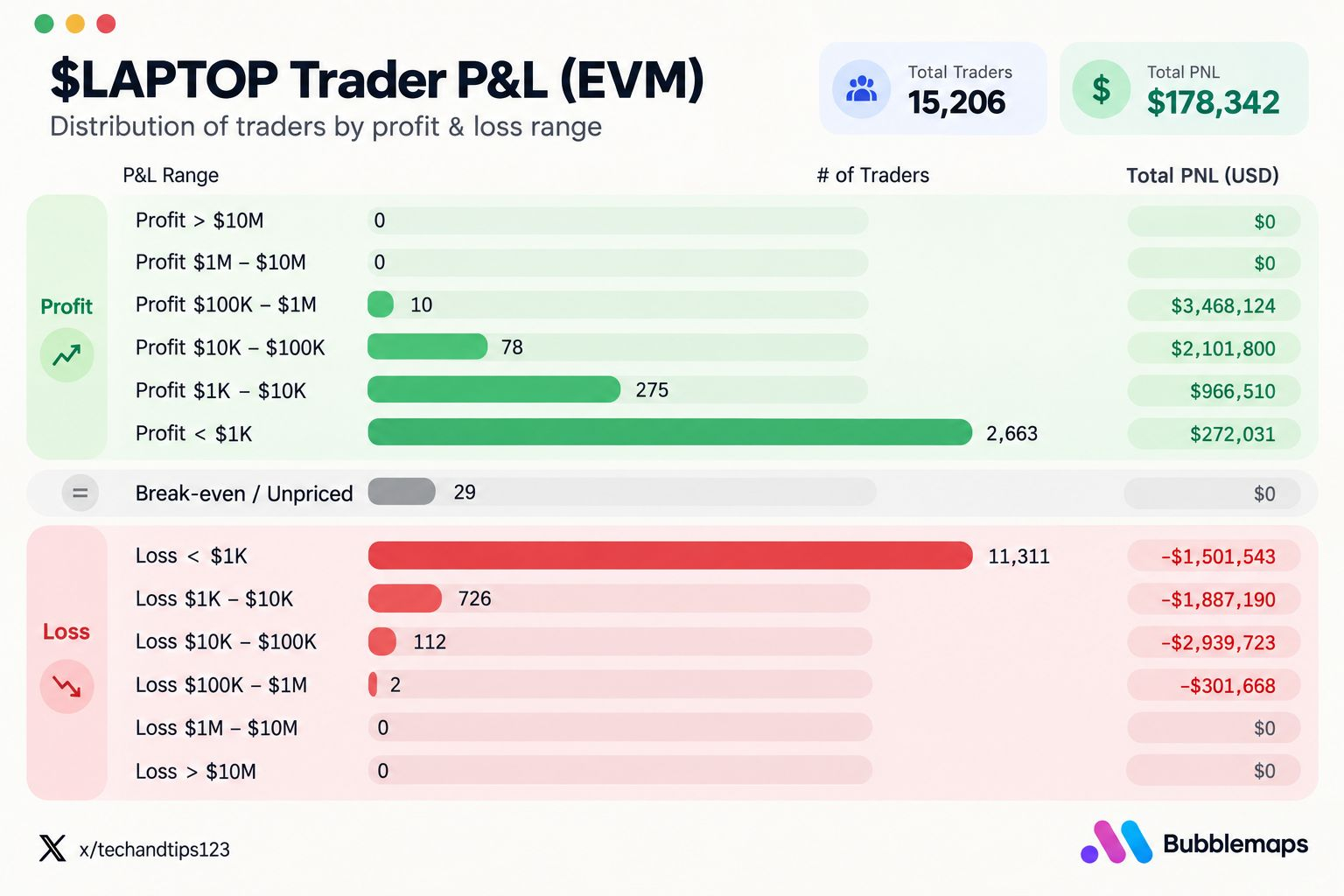
3
667
Partly True
$AVAX South Korea moves entire capital markets infrastructure onchain via Avalanche
-
South Korea's Financial Services Commission and Korea Securities Depository are laying groundwork to bring stocks, bonds, and funds onchain using Avalanche. The scope includes issuance, trading, clearing, settlement, and investor rights.
© Stacy Murr
$AVAX South Korea moves entire capital markets infrastructure onchain via Avalanche
-
South Korea's Financial Services Commission and Korea Securities Depository are laying groundwork to bring stocks, bonds, and funds onchain using Avalanche. The scope includes issuance, trading, clearing, settlement, and investor rights.
© Stacy Murr
-
South Korea's Financial Services Commission and Korea Securities Depository are laying groundwork to bring stocks, bonds, and funds onchain using Avalanche. The scope includes issuance, trading, clearing, settlement, and investor rights.
© Stacy Murr

1
4
1.7k
$VVV is Love , One of my Biggest Bag . Their staking mechanism is great and we have a separate Deep Dive on them --
>> [Read More About Venice VVV](https://app.binance.com/uni-qr/cart/306119248981586?r=HRL1TEWK&l=en&uco=RiugUaF_15X3S2_dvJO8uQ&uc=app_square_share_link&us=copylink)
$VVV is Love , One of my Biggest Bag . Their staking mechanism is great and we have a separate Deep Dive on them --
>> Read More About Venice VVV
>> Read More About Venice VVV
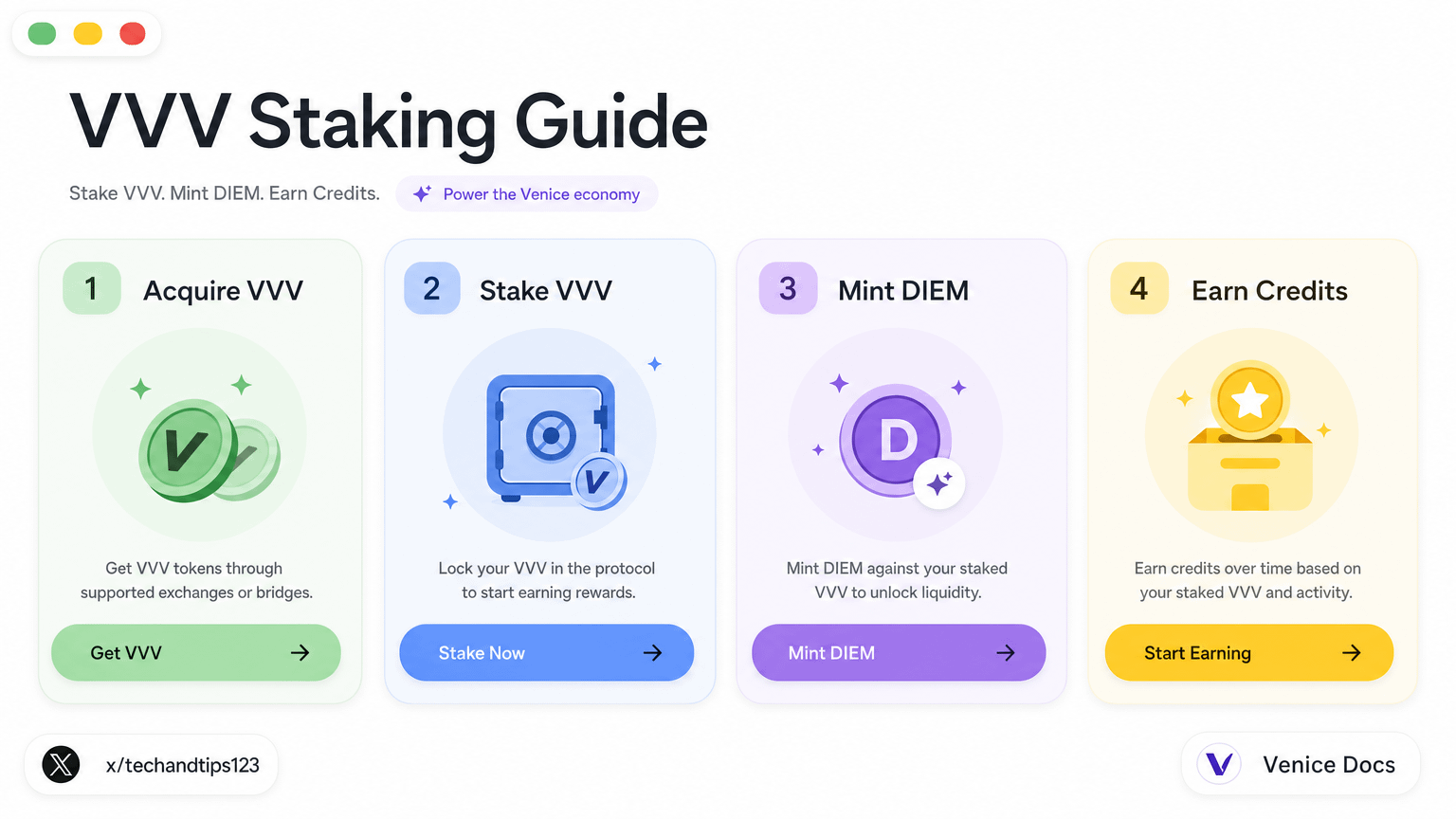
1
3
1.7k
Verified
$NEAR is an absolute sleeping giant in this mini privacy-focused AI meta.
-
• Venice is using NEAR’s infrastructure to enable confidential AI, with encryption, secure compute and hardware-level isolation keeping user data private. This gives $NEAR exposure to the growing intersection of AI × Privacy × Crypto.
• $VVV has already gone through a generational run, soaring from around $14 to $29 as the privacy AI narrative gained momentum. The bigger question now is whether the market starts looking for the next infrastructure play behind this trend.
• That’s where near gets interesting, because it isn’t just another privacy AI token chasing the narrative. If Venice and confidential AI adoption accelerate, NEAR could become one of the major infrastructure plays powering this entire meta.
$NEAR is an absolute sleeping giant in this mini privacy-focused AI meta.
-
• Venice is using NEAR’s infrastructure to enable confidential AI, with encryption, secure compute and hardware-level isolation keeping user data private. This gives $NEAR exposure to the growing intersection of AI × Privacy × Crypto.
• $VVV has already gone through a generational run, soaring from around $14 to $29 as the privacy AI narrative gained momentum. The bigger question now is whether the market starts looking for the next infrastructure play behind this trend.
• That’s where near gets interesting, because it isn’t just another privacy AI token chasing the narrative. If Venice and confidential AI adoption accelerate, NEAR could become one of the major infrastructure plays powering this entire meta.
-
• Venice is using NEAR’s infrastructure to enable confidential AI, with encryption, secure compute and hardware-level isolation keeping user data private. This gives $NEAR exposure to the growing intersection of AI × Privacy × Crypto.
• $VVV has already gone through a generational run, soaring from around $14 to $29 as the privacy AI narrative gained momentum. The bigger question now is whether the market starts looking for the next infrastructure play behind this trend.
• That’s where near gets interesting, because it isn’t just another privacy AI token chasing the narrative. If Venice and confidential AI adoption accelerate, NEAR could become one of the major infrastructure plays powering this entire meta.
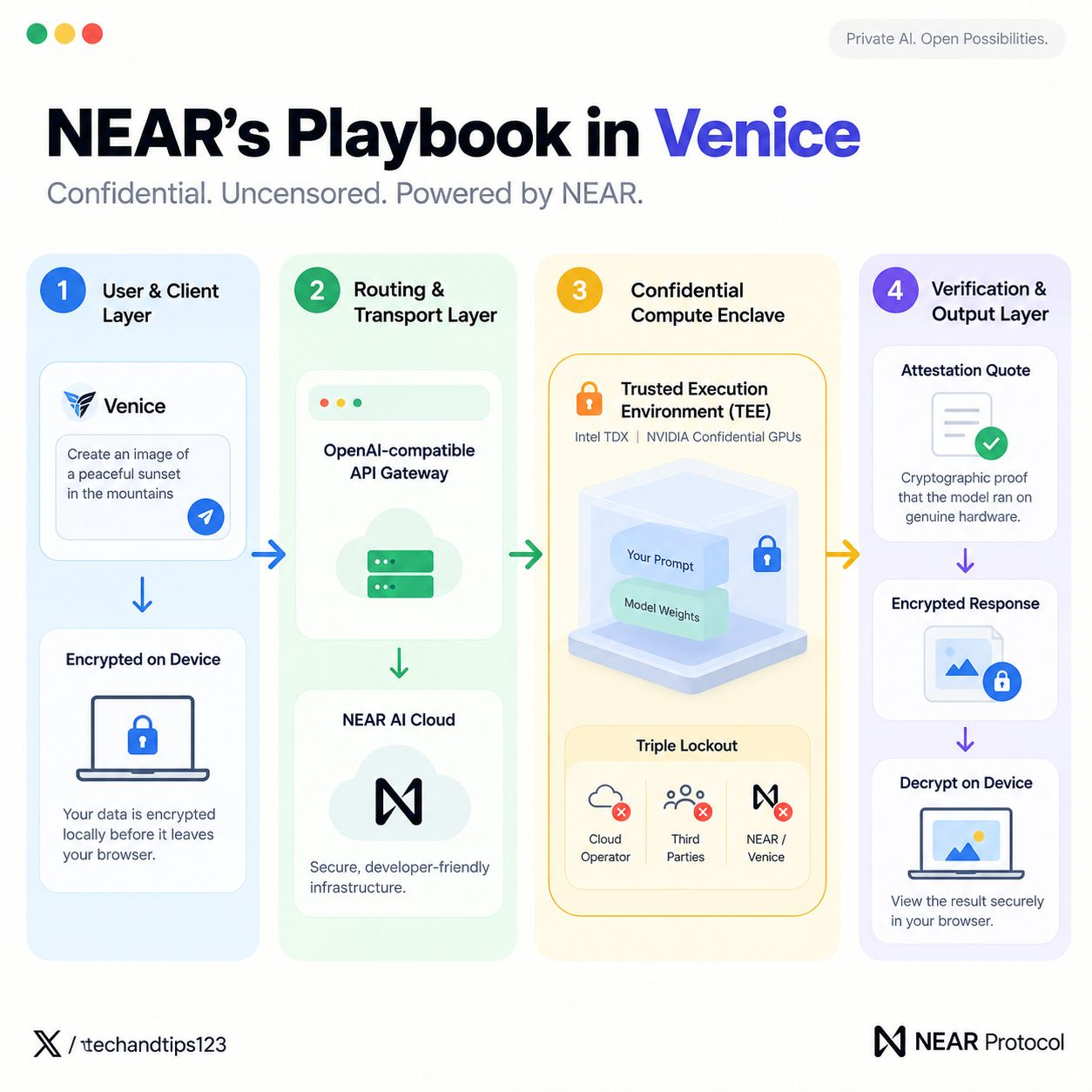
1
4
2k
🟡 𝐁𝐍𝐁 𝐂𝐡𝐚𝐢𝐧 𝐃𝐚𝐢𝐥𝐲 𝐑𝐞𝐜𝐚𝐩 | 𝐋𝐚𝐬𝐭 24𝐇 $BNB
-
• $FORM Four.meme launched 4Stock on BNB Chain, a new tokenized-stock product backed 1:1 by underlying shares, designed to bring stocks on-chain before an official bStock exists. Within roughly five hours, 4Stock had reached $45.46M in 24H volume and more than $67M circulating market cap.
• 4Stock quickly became a major BSC trading driver. BSC DEX volume reached about $1.33B over 24 hours, briefly moving ahead of Ethereum, with the surge concentrated around the new BNC4/4Stock activity.
• $CAKE PancakeSwap crossed 200M users, with lifetime trading volume reaching roughly $4.2T. The milestone was reported on September 8 and comes as the DEX continues expanding its tokenized-equity activity on BNB Chain.
• BSC remained heavily active on-chain, with DeFiLlama showing $5.75B TVL, $1.40B DEX volume, 1.84M active addresses, 350.6K new addresses, and 18.82M transactions in the latest 24-hour window. Chain fees were about $1.08M, while apps generated $1.98M revenue.
🟡 𝐁𝐍𝐁 𝐂𝐡𝐚𝐢𝐧 𝐃𝐚𝐢𝐥𝐲 𝐑𝐞𝐜𝐚𝐩 | 𝐋𝐚𝐬𝐭 24𝐇 $BNB
-
• $FORM Four.meme launched 4Stock on BNB Chain, a new tokenized-stock product backed 1:1 by underlying shares, designed to bring stocks on-chain before an official bStock exists. Within roughly five hours, 4Stock had reached $45.46M in 24H volume and more than $67M circulating market cap.
• 4Stock quickly became a major BSC trading driver. BSC DEX volume reached about $1.33B over 24 hours, briefly moving ahead of Ethereum, with the surge concentrated around the new BNC4/4Stock activity.
• $CAKE PancakeSwap crossed 200M users, with lifetime trading volume reaching roughly $4.2T. The milestone was reported on September 8 and comes as the DEX continues expanding its tokenized-equity activity on BNB Chain.
• BSC remained heavily active on-chain, with DeFiLlama showing $5.75B TVL, $1.40B DEX volume, 1.84M active addresses, 350.6K new addresses, and 18.82M transactions in the latest 24-hour window. Chain fees were about $1.08M, while apps generated $1.98M revenue.
-
• $FORM Four.meme launched 4Stock on BNB Chain, a new tokenized-stock product backed 1:1 by underlying shares, designed to bring stocks on-chain before an official bStock exists. Within roughly five hours, 4Stock had reached $45.46M in 24H volume and more than $67M circulating market cap.
• 4Stock quickly became a major BSC trading driver. BSC DEX volume reached about $1.33B over 24 hours, briefly moving ahead of Ethereum, with the surge concentrated around the new BNC4/4Stock activity.
• $CAKE PancakeSwap crossed 200M users, with lifetime trading volume reaching roughly $4.2T. The milestone was reported on September 8 and comes as the DEX continues expanding its tokenized-equity activity on BNB Chain.
• BSC remained heavily active on-chain, with DeFiLlama showing $5.75B TVL, $1.40B DEX volume, 1.84M active addresses, 350.6K new addresses, and 18.82M transactions in the latest 24-hour window. Chain fees were about $1.08M, while apps generated $1.98M revenue.

1
1.1k
🟡 𝐄𝐓𝐅 𝐈𝐧𝐬𝐢𝐠𝐡𝐭𝐬 | 𝐒𝐞𝐩𝐭𝐞𝐦𝐛𝐞𝐫 9, 2026 $BTC $ETH $XRP
🟡 𝐄𝐓𝐅 𝐈𝐧𝐬𝐢𝐠𝐡𝐭𝐬 | 𝐒𝐞𝐩𝐭𝐞𝐦𝐛𝐞𝐫 9, 2026 $BTC $ETH $XRP
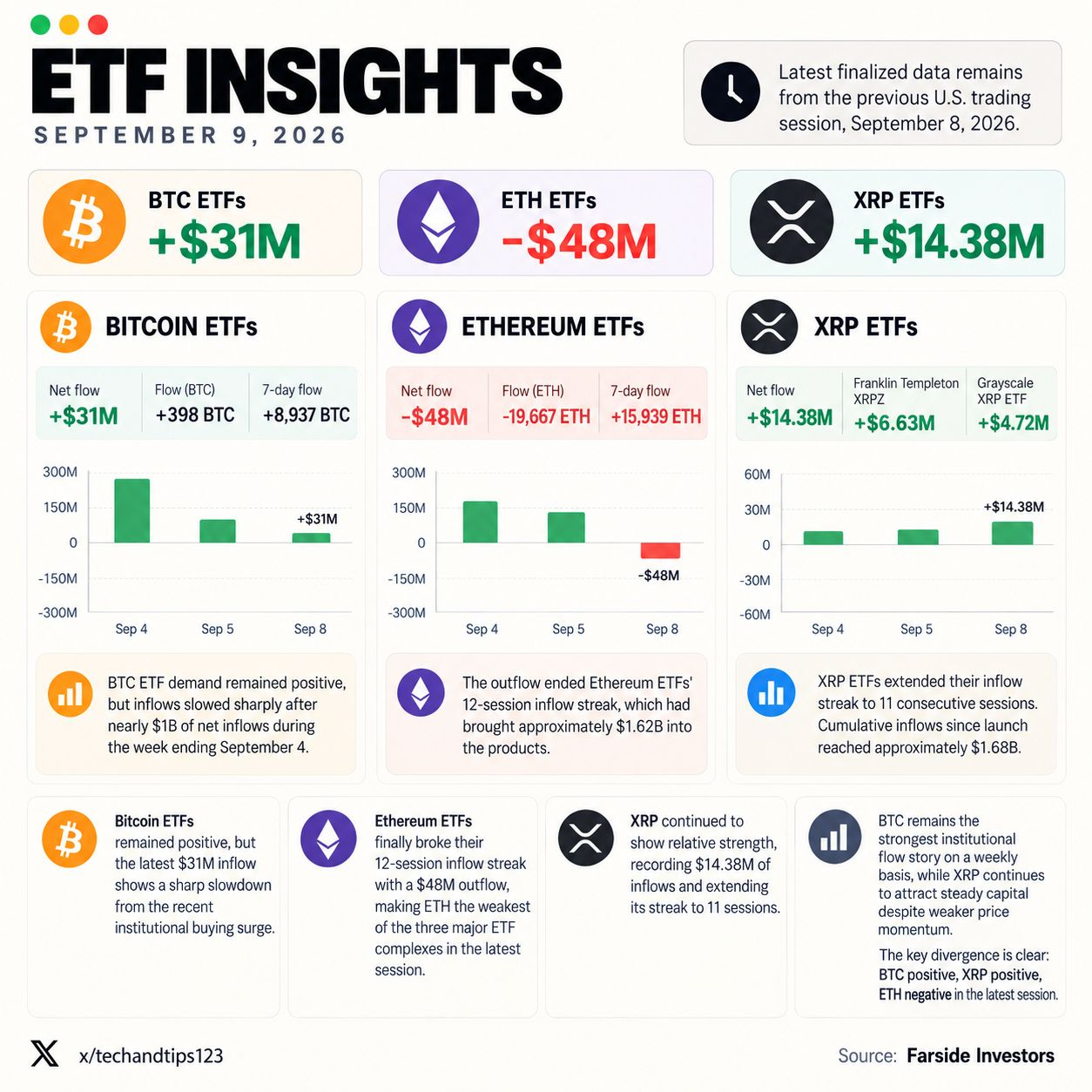
359
𝙏𝙤𝙥 𝙏𝙧𝙚𝙣𝙙𝙞𝙣𝙜 𝘾𝙤𝙞𝙣𝙨 𝙏𝙤𝙙𝙖𝙮 : 9 𝙎𝙚𝙥𝙩𝙚𝙢𝙗𝙚𝙧 2026 $VVV $USELESS $ETC
𝙏𝙤𝙥 𝙏𝙧𝙚𝙣𝙙𝙞𝙣𝙜 𝘾𝙤𝙞𝙣𝙨 𝙏𝙤𝙙𝙖𝙮 : 9 𝙎𝙚𝙥𝙩𝙚𝙢𝙗𝙚𝙧 2026 $VVV $USELESS $ETC
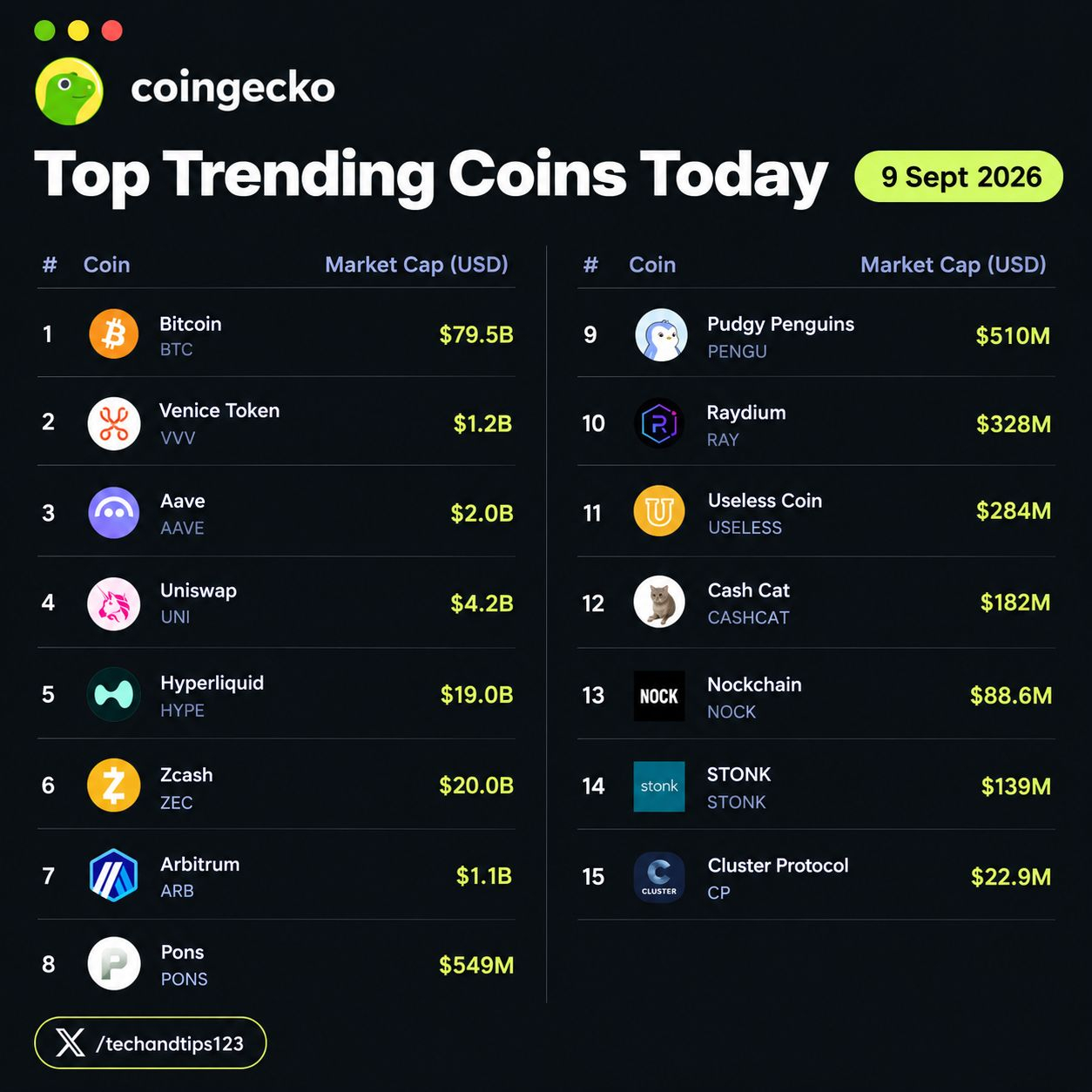
1
5
5.1k
🔅𝗪𝗵𝗮𝘁 𝗗𝗶𝗱 𝗬𝗼𝘂 𝗠𝗶𝘀𝘀𝗲𝗱 𝗶𝗻 𝗖𝗿𝘆𝗽𝘁𝗼 𝗶𝗻 𝗹𝗮𝘀𝘁 24𝗛?🔅
-
• Ethereum proposal could let users pay gas without $ETH
• Robinhood expands prediction markets across sports
• Strategy repurchases $176M of $STRC shares
• Hunter Biden to airdrop LAPTOP memecoin to losers
• Liquid hackers return $270M in Bitcoin
• UK weighs easing financial prediction market restrictions
• Circle agrees to buy Tazapay for $400M
💡 Courtesy - Datawallet
©𝑻𝒉𝒊𝒔 𝒂𝒓𝒕𝒊𝒄𝒍𝒆 𝒊𝒔 𝒇𝒐𝒓 𝒊𝒏𝒇𝒐𝒓𝒎𝒂𝒕𝒊𝒐𝒏 𝒐𝒏𝒍𝒚 𝒂𝒏𝒅 𝒏𝒐𝒕 𝒂𝒏 𝒆𝒏𝒅𝒐𝒓𝒔𝒆𝒎𝒆𝒏𝒕 𝒐𝒇 𝒂𝒏𝒚 𝒑𝒓𝒐𝒋𝒆𝒄𝒕 𝒐𝒓 𝒆𝒏𝒕𝒊𝒕𝒚. 𝑻𝒉𝒆 𝒏𝒂𝒎𝒆𝒔 𝒎𝒆𝒏𝒕𝒊𝒐𝒏𝒆𝒅 𝒂𝒓𝒆 𝒏𝒐𝒕 𝒓𝒆𝒍𝒂𝒕𝒆𝒅 𝒕𝒐 𝒖𝒔. 𝑾𝒆 𝒂𝒓𝒆 𝒏𝒐𝒕 𝒍𝒊𝒂𝒃𝒍𝒆 𝒇𝒐𝒓 𝒂𝒏𝒚 𝒍𝒐𝒔𝒔𝒆𝒔 𝒇𝒓𝒐𝒎 𝒊𝒏𝒗𝒆𝒔𝒕𝒊𝒏𝒈 𝒃𝒂𝒔𝒆𝒅 𝒐𝒏 𝒕𝒉𝒊𝒔 𝒂𝒓𝒕𝒊𝒄𝒍𝒆. 𝑻𝒉𝒊𝒔 𝒊𝒔 𝒏𝒐𝒕 𝒇𝒊𝒏𝒂𝒏𝒄𝒊𝒂𝒍 𝒂𝒅𝒗𝒊𝒄𝒆. 𝑻𝒉𝒊𝒔 𝒅𝒊𝒔𝒄𝒍𝒂𝒊𝒎𝒆𝒓 𝒑𝒓𝒐𝒕𝒆𝒄𝒕𝒔 𝒃𝒐𝒕𝒉 𝒚𝒐𝒖 𝒂𝒏𝒅 𝒖𝒔.
🅃🄴🄲🄷🄰🄽🄳🅃🄸🄿🅂123
🔅𝗪𝗵𝗮𝘁 𝗗𝗶𝗱 𝗬𝗼𝘂 𝗠𝗶𝘀𝘀𝗲𝗱 𝗶𝗻 𝗖𝗿𝘆𝗽𝘁𝗼 𝗶𝗻 𝗹𝗮𝘀𝘁 24𝗛?🔅
-
• Ethereum proposal could let users pay gas without $ETH
• Robinhood expands prediction markets across sports
• Strategy repurchases $176M of $STRC shares
• Hunter Biden to airdrop LAPTOP memecoin to losers
• Liquid hackers return $270M in Bitcoin
• UK weighs easing financial prediction market restrictions
• Circle agrees to buy Tazapay for $400M
💡 Courtesy - Datawallet
©𝑻𝒉𝒊𝒔 𝒂𝒓𝒕𝒊𝒄𝒍𝒆 𝒊𝒔 𝒇𝒐𝒓 𝒊𝒏𝒇𝒐𝒓𝒎𝒂𝒕𝒊𝒐𝒏 𝒐𝒏𝒍𝒚 𝒂𝒏𝒅 𝒏𝒐𝒕 𝒂𝒏 𝒆𝒏𝒅𝒐𝒓𝒔𝒆𝒎𝒆𝒏𝒕 𝒐𝒇 𝒂𝒏𝒚 𝒑𝒓𝒐𝒋𝒆𝒄𝒕 𝒐𝒓 𝒆𝒏𝒕𝒊𝒕𝒚. 𝑻𝒉𝒆 𝒏𝒂𝒎𝒆𝒔 𝒎𝒆𝒏𝒕𝒊𝒐𝒏𝒆𝒅 𝒂𝒓𝒆 𝒏𝒐𝒕 𝒓𝒆𝒍𝒂𝒕𝒆𝒅 𝒕𝒐 𝒖𝒔. 𝑾𝒆 𝒂𝒓𝒆 𝒏𝒐𝒕 𝒍𝒊𝒂𝒃𝒍𝒆 𝒇𝒐𝒓 𝒂𝒏𝒚 𝒍𝒐𝒔𝒔𝒆𝒔 𝒇𝒓𝒐𝒎 𝒊𝒏𝒗𝒆𝒔𝒕𝒊𝒏𝒈 𝒃𝒂𝒔𝒆𝒅 𝒐𝒏 𝒕𝒉𝒊𝒔 𝒂𝒓𝒕𝒊𝒄𝒍𝒆. 𝑻𝒉𝒊𝒔 𝒊𝒔 𝒏𝒐𝒕 𝒇𝒊𝒏𝒂𝒏𝒄𝒊𝒂𝒍 𝒂𝒅𝒗𝒊𝒄𝒆. 𝑻𝒉𝒊𝒔 𝒅𝒊𝒔𝒄𝒍𝒂𝒊𝒎𝒆𝒓 𝒑𝒓𝒐𝒕𝒆𝒄𝒕𝒔 𝒃𝒐𝒕𝒉 𝒚𝒐𝒖 𝒂𝒏𝒅 𝒖𝒔.
🅃🄴🄲🄷🄰🄽🄳🅃🄸🄿🅂123
-
• Ethereum proposal could let users pay gas without $ETH
• Robinhood expands prediction markets across sports
• Strategy repurchases $176M of $STRC shares
• Hunter Biden to airdrop LAPTOP memecoin to losers
• Liquid hackers return $270M in Bitcoin
• UK weighs easing financial prediction market restrictions
• Circle agrees to buy Tazapay for $400M
💡 Courtesy - Datawallet
©𝑻𝒉𝒊𝒔 𝒂𝒓𝒕𝒊𝒄𝒍𝒆 𝒊𝒔 𝒇𝒐𝒓 𝒊𝒏𝒇𝒐𝒓𝒎𝒂𝒕𝒊𝒐𝒏 𝒐𝒏𝒍𝒚 𝒂𝒏𝒅 𝒏𝒐𝒕 𝒂𝒏 𝒆𝒏𝒅𝒐𝒓𝒔𝒆𝒎𝒆𝒏𝒕 𝒐𝒇 𝒂𝒏𝒚 𝒑𝒓𝒐𝒋𝒆𝒄𝒕 𝒐𝒓 𝒆𝒏𝒕𝒊𝒕𝒚. 𝑻𝒉𝒆 𝒏𝒂𝒎𝒆𝒔 𝒎𝒆𝒏𝒕𝒊𝒐𝒏𝒆𝒅 𝒂𝒓𝒆 𝒏𝒐𝒕 𝒓𝒆𝒍𝒂𝒕𝒆𝒅 𝒕𝒐 𝒖𝒔. 𝑾𝒆 𝒂𝒓𝒆 𝒏𝒐𝒕 𝒍𝒊𝒂𝒃𝒍𝒆 𝒇𝒐𝒓 𝒂𝒏𝒚 𝒍𝒐𝒔𝒔𝒆𝒔 𝒇𝒓𝒐𝒎 𝒊𝒏𝒗𝒆𝒔𝒕𝒊𝒏𝒈 𝒃𝒂𝒔𝒆𝒅 𝒐𝒏 𝒕𝒉𝒊𝒔 𝒂𝒓𝒕𝒊𝒄𝒍𝒆. 𝑻𝒉𝒊𝒔 𝒊𝒔 𝒏𝒐𝒕 𝒇𝒊𝒏𝒂𝒏𝒄𝒊𝒂𝒍 𝒂𝒅𝒗𝒊𝒄𝒆. 𝑻𝒉𝒊𝒔 𝒅𝒊𝒔𝒄𝒍𝒂𝒊𝒎𝒆𝒓 𝒑𝒓𝒐𝒕𝒆𝒄𝒕𝒔 𝒃𝒐𝒕𝒉 𝒚𝒐𝒖 𝒂𝒏𝒅 𝒖𝒔.
🅃🄴🄲🄷🄰🄽🄳🅃🄸🄿🅂123

1
418
Vulnerable BNB Router Loses ~62.28 WBNB to Fake Pool Callback $BNB
-
The router's callback pulled tokens via a caller-supplied payer without verifying the caller was a genuine pool, and its factory address was set to zero.
A single flash-swapped transaction deployed a fake pool and drained standing approvals from 29 users; anyone who ever approved this router was exposed.
© Defendor x ExVul
Vulnerable BNB Router Loses ~62.28 WBNB to Fake Pool Callback $BNB
-
The router's callback pulled tokens via a caller-supplied payer without verifying the caller was a genuine pool, and its factory address was set to zero.
A single flash-swapped transaction deployed a fake pool and drained standing approvals from 29 users; anyone who ever approved this router was exposed.
© Defendor x ExVul
-
The router's callback pulled tokens via a caller-supplied payer without verifying the caller was a genuine pool, and its factory address was set to zero.
A single flash-swapped transaction deployed a fake pool and drained standing approvals from 29 users; anyone who ever approved this router was exposed.
© Defendor x ExVul
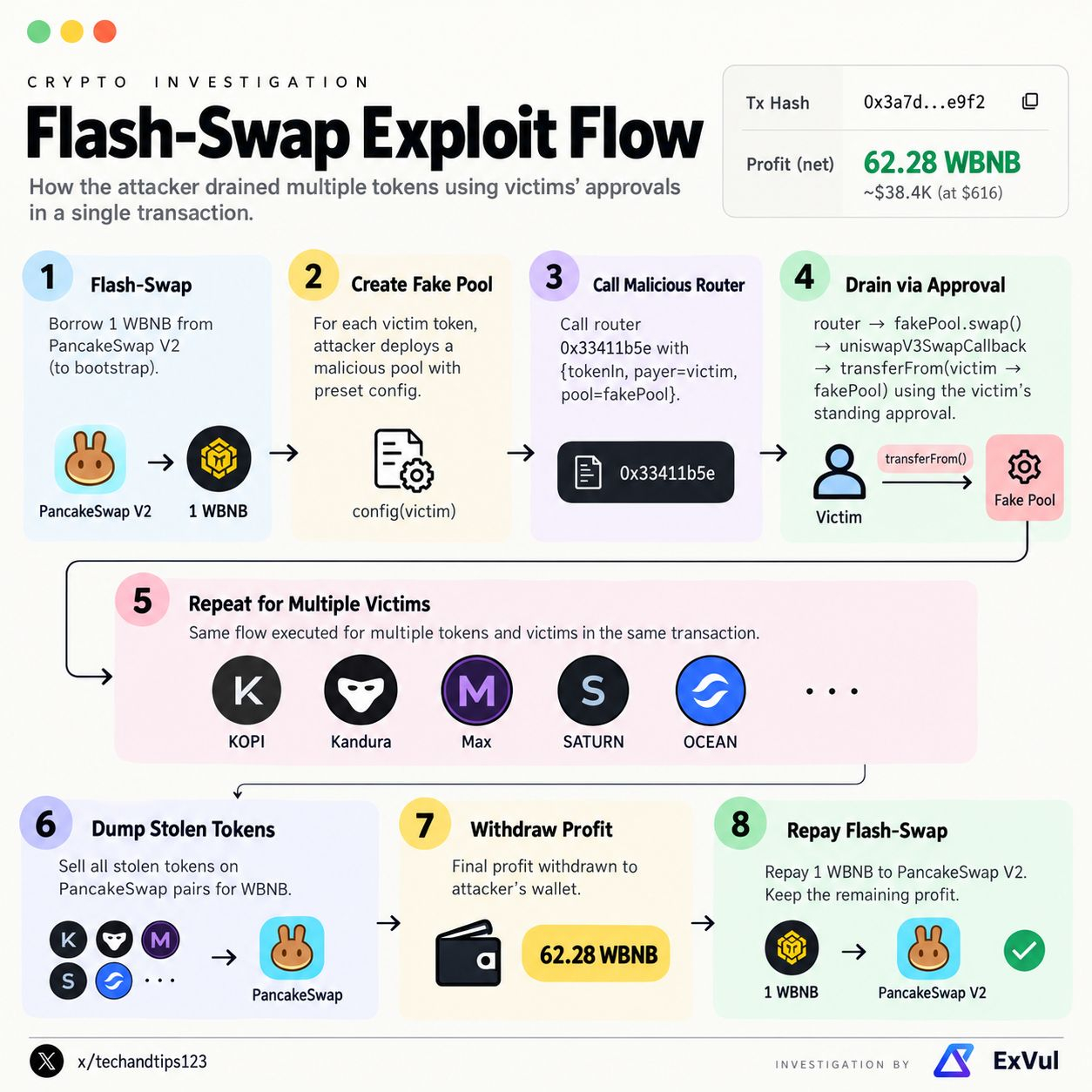
1
2
1k
$VVV 𝐢𝐬 𝐓𝐨𝐮𝐜𝐡𝐢𝐧𝐠 100 $ZEC 𝐌𝐢𝐠𝐡𝐭 𝐭𝐨𝐮𝐜𝐡 2000 $FORM 𝐢𝐬 𝐃𝐨𝐦𝐢𝐧𝐚𝐭𝐢𝐧𝐠, 𝐁𝐮𝐭 𝐑𝐞𝐚𝐥 𝐨𝐩𝐩𝐨𝐫𝐭𝐮𝐧𝐢𝐭𝐢𝐞𝐬 𝐥𝐢𝐞𝐬 𝐢𝐧 𝐀𝐞𝐯𝐨
-
Noise is dominating every social feed with arbitrary token pumps, but structural utility is where long-term positioning wins. While speculative rotations capture short-term attention, Aevo provides the actual multi-asset infrastructure required for serious derivatives trading.
Operating on a custom OP Stack layer-2 network, Aevo pairs sub-10ms off-chain matching with Ethereum-secured on-chain settlement. Traders manage perpetual futures, crypto options, equity perps, and real-world asset spot markets through a single, unified margin account.
The breakthrough feature is aeUSD, a battle-tested, yield-bearing stablecoin collateral backed by an sDAI/Spark wrapper. Instead of leaving capital sitting idle between positions, margin collateral continuously generates native yield in the background while backing active trades.
That architecture pairs directly with PERPS+, a system that lets traders attach automated downside protection like Limit My Loss to leverage in a single click. Execution speed, continuous yield generation, and native risk management merge into one seamless trading engine.
B U L L I S H 🥂 Aevo
$VVV 𝐢𝐬 𝐓𝐨𝐮𝐜𝐡𝐢𝐧𝐠 100 $ZEC 𝐌𝐢𝐠𝐡𝐭 𝐭𝐨𝐮𝐜𝐡 2000 $FORM 𝐢𝐬 𝐃𝐨𝐦𝐢𝐧𝐚𝐭𝐢𝐧𝐠, 𝐁𝐮𝐭 𝐑𝐞𝐚𝐥 𝐨𝐩𝐩𝐨𝐫𝐭𝐮𝐧𝐢𝐭𝐢𝐞𝐬 𝐥𝐢𝐞𝐬 𝐢𝐧 𝐀𝐞𝐯𝐨
-
Noise is dominating every social feed with arbitrary token pumps, but structural utility is where long-term positioning wins. While speculative rotations capture short-term attention, Aevo provides the actual multi-asset infrastructure required for serious derivatives trading.
Operating on a custom OP Stack layer-2 network, Aevo pairs sub-10ms off-chain matching with Ethereum-secured on-chain settlement. Traders manage perpetual futures, crypto options, equity perps, and real-world asset spot markets through a single, unified margin account.
The breakthrough feature is aeUSD, a battle-tested, yield-bearing stablecoin collateral backed by an sDAI/Spark wrapper. Instead of leaving capital sitting idle between positions, margin collateral continuously generates native yield in the background while backing active trades.
That architecture pairs directly with PERPS+, a system that lets traders attach automated downside protection like Limit My Loss to leverage in a single click. Execution speed, continuous yield generation, and native risk management merge into one seamless trading engine.
B U L L I S H 🥂 Aevo
-
Noise is dominating every social feed with arbitrary token pumps, but structural utility is where long-term positioning wins. While speculative rotations capture short-term attention, Aevo provides the actual multi-asset infrastructure required for serious derivatives trading.
Operating on a custom OP Stack layer-2 network, Aevo pairs sub-10ms off-chain matching with Ethereum-secured on-chain settlement. Traders manage perpetual futures, crypto options, equity perps, and real-world asset spot markets through a single, unified margin account.
The breakthrough feature is aeUSD, a battle-tested, yield-bearing stablecoin collateral backed by an sDAI/Spark wrapper. Instead of leaving capital sitting idle between positions, margin collateral continuously generates native yield in the background while backing active trades.
That architecture pairs directly with PERPS+, a system that lets traders attach automated downside protection like Limit My Loss to leverage in a single click. Execution speed, continuous yield generation, and native risk management merge into one seamless trading engine.
B U L L I S H 🥂 Aevo
2
2
486
🟡 𝐁𝐍𝐁 𝐂𝐡𝐚𝐢𝐧 𝐃𝐚𝐢𝐥𝐲 𝐑𝐞𝐜𝐚𝐩 | 𝐋𝐚𝐬𝐭 24𝐇 $BNB
-
• BNB Chain absorbed $28.1M in net capital inflows over the latest 24-hour period, according to DeFiLlama. BSC DEX volume reached $1.38B, while 7-day DEX volume climbed to $8.76B, up 32.17% WoW.
• On-chain activity remained elevated, with BSC recording 1.96M active addresses, 343,871 new addresses and 18.31M transactions over 24 hours. Chain fees were $889K, while apps generated $2.01M in revenue and $5.65M in fees.
• BNB Chain’s stablecoin base held at $13.30B, while its active RWA market cap stood at $4.71B. The network’s DeFi TVL was $5.66B, down 2.86% over 24 hours.
🟡 𝐁𝐍𝐁 𝐂𝐡𝐚𝐢𝐧 𝐃𝐚𝐢𝐥𝐲 𝐑𝐞𝐜𝐚𝐩 | 𝐋𝐚𝐬𝐭 24𝐇 $BNB
-
• BNB Chain absorbed $28.1M in net capital inflows over the latest 24-hour period, according to DeFiLlama. BSC DEX volume reached $1.38B, while 7-day DEX volume climbed to $8.76B, up 32.17% WoW.
• On-chain activity remained elevated, with BSC recording 1.96M active addresses, 343,871 new addresses and 18.31M transactions over 24 hours. Chain fees were $889K, while apps generated $2.01M in revenue and $5.65M in fees.
• BNB Chain’s stablecoin base held at $13.30B, while its active RWA market cap stood at $4.71B. The network’s DeFi TVL was $5.66B, down 2.86% over 24 hours.
-
• BNB Chain absorbed $28.1M in net capital inflows over the latest 24-hour period, according to DeFiLlama. BSC DEX volume reached $1.38B, while 7-day DEX volume climbed to $8.76B, up 32.17% WoW.
• On-chain activity remained elevated, with BSC recording 1.96M active addresses, 343,871 new addresses and 18.31M transactions over 24 hours. Chain fees were $889K, while apps generated $2.01M in revenue and $5.65M in fees.
• BNB Chain’s stablecoin base held at $13.30B, while its active RWA market cap stood at $4.71B. The network’s DeFi TVL was $5.66B, down 2.86% over 24 hours.
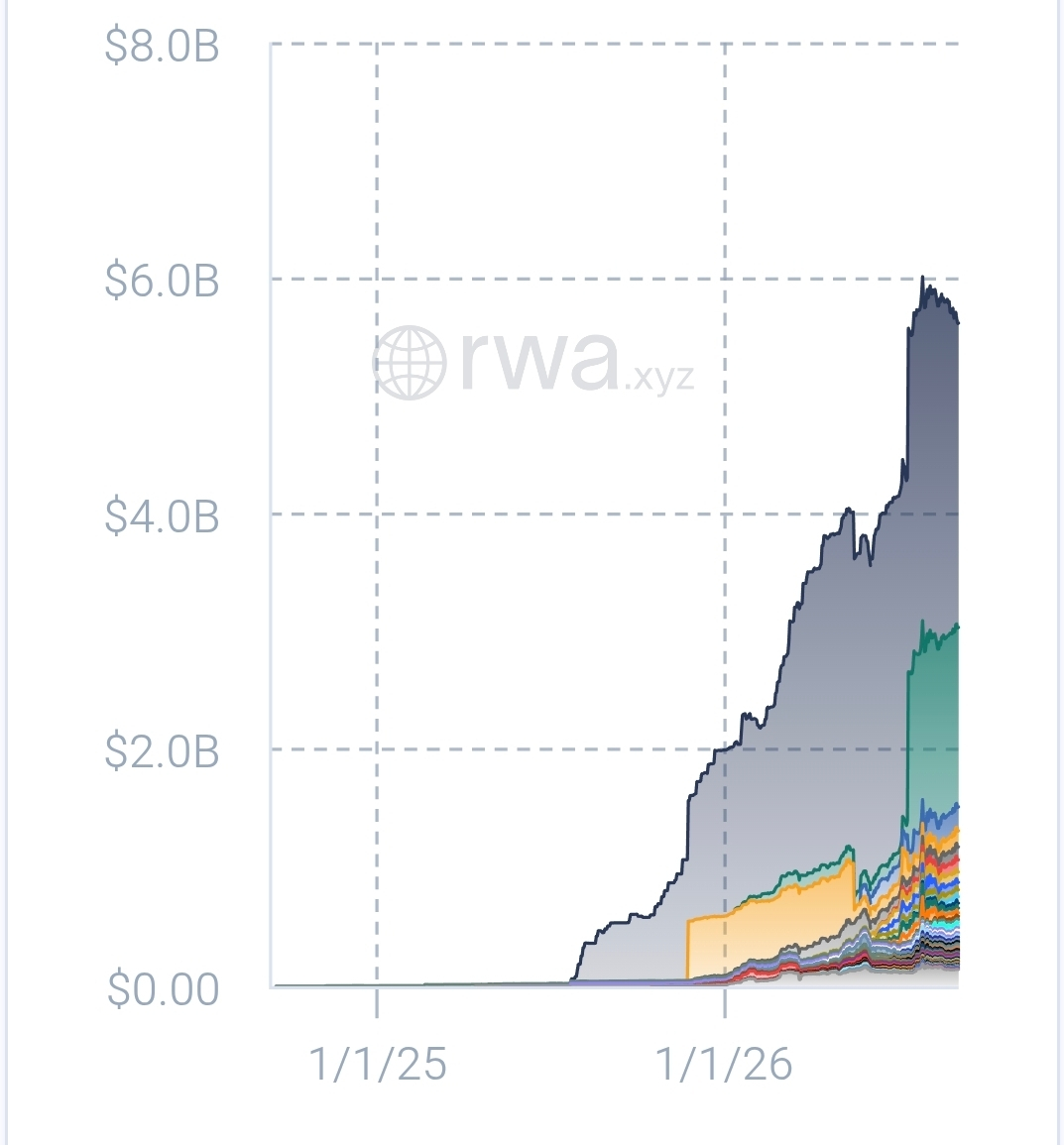
1
1
1.1k
𝐋𝐢𝐪𝐮𝐢𝐝 𝐍𝐞𝐭𝐰𝐨𝐫𝐤 𝐡𝐢𝐭 𝐛𝐲 $320𝐌 𝐞𝐱𝐩𝐥𝐨𝐢𝐭, 𝐭𝐫𝐚𝐧𝐬𝐚𝐜𝐭𝐢𝐨𝐧𝐬 𝐡𝐚𝐥𝐭𝐞𝐝
-
A Bitcoin sidechain settlement layer used by several exchanges, Blockstream's Liquid Network, was drained of roughly 4,000 BTC (≈$320M) by attackers claiming to be "white hats." The network has been fully paused.
© Coindesk
𝐋𝐢𝐪𝐮𝐢𝐝 𝐍𝐞𝐭𝐰𝐨𝐫𝐤 𝐡𝐢𝐭 𝐛𝐲 $320𝐌 𝐞𝐱𝐩𝐥𝐨𝐢𝐭, 𝐭𝐫𝐚𝐧𝐬𝐚𝐜𝐭𝐢𝐨𝐧𝐬 𝐡𝐚𝐥𝐭𝐞𝐝
-
A Bitcoin sidechain settlement layer used by several exchanges, Blockstream's Liquid Network, was drained of roughly 4,000 BTC (≈$320M) by attackers claiming to be "white hats." The network has been fully paused.
© Coindesk
-
A Bitcoin sidechain settlement layer used by several exchanges, Blockstream's Liquid Network, was drained of roughly 4,000 BTC (≈$320M) by attackers claiming to be "white hats." The network has been fully paused.
© Coindesk
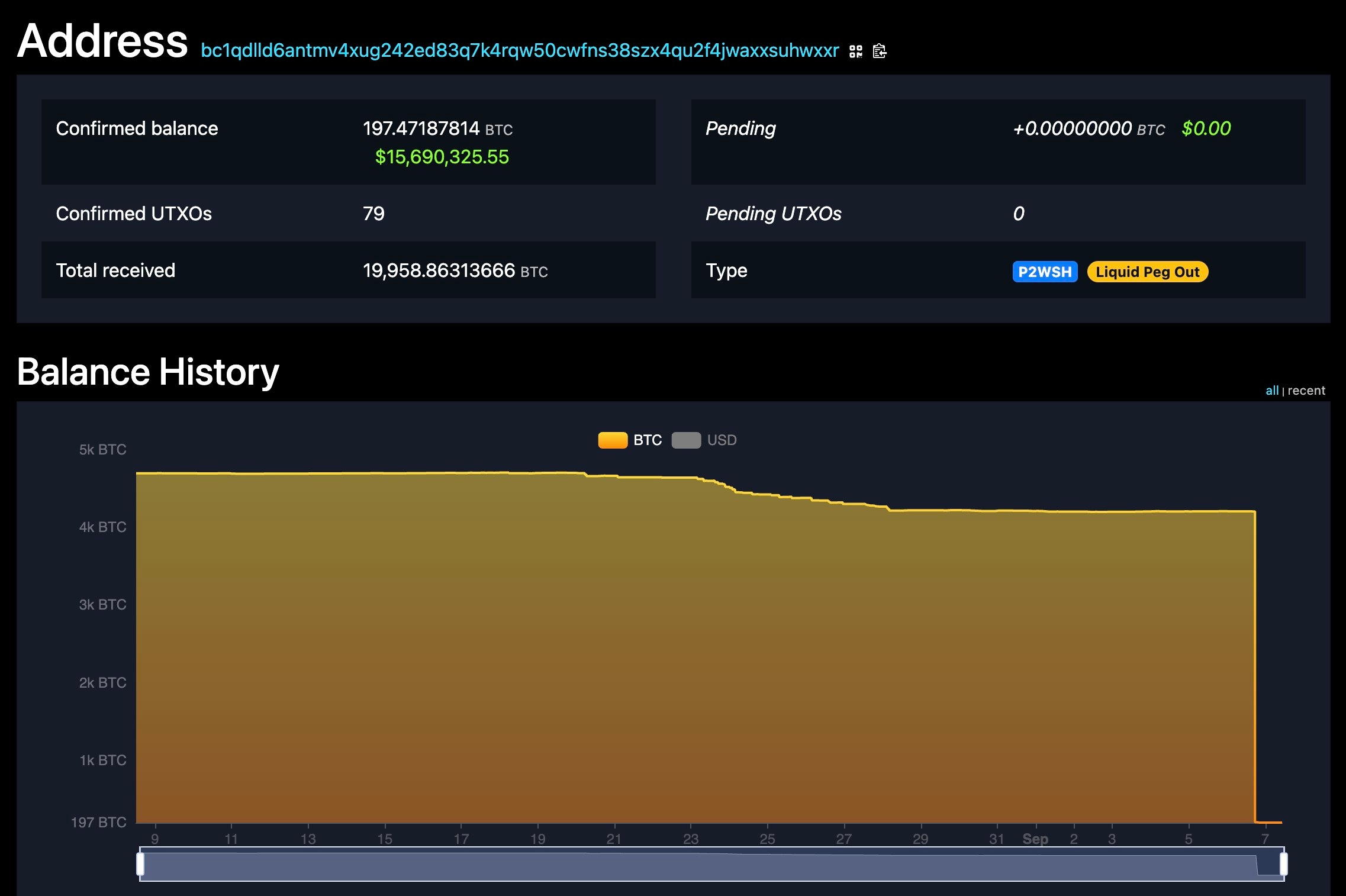
364
$ETH 𝙑𝙞𝙩𝙖𝙡𝙞𝙠 𝙪𝙥𝙙𝙖𝙩𝙚𝙨 𝙀𝙄𝙋-8141 𝙛𝙤𝙧 𝙦𝙪𝙖𝙣𝙩𝙪𝙢-𝙧𝙚𝙨𝙞𝙨𝙩𝙖𝙣𝙩 𝙨𝙞𝙜𝙣𝙖𝙩𝙪𝙧𝙚𝙨 𝙖𝙣𝙙 𝙬𝙖𝙡𝙡𝙚𝙩 𝙨𝙤𝙘𝙞𝙖𝙡 𝙧𝙚𝙘𝙤𝙫𝙚𝙧𝙮
-
Vitalik Buterin and co-authors revised the EIP-8141 "Frame Transaction" proposal for Ethereum's 2027 "Hegotá" upgrade.
• P256 quantum-resistant signatures
• Google-style social account recovery
• Batched execution of up to 64 operations
© Stacy Murr
$ETH 𝙑𝙞𝙩𝙖𝙡𝙞𝙠 𝙪𝙥𝙙𝙖𝙩𝙚𝙨 𝙀𝙄𝙋-8141 𝙛𝙤𝙧 𝙦𝙪𝙖𝙣𝙩𝙪𝙢-𝙧𝙚𝙨𝙞𝙨𝙩𝙖𝙣𝙩 𝙨𝙞𝙜𝙣𝙖𝙩𝙪𝙧𝙚𝙨 𝙖𝙣𝙙 𝙬𝙖𝙡𝙡𝙚𝙩 𝙨𝙤𝙘𝙞𝙖𝙡 𝙧𝙚𝙘𝙤𝙫𝙚𝙧𝙮
-
Vitalik Buterin and co-authors revised the EIP-8141 "Frame Transaction" proposal for Ethereum's 2027 "Hegotá" upgrade.
• P256 quantum-resistant signatures
• Google-style social account recovery
• Batched execution of up to 64 operations
© Stacy Murr
-
Vitalik Buterin and co-authors revised the EIP-8141 "Frame Transaction" proposal for Ethereum's 2027 "Hegotá" upgrade.
• P256 quantum-resistant signatures
• Google-style social account recovery
• Batched execution of up to 64 operations
© Stacy Murr
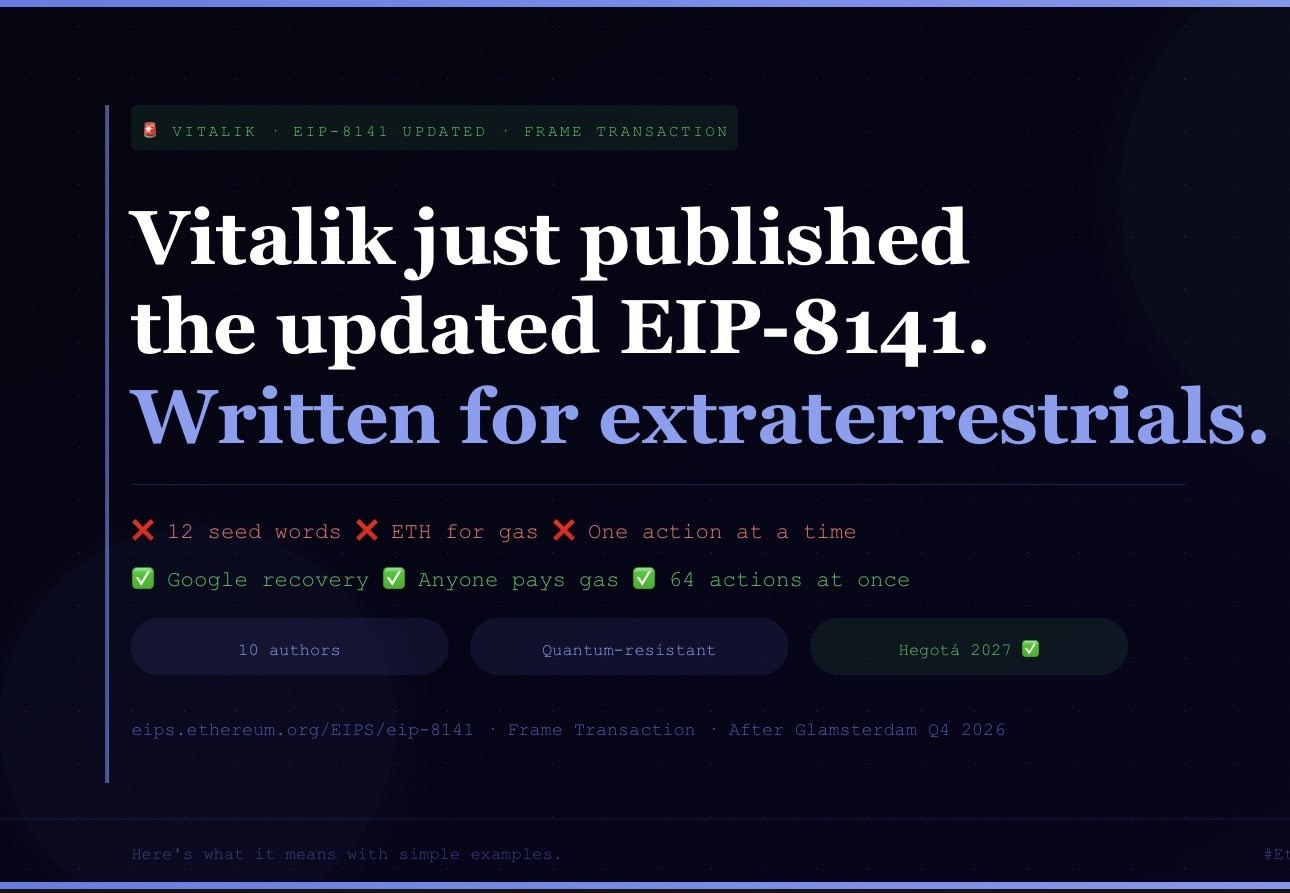
242
🟡 𝙀𝙏𝙁 𝙄𝙣𝙨𝙞𝙜𝙝𝙩𝙨 | 𝙎𝙚𝙥𝙩𝙚𝙢𝙗𝙚𝙧 8 $XRP $BTC $ETH
🟡 𝙀𝙏𝙁 𝙄𝙣𝙨𝙞𝙜𝙝𝙩𝙨 | 𝙎𝙚𝙥𝙩𝙚𝙢𝙗𝙚𝙧 8 $XRP $BTC $ETH
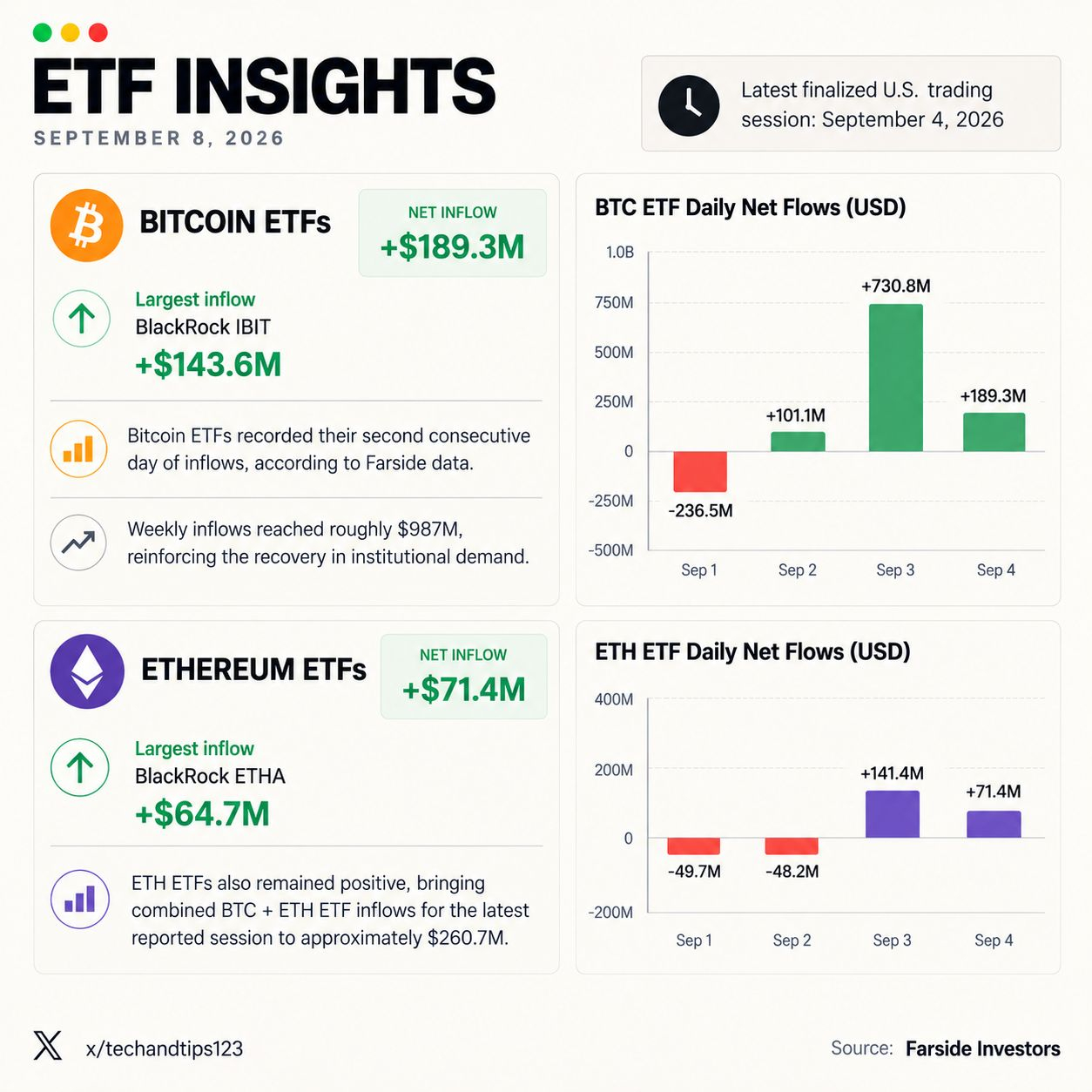
434
Log in to explore more content
Join global crypto users on Binance Square
⚡️ Get latest and useful information about crypto.
💬 Trusted by the world’s largest crypto exchange.
👍 Discover real insights from verified creators.
Email / Phone number
Trending Topics
USAugustPPIRisesLessThanExpected
23,267 views
535 Discussing
🚨 US AUG PPI: Rises LESS Than Expected! Bullish for Crypto? 🚀
PPI +0.4% MoM as expected, but CORE PPI only +0.2% vs +0.3% expected - cooling!
What it means:
• Wholesale inflation softer than feared
• Fed rate hike chance now 62% - but dovish signals coming
• Core PCE revisions expected downward - bullish
• BTC usually pumps on softer PPI
Fed meeting Sep 15-16 - Market now expects pause, not hike?
Is this the green light for Q4 rally?
#Bitcoin #PPI #Fed #CryptoNews #BTC#usaugustppiriseslessthanexpected
True News
·1 Likes
·1.2k views
SECApprovesNasdaqTexasCommodityTrustRule
16,108 views
431 Discussing
ECBRaisesRatesSecondTimeTo2.5%
12,912 views
309 Discussing