
Sattar Chaqer
7.6k Posts

Sattar Chaqer
 Square Verified+
Report
Block User
I’m back x - @SattarChaqer

Traders League Badge Expert
112 Following
48.5K+ Followers
90.8K+ Liked
1 Badges
Posts
All
Quotes
Videos
Live
Lets join here too have fun #Binance #StarLineTeam
Lets join here too have fun #Binance #StarLineTeam

MrStar
·
--
[Replay] 🎙️ Binance Square Rewards & Weekly Datas & Marvin & Crypto Talks
02 h 43 m 20 s · 6.7k listens
119
🎙️ Binance Square Rewards & Weekly Datas & Marvin & Crypto Talks

End
02 h 43 m 20 s
6.3k
26
23
ALL TP HITS
ALL TP HITS
Sattar Chaqer
·
--
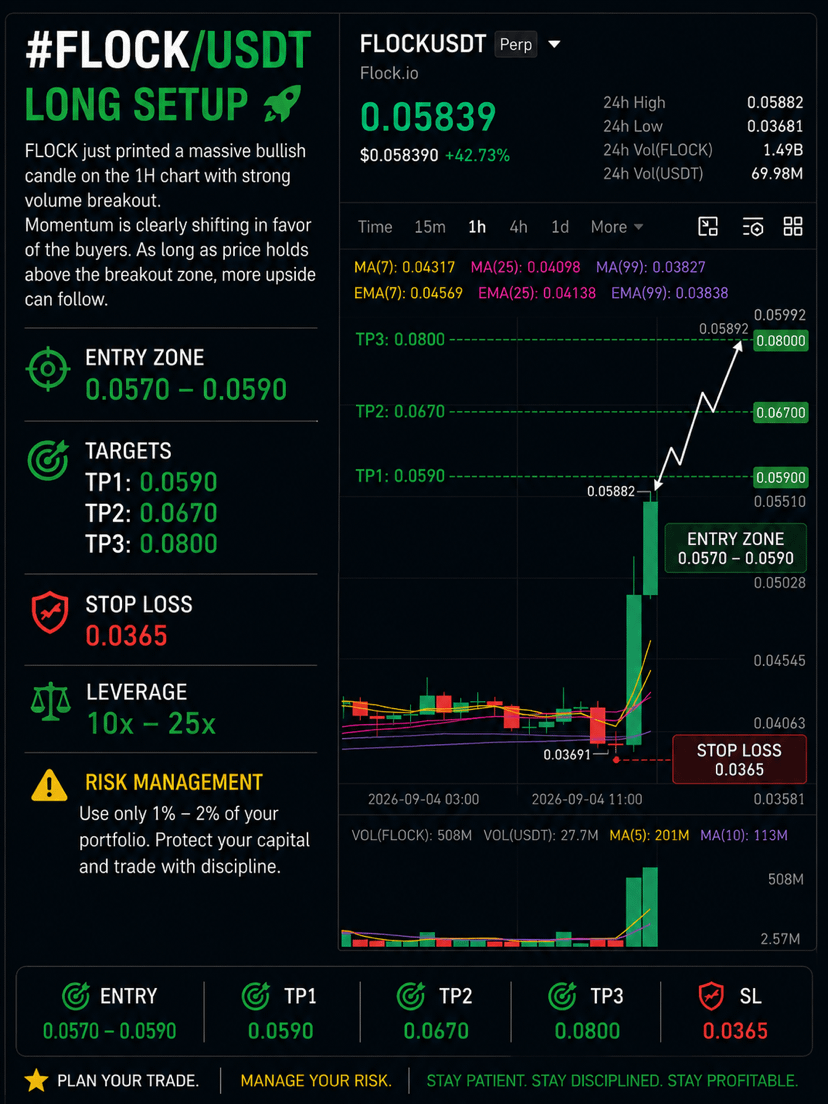
🟢 $FLOCK /USDT — LONG | 10–25x
FLOCK just broke out hard on the 1H chart, with a strong volume spike behind the move. Price is sitting near the recent high, so I’d rather wait for a pullback into the entry zone than chase the candle.
📌 ENTRY: 0.0570 → 0.0590
🎯 TP1: 0.0615
🎯 TP2: 0.0690
🎯 TP3: 0.0820
🛑 SL: 0.0500
⚡ LEVERAGE: 10–25x
⚠️ RISK: Use only 1–2% of your portfolio.
The breakout has momentum, but after a move this fast, the entry matters. If price loses the zone, I’d skip the setup.
FLOCK just broke out hard on the 1H chart, with a strong volume spike behind the move. Price is sitting near the recent high, so I’d rather wait for a pullback into the entry zone than chase the candle.
📌 ENTRY: 0.0570 → 0.0590
🎯 TP1: 0.0615
🎯 TP2: 0.0690
🎯 TP3: 0.0820
🛑 SL: 0.0500
⚡ LEVERAGE: 10–25x
⚠️ RISK: Use only 1–2% of your portfolio.
The breakout has momentum, but after a move this fast, the entry matters. If price loses the zone, I’d skip the setup.
98
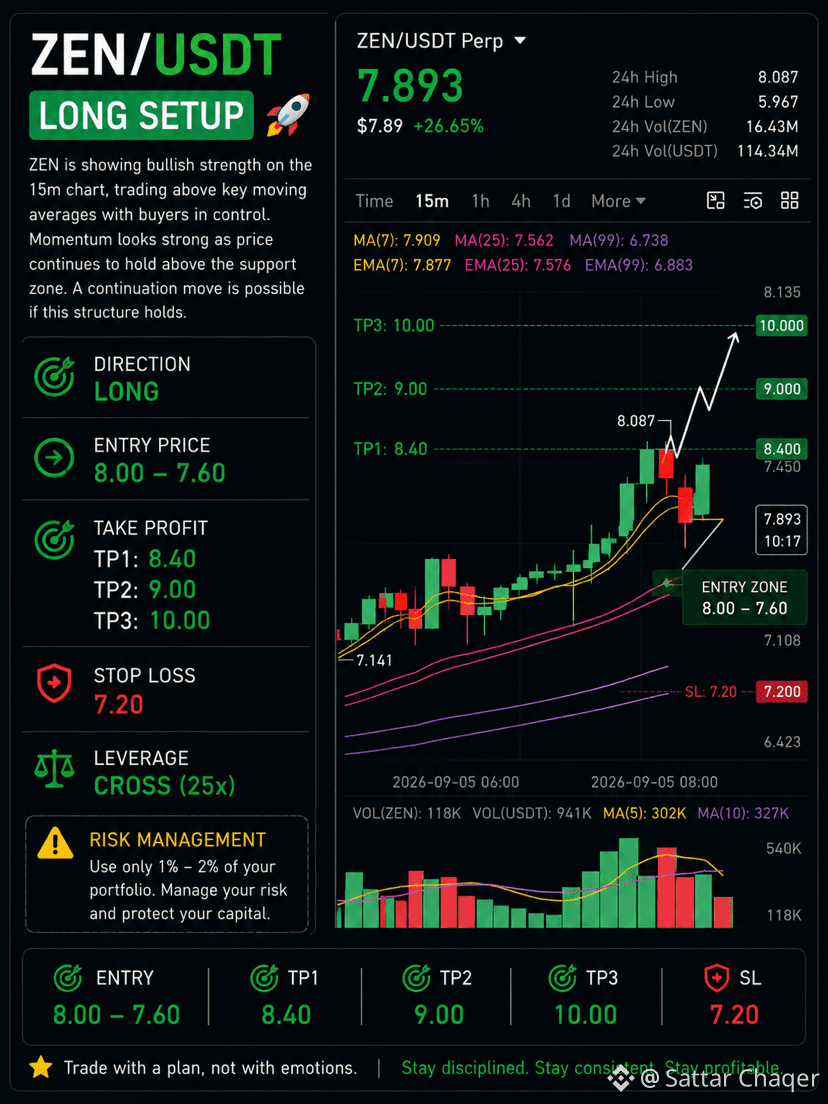
🟢 $ZEN /USDT — LONG | 25x CROSS
ZEN is holding above the short-term moving averages on the 15m chart, with price consolidating near $7.90 after reaching $8.087.
I’m watching the $8.00–$7.60 area for a continuation setup.
📌 ENTRY: $8.00 → $7.60
🚀 TP1: $8.55
🚀 TP2: $9.25
🚀 TP3: $10.20
🛑 SL: $7.20
⚡ LEVERAGE: Cross 25x
⚠️ RISK: Use only 1–2% of your portfolio.
If ZEN loses $7.60 with strong selling pressure, I’d rather wait than force the long.
{future}(ZENUSDT)
🟢 $ZEN /USDT — LONG | 25x CROSS
ZEN is holding above the short-term moving averages on the 15m chart, with price consolidating near $7.90 after reaching $8.087.
I’m watching the $8.00–$7.60 area for a continuation setup.
📌 ENTRY: $8.00 → $7.60
🚀 TP1: $8.55
🚀 TP2: $9.25
🚀 TP3: $10.20
🛑 SL: $7.20
⚡ LEVERAGE: Cross 25x
⚠️ RISK: Use only 1–2% of your portfolio.
If ZEN loses $7.60 with strong selling pressure, I’d rather wait than force the long.
ZEN is holding above the short-term moving averages on the 15m chart, with price consolidating near $7.90 after reaching $8.087.
I’m watching the $8.00–$7.60 area for a continuation setup.
📌 ENTRY: $8.00 → $7.60
🚀 TP1: $8.55
🚀 TP2: $9.25
🚀 TP3: $10.20
🛑 SL: $7.20
⚡ LEVERAGE: Cross 25x
⚠️ RISK: Use only 1–2% of your portfolio.
If ZEN loses $7.60 with strong selling pressure, I’d rather wait than force the long.
288
Tp 1 and tp 2 hits $EDU
{future}(EDUUSDT)
Tp 1 and tp 2 hits $EDU
Sattar Chaqer
·
--
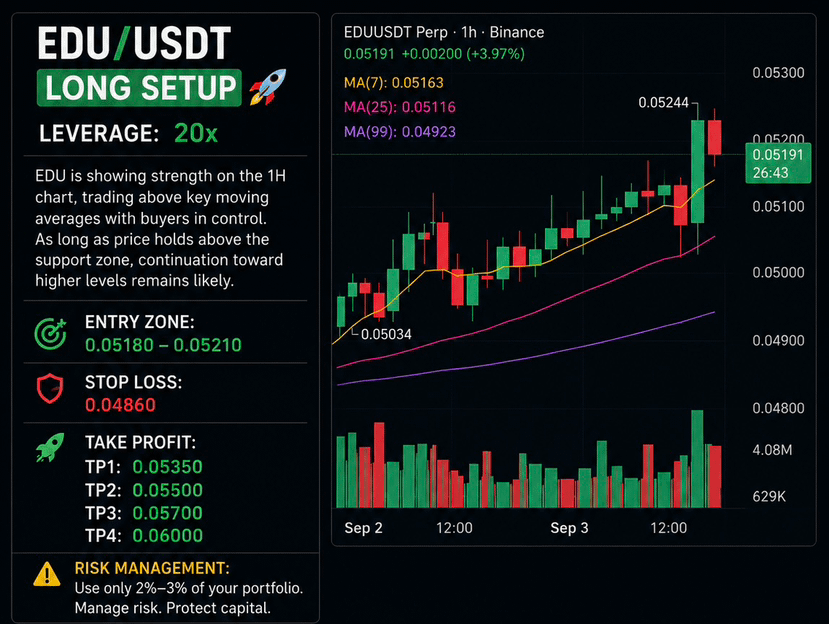
🚀 $EDU /USDT LONG | 20x
EDU is holding above the short-term moving averages on the 1H chart, with price still close to the recent 0.05244 high.
I’m watching the 0.05180–0.05210 zone for a long entry. If that area holds, the next levels I’m watching are:
🎯 Entry: 0.05180 – 0.05210
🔥 TP1: 0.05350
🔥 TP2: 0.05500
🔥 TP3: 0.05700
🔥 TP4: 0.06000
🛑 SL: 0.04860
⚡ Leverage: 20x
Keep the position size controlled. 20x leverage can move fast, so risk management matters more than chasing the entry.
Not financial advice. Trade with a plan.
EDU is holding above the short-term moving averages on the 1H chart, with price still close to the recent 0.05244 high.
I’m watching the 0.05180–0.05210 zone for a long entry. If that area holds, the next levels I’m watching are:
🎯 Entry: 0.05180 – 0.05210
🔥 TP1: 0.05350
🔥 TP2: 0.05500
🔥 TP3: 0.05700
🔥 TP4: 0.06000
🛑 SL: 0.04860
⚡ Leverage: 20x
Keep the position size controlled. 20x leverage can move fast, so risk management matters more than chasing the entry.
Not financial advice. Trade with a plan.
392
Go go lets go join here guys
Go go lets go join here guys
MrStar
·
--
[Replay] 🎙️ Cryto World Weekly Datas & Binance Square & Marvin
02 h 16 m 37 s · 4k listens
1
191
$FLOCK first TP1 HIT
{future}(FLOCKUSDT)
$FLOCK first TP1 HIT
Sattar Chaqer
·
--
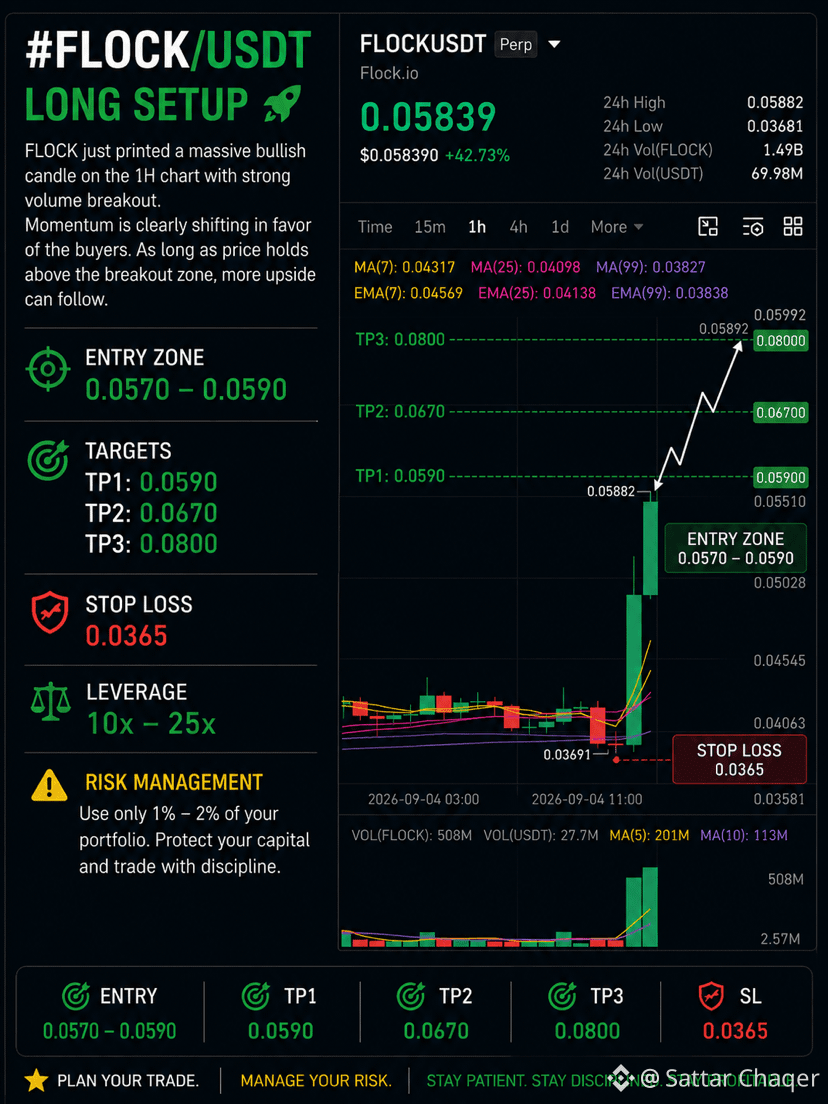
🟢 $FLOCK /USDT — LONG | 10–25x
FLOCK just broke out hard on the 1H chart, with a strong volume spike behind the move. Price is sitting near the recent high, so I’d rather wait for a pullback into the entry zone than chase the candle.
📌 ENTRY: 0.0570 → 0.0590
🎯 TP1: 0.0615
🎯 TP2: 0.0690
🎯 TP3: 0.0820
🛑 SL: 0.0500
⚡ LEVERAGE: 10–25x
⚠️ RISK: Use only 1–2% of your portfolio.
The breakout has momentum, but after a move this fast, the entry matters. If price loses the zone, I’d skip the setup.
FLOCK just broke out hard on the 1H chart, with a strong volume spike behind the move. Price is sitting near the recent high, so I’d rather wait for a pullback into the entry zone than chase the candle.
📌 ENTRY: 0.0570 → 0.0590
🎯 TP1: 0.0615
🎯 TP2: 0.0690
🎯 TP3: 0.0820
🛑 SL: 0.0500
⚡ LEVERAGE: 10–25x
⚠️ RISK: Use only 1–2% of your portfolio.
The breakout has momentum, but after a move this fast, the entry matters. If price loses the zone, I’d skip the setup.
298
🟢 $FLOCK /USDT — LONG | 10–25x
FLOCK just broke out hard on the 1H chart, with a strong volume spike behind the move. Price is sitting near the recent high, so I’d rather wait for a pullback into the entry zone than chase the candle.
📌 ENTRY: 0.0570 → 0.0590
🎯 TP1: 0.0615
🎯 TP2: 0.0690
🎯 TP3: 0.0820
🛑 SL: 0.0500
⚡ LEVERAGE: 10–25x
⚠️ RISK: Use only 1–2% of your portfolio.
The breakout has momentum, but after a move this fast, the entry matters. If price loses the zone, I’d skip the setup.
{future}(FLOCKUSDT)
🟢 $FLOCK /USDT — LONG | 10–25x
FLOCK just broke out hard on the 1H chart, with a strong volume spike behind the move. Price is sitting near the recent high, so I’d rather wait for a pullback into the entry zone than chase the candle.
📌 ENTRY: 0.0570 → 0.0590
🎯 TP1: 0.0615
🎯 TP2: 0.0690
🎯 TP3: 0.0820
🛑 SL: 0.0500
⚡ LEVERAGE: 10–25x
⚠️ RISK: Use only 1–2% of your portfolio.
The breakout has momentum, but after a move this fast, the entry matters. If price loses the zone, I’d skip the setup.
FLOCK just broke out hard on the 1H chart, with a strong volume spike behind the move. Price is sitting near the recent high, so I’d rather wait for a pullback into the entry zone than chase the candle.
📌 ENTRY: 0.0570 → 0.0590
🎯 TP1: 0.0615
🎯 TP2: 0.0690
🎯 TP3: 0.0820
🛑 SL: 0.0500
⚡ LEVERAGE: 10–25x
⚠️ RISK: Use only 1–2% of your portfolio.
The breakout has momentum, but after a move this fast, the entry matters. If price loses the zone, I’d skip the setup.
2
4
559
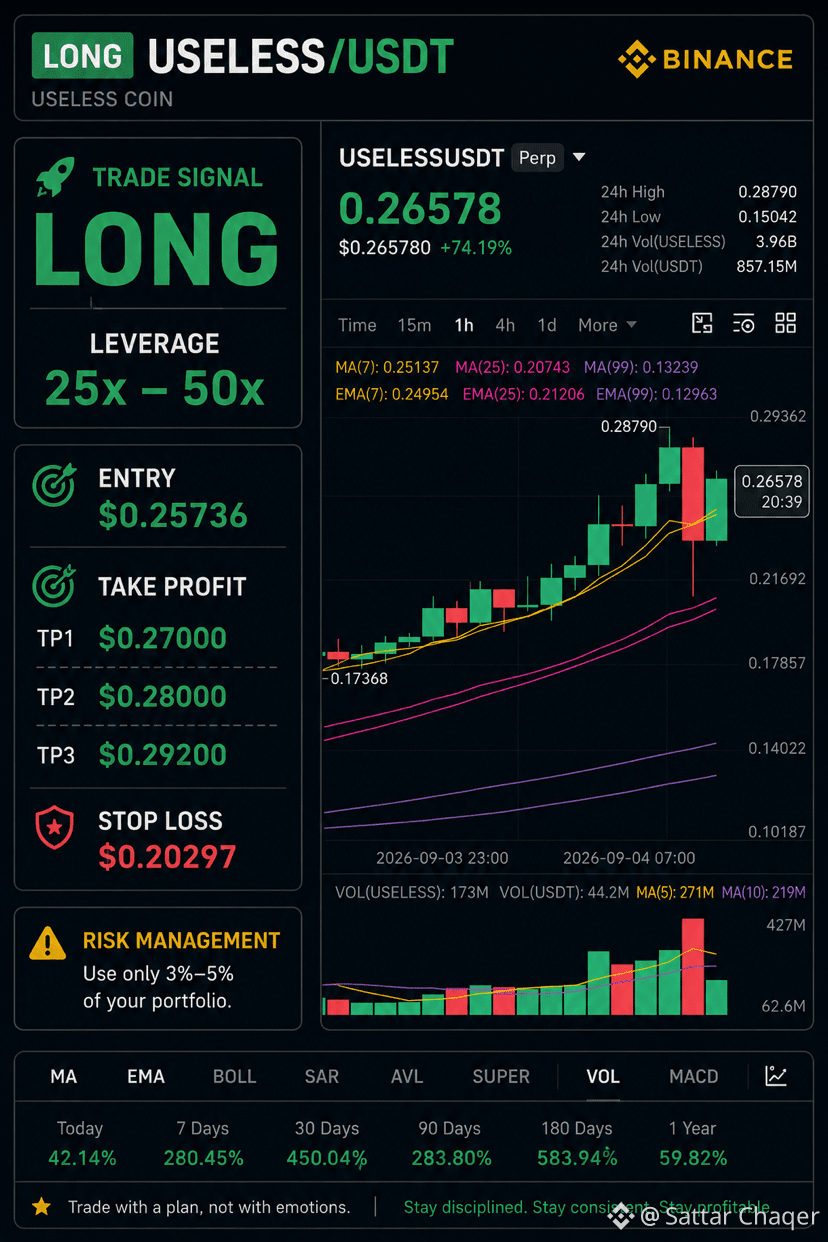
🟢 $USELESS /USDT — LONG | 25–50x
USELESS is holding above the short-term moving averages on the 1H chart after a strong move. Price is currently around $0.2658, with the recent high near $0.2879.
📌 ENTRY: $0.25736
🎯 TP1: $0.27000
🎯 TP2: $0.28000
🎯 TP3: $0.29200
🛑 SL: $0.20297
⚠️ RISK MANAGEMENT: Use only 3–5% of your portfolio.
Price has already moved hard, so I’d avoid chasing a breakout. The entry zone matters here.
{future}(USELESSUSDT)
🟢 $USELESS /USDT — LONG | 25–50x
USELESS is holding above the short-term moving averages on the 1H chart after a strong move. Price is currently around $0.2658, with the recent high near $0.2879.
📌 ENTRY: $0.25736
🎯 TP1: $0.27000
🎯 TP2: $0.28000
🎯 TP3: $0.29200
🛑 SL: $0.20297
⚠️ RISK MANAGEMENT: Use only 3–5% of your portfolio.
Price has already moved hard, so I’d avoid chasing a breakout. The entry zone matters here.
USELESS is holding above the short-term moving averages on the 1H chart after a strong move. Price is currently around $0.2658, with the recent high near $0.2879.
📌 ENTRY: $0.25736
🎯 TP1: $0.27000
🎯 TP2: $0.28000
🎯 TP3: $0.29200
🛑 SL: $0.20297
⚠️ RISK MANAGEMENT: Use only 3–5% of your portfolio.
Price has already moved hard, so I’d avoid chasing a breakout. The entry zone matters here.
1
390
TP 1 HITS
TP 1 HITS
Sattar Chaqer
·
--
🚀 $EDU /USDT LONG | 20x
EDU is holding above the short-term moving averages on the 1H chart, with price still close to the recent 0.05244 high.
I’m watching the 0.05180–0.05210 zone for a long entry. If that area holds, the next levels I’m watching are:
🎯 Entry: 0.05180 – 0.05210
🔥 TP1: 0.05350
🔥 TP2: 0.05500
🔥 TP3: 0.05700
🔥 TP4: 0.06000
🛑 SL: 0.04860
⚡ Leverage: 20x
Keep the position size controlled. 20x leverage can move fast, so risk management matters more than chasing the entry.
Not financial advice. Trade with a plan.
EDU is holding above the short-term moving averages on the 1H chart, with price still close to the recent 0.05244 high.
I’m watching the 0.05180–0.05210 zone for a long entry. If that area holds, the next levels I’m watching are:
🎯 Entry: 0.05180 – 0.05210
🔥 TP1: 0.05350
🔥 TP2: 0.05500
🔥 TP3: 0.05700
🔥 TP4: 0.06000
🛑 SL: 0.04860
⚡ Leverage: 20x
Keep the position size controlled. 20x leverage can move fast, so risk management matters more than chasing the entry.
Not financial advice. Trade with a plan.
1
217
All TP HITS
All TP HITS
Sattar Chaqer
·
--
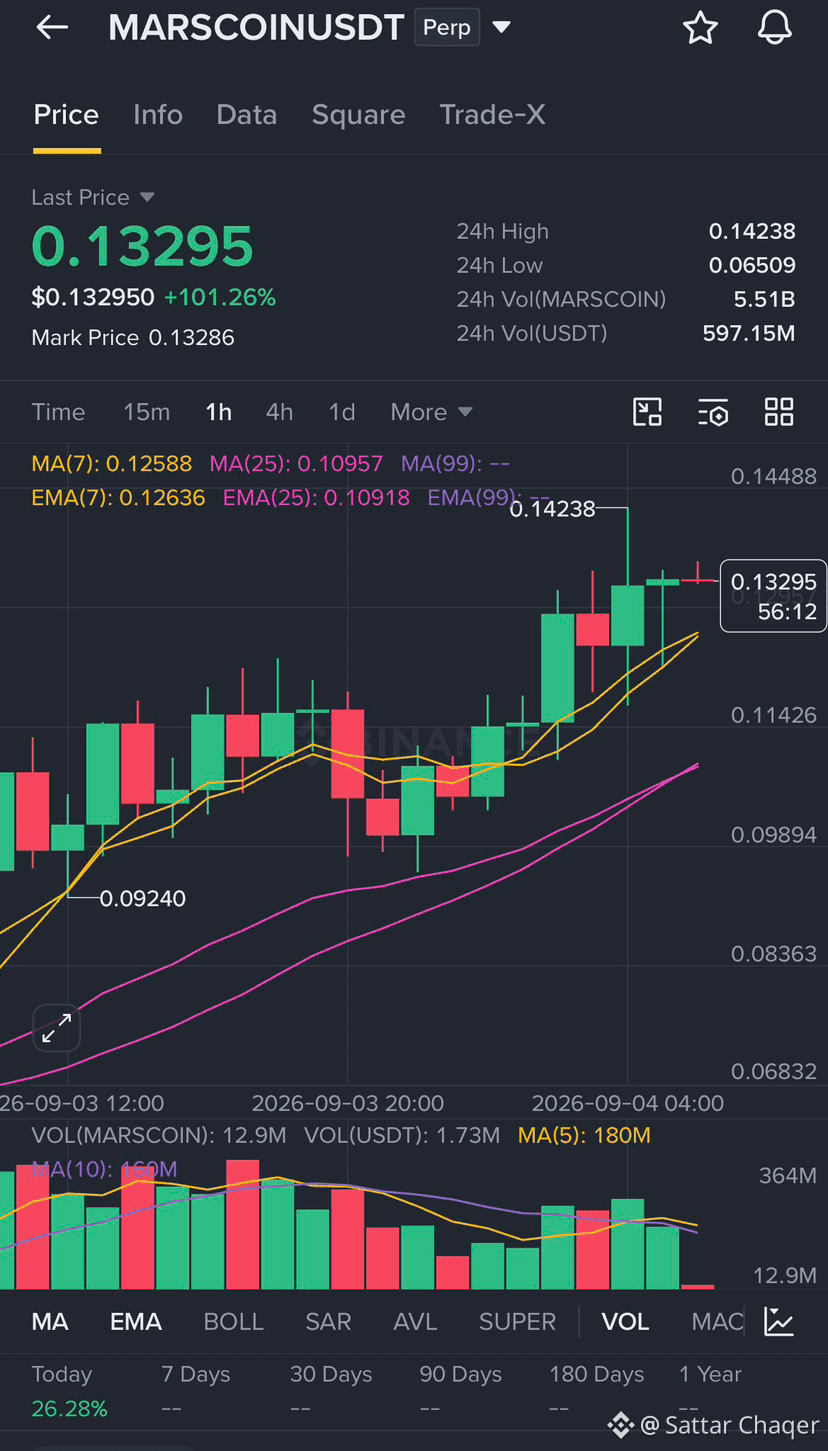
🚀 $MARSCOIN /USDT LONG | 25x
MARSCOIN is holding above the short-term moving averages on the 1H chart after a strong push higher. Price is now consolidating below the recent 0.12181 high.
I’m watching the 0.1100–0.1135 area for a long continuation setup.
🎯 ENTRY: 0.1100 → 0.1135
🚀 TP1: 0.1190
🚀 TP2: 0.1235
🚀 TP3: 0.1290
🛑 SL: 0.1035
⚡ LEVERAGE: 25x
⚠️ RISK MANAGEMENT: Use only 1% of your portfolio.
If price loses the entry zone with strong selling pressure, I’d avoid forcing the trade.
MARSCOIN is holding above the short-term moving averages on the 1H chart after a strong push higher. Price is now consolidating below the recent 0.12181 high.
I’m watching the 0.1100–0.1135 area for a long continuation setup.
🎯 ENTRY: 0.1100 → 0.1135
🚀 TP1: 0.1190
🚀 TP2: 0.1235
🚀 TP3: 0.1290
🛑 SL: 0.1035
⚡ LEVERAGE: 25x
⚠️ RISK MANAGEMENT: Use only 1% of your portfolio.
If price loses the entry zone with strong selling pressure, I’d avoid forcing the trade.
1
309
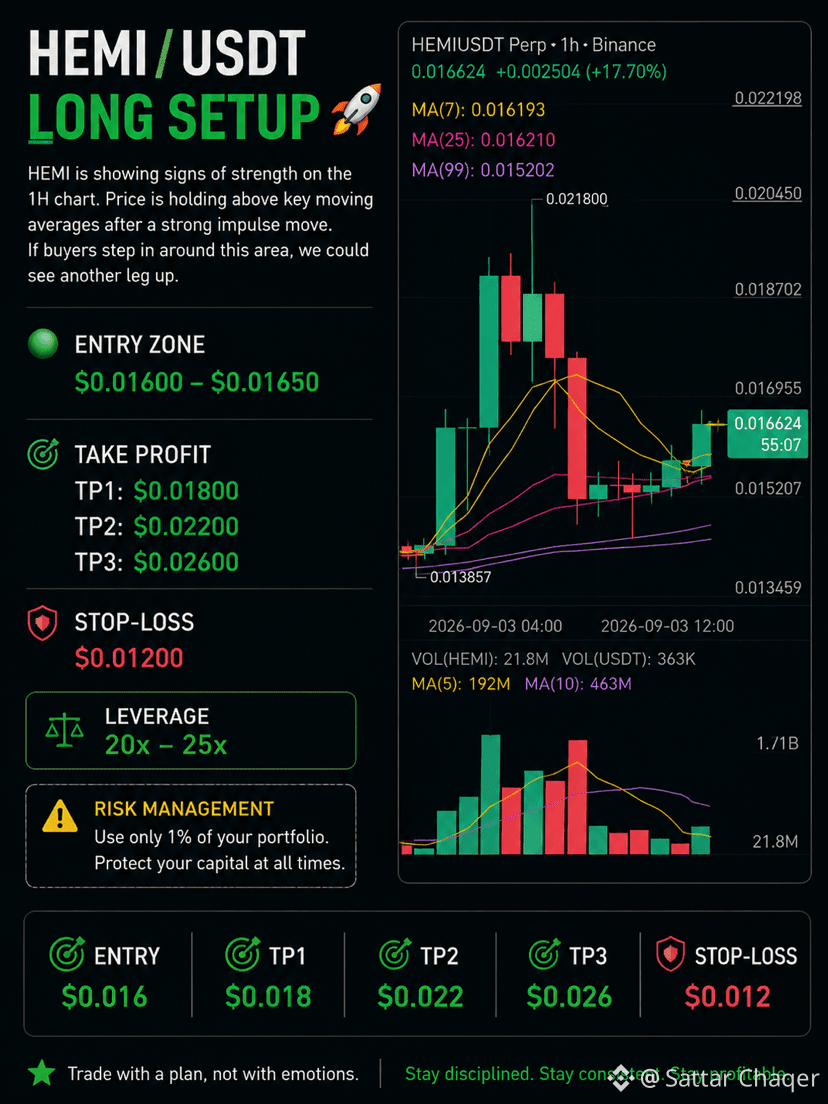
🟢 $HEMI /USDT — LONG
HEMI is holding around the $0.0160 area after the strong move earlier. On the 1H chart, price is still sitting around the short-term moving averages, so I’m watching this zone for another push higher.
📌 ENTRY: $0.01600 → $0.01650
🎯 TP1: $0.01800
🎯 TP2: $0.02200
🎯 TP3: $0.02600
🛑 SL: $0.01200
⚡ LEVERAGE: 20x–25x
⚠️ RISK MANAGEMENT: Use only 1% of your portfolio.
If HEMI loses the entry zone and selling volume picks up, I’d stay out instead of forcing the setup.
{future}(HEMIUSDT)
🟢 $HEMI /USDT — LONG
HEMI is holding around the $0.0160 area after the strong move earlier. On the 1H chart, price is still sitting around the short-term moving averages, so I’m watching this zone for another push higher.
📌 ENTRY: $0.01600 → $0.01650
🎯 TP1: $0.01800
🎯 TP2: $0.02200
🎯 TP3: $0.02600
🛑 SL: $0.01200
⚡ LEVERAGE: 20x–25x
⚠️ RISK MANAGEMENT: Use only 1% of your portfolio.
If HEMI loses the entry zone and selling volume picks up, I’d stay out instead of forcing the setup.
HEMI is holding around the $0.0160 area after the strong move earlier. On the 1H chart, price is still sitting around the short-term moving averages, so I’m watching this zone for another push higher.
📌 ENTRY: $0.01600 → $0.01650
🎯 TP1: $0.01800
🎯 TP2: $0.02200
🎯 TP3: $0.02600
🛑 SL: $0.01200
⚡ LEVERAGE: 20x–25x
⚠️ RISK MANAGEMENT: Use only 1% of your portfolio.
If HEMI loses the entry zone and selling volume picks up, I’d stay out instead of forcing the setup.
5
1.9k
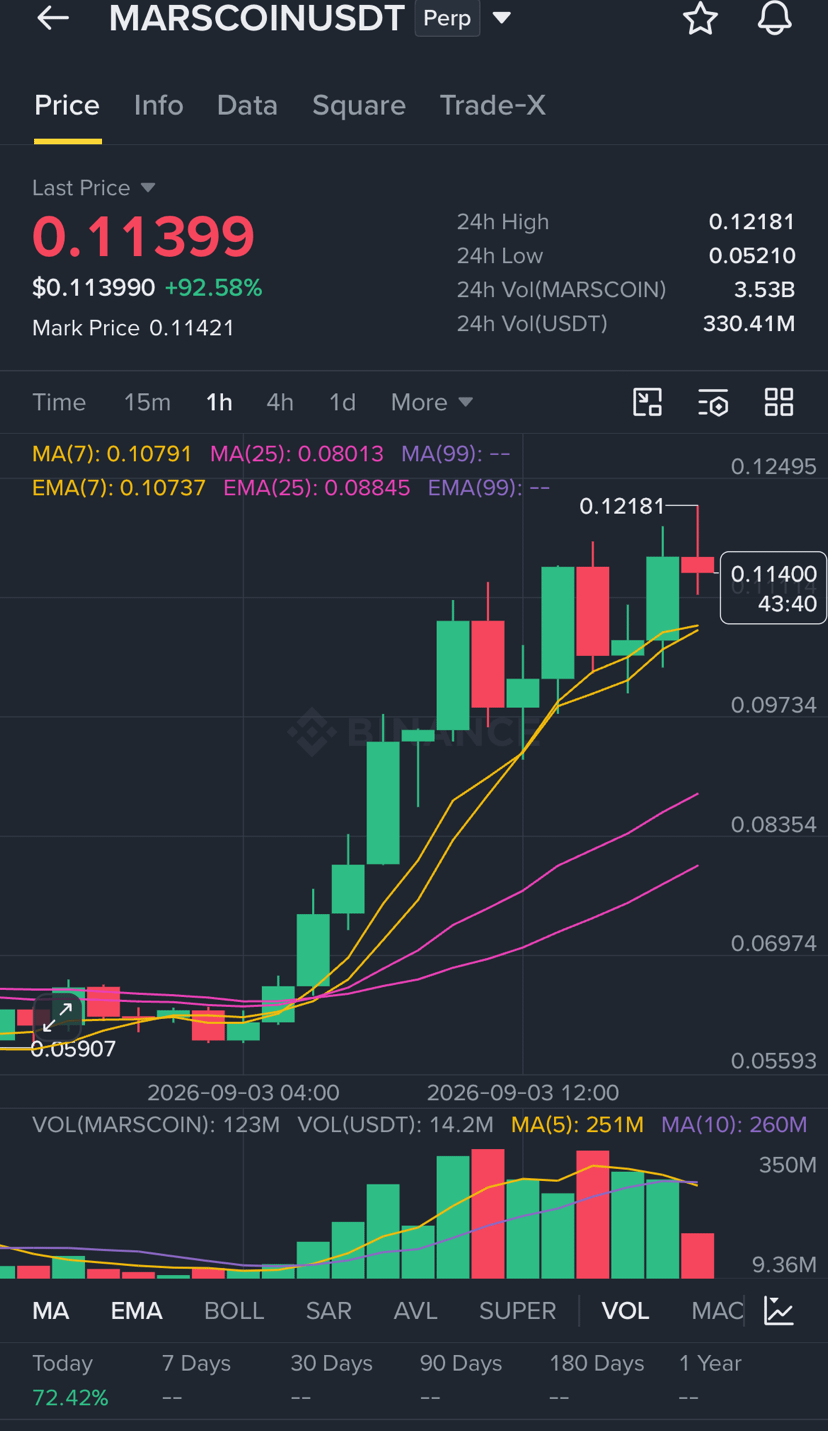
🚀 $MARSCOIN /USDT LONG | 25x
MARSCOIN is holding above the short-term moving averages on the 1H chart after a strong push higher. Price is now consolidating below the recent 0.12181 high.
I’m watching the 0.1100–0.1135 area for a long continuation setup.
🎯 ENTRY: 0.1100 → 0.1135
🚀 TP1: 0.1190
🚀 TP2: 0.1235
🚀 TP3: 0.1290
🛑 SL: 0.1035
⚡ LEVERAGE: 25x
⚠️ RISK MANAGEMENT: Use only 1% of your portfolio.
If price loses the entry zone with strong selling pressure, I’d avoid forcing the trade.
{future}(MARSCOINUSDT)
🚀 $MARSCOIN /USDT LONG | 25x
MARSCOIN is holding above the short-term moving averages on the 1H chart after a strong push higher. Price is now consolidating below the recent 0.12181 high.
I’m watching the 0.1100–0.1135 area for a long continuation setup.
🎯 ENTRY: 0.1100 → 0.1135
🚀 TP1: 0.1190
🚀 TP2: 0.1235
🚀 TP3: 0.1290
🛑 SL: 0.1035
⚡ LEVERAGE: 25x
⚠️ RISK MANAGEMENT: Use only 1% of your portfolio.
If price loses the entry zone with strong selling pressure, I’d avoid forcing the trade.
MARSCOIN is holding above the short-term moving averages on the 1H chart after a strong push higher. Price is now consolidating below the recent 0.12181 high.
I’m watching the 0.1100–0.1135 area for a long continuation setup.
🎯 ENTRY: 0.1100 → 0.1135
🚀 TP1: 0.1190
🚀 TP2: 0.1235
🚀 TP3: 0.1290
🛑 SL: 0.1035
⚡ LEVERAGE: 25x
⚠️ RISK MANAGEMENT: Use only 1% of your portfolio.
If price loses the entry zone with strong selling pressure, I’d avoid forcing the trade.
1
3
1.6k
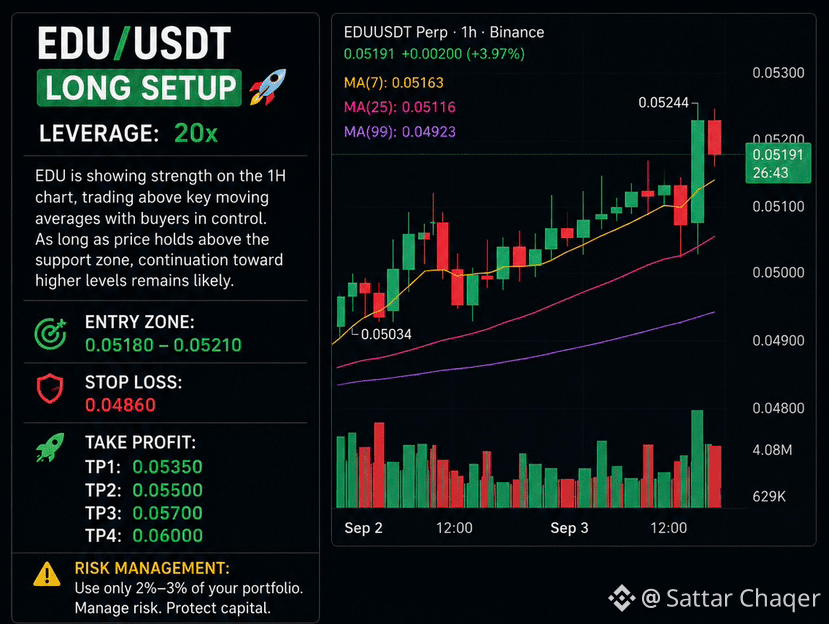
🚀 $EDU /USDT LONG | 20x
EDU is holding above the short-term moving averages on the 1H chart, with price still close to the recent 0.05244 high.
I’m watching the 0.05180–0.05210 zone for a long entry. If that area holds, the next levels I’m watching are:
🎯 Entry: 0.05180 – 0.05210
🔥 TP1: 0.05350
🔥 TP2: 0.05500
🔥 TP3: 0.05700
🔥 TP4: 0.06000
🛑 SL: 0.04860
⚡ Leverage: 20x
Keep the position size controlled. 20x leverage can move fast, so risk management matters more than chasing the entry.
Not financial advice. Trade with a plan.
{future}(EDUUSDT)
🚀 $EDU /USDT LONG | 20x
EDU is holding above the short-term moving averages on the 1H chart, with price still close to the recent 0.05244 high.
I’m watching the 0.05180–0.05210 zone for a long entry. If that area holds, the next levels I’m watching are:
🎯 Entry: 0.05180 – 0.05210
🔥 TP1: 0.05350
🔥 TP2: 0.05500
🔥 TP3: 0.05700
🔥 TP4: 0.06000
🛑 SL: 0.04860
⚡ Leverage: 20x
Keep the position size controlled. 20x leverage can move fast, so risk management matters more than chasing the entry.
Not financial advice. Trade with a plan.
EDU is holding above the short-term moving averages on the 1H chart, with price still close to the recent 0.05244 high.
I’m watching the 0.05180–0.05210 zone for a long entry. If that area holds, the next levels I’m watching are:
🎯 Entry: 0.05180 – 0.05210
🔥 TP1: 0.05350
🔥 TP2: 0.05500
🔥 TP3: 0.05700
🔥 TP4: 0.06000
🛑 SL: 0.04860
⚡ Leverage: 20x
Keep the position size controlled. 20x leverage can move fast, so risk management matters more than chasing the entry.
Not financial advice. Trade with a plan.
1
2
1
308
Verified
I used to think consensus was mostly about choosing the next block.
Dusk made me look at it differently.
With Succinct Attestation, a candidate block has to move through multiple stages before it becomes the new tip.
First comes Proposal, where a randomly selected provisioner generates and broadcasts a candidate block.
Then Validation. A committee checks the candidate against the current chain and votes on whether it is valid.
But Dusk doesn’t stop there.
A separate committee handles Ratification, voting on the result of the validation stage.
That separation is what caught my attention.
The network isn’t simply asking, “Do we have a block?”
It is asking whether the block is valid, whether that validation reached quorum, and whether another committee agrees with that outcome.
Only after successful ratification is the candidate accepted as the new tip.
That’s a very different way to think about consensus.
@Dusk_Foundation $DUSK #dusk
I used to think consensus was mostly about choosing the next block.
Dusk made me look at it differently.
With Succinct Attestation, a candidate block has to move through multiple stages before it becomes the new tip.
First comes Proposal, where a randomly selected provisioner generates and broadcasts a candidate block.
Then Validation. A committee checks the candidate against the current chain and votes on whether it is valid.
But Dusk doesn’t stop there.
A separate committee handles Ratification, voting on the result of the validation stage.
That separation is what caught my attention.
The network isn’t simply asking, “Do we have a block?”
It is asking whether the block is valid, whether that validation reached quorum, and whether another committee agrees with that outcome.
Only after successful ratification is the candidate accepted as the new tip.
That’s a very different way to think about consensus.
@Dusk $DUSK #dusk
Dusk made me look at it differently.
With Succinct Attestation, a candidate block has to move through multiple stages before it becomes the new tip.
First comes Proposal, where a randomly selected provisioner generates and broadcasts a candidate block.
Then Validation. A committee checks the candidate against the current chain and votes on whether it is valid.
But Dusk doesn’t stop there.
A separate committee handles Ratification, voting on the result of the validation stage.
That separation is what caught my attention.
The network isn’t simply asking, “Do we have a block?”
It is asking whether the block is valid, whether that validation reached quorum, and whether another committee agrees with that outcome.
Only after successful ratification is the candidate accepted as the new tip.
That’s a very different way to think about consensus.
@Dusk $DUSK #dusk
1
5
153
·
--
Bullish
Verified
What Reward Splitting Rules a Staking Contract Can Actually Set
Spent the afternoon tracing what a staking contract on Dusk is actually allowed to configure and i expected a fairly narrow set of options. it isn't narrow.
Dusk's own documentation on Stake Abstraction confirms contracts can implement arbitrary reward splitting rules routing a portion of rewards to referrers affiliates or operators entirely at the contract's own discretion. that's not a fixed protocol level percentage. that's a genuinely open configuration space.$BTR
thats the part that stuck.
give up protocol enforced simplicity in exchange for letting whoever deploys the contract decide how rewards actually get divided among the people using it. no standard split gets imposed from above.$TAC
But hold up i want to be precise about what i actually know here. Dusk names Sozu as the example of this pattern in practice an automated staking pool. What i haven't found documented anywhere is Sozu's current deployment status mainnet live testnet only or something in between. i won't guess at that.@Dusk_Foundation
Kept coming back to what this actually enables regardless of Sozu's specific status referral driven staking services operator fee models affiliate programs all technically possible without needing Dusk itself to build any of them.#dusk
So does open reward splitting create genuinely useful staking products or does it just shift the trust question from does Dusk's protocol treat me fairly to does this specific contract's operator treat me fairly?$DUSK
What Reward Splitting Rules a Staking Contract Can Actually Set
Spent the afternoon tracing what a staking contract on Dusk is actually allowed to configure and i expected a fairly narrow set of options. it isn't narrow.
Dusk's own documentation on Stake Abstraction confirms contracts can implement arbitrary reward splitting rules routing a portion of rewards to referrers affiliates or operators entirely at the contract's own discretion. that's not a fixed protocol level percentage. that's a genuinely open configuration space.$BTR
thats the part that stuck.
give up protocol enforced simplicity in exchange for letting whoever deploys the contract decide how rewards actually get divided among the people using it. no standard split gets imposed from above.$TAC
But hold up i want to be precise about what i actually know here. Dusk names Sozu as the example of this pattern in practice an automated staking pool. What i haven't found documented anywhere is Sozu's current deployment status mainnet live testnet only or something in between. i won't guess at that.@Dusk
Kept coming back to what this actually enables regardless of Sozu's specific status referral driven staking services operator fee models affiliate programs all technically possible without needing Dusk itself to build any of them.#dusk
So does open reward splitting create genuinely useful staking products or does it just shift the trust question from does Dusk's protocol treat me fairly to does this specific contract's operator treat me fairly?$DUSK
Spent the afternoon tracing what a staking contract on Dusk is actually allowed to configure and i expected a fairly narrow set of options. it isn't narrow.
Dusk's own documentation on Stake Abstraction confirms contracts can implement arbitrary reward splitting rules routing a portion of rewards to referrers affiliates or operators entirely at the contract's own discretion. that's not a fixed protocol level percentage. that's a genuinely open configuration space.$BTR
thats the part that stuck.
give up protocol enforced simplicity in exchange for letting whoever deploys the contract decide how rewards actually get divided among the people using it. no standard split gets imposed from above.$TAC
But hold up i want to be precise about what i actually know here. Dusk names Sozu as the example of this pattern in practice an automated staking pool. What i haven't found documented anywhere is Sozu's current deployment status mainnet live testnet only or something in between. i won't guess at that.@Dusk
Kept coming back to what this actually enables regardless of Sozu's specific status referral driven staking services operator fee models affiliate programs all technically possible without needing Dusk itself to build any of them.#dusk
So does open reward splitting create genuinely useful staking products or does it just shift the trust question from does Dusk's protocol treat me fairly to does this specific contract's operator treat me fairly?$DUSK
Useful flexibility
100%
New trust question
0%
1 votes • Voting closed
1
5
521
·
--
Bearish
Verified
Privacy isn’t just about hiding the amount.
What I found interesting in Phoenix is that it also tries to make transactions harder to connect.
Phoenix uses notes stored in a Merkle tree. Each note has its own note public key.
Instead of using the same public key again and again Phoenix creates a one time note public key for each note.
That stood out to me because reusing the same identifier could make it easier to connect different transactions to the same user.$GRASS
The whitepaper says this one time key is designed to provide unlinkability between transactions.$UAI
There’s another part I found interesting.
The recipient can use a view key to check whether a note belongs to them while the secret key needed to spend that note can only be derived using their full secret key.
So the privacy idea here isn’t simply hide everything.
It’s more about controlling what can be connected publicly.
That made me look at Phoenix differently.
A private transaction is one thing.
Making it harder for someone to look at several transactions and connect them together is another.
And honestly that second part might be just as important.
@Dusk_Foundation $DUSK #dusk
What matters most for privacy?
Privacy isn’t just about hiding the amount.
What I found interesting in Phoenix is that it also tries to make transactions harder to connect.
Phoenix uses notes stored in a Merkle tree. Each note has its own note public key.
Instead of using the same public key again and again Phoenix creates a one time note public key for each note.
That stood out to me because reusing the same identifier could make it easier to connect different transactions to the same user.$GRASS
The whitepaper says this one time key is designed to provide unlinkability between transactions.$UAI
There’s another part I found interesting.
The recipient can use a view key to check whether a note belongs to them while the secret key needed to spend that note can only be derived using their full secret key.
So the privacy idea here isn’t simply hide everything.
It’s more about controlling what can be connected publicly.
That made me look at Phoenix differently.
A private transaction is one thing.
Making it harder for someone to look at several transactions and connect them together is another.
And honestly that second part might be just as important.
@Dusk $DUSK #dusk
What matters most for privacy?
What I found interesting in Phoenix is that it also tries to make transactions harder to connect.
Phoenix uses notes stored in a Merkle tree. Each note has its own note public key.
Instead of using the same public key again and again Phoenix creates a one time note public key for each note.
That stood out to me because reusing the same identifier could make it easier to connect different transactions to the same user.$GRASS
The whitepaper says this one time key is designed to provide unlinkability between transactions.$UAI
There’s another part I found interesting.
The recipient can use a view key to check whether a note belongs to them while the secret key needed to spend that note can only be derived using their full secret key.
So the privacy idea here isn’t simply hide everything.
It’s more about controlling what can be connected publicly.
That made me look at Phoenix differently.
A private transaction is one thing.
Making it harder for someone to look at several transactions and connect them together is another.
And honestly that second part might be just as important.
@Dusk $DUSK #dusk
What matters most for privacy?
🕵️ Unlinkable transactions
100%
👁️ Hidden amounts
0%
2 votes • Voting closed
3
3
1.5k
Verified
Sending every blockchain message to everyone sounds safe. It also sounds incredibly wasteful.
That’s what made Kadcast interesting when I went through Dusk’s whitepaper.
Dusk uses Kadcast to broadcast blocks transactions and consensus votes. Instead of simply flooding every neighboring node with the same message Kadcast organizes nodes using ideas from Kademlia.
Each node keeps routing information grouped into buckets based on the XOR distance between node IDs.
Then the propagation gets more selective.
A node forwards a message to selected peers at increasing XOR distances. Those peers continue the process creating a structured cascade across the network.
Kadcast also uses multicast trees. A message starts with nearby peers which then pass it toward nodes farther away in the network. This lets the network cover its nodes with fewer relays instead of repeatedly sending the same information through unnecessary paths.$TUT
That distinction caught my attention because blockchain networking can become expensive when every node keeps forwarding everything to every neighbor.
The point isn’t just making messages move quickly.
It is reducing redundant transmissions while maintaining reliable and timely propagation.
I like this because it shows that blockchain performance isn’t only about consensus or block production.$PUMP
The network has to move information efficiently too.
Sometimes the smarter design isn’t sending more messages.
It’s knowing which nodes actually need to receive them.
@Dusk_Foundation $DUSK #dusk
What makes Kadcast efficient?
Sending every blockchain message to everyone sounds safe. It also sounds incredibly wasteful.
That’s what made Kadcast interesting when I went through Dusk’s whitepaper.
Dusk uses Kadcast to broadcast blocks transactions and consensus votes. Instead of simply flooding every neighboring node with the same message Kadcast organizes nodes using ideas from Kademlia.
Each node keeps routing information grouped into buckets based on the XOR distance between node IDs.
Then the propagation gets more selective.
A node forwards a message to selected peers at increasing XOR distances. Those peers continue the process creating a structured cascade across the network.
Kadcast also uses multicast trees. A message starts with nearby peers which then pass it toward nodes farther away in the network. This lets the network cover its nodes with fewer relays instead of repeatedly sending the same information through unnecessary paths.$TUT
That distinction caught my attention because blockchain networking can become expensive when every node keeps forwarding everything to every neighbor.
The point isn’t just making messages move quickly.
It is reducing redundant transmissions while maintaining reliable and timely propagation.
I like this because it shows that blockchain performance isn’t only about consensus or block production.$PUMP
The network has to move information efficiently too.
Sometimes the smarter design isn’t sending more messages.
It’s knowing which nodes actually need to receive them.
@Dusk $DUSK #dusk
What makes Kadcast efficient?
That’s what made Kadcast interesting when I went through Dusk’s whitepaper.
Dusk uses Kadcast to broadcast blocks transactions and consensus votes. Instead of simply flooding every neighboring node with the same message Kadcast organizes nodes using ideas from Kademlia.
Each node keeps routing information grouped into buckets based on the XOR distance between node IDs.
Then the propagation gets more selective.
A node forwards a message to selected peers at increasing XOR distances. Those peers continue the process creating a structured cascade across the network.
Kadcast also uses multicast trees. A message starts with nearby peers which then pass it toward nodes farther away in the network. This lets the network cover its nodes with fewer relays instead of repeatedly sending the same information through unnecessary paths.$TUT
That distinction caught my attention because blockchain networking can become expensive when every node keeps forwarding everything to every neighbor.
The point isn’t just making messages move quickly.
It is reducing redundant transmissions while maintaining reliable and timely propagation.
I like this because it shows that blockchain performance isn’t only about consensus or block production.$PUMP
The network has to move information efficiently too.
Sometimes the smarter design isn’t sending more messages.
It’s knowing which nodes actually need to receive them.
@Dusk $DUSK #dusk
What makes Kadcast efficient?
🌐 Selective propagation
0%
🔁 More message flooding
100%
1 votes • Voting closed
2
8
576
The market is bringing some interesting names again. $TRUMP $BEAT Both are getting plenty of attention on the chart. At this point I’m just trying to figure out how everyone finds these moves before I do.
I used to think a failed smart contract call was basically just an error.
But the more I looked at DuskVM the more interesting the failure path became.
Before execution gets underway Dusk checks things like the sender’s balance signature and nonce. If those basic conditions fail the transaction doesn’t get to execute normally.
But what happens when something goes wrong during execution?
That’s the part I find more important.
A smart contract can make state changes while running but a failed call doesn’t simply leave those changes sitting there. The state changes from that failed execution are not committed.
So you don’t end up with a contract stuck halfway between its old state and an incomplete new one.
Gas matters here too. Contract execution consumes gas which means failure isn’t just about whether the final result was successful. There are still execution resources involved along the way.
That made me rethink what safe execution actually means.
It isn’t only about making successful transactions work.
It’s also about having predictable behavior when execution fails.
For financial applications that distinction matters. A system handling valuable assets needs to know what happens when the expected path breaks.
Sometimes the most important part of a smart contract isn’t what happens when everything goes right.
It’s what the network does when it doesn’t.
@Dusk_Foundation $DUSK #dusk
What matters most when calls fail?
The market is bringing some interesting names again. $TRUMP $BEAT Both are getting plenty of attention on the chart. At this point I’m just trying to figure out how everyone finds these moves before I do.
I used to think a failed smart contract call was basically just an error.
But the more I looked at DuskVM the more interesting the failure path became.
Before execution gets underway Dusk checks things like the sender’s balance signature and nonce. If those basic conditions fail the transaction doesn’t get to execute normally.
But what happens when something goes wrong during execution?
That’s the part I find more important.
A smart contract can make state changes while running but a failed call doesn’t simply leave those changes sitting there. The state changes from that failed execution are not committed.
So you don’t end up with a contract stuck halfway between its old state and an incomplete new one.
Gas matters here too. Contract execution consumes gas which means failure isn’t just about whether the final result was successful. There are still execution resources involved along the way.
That made me rethink what safe execution actually means.
It isn’t only about making successful transactions work.
It’s also about having predictable behavior when execution fails.
For financial applications that distinction matters. A system handling valuable assets needs to know what happens when the expected path breaks.
Sometimes the most important part of a smart contract isn’t what happens when everything goes right.
It’s what the network does when it doesn’t.
@Dusk $DUSK #dusk
What matters most when calls fail?
I used to think a failed smart contract call was basically just an error.
But the more I looked at DuskVM the more interesting the failure path became.
Before execution gets underway Dusk checks things like the sender’s balance signature and nonce. If those basic conditions fail the transaction doesn’t get to execute normally.
But what happens when something goes wrong during execution?
That’s the part I find more important.
A smart contract can make state changes while running but a failed call doesn’t simply leave those changes sitting there. The state changes from that failed execution are not committed.
So you don’t end up with a contract stuck halfway between its old state and an incomplete new one.
Gas matters here too. Contract execution consumes gas which means failure isn’t just about whether the final result was successful. There are still execution resources involved along the way.
That made me rethink what safe execution actually means.
It isn’t only about making successful transactions work.
It’s also about having predictable behavior when execution fails.
For financial applications that distinction matters. A system handling valuable assets needs to know what happens when the expected path breaks.
Sometimes the most important part of a smart contract isn’t what happens when everything goes right.
It’s what the network does when it doesn’t.
@Dusk $DUSK #dusk
What matters most when calls fail?
🔄 State rollback
67%
⛽ Gas handling
33%
9 votes • Voting closed
5
9
1.8k
The charts are getting harder to ignore.$HEMI $ONG $ENA
Three names making some serious noise.
And somehow I’m still sitting here thinking Maybe I should’ve been watching these earlier.
One thing that stands out about TermMax Alpha is how clearly it defines the downside before a position begins.
In Alpha a Long position means buying a call while a Short position means buying a put.
In both cases you pay the premium upfront.
And that premium is what TermMax calls Max Cost the upfront amount paid and the maximum possible loss of the position.
That creates an interesting way to think about options.
You can be wrong about the market direction. The position can lose value. But you already know the maximum amount you can lose before entering the trade.
There’s no need to guess how large the downside could become.
The risk is defined from the beginning.
That doesn’t remove market risk of course. It simply makes the downside easier to understand.
And that’s the part I find interesting about Alpha.
The product isn’t only giving users exposure to a potential price move.
It also gives them a clearly defined cost for taking that exposure.
For me that changes the question from How much could I lose? to Am I comfortable with the maximum cost before I enter?
That distinction makes options much easier to evaluate.
@termmax #TermMax
What makes Alpha interesting?
The charts are getting harder to ignore.$HEMI $ONG $ENA
Three names making some serious noise.
And somehow I’m still sitting here thinking Maybe I should’ve been watching these earlier.
One thing that stands out about TermMax Alpha is how clearly it defines the downside before a position begins.
In Alpha a Long position means buying a call while a Short position means buying a put.
In both cases you pay the premium upfront.
And that premium is what TermMax calls Max Cost the upfront amount paid and the maximum possible loss of the position.
That creates an interesting way to think about options.
You can be wrong about the market direction. The position can lose value. But you already know the maximum amount you can lose before entering the trade.
There’s no need to guess how large the downside could become.
The risk is defined from the beginning.
That doesn’t remove market risk of course. It simply makes the downside easier to understand.
And that’s the part I find interesting about Alpha.
The product isn’t only giving users exposure to a potential price move.
It also gives them a clearly defined cost for taking that exposure.
For me that changes the question from How much could I lose? to Am I comfortable with the maximum cost before I enter?
That distinction makes options much easier to evaluate.
@TermMax #TermMax
What makes Alpha interesting?
Three names making some serious noise.
And somehow I’m still sitting here thinking Maybe I should’ve been watching these earlier.
One thing that stands out about TermMax Alpha is how clearly it defines the downside before a position begins.
In Alpha a Long position means buying a call while a Short position means buying a put.
In both cases you pay the premium upfront.
And that premium is what TermMax calls Max Cost the upfront amount paid and the maximum possible loss of the position.
That creates an interesting way to think about options.
You can be wrong about the market direction. The position can lose value. But you already know the maximum amount you can lose before entering the trade.
There’s no need to guess how large the downside could become.
The risk is defined from the beginning.
That doesn’t remove market risk of course. It simply makes the downside easier to understand.
And that’s the part I find interesting about Alpha.
The product isn’t only giving users exposure to a potential price move.
It also gives them a clearly defined cost for taking that exposure.
For me that changes the question from How much could I lose? to Am I comfortable with the maximum cost before I enter?
That distinction makes options much easier to evaluate.
@TermMax #TermMax
What makes Alpha interesting?
🔒 Defined downside
57%
📈 Market exposure
43%
7 votes • Voting closed
1
4
2.1k
Log in to explore more content
Join global crypto users on Binance Square
⚡️ Get latest and useful information about crypto.
💬 Trusted by the world’s largest crypto exchange.
👍 Discover real insights from verified creators.
Email / Phone number
Trending Topics
AppleDebutsFoldablePhone
18,090 views
368 Discussing
Apple just dropped the foldable iPhone — and the market is paying attention. This isn't just another product cycle; it's a new product category, a new CEO on stage, and a $1,999 price tag that pushes $AAPL further into ultra-premium territory. Foldables are the narrative, and Apple is now the headline.
#appledebutsfoldablephone #EUExtendsCentralContactPointToCASPs #US10YTreasuryYieldHitsHighestSinceNov2023 #BrentCrudeTops$100 #USTreasuryToBuyBackUpTo$6BLongDatedDebt
KimHotbae
·1 Likes
·1.7k views
IranSaysReadyToEscalateWarWithUS
35 views
7 Discussing
EUExtendsCentralContactPointToCASPs
3,360 views
112 Discussing