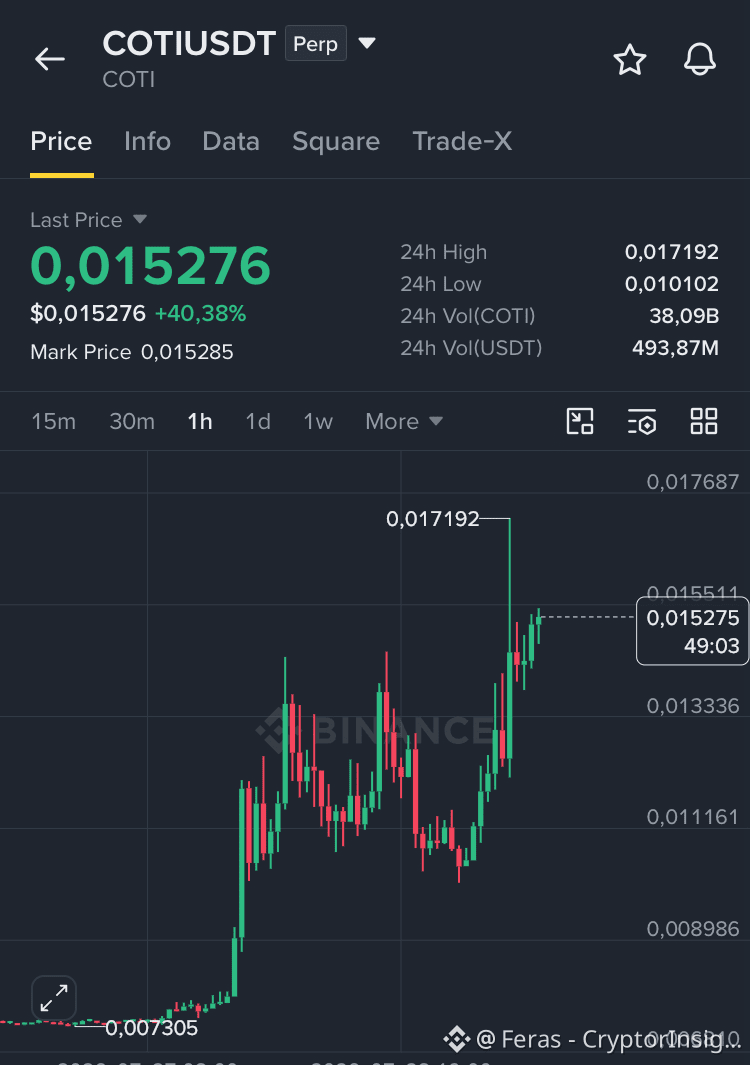
Dear legends, The mission is ACCOMPLISHED. ✅✅ I am satisfied with $USTC these results. The price might drop further to 0.011 or lower, but we do not get greedy. Action: CLOSE the position. Secure the 400% profit. Next Step: Cash out and wait for the next setup. We don't need to catch every last pip. We bank the win and move on. Great work team! 💸💸
PARABOLIC MOVE! 💡📈 Bitlight $LIGHT is defying gravity! Up another +39% today, trading at $3.76. We identified this strength early.m💰💸 The trend is vertical. Do not short this! Take profit along the way, but keep a moonbag. This is the star of the week! ⭐ #light #Bitlight #TradingSignals
CryptorInsight
--
Бичи
$LIGHT is flashing a major signal on my radar! 🚨🚨 {future}(LIGHTUSDT) Trading at $1.54 with a +24% gain, this token is waking up from a long accumulation phase. When high-priced tokens like Bitlight $LIGHT start moving, they tend to move fast and hard.
I spot a "Cup and Handle" breakout on the 4H timeframe. The measured move for this pattern targets $2.00+. If you missed the bottom, do not worry the breakout entry is here. Let's catch this light!
UNSTOPPABLE! 🧬🚀 Humanity Protocol $H has smashed another target! Currently trading at $0.144, up +24% today. If you entered on our first call at $0.076, you are nearly up 100% (2x)! 💰💰 This is how we beat the market. Trail your stop loss to $0.13 to lock in those massive gains. We are printing! 🖨️ #H #HumanityProtocol #100xgems
CryptorInsight
--
Бичи
$H Humanity Protocol The Bottom Fish 🟢 LONG
🟢 $H Entry: 0.074 – 0.076
🎯 T1: 0.088 🎯 T2: 0.105 ❌ SL: < 0.068 {future}(HUSDT) Why: We are buying the confirmation of support. The RSI has reset from oversold levels and is pointing up. The risk is very low because our Stop Loss is just below the recent accumulation zone. High reward potential here. 💎
🎯 T1: 0.105 🎯 T2: 0.125 ❌ SL: < 0.078 Why: Breakout confirmation with volume. The market structure has shifted from accumulation to expansion. We are buying the start of the markup phase. 📈💎
Dear friends The night is darkest just before the dawn!
Midnight $NIGHT is surging again, up +32% at $0.090. We have been tracking this gem, and it is finally breaking its resistance at $0.085. The volume has jumped to $121 Million. This indicates that whales are accumulating for the next leg up. With the AI/Privacy narrative heating up, $NIGHT is positioned perfectly for a run to $0.12.
Dear friends Let's address the King $BTC We are currently in a Technical Standoff Price is holding above the critical $88k support, but we are seeing a bearish MACD crossover. This signals weakening momentum in the short term. 📉
The news is reporting nearly $500M in net outflows from US Spot ETFs this week. This institutional selling is capping our upside potential for now. The "Fear & Greed" index is at 27 (Fear), and we've seen $194M in liquidations.
My Strategy: Bitcoin is in a consolidation phase. I am not aggressively longing BTC here. Instead, I am earning yield (up to 2.5% APR) via staking and focusing ALL my attention on high momentum Altcoins that are decoupling from $BTC . Volatility is high, so keep leverage low!
My friend, welcome to another day of navigating the crypto jungle!
The market is showing a clear divergence While Bitcoin is struggling with institutional pressure, the Altcoins is heating up for specific narratives! I have analyzed the provided text and the latest charts. Superfortune $GUA and AS Roma $ASR are the new breakout stars. And look at our previous calls Humanity Protocol $H has exploded to $0.144 (+24%) and Bitlight LIGHT is essentially going vertical at $3.76!
Why Kite AI Is the Economic Rocket Fuel AI Agents Have Been Waiting For
Have you ever stopped to think what the world looks like when AI agents aren’t just chatting with us or generating pictures — but actually running their own economies? I’m talking thousands, maybe millions, of autonomous agents negotiating deals, paying for data, voting on proposals, hiring other agents, all without a human in the loop. It sounds like sci-fi, but we’re already seeing the early versions: dev teams building agent swarms, researchers deploying AI that books its own cloud compute, traders letting models execute strategies end-to-end. The bottleneck isn’t the intelligence anymore. It’s the economy. How do these agents hold value? How do they pay each other securely, instantly, at scale? How do they prove who they are without getting spoofed or drained? That’s where @KITE AI comes in — and why I’m genuinely pumped about it. Kite AI isn’t just another Layer 1 chasing TPS bragging rights. It’s the first blockchain explicitly designed as the payment and identity layer for autonomous AI agents. Think of it as the economic operating system for the agentic future. Most blockchains today were built for humans. Wallets assume you’ll remember seed phrases, transactions are batched because humans don’t make 100 payments per second, governance is slow because people need time to read proposals. AI agents break all those assumptions. An agent might spin up, complete a task, earn tokens, pay subcontractors, and shut down — all in minutes. It needs identity that can’t be faked, payments that settle in milliseconds for fractions of a cent, governance that can handle thousands of votes per hour. Kite AI solves this with a purpose-built stack: • Agent-native identity: Every agent gets a verifiable on-chain identity tied to its creator and behavior history. No more “who is this random bot paying me?” problems. • Micro-payment channels optimized for agent volume: Think Lightning-level speed but tuned for millions of tiny, frequent transfers. • Programmable governance primitives: Agents can stake, delegate, or vote automatically based on predefined rules — no Discord spam needed. • Verification oracles: Built-in mechanisms to confirm an agent actually completed a task before payment releases. • Scalable execution: High throughput without the gas wars that would bankrupt tiny agent budgets. I know what some of you are thinking — “another chain promising scalability, seen this movie before.” Fair. But Kite isn’t trying to be everything to everyone. It’s laser-focused on being the economic backbone for agents. That narrow focus is its superpower. Let me paint a picture of what this unlocks. Imagine you’re a freelance designer in 2026. You deploy an AI agent that scours the web for client leads, negotiates rates, creates mockups, iterates based on feedback, and delivers finals. The client doesn’t even talk to you — their own procurement agent negotiates with yours. Your agent gets paid in $KITE , instantly converts a portion to pay for GPU time from a compute provider’s agent, tips a research agent for market data, and stakes the rest in a yield pool run by yet another agent collective. All of this happens seamlessly because every participant trusts the underlying identity and payment rails — Kite AI. Or think about decentralized physical operations: delivery drones (agents) negotiating landing rights with building agents, paying micro-fees for airspace, coordinating with warehouse agents for pickup. The efficiency gains are insane. We’re already seeing the agent explosion. Projects like Virtuals, Aixbt, and others are building agent frameworks. OpenAI and Anthropic keep dropping more powerful models. The compute layer is scaling fast. What’s missing is the economic layer that lets these agents actually own and move value independently. Kite AI fills that gap. And because it’s built from the ground up for this use case, it has a real shot at becoming the default settlement layer — like how Ethereum became DeFi’s home or Solana grabbed memecoins. The network effects here could be brutal in the best way. The more agents use Kite for identity and payments, the more valuable it becomes for new agents to join. The more developer tools and templates emerge, the faster adoption snowballs. I’ve been in crypto since 2017. I’ve watched narratives come and go — ICOs, DeFi summer, NFTs, play-to-earn, you name it. But the AI agent narrative feels different. It’s not just speculation; it’s inevitable infrastructure. Every major tech company is racing to build agents. Every vertical will eventually have agent workflows. And every one of those agents will need to transact. That’s why I’m so bullish on Kite AI specifically. It’s not riding the wave — it’s building the pipes that make the wave possible. We’re still early. Most people haven’t even realized the agent economy is coming, let alone thought about its plumbing requirements. That means massive upside for projects solving the real problems. If you’re building agents, you should be looking at Kite’s dev docs. If you’re investing in the AI x crypto intersection, this belongs on your radar. What do you think the first breakout agent use case will be? Personal assistants managing finances? Automated research marketplaces? On-chain trading swarms? Drop your predictions below — best ones get a repost. Let’s build this future together. #KITE $KITE
Lorenzo Protocol Tokenizing Wall Street Strategies for DeFi’s Everyday Heroes
The Quiet Revolution Happening Right Now I’ve been in crypto since the 2017 bull run – you know, back when telling your friends about Bitcoin felt like explaining the internet in 1995. Over the years, I’ve watched DeFi explode with promise, but there’s always been this nagging gap. We have all these decentralized tools, yet the really sophisticated stuff – the kind of structured products and yield strategies that hedge funds charge millions for – stayed locked behind glass walls in traditional finance. Until now. Lately, I’ve been diving deep into one project that’s quietly changing that: Lorenzo Protocol.
Picture this: You’re a regular crypto holder, maybe with some BTC sitting in your wallet earning dust, or stablecoins you’re parking for safety. You want better returns without selling your assets or taking insane risks, but the options feel either too basic (just staking) or too wild (leveraged farming that can wipe you out). What if you could access strategies like principal-protected yield, fixed-income style returns, or even dynamic leverage plays – all tokenized, transparent, and on-chain? That’s exactly what Lorenzo is building with their On-Chain Traded Funds (OTFs). Let me break it down without the hype fluff. Traditional finance has ETFs and structured products that bundle strategies for investors. Think BlackRock funds that mix bonds, options, and equities to deliver consistent yields with downside protection. Wall Street’s been perfecting this for decades, making billions while retail gets scraps. DeFi tried to copy it with vaults and pools, but most are simple yield aggregators or high-risk bets that lack the polish and safety nets institutions demand. Lorenzo Protocol flips the script by tokenizing real institutional-grade strategies into OTFs. These aren’t just pools – they’re fully on-chain traded funds that represent sophisticated financial products. For example, things like fixed yield with principal protection mean you can earn steady returns without worrying about total loss if markets tank. Or dynamic leverage that adjusts based on conditions, bringing options-like plays to crypto without the complexity of managing them yourself. It’s like taking a hedge fund’s playbook, digitizing it, and handing the keys to anyone with a wallet. Why does this matter so much? Because it’s the real bridge between TradFi and DeFi we’ve been talking about forever. Most “bridges” are just asset transfers or basic wrappers. Lorenzo goes deeper: they’re creating a financial abstraction layer that integrates CeFi sophistication with on-chain transparency. Everything is auditable, no black boxes, yet it maintains the security and customization institutions need. They’ve got multi-sig custody with partners like COBO and CEFFU, bridges via Chainlink and LayerZero – battle-tested stuff. And they’re multi-chain, supporting over 20 networks, which means your BTC can flow seamlessly to earn yields across ecosystems. I’ve been tracking their progress, and the numbers speak for themselves. As of late 2025, Lorenzo has over $477 million in TVL, with thousands of BTC staked through products like enzoBTC (their wrapped standard for liquidity) and stBTC (earning Babylon staking rewards). But the exciting part is the OTF vision unfolding. Their first pushes, like the USD1+ OTF concepts from earlier this year, aggregated real-world yields into tokenized products. Now, they’re scaling this to make structured products accessible – imagine tokenizing treasury yields, covered calls on BTC, or even delta-neutral strategies, all tradable like any ERC-20. What gets me personally bullish – and I’ve aped into similar plays before, sometimes winning big, sometimes learning hard lessons – is the adoption potential. Institutions are dipping toes into crypto, but they need compliant, secure on-ramps. Lorenzo is built for that: backed by YZi Labs, with in-house cyber experts, and a focus on regulatory-friendly designs (like integrating regulated stablecoins). At the same time, it’s democratizing access. You or I can hold an OTF token that mirrors a Wall Street strategy without KYC walls or minimums in the millions. Think about the “what if” scenario here. What if retail investors start rotating out of simple staking into these OTFs? TVL could explode past billions as more strategies launch. What if institutions use Lorenzo as their DeFi gateway, channeling real money in? We’re talking massive inflows driving $BANK utility – governance, fees, rewards in the ecosystem. And with Bitcoin’s liquidity layer at the core (turning staked BTC into productive assets), it’s positioned perfectly for the next cycle where BTC dominance rises again. There’s a bit of humor in how understated this all feels. While meme coins scream for attention, Lorenzo’s team is heads-down building something substantial. No flashy airdrops or viral stunts – just solid tech delivering value. It’s refreshing, honestly. Reminds me of early Ethereum days, when the real builders were quiet until adoption hit critical mass. But let’s be real: risks exist. Crypto’s volatile, bridges have had issues historically, and new products need time to prove out. Lorenzo mitigates a lot with their institutional focus – audited bridges, multi-sig – but always DYOR and don’t overexpose. I’m excited because this feels like the maturation phase DeFi needed. No more “DeFi 1.0” gambling vibes; this is DeFi evolving into something sustainable, attractive to normies and pros alike. Lorenzo Protocol isn’t just another protocol – it’s paving the way for on-chain asset management to rival TradFi. If you’re into building long-term wealth in crypto, check out what they’re doing. Head over to their app, explore the vaults, and see the OTF roadmap for yourself. What about you? Which traditional strategy do you wish was tokenized on-chain first – covered calls, principal-protected notes, something else? Drop your thoughts below, quote this if it resonates, and let’s discuss how this changes the game. @Lorenzo Protocol $BANK #lorenzoprotocol
THE FLIGHT TO PRISTINE COLLATERAL: WHY DEFI WILL RUN ON STBTC
The global financial system runs on collateral. It is the grease in the gears of the credit markets. When banks lend to each other, they don't do it on a handshake; they do it against high-quality assets like US Treasury Bonds. In the crypto financial system (DeFi), we also run on collateral. But frankly, our collateral is garbage. We use volatile altcoins that can crash 90% in a week. We use stablecoins (USDC/USDT) that carry the risk of bank failures and regulatory censorship. We use Wrapped Bitcoin (WBTC) that carries the risk of a centralized custodian stealing the keys.
This poor quality of collateral creates a "Collateral Cliff." When the market crashes, lenders panic. They realize the collateral backing their loans is toxic. They liquidate everything. Liquidity evaporates. The system freezes. This is exactly what happened during the 2008 Financial Crisis and the 2022 Crypto Credit Crisis. To build a resilient financial system that can handle trillions of dollars, we need Pristine Collateral. Lorenzo Protocol ($BANK ) mints the pristine collateral of the future. stBTC (Lorenzo Liquid Bitcoin) is the superior form of collateral for three specific reasons that every banker understands instantly. 1. The "Self-Repaying" Loan If you borrow money against raw Bitcoin, you have to make monthly interest payments out of your pocket. If you lose your job or run out of cash, you default, and you lose your Bitcoin. If you borrow money against Lorenzo stBTC, the collateral itself pays the interest. Because stBTC is constantly generating a staking yield (from securing Babylon), that yield can be automatically redirected to pay down the loan interest. It is a Self-Servicing Asset. This dramatically reduces the risk of default. Lending protocols (like Aave or Compound) will offer higher Loan-to-Value (LTV) ratios for stBTC than for raw BTC because the cash flow reduces the risk profile. Borrowers will flock to Lorenzo stBTC because it is "cheaper" to borrow against. 2. The End of Opportunity Cost In the current system, if you use Bitcoin as collateral, you are paying an invisible tax called "Opportunity Cost." Your Bitcoin sits in the lending contract doing nothing. With Lorenzo, your collateral is Double-Working. It is securing the loan AND securing the network simultaneously. This efficiency means that the "Cost of Capital" in the crypto economy drops. When the cost of capital drops, innovation explodes. Entrepreneurs can borrow cheaper. Traders can hedge cheaper. Lorenzo lubricates the entire economic engine. 3. The Sovereign Grade As we discussed in previous reports, stablecoins are risky. The US government can turn off USDC. They cannot turn off Bitcoin. For a sovereign entity or a large institution operating in a "Grey Zone" jurisdiction, they cannot use USDC as collateral. They must use a decentralized asset. But they need liquidity. Lorenzo stBTC is the only asset that is Censorship Resistant, Liquid, and Yield-Bearing. It is the only collateral that meets the requirements of a "Neutral Reserve Currency." The Liquidity Black Hole This creates a phenomenon I call the Collateral Sponge. As DeFi matures, lending protocols will naturally raise the standards for what they accept as collateral. They will start delisting low-quality tokens. They will increase the "Haircuts" (safety margins) on volatile assets. But they will lower the haircuts on stBTC. This will suck liquidity out of the rest of the market and channel it into the Lorenzo ecosystem. Users will swap their raw BTC for stBTC not because they want to speculate, but because they need to post collateral. This turns Lorenzo into the Base Layer of Credit. In 2030, when you take out a mortgage on a house in the Metaverse, the contract won't look at your credit score. It will look at your Lorenzo balance. That is the bedrock. Everything else is just sand. @Lorenzo Protocol $BANK #lorenzoprotocol
SPLITTING THE ATOM: HOW LORENZO INVENTED THE BITCOIN BOND MARKET
In the history of financial innovation, the most profound breakthroughs often come from taking a single, solid asset and splitting it into two distinct components. In the 1980s, Wall Street revolutionized the Treasury market with a program called STRIPS (Separate Trading of Registered Interest and Principal of Securities). They took a standard government bond and used scissors—metaphorically and sometimes literally—to separate the "Principal" (the face value paid at maturity) from the "Coupons" (the interest payments paid over time). Why did they do this? Because different investors want different things. A pension fund wants the guaranteed safety of the Principal to pay retirees in 30 years. A hedge fund wants the volatile, immediate cash flow of the Interest to hit their quarterly targets. By splitting the asset, Wall Street unlocked trillions of dollars in value because they could sell each piece to the perfect buyer at a premium price. For fifteen years, Bitcoin has been a monolithic block. It was an atom that could not be split. You either owned the Bitcoin and its future price appreciation, or you didn't. There was no way to separate the "Asset" from the "Utility." Lorenzo Protocol ($BANK ) has successfully split the Bitcoin atom. Through its advanced Liquid Staking architecture, Lorenzo does not just issue a generic receipt token. It pioneers a dual-token structure that separates Principal from Yield. When you stake Bitcoin into the Lorenzo ecosystem, the protocol effectively mints two distinct derivatives: Liquid Principal Token (LPT): This represents the claim on the underlying Bitcoin. It tracks the price of BTC. It is the "Safe Asset."Yield Accruing Token (YAT): This represents the claim on the future staking rewards generated by securing the Babylon network. It is the "Cash Flow Asset." The Creation of "Zero-Coupon" Bitcoin This financial engineering allows for the creation of Zero-Coupon Bitcoin Bonds. Imagine a scenario in 2026. A conservative institution—let's call them "SafeHaven Capital"—wants exposure to Bitcoin's price appreciation but wants to buy it at a discount. On the Lorenzo market, they can buy the Liquid Principal Token from a user who has sold off their yield rights. Because the LPT does not earn yield, it trades at a discount to raw Bitcoin. SafeHaven buys $100 worth of Bitcoin exposure for $95. They hold it until maturity (unstaking). They make a guaranteed profit denominated in BTC, plus the price appreciation. This creates a Fixed-Rate Bitcoin Instrument. This is the "Holy Grail" for insurance companies and defined-benefit pension plans. They cannot speculate on yield curves. They need fixed, deterministic returns. Lorenzo provides the architecture to build these products on the Bitcoin timechain. The Speculator's Paradise On the other side of the trade, we have the "Yield Hunters." These are the DeFi degens and the macro hedge funds. They do not care about holding the underlying Bitcoin for ten years. They want cash flow now. They can buy the Yield Accruing Tokens (YATs) separately. By purchasing YATs, they are effectively buying a stream of future revenue at a present-day price. If they believe that staking rewards on the Babylon network will increase (due to high activity), they can buy the YATs cheap and reap massive rewards. They are making a leveraged bet on the Productivity of the Bitcoin Network without having to own the expensive underlying asset. This is exactly how Interest Rate Swaps work in traditional finance—a $500 Trillion market. Lorenzo is bringing this logic to crypto. The Standardization of Risk Why does this matter for the price of the $BANK token? Because Lorenzo is the Clearing House for this entire market. Every time a Principal Token is separated from a Yield Token, the protocol facilitates the transaction. Every time a structured product (like a Fixed-Rate Bond) is built on top of Lorenzo, the protocol accrues value. We are moving away from the primitive era of "Number Go Up" into the sophisticated era of "Structured Products." In the primitive era, you just bought BTC. In the Lorenzo era, you construct a bespoke portfolio of Principal and Yield that perfectly matches your risk profile. This sophistication is what attracts the Trillions. BlackRock does not want to just "buy Bitcoin." They want to buy a "Duration-Matched, Risk-Hedged, Yield-Stripped Bitcoin Instrument." Lorenzo is the only protocol building the factory that manufactures that product. @Lorenzo Protocol $BANK #lorenzoprotocol
THE ILLIQUIDITY CRISIS: HOW STAKING STABILIZES BITCOIN
Bitcoin is famous for its volatility. It crashes 80% and pumps 500%. This volatility keeps many conservative investors away. They want the growth, but they can't handle the drawdown. Paradoxically, the solution to volatility is Lock-Ups. When you reduce the "Free Float" (the amount of supply available for sale), you reduce the ability of the market to crash violently. In Ethereum, we saw this happen. As more ETH was locked in staking (30%+ of supply), the volatility of ETH decreased relative to its history. It became a more mature asset. Lorenzo Protocol $BANK is the Volatility Dampener for Bitcoin. By incentivizing users to stake their Bitcoin for yield, Lorenzo removes that Bitcoin from the circulating supply. A staker is less likely to panic sell than a trader. Why? Because they are earning passive income. They are focused on the Cash Flow, not just the Price. If Bitcoin drops 10%, the Lorenzo staker says, "I am still earning 5% APY in Satoshis. I will wait." The HODLer says, "I am losing money! Sell!" The Supply Shock Lorenzo creates a "Soft Floor" under the price. As trillions of dollars of Bitcoin move into staking contracts, the order books on Binance and Coinbase thin out. There is less Bitcoin for sale. When the next Demand Shock hits (like a Sovereign Wealth Fund buying), the price will have to go much higher to find a willing seller. Lorenzo engineers a Supply Squeeze. It turns Bitcoin into a scarce, yielding, sticky asset. This is the maturity phase of the asset class. Lorenzo is the maturation engine. @Lorenzo Protocol $BANK #LorenzoProtocol
There is a myth that "Institutions are coming to DeFi." They are not coming to current DeFi. BlackRock and Fidelity have a legal obligation called Fiduciary Duty. They cannot put their clients' pension money into a smart contract if they cannot prove exactly what that contract is doing and where the data is coming from. If a smart contract liquidates a position based on a price feed, and that price feed was an anonymous average from three nodes, BlackRock gets sued. They need a Chain of Evidence.
Apro Oracle ($AT ) provides the Audit Trail. Because Apro anchors every data verification to the Bitcoin Blockchain, it creates a permanent, immutable record of why the smart contract executed. "At Block 850,000, Apro verified the price of ETH was $4,000.""Here is the cryptographic proof.""Here is the hash." The Regulatory Moat This makes Apro the only "Compliance-Ready" oracle. When the SEC and European regulators write the rules for Institutional DeFi, they will mandate Traceability. They will demand to know the source of the data. Legacy oracles are "black boxes." They give you the price, but not the proof. Apro gives you the proof. This positions Apro as the gateway for the Trillion Dollar Migration of assets on-chain. Institutions will pay a premium for regulatory safety. They will use the oracle that keeps them out of jail. Apro is that oracle. @APRO Oracle $AT #APRO
THE BROKEN BOND MARKET: WHY DEFI YIELD IS THE NEW BENCHMARK
The most important signal in global finance is the "Yield Curve." Normally, if you lock your money away for 10 years (10-Year Treasury), you should get paid more than if you lock it away for 2 years. When this flips—when short-term rates are higher than long-term rates—it is called an Inversion. It signals that the market is broken. It signals a recession. For the last two years, the Yield Curve has been inverted. The bond market is screaming that the fiat system is dysfunctional. Investors are buying bonds guaranteed to lose value in real terms just to find safety. This is madness.
Falcon Finance ($FF offers a rational alternative. We need to stop comparing DeFi yields to "Ponzi schemes" and start comparing them to the "Risk-Free Rate." The Falcon Yield is derived from the Basis Trade (Long Spot / Short Future). This yield represents the Global Demand for Leverage. Unlike the Fed Funds Rate, which is manipulated by old men in a boardroom, the Falcon Rate is set by the free market. It is the "True Cost of Capital." Structural Alpha Why is the Falcon yield consistently higher than US Treasuries? Because the crypto market is inefficient and capital-constrained. Hedge funds cannot easily access it due to regulations. This creates Structural Alpha for the retail user. By using Falcon, you are effectively taking the other side of a trade against a degenerate gambler who is willing to pay 20% interest to go long on Bitcoin. You are the casino. The gambler pays you. This is a transfer of wealth from the impatient (speculators) to the patient (Falcon savers). In a world where government bonds yield less than inflation, Falcon is the only "Fixed Income" asset that actually generates income. The Bond Market is dead. The Basis Market is alive. Smart capital is moving accordingly. @Falcon Finance $FF #FalconFinance
THE CATHEDRAL AND THE BAZAAR: WHY CLOSED AI IS DOOMED
In his famous essay "The Cathedral and the Bazaar," Eric Raymond argued that open-source software (The Bazaar) would always eventually outperform closed, proprietary software (The Cathedral) because the collective intelligence of the crowd is faster than a team of hired engineers. History proved him right. Linux runs the internet, not Windows Server. Wikipedia killed Encyclopedia Britannica. Today, OpenAI is the Cathedral. They are building a closed, secretive, proprietary God-Model behind high walls. Kite AI ($KITE ) is the Bazaar. The Innovation Bottleneck Centralized AI companies have a bottleneck: their own payroll. They can only hire so many engineers. They can only think of so many ideas. They are limited by the imagination of their employees. Kite AI is permissionless. Any developer in the world—a kid in Mumbai, a professor in Zurich, a hacker in Seoul—can build on Kite. They can build specialized agents. They can contribute niche datasets. They can fine-tune Small Language Models for specific tasks that Sam Altman doesn't care about. This creates a Cambrian Explosion of innovation. While OpenAI is focused on "General Intelligence," the Kite swarm is solving millions of specific problems simultaneously. The Fragility of Centralization Closed systems are fragile. If OpenAI pushes a bad update, the whole world suffers. If they decide to censor a topic, the whole world is silenced. Kite is antifragile. Because the "Brain" of Kite is distributed across thousands of nodes and millions of contributors, it cannot be lobotomized. It evolves organically. If one model fails, another takes its place. The market decides what works, not a product manager. The Economic Victory Ultimately, open systems win because they are cheaper. OpenAI has to pay for the electricity, the chips, and the data. They have to charge a subscription to recoup costs. Kite crowdsources the costs. The users provide the compute. The users provide the data. This allows Kite to offer intelligence at a lower marginal cost. In economics, the low-cost provider always wins in the long run. We are witnessing the Linux moment for Artificial Intelligence. Investors betting on closed models are betting against history. Investors betting on Kite are betting on the swarm. @KITE AI $KITE #KITE
THE YIELD WAR: WHY BITCOIN ETFS MUST EVOLVE OR DIE
In 2024, the Bitcoin Spot ETFs launched. It was a historic moment. BlackRock (IBIT) and Fidelity (FBTC) sucked in billions of dollars. But these products are primitive. They are "ETF 1.0." They hold the Bitcoin in a cold vault, and they charge you a management fee (expense ratio). This model is mathematically inefficient. The ETF holder is paying a fee to hold an asset that could be generating a yield. In a competitive market, margins compress. Eventually, one ETF issuer will break rank. They will say: "We don't charge fees. In fact, we pay you a dividend." How? By staking the underlying Bitcoin.
Lorenzo Protocol ($BANK ) is the infrastructure for ETF 2.0. Lorenzo enables Liquid Bitcoin Staking at an institutional scale. It allows the custodian (Coinbase Custody, BitGo) to stake the Bitcoin held in the ETF trust to secure other networks via Babylon. This generates a 5% yield. The ETF issuer can take 1% as profit and pass 4% to the investor. ETF 1.0: You pay 0.25% fee.ETF 2.0 (Lorenzo): You earn 4.00% yield. The Inevitable Shift Money always flows to the highest risk-adjusted return. Once the first "Staked Bitcoin ETF" launches, the legacy ETFs will bleed assets instantly. Nobody will hold the non-yielding asset when a yielding version exists with the same risk profile. Lorenzo creates the Standard for this staking layer. It provides the "Liquid Receipt" (stBTC) that allows the ETF to maintain daily liquidity for redemptions while the underlying asset is earning rewards. This is the next trillion dollar battleground. Lorenzo arms the issuers for the Yield War. @Lorenzo Protocol $BANK #LorenzoProtocol
THE TRUST TAX: HOW TO ADD $5 TRILLION TO GLOBAL GDP
If you analyze the GDP of the world, you will find a massive, hidden line item that produces nothing but costs everything. It is called the Trust Tax. It is the cost of lawyers writing contracts. It is the cost of auditors checking books. It is the cost of escrow agents holding funds. It is the cost of delays while banks verify transactions. Economists estimate that "Verification Costs" consume nearly 30% of the US economy. We spend trillions of dollars just making sure people aren't lying to us. Imagine if we could delete that cost.
Apro Oracle ($AT ) is the software that deletes the Trust Tax. Apro allows two parties who do not trust each other to transact without a middleman. The Scenario: A supplier in Vietnam sends electronics to a buyer in Germany.The Old Way: They hire a bank for a Letter of Credit. They hire inspectors. They hire lawyers. This costs 5% of the deal and takes 2 weeks.The Apro Way: They use a Smart Contract connected to Apro IoT sensors.Sensor says "Shipment Arrived."Apro verifies sensor data on Bitcoin.Contract releases funds.Cost: 0.1%. Time: Seconds. The Productivity Boom When you remove friction, you get velocity. By automating the verification of reality, Apro allows money to move at the speed of software. This unlocks a productivity boom similar to the invention of the shipping container. The shipping container standardized moving atoms. Apro standardizes verifying atoms. It creates a "Low-Trust, High-Velocity" environment. We don't need to trust the supplier. We trust the sensor and the oracle. The Investment Thesis Apro is an efficiency play. In a high-inflation, low-growth world, every company is desperate to cut costs. Apro allows them to fire the middlemen. It allows them to automate the back office. The demand for "Automated Truth" is not a crypto niche. It is a Fortune 500 necessity. We are investing in the protocol that leans out the global economy. @APRO Oracle $AT #APRO
THE DEATH OF THE BANKING APP: WHY THE FUTURE IS "EMBEDDED"
Ask yourself a simple question: Why do you have a separate app for your money? Why isn't your money just inside the apps you already use? You spend your life in WhatsApp, Telegram, Instagram, and Uber. But when you need to check your balance or make a transfer, you have to close those apps, open a clunky banking app, log in with FaceID, and navigate a terrible interface. This is Friction. And in the digital economy, friction is death. The future of finance is not "Neobanks" (better banking apps). The future is "Headless Banking" (no banking app at all). Falcon Finance $FF is the engine of Headless Banking. Falcon is designed as an API-first protocol. It allows any developer to embed a high-yield savings account or a payment rail directly into their interface with a few lines of code. Imagine "WhatsApp Pay" powered by Falcon. You are chatting with a friend. You type "/send $50." The money moves instantly. But crucially, the money sitting in your WhatsApp wallet isn't dead capital. It is Falcon. It is earning 10-20% APY while it sits there. WhatsApp didn't have to become a bank. They didn't have to get a banking license. They just integrated the Falcon protocol. The Super-App Thesis In China, WeChat is everything. It is your messenger, your social network, and your bank. The West has failed to build a Super-App because the legacy banking infrastructure is too rigid to integrate. Falcon solves this. It allows X (Twitter), Discord, or even a video game like Fortnite to become a bank. Fortnite: "Keep your V-Bucks in Falcon and earn yield to buy more skins."Uber: "Drivers, keep your earnings in Falcon and beat inflation." This is Embedded Finance. It makes banking a feature, not a destination. The Viral Coefficient This distribution strategy is viral. Falcon doesn't need to spend millions on marketing to acquire users. They just need to integrate with one major platform, and they instantly acquire 100 million users. Investors are looking at Falcon's user numbers on the dApp. They are looking in the wrong place. They should be looking at the API calls. The user of the future won't even know they are using Falcon. They will just know that their money grows faster and moves easier than ever before. Falcon is the invisible layer that powers the next generation of the internet. @Falcon Finance $FF #FalconFinance
BREAKING THE HIPPA WALL: HOW KITE AI UNLOCKS THE CURE FOR CANCER
There is a tragic irony in modern healthcare. We likely already possess the data required to cure major diseases like Alzheimer's, rare cancers, and autoimmune disorders. This data exists in high-resolution MRI scans, genomic sequences, and detailed patient histories. But this data is useless. It is trapped. It is locked inside the digital vaults of thousands of disparate hospitals, research clinics, and universities, guarded by a fortress of privacy laws like HIPAA (Health Insurance Portability and Accountability Act) and GDPR. No hospital will ever upload their patient records to a centralized server owned by OpenAI or Google. The privacy risk is infinite. The legal liability is catastrophic. So, the data sits in silos. The AI models remain starved of the most critical information on earth. The cure remains hidden in the fragmentation. Kite AI ($KITE ) is the key that unlocks these silos without breaking the laws. Kite utilizes a revolutionary architectural shift known as Federated Learning. In the current AI paradigm, you move the data to the model. In the Kite paradigm, you move the model to the data. Imagine a Kite-powered "Oncology Agent." This agent travels to the secure server of the Mayo Clinic. It "learns" from the patient data locally. It identifies patterns, updates its mathematical weights, and then leaves. Crucially, no patient data ever leaves the hospital. The agent only exports the learnings, not the records. It then travels to Johns Hopkins, then to Charité in Berlin, repeating the process. The result is a Global Super-Model that has "seen" millions of cases but holds no private data. The Privacy-First Economy This allows for the monetization of private data without selling privacy. Hospitals are sitting on a goldmine of data that is currently a cost center (storage fees). Kite turns it into a profit center. Through the Kite Protocol, hospitals can license their data to these travelling agents. Every time the agent learns from their server, the hospital receives $KITE . This creates a new revenue stream for the healthcare system, incentivizing them to structure and digitize their records better. It aligns the incentives of the researchers (who need data) and the administrators (who need revenue/compliance). The Humanitarian Alpha Investors often look for "Tech" plays. Kite is a "Human Survival" play. By 2026, the cost of healthcare will be the single biggest drag on the global economy. AI is the only deflationary force capable of lowering it. But AI cannot work without the data. Kite is the only protocol that navigates the legal maze of healthcare data privacy. We are betting on a future where the next medical breakthrough is not discovered by a genius in a lab, but by a decentralized swarm of Kite agents connecting the dots that humans couldn't see. @KITE AI $KITE #KITE
Влезте, за да разгледате още съдържание
Разгледайте най-новите крипто новини
⚡️ Бъдете част от най-новите дискусии в криптовалутното пространство