

Author: Stacy Muur Compiler: Cointime.com 237

Currently, the L2 war is heating up.
1、Optimism → Superchains
2、Arbitrum → Orbit Orbit(L3)
3、zkSync → Hyperchains
4、StarkWare → Fractal Scaling
5、Polygon → Value Layer
Want to follow this trend?
Let’s take a deeper look at the cutting-edge world of L2 development.
It is expected that the future of Ethereum scaling will revolve around the development of L3, Superchains and Hyperchains.
why?
Although Ethereum operates as an L1, it must be able to operate at the same scale as the Internet. However, no single L2 chain currently has this capability.

At a high level, Web3 developers currently have three options:
• Deployed on Ethereum, sacrificing scalability.
• Choosing an L2 solution risks becoming dependent on a specific ecosystem.
• Deploying and maintaining your own chain may lead to fragmented liquidity.
Additionally, achieving interoperability has been a major challenge.
Our efforts to address this challenge using cross-chain bridges have proven to be fragile and have frequently been the target of attacks by malicious actors.
New challenges require innovative solutions.
The next wave of Rollups (such as OP Chains on Optimism, L3 on Arbitrum Orbit, or Hyperchains on zkSync) will give various entities with different goals the ability to create their own customized environments.
Think of it as deploying a new Rollup chain = creating a new web page.
Let’s take a closer look at the solutions provided by the core scaling players.
1、OPTIMISM和OP STACK
In October 2022, @optimismFND launched:
• OP Stack - a modular open source blueprint for creating scalable and interoperable blockchains
• Superchain - consists of highly integrated and unified L2 chains built on top of OP Stack.

In simple terms, OP Stack can be considered as a supermarket for "building L2". It provides different layers (modules) that can be easily customized to meet the specific needs of a project.
By leveraging this approach, they can unlock the future potential of Superchain.
In early June this year, Optimism announced that it would migrate its flagship L2 Rollup to Bedrock.
This launch represents the first official launch of the OP Stack, making the OP Mainnet the most cost-effective Ethereum L2 Rollup for token transactions.

In addition, Bedrock offers the following benefits:
• Reduce deposit time from 10 minutes to 3 minutes.
• Enhanced proof modularity by supporting fault proofs and ZK proofs.
• Multiple transactions can be executed within a single Rollup “block”.
After completing the Bedrock upgrade, Optimism’s next step is to transition to Superchain.

Superchain is a decentralized network consisting of L2 chains (OP Chains) that share security, communication layers, and open source technology stack (OP Stack).
what's next?
The Alpha section starts here.
• Optimism’s L2 Rollup chain - the first member of Superchain.
• Coinbase’s upcoming Base L2 – the second member, expected to announce mainnet this year.
• Worldcoin also promises to be built on the OP Stack.
• @aevoxyz is a decentralized options exchange that recently partnered with @conduitxyz to launch a Rollup based on the OP Stack.
• The BNB chain here uses opBNB, which also utilizes the OP Stack.
• Zora Network, developed by @ourZORA, is an L2 solution built on the OP Stack.
2、THE ARBITRATOR IS INVOLVED
Arbitrum is currently the largest and most dominant L2 network in terms of total locked value (TVL), with a total TVL of over $5.9 billion and over 60% market share.
Arbitrum offers 4 core products:
1) Arbitrum One: This is the first mainnet Rollup in the Arbitrum ecosystem.
2) Arbitrum Nova: An AnyTrust solution for cost-sensitive projects with high transaction volume expectations.
3) Arbitrum Nitro: This technology software stack makes Arbitrum L2 faster, cheaper, and more EVM-compatible.
4) Arbitrum Orbit: This development framework allows the creation and deployment of L3 chains on top of the Arbitrum mainnet.

L3 Rollups, also known as app chains, play a critical role in settling transactions onto Arbitrum’s chain. They are fundamental to the next phase of Arbitrum’s scaling journey and are the solution to achieving their vision.
Arbitrum places a heavy emphasis on customizability.
Orbit is designed to be compatible with the upcoming Arbitrum Stylus upgrade. This compatibility opens the possibility for developers to build dApps in C, C++, and Rust, expanding the diversity and impact of Arbitrum.
3. ZKSYNC and HYPERCHAINS
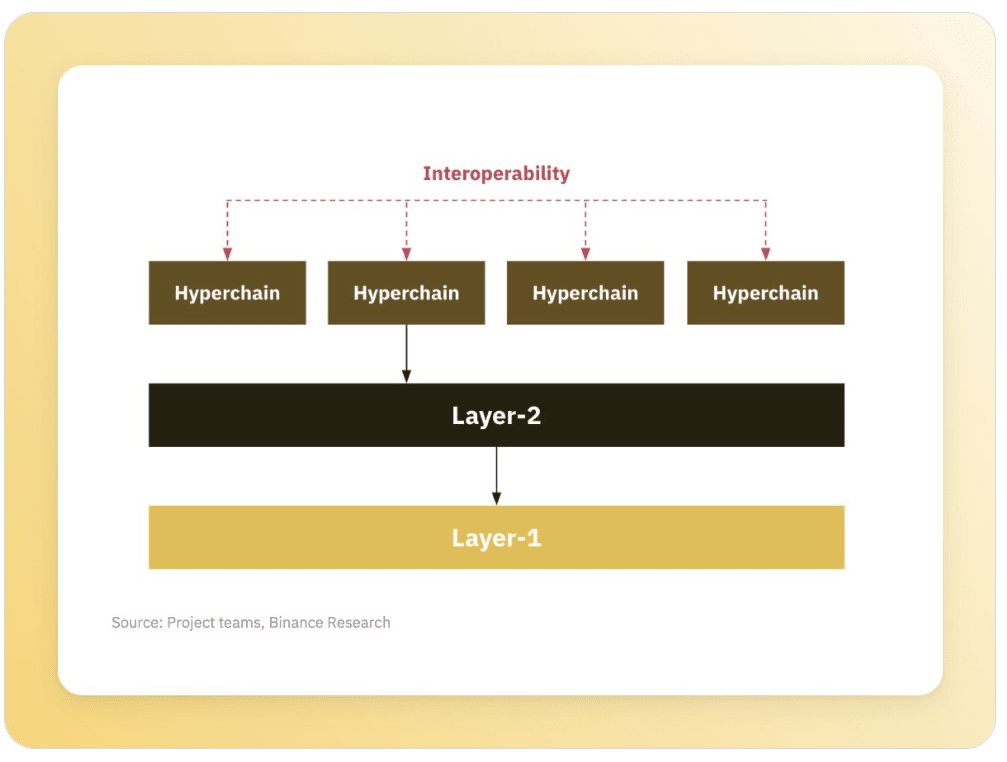
Next, let’s turn to zkSync and its vision for the future of Ethereum scaling.
Hyperchains is zkSync’s vision for L3, conceived as a broad ecosystem of trusted and customizable linked blockchains.
Simply put, Hyperchains refers to independent ZK chains on Ethereum.
These chains are interconnected through a series of customizable and fully trusted super bridge networks. This approach helps overcome vulnerabilities associated with non-native bridges.
4、STARKWARE 和 FRACTAL SCALING

Theoretically, the system can have an infinite number of Hyperchains representing the entire system. This is where StarkWare comes in as a pioneer in the concept of fractal scaling.
To summarize, StarkWare’s multi-layer network paper proposes the idea that L2 is used for general extensions, while L3 should be used for customized extensions.
However, beyond the initial publication of the paper, StarkWare has not made any further announcements.
5、POLYGON 2.0
Polygon made their latest announcement in early June about the next phase of their L2 journey. The goal of Polygon 2.0 is to create “the value layer of the internet.”
The solution aims to enhance interoperability between Polygon zkEVM, PoS, and the supernetwork through a series of upgrades.
By combining zero-knowledge technology with existing PoS mechanisms, Polygon seeks to enhance security and privacy.
In Polygon 2.0, they aimed to combine the strengths of both technologies.
A recent announcement from the Polygon team revealed their plans to transition Polygon PoS to a zkEVM validium in Q1 2024.
https://polygon.technology/blog/introducing-polygon-2-0-the-value-layer-of-the-internet