
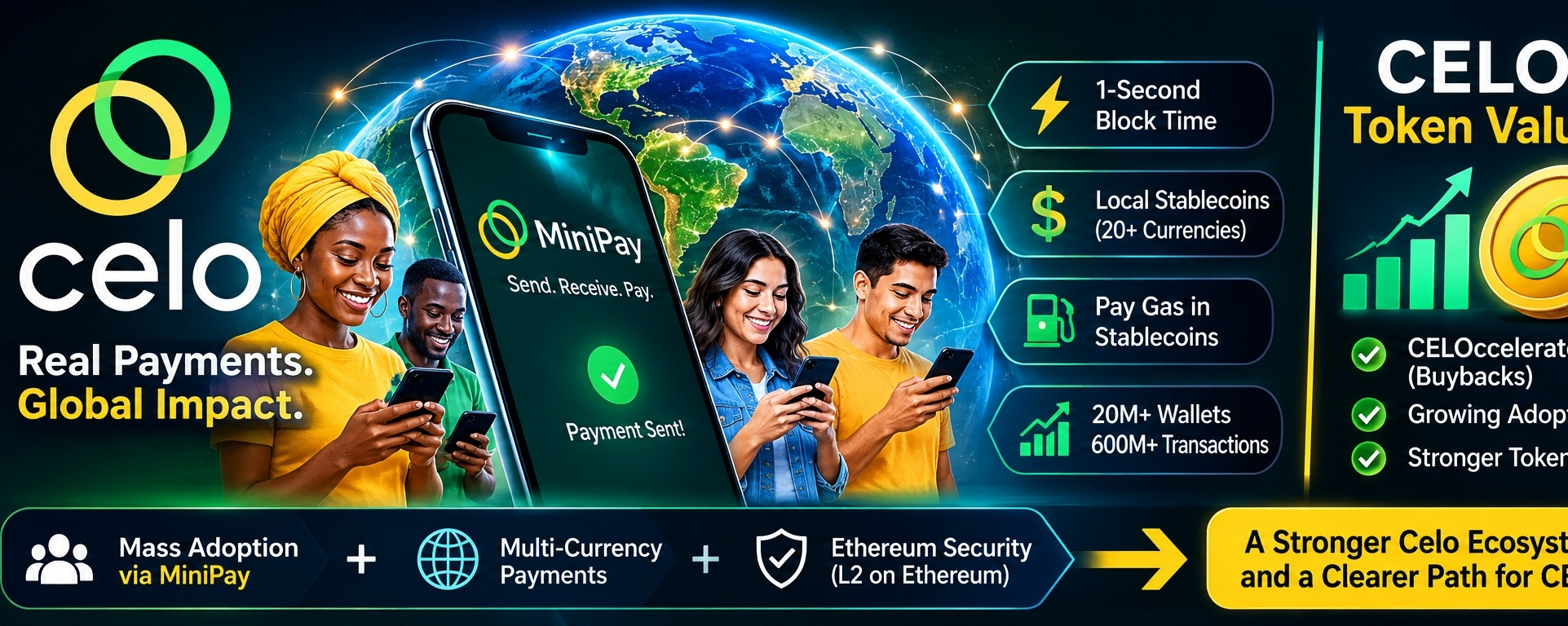

Crypto has no shortage of projects promising to bring blockchain into everyday life. Most talk about adoption, partnerships, and millions of users, but very few manage to turn those promises into something people genuinely use.
Celo is starting to look different.
Instead of competing only for DeFi activity or speculative attention, Celo is focusing on something much bigger: making digital payments easier, cheaper, and more accessible.
And the interesting part is that people are already using its ecosystem to move money.
But there is one question that makes Celo particularly interesting as an investment:
If the network succeeds, does the CELO token win alongside it?
I think this is where the real story begins.
Celo's biggest opportunity is hiding in everyday payments
Imagine receiving money from another country without waiting days for a bank transfer or losing a noticeable amount to fees.
For someone in Nigeria, Kenya, Argentina, or Brazil, that is not just a crypto feature. It can solve a genuine financial problem.
This is the market Celo wants to serve.
Its transition from an independent Layer 1 blockchain to an Ethereum Layer 2 on March 26, 2025, was an important step toward that goal.
Using the OP Stack, Celo became more closely connected to Ethereum while maintaining its focus on low-cost transactions and mobile-friendly payments.
Block times also improved from around five seconds to approximately one second.
That is meaningful for a network designed around frequent transfers and everyday financial activity.
Of course, becoming an Ethereum Layer 2 does not mean inheriting every Ethereum security guarantee. Celo's use of EigenDA for data availability and its upgrade and governance arrangements are important considerations.
Still, the direction makes sense: build on established infrastructure while making payments simple enough for ordinary users.
MiniPay could be Celo's strongest growth engine
One reason I find Celo's strategy interesting is MiniPay.
Instead of expecting people to download a complicated crypto application and learn how wallets work, MiniPay focuses on a familiar mobile experience.
It gives users access to stablecoin payments through a simple, self-custodial wallet.
This matters because the biggest barrier to crypto adoption is not always technology. Sometimes it is simply making the experience understandable.
The adoption numbers are worth watching.
Opera's Q3 2026 update reported:
More than 20 million wallet activations.
Over 600 million transactions.
Approximately $2.3 billion in cumulative transaction volume.
Availability across more than 70 countries.
These numbers show that MiniPay has developed meaningful reach.
However, wallet activations should not be confused with monthly active users. What matters next is how many people return regularly, make payments, and continue using the product without incentives.
That is the difference between attracting attention and building lasting adoption.
The November 19 announcement involving Privy, owned by Stripe, is another development worth following as MiniPay expands its wallet infrastructure.
For me, the bigger advantage is distribution. Celo is not just trying to build better blockchain technology. It is trying to put that technology in the hands of people who may never have cared about blockchain in the first place.
Stablecoins could give Celo a real competitive advantage
Another part of Celo's strategy deserves more attention: local-currency stablecoins.
Digital dollars are useful, particularly in countries where people want access to a more stable store of value. But everyday spending often happens in local currencies.
That is why Celo's growing stablecoin ecosystem is interesting.
Through Mento and integrations with external issuers, the network has been expanding its support for different currencies.
In July 2026, Ripio introduced its wFIAT stablecoin stack on Celo, covering six Latin American currencies:
Argentine peso
Brazilian real
Mexican peso
Colombian peso
Chilean peso
Peruvian sol
USA₮ also launched on Celo during July, adding another dollar-denominated option.
By October 2026, Celo reported 33 stablecoins representing 20 currencies.
This is an important direction because a payment network becomes more useful when people can move between the currencies they actually need.
But there is a difference between launching a stablecoin and creating a useful financial market around it.
Liquidity, redemption, reliable issuers, and real-world demand will determine whether these assets become practical payment tools.
Celo has an interesting opportunity here, but execution will matter more than the number of supported tokens.
Paying gas in stablecoins makes crypto feel less complicated
There is another feature that could quietly improve Celo's adoption: fee abstraction.
On many blockchains, users need the native token just to pay transaction fees.
For experienced crypto users, that is normal. For a newcomer, it can be frustrating.
Imagine receiving USDT but being unable to send it because you don't have the required gas token.
Celo helps remove that friction by allowing supported ERC-20 assets to be used for transaction fees.
This makes the experience much more natural. People can hold and transfer the assets they actually want to use without constantly worrying about maintaining a separate gas balance.
Ledger's July 2026 integration of CIP-64 support also expanded this functionality through Ledger Live.
However, there is an interesting twist.
Making stablecoins usable for gas payments improves the network experience, but it also reduces the need for ordinary users to hold CELO.
That creates a serious question for investors: how much network growth actually translates into demand for the native token?
The biggest challenge: Network growth doesn't automatically mean CELO growth
This is where I think investors need to look beyond adoption headlines.
Celo can process millions of transactions, attract payment partners, and increase stablecoin activity without creating an equal amount of buying pressure for CELO.
Why?
Because users can pay fees using supported stablecoins.
CELO still has important roles in governance, staking, and the network's economic structure, but those roles do not automatically guarantee that every new user becomes a CELO buyer.
This is a distinction many crypto investors overlook.
A successful blockchain and a successful token are two different things.
Supply is another factor worth monitoring. CELO has a maximum supply of one billion tokens, and circulating supply, unlocks, and staking emissions all influence the investment picture.
Staking rewards may look attractive, but investors should understand whether those rewards come from genuine economic activity or additional token issuance.
A high staking yield does not automatically mean a high real return.
For CELO to develop a stronger long-term investment case, the connection between network usage and token value needs to become clearer.
CELOccelerate could be the missing piece
There has been an interesting development in this area.
Celo's CELOccelerate initiative aims to connect network economics with token value by directing net sequencer revenue toward CELO purchases for the Community Fund.
According to Celo's September 2026 ecosystem update, approximately 1.749 million CELO in first-year sequencer fees had been returned to the Community Fund, with programmatic buybacks being implemented for qualifying net sequencer revenue.
This is a meaningful step because it creates a more direct economic relationship between network activity and CELO acquisition.
But I would not call it a complete solution yet.
Investors should pay attention to a few things:
How much revenue remains after operating expenses?
Are buybacks happening consistently?
How large are the purchases compared with circulating supply?
What happens to the CELO acquired by the Community Fund?
Can sustainable revenue growth outpace token dilution?
A buyback announcement can create excitement, but consistent execution is what builds confidence.
If Celo continues increasing payment activity and generates enough revenue to support meaningful purchases, the token's investment narrative could become considerably stronger.
Competition will decide how far Celo can go
Celo is not alone in the payments market.
Solana is pushing fast and inexpensive transactions. Stellar has a long history of focusing on cross-border payments. Other networks and payment companies are also working to connect stablecoins with traditional financial systems.
That means Celo cannot rely on low fees alone.
Its strongest opportunity is the combination of MiniPay's distribution, local-currency stablecoins, mobile accessibility, and Ethereum ecosystem connectivity.
These pieces could create something more valuable than another blockchain competing for speculative activity.
But the competition is real, and users will ultimately choose the service that offers the best experience, liquidity, reliability, and accessibility.
My final thoughts: Celo's network story is stronger than its token story
I like the direction Celo is taking.
It is targeting a real problem, building around stablecoin payments, and finding ways to bring blockchain technology closer to everyday financial activity.
MiniPay's growth is particularly interesting because it gives the ecosystem something many blockchain projects struggle to achieve: a direct connection with ordinary users.
However, I would separate two investment questions.
First, can Celo become an important network for global stablecoin payments?
Second, can that success create enough sustainable economic demand to benefit CELO holders?
The first question looks increasingly interesting. The second still needs to prove itself.
CELOccelerate is a step in the right direction, but future revenue, buyback execution, token supply, and governance will determine whether the economics can support long-term value.
My view is simple: Celo could become a bigger name in everyday crypto payments, but the real opportunity for CELO investors depends on whether network adoption eventually turns into measurable token value.
Because in the end, having millions of people use your blockchain is impressive.
Making sure the native token benefits from that success is an entirely different achievement.