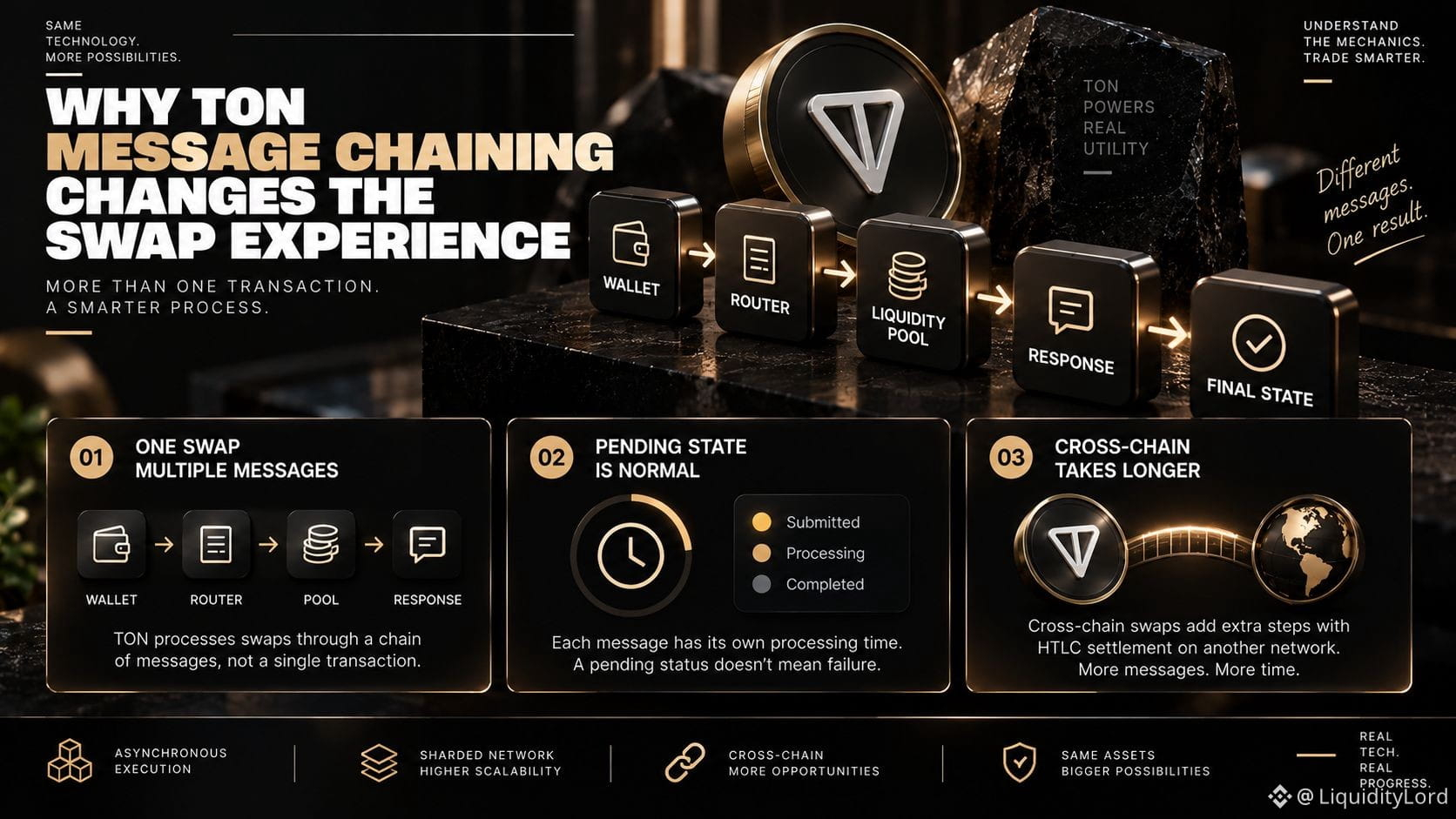
🔗 WHY TON MESSAGE CHAINING CHANGES THE STONfi SWAP EXPERIENCE
A STONfi swap can look like one action: connect, confirm, wait. Underneath, TON works differently from a simple single-step transaction. The request moves through smart contracts, and that architecture affects execution.
🧠 ONE SWAP, MULTIPLE MESSAGES
TON uses asynchronous, sharded execution. A swap therefore moves through messages rather than one synchronous function call.
- Wallet → Router
- Router → liquidity Pool
- Pool → response
- Response → final wallet state
Each message has its own processing stage. A single-pool swap has a shorter chain. A multi-hop route adds steps, so waiting longer does not automatically mean failure.
⏱ WHY STONfi NEEDS A PENDING STATE
This architecture makes the difference between submitted and completed important.
The first message does not mean the entire swap has settled. The interface needs to communicate progress.
Three rules matter:
- Do not resubmit just because the interface is processing.
- Check transaction status before assuming the first attempt failed.
- Treat pending, failed and completed as different execution states.
The delay can simply reflect the chain.
🌉 CROSS-CHAIN MAKES THE CHAIN LONGER
Omniston adds another layer when the destination is on a different blockchain. The TON-side flow must coordinate with HTLC settlement on an independent network, which has its own blocks and confirmation rules.
That is why a cross-chain STONfi swap can take longer than a TON-to-TON swap. The extra latency reflects coordination between two separate systems.
Pending is not necessarily a problem — sometimes it is simply the architecture showing its work.
Not investment advice - research on your own! 🚀
$SOL
A STONfi swap can look like one action: connect, confirm, wait. Underneath, TON works differently from a simple single-step transaction. The request moves through smart contracts, and that architecture affects execution.
🧠 ONE SWAP, MULTIPLE MESSAGES
TON uses asynchronous, sharded execution. A swap therefore moves through messages rather than one synchronous function call.
- Wallet → Router
- Router → liquidity Pool
- Pool → response
- Response → final wallet state
Each message has its own processing stage. A single-pool swap has a shorter chain. A multi-hop route adds steps, so waiting longer does not automatically mean failure.
⏱ WHY STONfi NEEDS A PENDING STATE
This architecture makes the difference between submitted and completed important.
The first message does not mean the entire swap has settled. The interface needs to communicate progress.
Three rules matter:
- Do not resubmit just because the interface is processing.
- Check transaction status before assuming the first attempt failed.
- Treat pending, failed and completed as different execution states.
The delay can simply reflect the chain.
🌉 CROSS-CHAIN MAKES THE CHAIN LONGER
Omniston adds another layer when the destination is on a different blockchain. The TON-side flow must coordinate with HTLC settlement on an independent network, which has its own blocks and confirmation rules.
That is why a cross-chain STONfi swap can take longer than a TON-to-TON swap. The extra latency reflects coordination between two separate systems.
Pending is not necessarily a problem — sometimes it is simply the architecture showing its work.
Not investment advice - research on your own! 🚀
$SOL