

Author: DefiOasis Editor: Faust
Introduction: The enthusiasm of Web3 companies for sports is excellently illustrated in the case of FTX. Previously, they spent $135 million to buy the naming rights of the Miami Heat's arena for 19 years and made Curry a shareholder and brand ambassador for FTX, while Coinbase and FTX, Crypto.com, etc., directly advertised during the national event in the U.S.—the Super Bowl.
In recent years, fan tokens and player NFTs, along with Web3 sports games, have become topics of interest for some fans. However, with scandals related to Web3 like the FTX fallout, the honeymoon period between the sports world and Web3 seems to have ended quickly. Sports stars previously associated with FTX were also implicated, the Heat terminated its naming partnership with FTX, and the Super Bowl event even banned any cryptocurrency-related companies from advertising in 2023. The dismal performance of Crawley Town FC, which introduced Web3 governance, has further led the sports community to question Web3 itself. At its core, is it sports events that need Web3, or does Web3 need sports events?
Do cryptocurrency and DAO governance, as Web3's original products, really make sense when combined with real-world business scenarios like sports? This article by DefiOasis will critically discuss this topic, using objective facts to explain why the 'forced pairing' of sports and Web3 does not yield sweet fruit.
The collision of sports competition and Web3
Throughout history, humans have an instinctive yearning for competitive sports activities, a sentiment even reflected in the Bible when discussing the origins of 'Israel' (the Jewish ancestor Jacob wrestled with an angel and was recognized, thus he was named 'Israel', meaning 'one who wrestles with God').
In modern times, sports have gradually become a mainstream form of entertainment and have a vast market. In 2022 alone, the NBA's revenue surpassed $10 billion, while the NFL reached $18.6 billion; according to Deloitte's (2023 Football Financial Report), the five major European football leagues generated over €17.2 billion in annual revenue, and FIFA's World Cup financial reports indicated that the 2022 Qatar World Cup earned $5.769 billion, gaining over 5 billion viewers, accounting for 62.5% of the global population.
The powerful attraction of sports naturally draws the attention of many Web3 companies. From the sidelines of Manchester City's Etihad Stadium featuring OKX, the naming rights of the Lakers' Crypto.com Arena, to Messi's collaboration with Bitget and Suarez with Binance, everything shows that Web3 companies are determined to connect with sports star fans. In addition to inviting stars for endorsements and other collaborations, Web3 has also evolved unique scenarios like fan tokens and player NFTs.
Sports fan economy: from collectibles to gamified NFTs and fan tokens
It can be said that NFTs are one of the best ways for sports IP to go on-chain. Mainstream sports NFTs primarily focus on collectibility and gamification, with their inherent social and trendy attributes being widely loved by young people.
The well-known accounting firm Deloitte had optimistically predicted that sports-related NFT transaction volume would exceed $2 billion in 2022, but according to data from TheFirstMint founder LGDoucet, the 2022 sports NFT trading volume on the primary market was about $100 million, and about $700 million on the secondary market, which is less than in 2021.
The decline of collectible NFTs
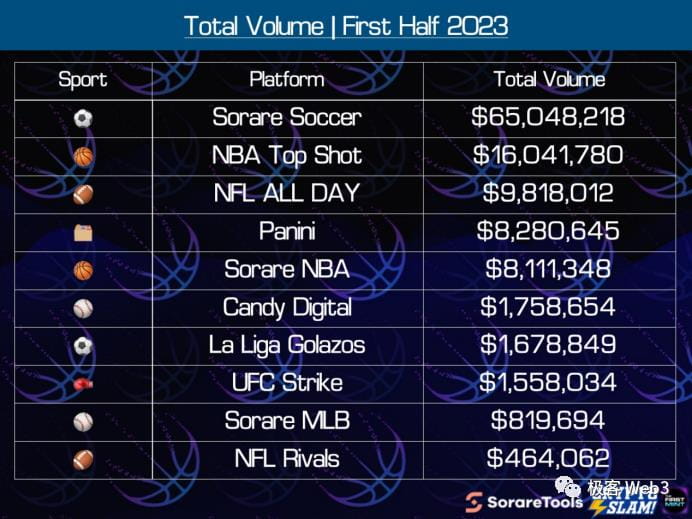
(In the first half of the year, among the top sports platforms by transaction volume, game NFTs represented by Sorare and collectible NFT platforms under DapperLabs remain dominant) Collectible NFTs are the first step for Web3 to enter the sports circle. Previously, soccer star Cristiano Ronaldo had collaborated with Binance to release several personal series of NFTs.
Today, we can still see the shadows of collectible NFTs in the traditional sports realm, such as sports cards. Whether collectible NFTs or physical cards, as well as star-centric sports cards, their value depends on the star's popularity.
In the auction prices exceeding $1 million for physical star cards, prominent stars like Mickey Mantle, LeBron James, and Patrick Mahomes are not uncommon. The rarity and aesthetic design of the cards are points that add value. When collectibles are presented in video form, whether they feature a star's memorable moments can also determine their worth.
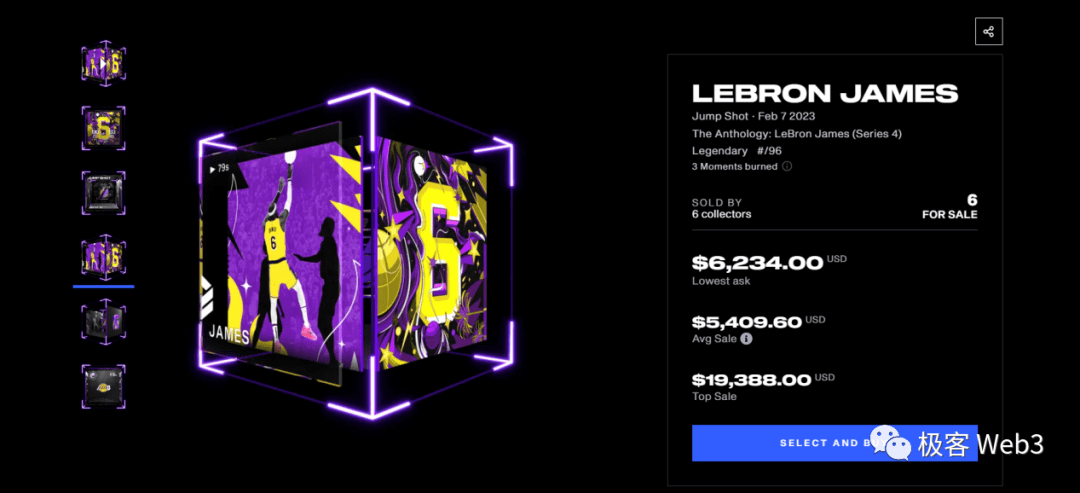
(Memorable moments of stars add value: LeBron James' shot that made him the all-time leading scorer sold for nearly $20,000) In the field of collectible NFTs related to sports, DapperLabs is the undisputed leader, with its collaborations including NBATopShot, NFL All Day, La Liga, UFC Strike, etc., catering to the needs of fans from different top-tier sports leagues. It can be said that DapperLabs and its collaborative products are the culmination of Panini-style card collection gameplay.
Among them, NBATopShot is the most popular, benefiting from the official endorsement of the NBA and its fan base. At its peak, NBATopShot's daily trading volume once exceeded $40 million and consistently ranked among the top five in the NFT trading market. However, this good fortune did not last long; NBATopShot soon declined due to an oversupply of player cards in a short period, exciting moments being limited to current players, and its parent company facing an SEC lawsuit.
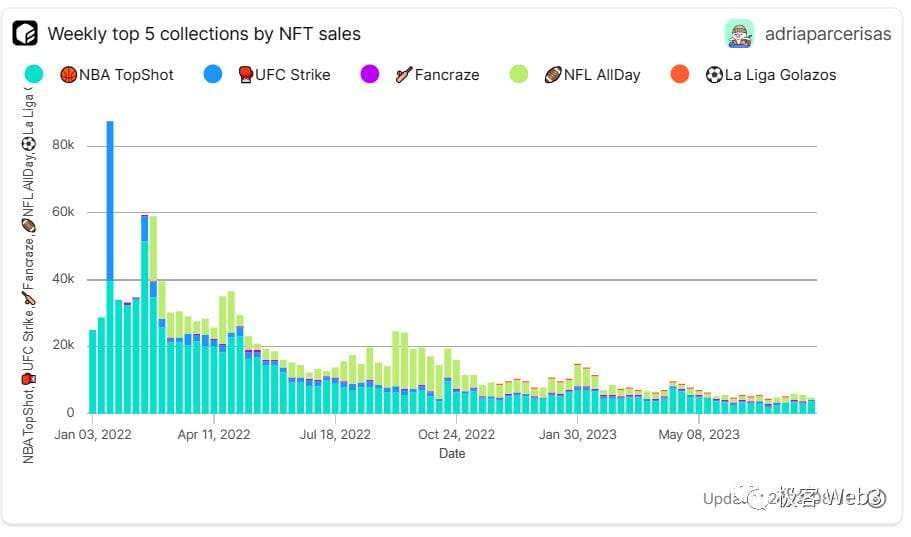
(The NBA is a league with high attention on sports NFTs)
It can be said that the decline of collectible NFTs is inevitable.
Similar to niche collectibles like stamps, most players of sports collectible NFTs are an intersection of sports fans and Web3 users. When the NFT market cools down, the lack of influx from outside players puts the trading market in a situation of having prices but no transactions. Accompanied by the downturn of the NFT market and manipulations by project parties, the activity of NBATopShop has remained in a low ebb since peaking in 2021.
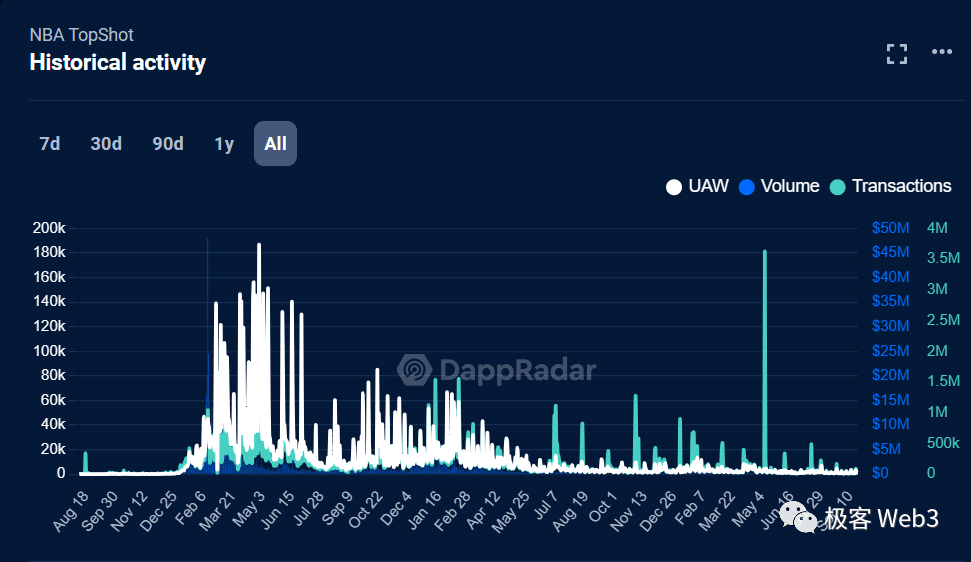
(Accompanied by the cooling of the NFT market and manipulative actions by project parties, the activity of NBATopShop has remained in a low ebb since peaking in 2021)
Gamified NFTs in fantasy sports
Despite the decline in the activity of sports collectibles NFTs, sports themselves inherently carry a huge fan base, especially in top-tier global sports leagues. With the entry of DraftKings Reignmakers, Sorare, etc., the gameplay of sports NFTs has been upgraded, injecting more game elements.
From the slump of collectible NFTs to the boom of gamified NFTs, sports fans only need a trigger point to become fervent.
According to CryptoSlam data, in the month leading up to October 24 this year, NFT transactions showed a significant trend of shifting from PFP to gamified NFTs, with two sports event game NFTs appearing in the top five, surpassing well-known NFTs like CryptoPunks and MAYC.
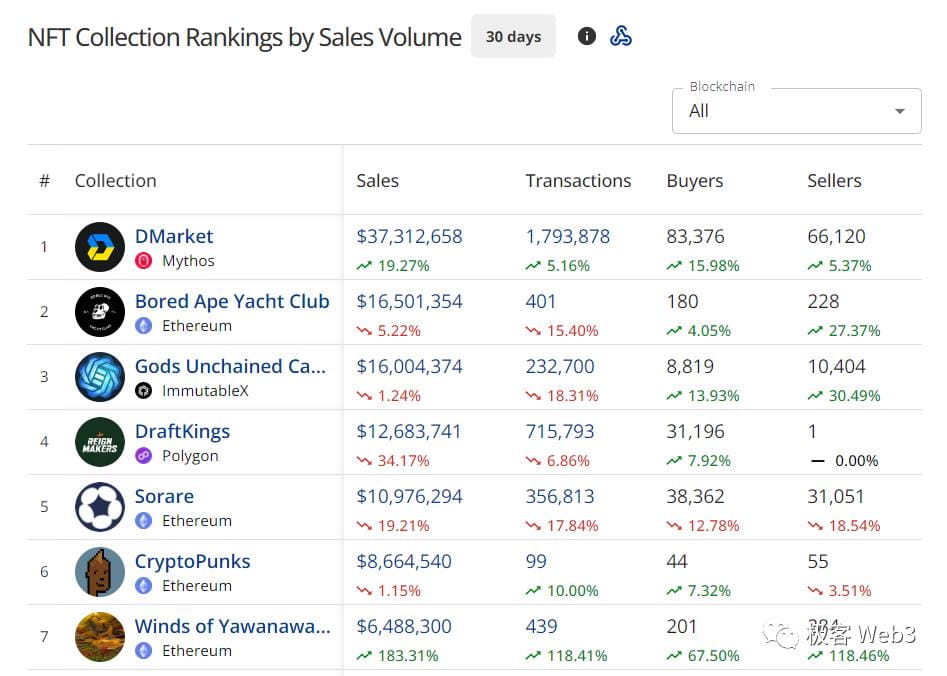
Sports games typically focus on realistic simulation sports and management simulation gameplay. However, the current mainstream Web3 sports games emphasize NFT-centric 'fantasy sports' management simulation gameplay. This is a type of game where players manage teams from the perspective of a club manager. One reason for choosing this approach is that realistic simulation games developed by sports gaming giants like EAFC and F1 have already matured significantly.
These games have gained wide recognition among sports players in terms of cost investment, visual presentation, and maturity of the model, establishing a strong market share on PC and mobile platforms. Therefore, Web3 sports games starting from scratch may find it relatively difficult to carve out a piece of the pie in this field.
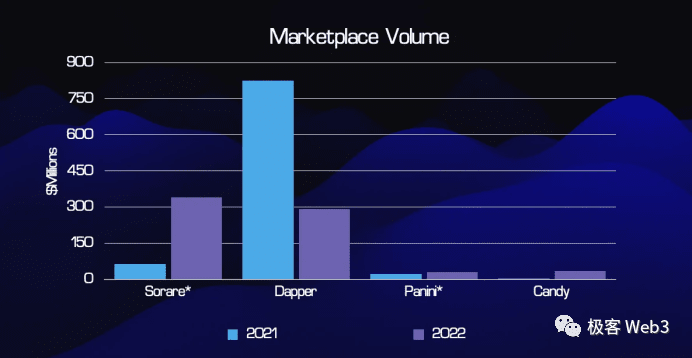
(The changes in game NFTs represented by Sorare and collectible NFTs represented by DapperLabs reflect the trends of both in the past two years)
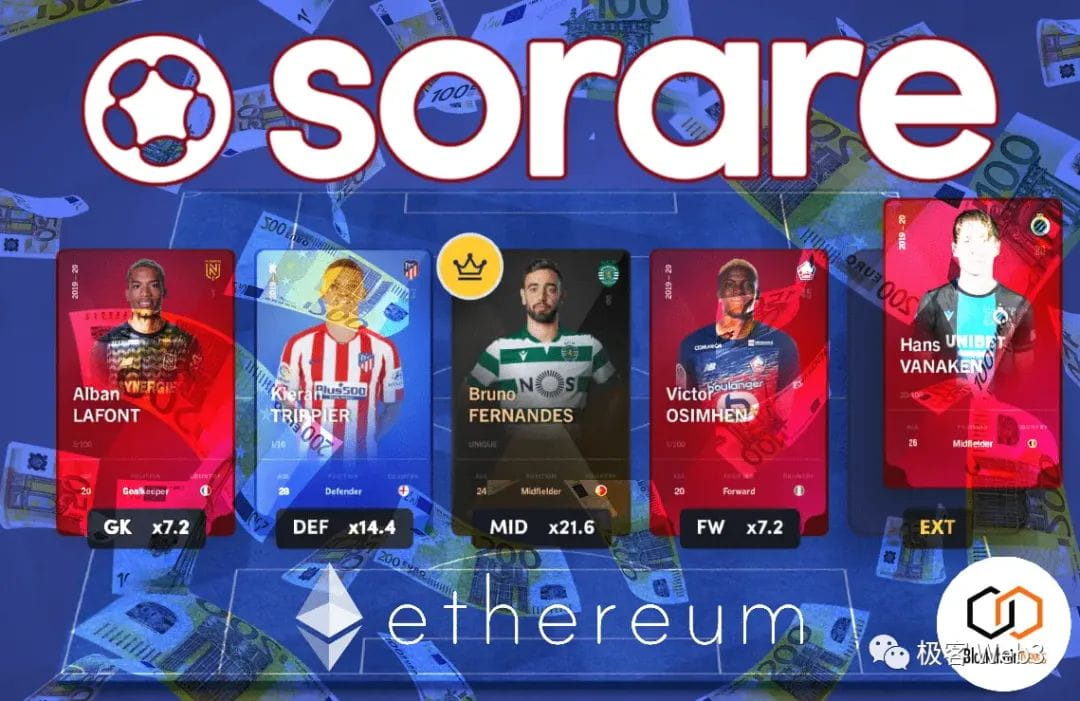
Web3 sports games like DraftKings, Sorare, UltimateChampions choose 'fantasy sports' gameplay that perfectly combines real matches with NFT elements, allowing players to predict the status of players and teams to select suitable lineups for simulated matches. This model is not new in the sports game field; similar mechanisms like FM (Football Manager) and basketball fantasy have already formed mature simulation game mechanisms.
However, unlike before, the core of Web3 sports games lies in star card NFTs, which players can trade in the secondary market, leading to the financialization of star cards and attracting many speculators. Interestingly, the growth potential and rarity of the players themselves influence the prices of player cards. For instance, emerging stars in the early stages of their careers have significant hype potential, while soon-to-retire veterans are exactly the opposite. Earlier this year, NBA's rising star Giannis Antetokounmpo's player NFT was sold on Sorare for 113.888 ETH (about $186,000).
'Fantasy sports' can maintain long-term playability due to two core points:
1. Maintain timely data updates
Unlike most game fans, the appeal of sports games primarily comes from sports fans. Deep sports game enthusiasts have a high overlap with real-world sports fans.
From EAFC (formerly FIFA) to NBA2K, although they have evolved from stunning initial works to regularly criticized products, they still maintain strong revenue-generating capabilities, with timely updates to game data being the main reason for their sales.
In simulation sports games like DraftKings Reignmakers and Sorare, players need to understand real player data, grasp tactics, and assess the overall state of the teams, which effectively attracts passionate fans.
For such players, once sufficient stickiness is formed, the timely updates of roster data become more important than changes in details like graphics, animations, and gameplay diversity.
While most sports games only undergo minor updates each year, players' tolerance is quite high, and they are willing to pay for more timely sports data. If player and team data lack timeliness, the appeal of such games will significantly diminish.
2. Income model favored by rarity
Fantasy sports games refer to MyTEAM and UltimateTeam's player rarity preferences, generating revenue by dynamically adjusting the player card pool. This includes frequently raising the pool limits (such as player abilities and salary caps), prompting players to buy card packs and participate in draws, or directly obtaining desired players through purchasing game coins.
However, the mainstream 'fantasy sports' gameplay of Web3 sports games also has some flaws. For example, the long game cycle leads to weak continuity, making it difficult to ensure players maintain sufficient attention throughout a complete season lasting a year. Additionally, the 'entry fee + prize pool' gameplay is often viewed as having gambling implications, as entering the game, selecting players (similar to betting), and sharing the prize pool are akin to gambling behavior.
On the surface, players need to rationally predict player performances, but in reality, they require a bit of luck. Additionally, the high entry barrier of the game is unfriendly to new fans or non-fans.
Aside from fantasy sports games like Sorare and DraftKings, other sports blockchain games have yet to make waves. Previously, FIFA and EA's relationship broke down over exorbitant renewal fees, leading to the launch of four different Web3 games, but these games still do not attract enough interest from fans.
Specifically, aspects like gameplay, visual presentation, and player likeness rights show considerable gaps compared to mature Web2 sports games. In the future, as AAA-level sports games like Goals attempt to enter Web3, this situation may improve.
New directions for sports NFTs
In addition to the above scenarios, new ways to combine NFTs with real-world sports also serve as an excellent attempt to bring NFTs down to earth, such as NFT tickets. Ticket NFTs have precedents in the music field, where their main function is to prevent ticket scalping and fraud.
However, most ticket NFTs are one-time, with relatively short validity periods. Once ticket NFTs grant access, they only hold collectible value, but apart from rare NFT tickets (such as a star's debut or collaborations with a big name), their value is quite limited. Sports events, however, offer the possibility of long-term use for NFT tickets—such as season tickets for a team's home games. For clubs with a large number of fans, season tickets are generally 'hard to come by'.
Ticket NFTs can serve as a form of team POAP, allowing clubs to launch loyalty point programs similar to 'Odyssey', such as: purchasing team merchandise, verifying attendance for the season, etc., retaining or eliminating season ticket holders, and allocating seats for the next season's season tickets.
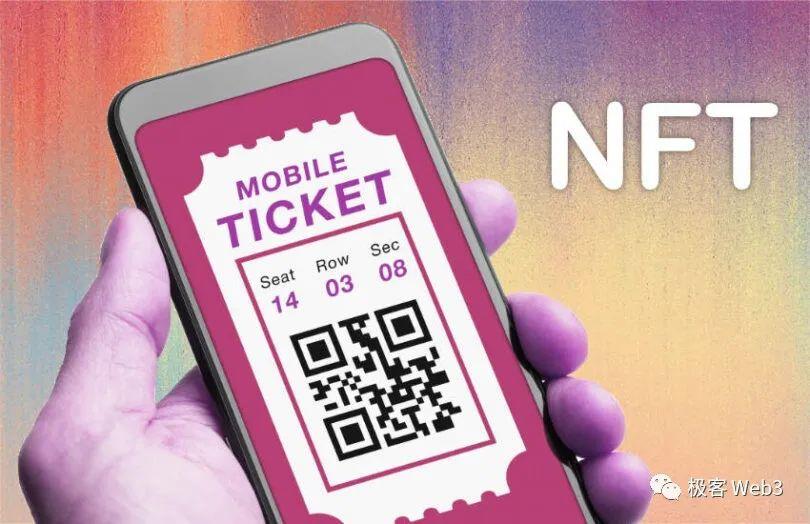
Clubs can also provide benefits to some high-scoring NFT holders, such as signed player merchandise and offline meet-and-greets.
In July last year, Paris Saint-Germain sold three NFT tickets for over $220,000 during their tour friendly match in Japan, allowing buyers to gain unique benefits. While NFT tickets are a great solution, sports fans span all ages, and the NFT audience is small, combined with many sports fans being older and more conservative, making it slow to accept new ideas; at this stage, ticket NFTs are more suitable for limited promotions.
NFT governance
The decentralized nature of Web3 makes democratic decision-making for teams possible. Last year, Chelsea's former owner Abramovich was forced to sell his stake in the team due to political reasons. Some fans wanted to protect the team's interests, and during this transitional period, they initiated crowdfunding to purchase 10% of Chelsea's shares, forming ChelseaDAO and hoping to participate in key decisions for the team in the future.
(During Chelsea's turbulent period, fans hoped to raise funds to establish a DAO organization to take over some team affairs)
For various reasons, ChelseaDAO ultimately could not achieve its goals, but not far away in England, Crawley Town FC has initiated a small democratic 'revolution' through NFTs: a Web3 capital called WAGMI United acquired this football club in the English Football League Two, allowing fans to participate in team construction through Web3 governance (centered on NFTs), introducing voting to decide on team recruitment positions, and allowing season ticket holders and NFT holders to vote together. While this management approach is very democratic, it seems to have little relation to the club's performance, as Crawley Town experienced fluctuating conditions during the season, changing coaches multiple times, ultimately finishing in a difficult 22nd place.
The poor performance of Crawley Town may relate to fans' lack of professional knowledge in sports management, which is also a common issue in DAO management—community voting relies more on common sense than expertise. Moreover, due to information asymmetry, the daily operations of the team, locker room management, and other information cannot all be known to the outside world. It is foreseeable that when a team hands over overall decision-making to a fan DAO, this lack of innovative and long-term perspective in democratic management will struggle to improve the team's performance.
Club fan tokens: a new attempt to empower fans. In addition to NFTs, fan tokens represent another business model related to sports fans. Compared to holding less liquid NFTs and passively bearing price fluctuations, fan tokens actively grant governance rights to assets. There have been fan groups hoping to operate clubs through 'DAO + Token'.
Fan tokens provide such opportunities, allowing fans to participate in certain governance activities, such as deciding the captain's armband for a match, club bus design, warm-up songs, etc., giving fans some say. In this model, clubs can also benefit.
Chiliz, as a leader in Web3 sports fan projects, has incubated fan tokens for several clubs, including AC Milan (ACM), Atlético Madrid (ATM), Tottenham Hotspur (SPURS), etc. Chiliz's incentive platform Socios.com generated $12 million in revenue in 2021 through fan tokens, with clubs collaborating on these fan tokens receiving a share, creating new revenue pathways for teams.
For instance, in 2020, Barcelona's fan tokens sold out on the first day of launch, generating $1.3 million in sales, part of which was shared with the club, increasing its financial revenue.
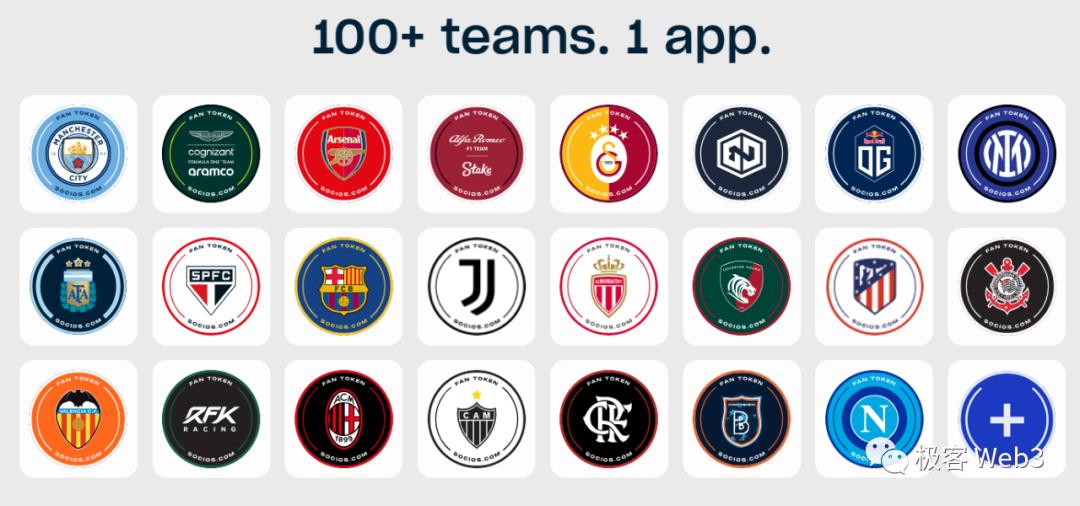
(Socios.com has reached partnerships with multiple sports clubs)
However, the revenue from fan tokens offers limited financial help to teams; broadcasting rights, match days, and real-world commercial activities remain the main income sources for sports clubs.
Taking the financially troubled Barcelona as an example, according to Deloitte's football wealth rankings, the club's revenue in 2022 was nearly €640 million. In comparison, even Socios.com in 2021 only generated a small fraction of revenue for all partnered teams.
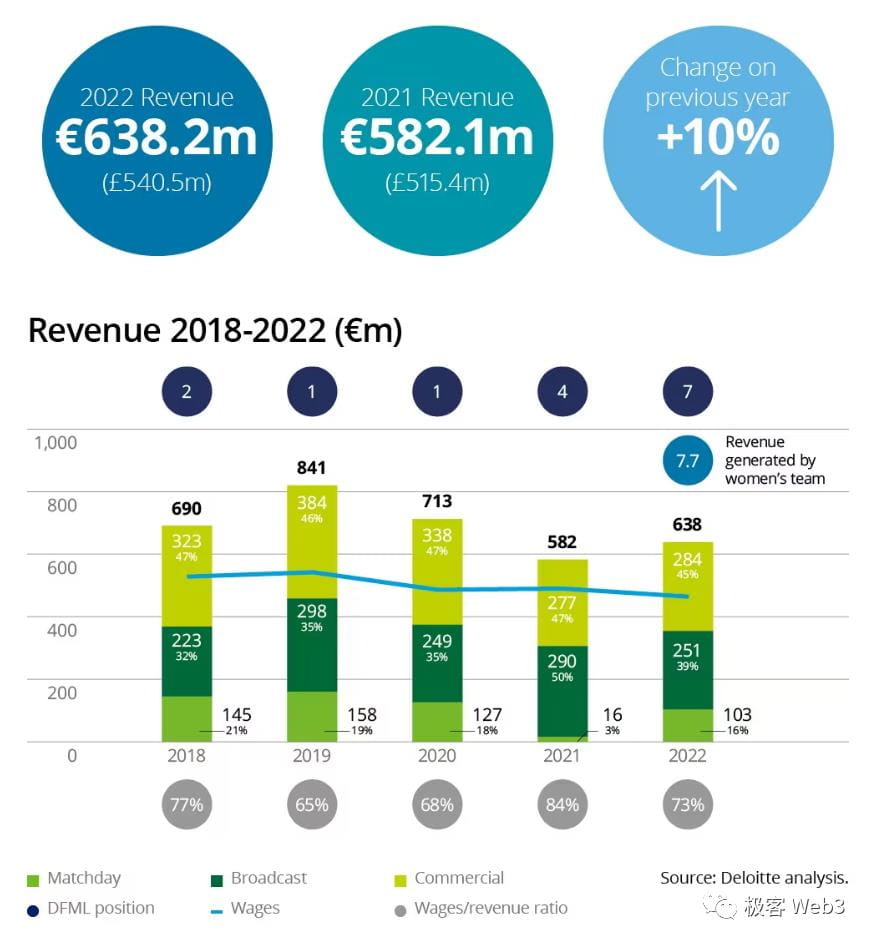
(Barcelona FC 2022 revenue composition source: (Deloitte Football Money League 2023))
At the same time, fan tokens have also become 'fans using love to generate electricity, and non-fans as speculative targets'.
On one hand, the matters that token holders can participate in are limited, with few opportunities each season, and they are often inconsequential; major decisions are still managed by club executives.
On the other hand, the long-term investment value of fan tokens is lacking, reducing them to a de facto casino. While collectible star NFTs may still be sold at high prices due to their rarity, fan tokens lack a value anchor, and even a club's league position and match performance can affect token prices.
During the 2021 European Championship and 2022 World Cup, fan tokens of different teams experienced price fluctuations at various stages of the matches. Even during the off-season, a team's transfer operations or the departure of its top star or the introduction of a famous star can affect the prices of the tokens.
It can be said that these meme-like fan tokens are essentially guided by fan emotions.
The winter of Web3 and sports IP
In the past, Web3 sports projects actively launched advertising displays, NFTs, fan tokens, metaverse games, and other scenario offensives aimed at fans, providing rights and conveniences for fans, but this did not persuade them to buy in.
Firstly, the concept of the fanbase itself is quite complex, as sports fans generally cover all age groups and encompass individuals with various educational backgrounds and ages. It will take time for most of them to accept new concepts.
Secondly, having witnessed several European giants like Manchester United and AC Milan introduce external capital and operate clubs with the management approach of public companies, resulting in years or even decades of turmoil, traditional European fans are more resistant to external capital participating in team affairs, and Web3 capital, which has yet to be understood by most, is even more so.
While this does not mean that investment in teams by Web3 capital is destined to fail, at least the failures of Crawley Town have left a lasting impression on fans. However, sports event clubs have massive fan bases, which is also why Web3 capital is unwilling to give up on sports projects. But for Web3 to gain recognition from fans, it must not only truly benefit fans but also prove its own value first.
In the 2021-2022 season, the crypto industry provided approximately $130 million in sponsorships for the NBA, making it the second-ranked sponsorship category of the season. Meanwhile, sports brands like Adidas and Nike have also entered Web3 in recent years. Just as Web3 and sports entered a honeymoon period, the series of scandals surrounding FTX, including the fallout that affected stars like Tom Brady and Stephen Curry, who had endorsed FTX, led to the termination of the naming rights partnership between the Miami Heat and FTX. The situation worsened with Voyager's bankruptcy and its broken collaboration with the Dallas Mavericks, causing 'Web3' to be stigmatized in the sports world, leading to a sharp decline in reputation.
The crypto industry aims to leverage sports events to build a massive commercial empire, but the continuous negative news not only damages its image but also drags down some individuals in the sports circle, forcing the sports industry to cautiously face Web3 capital and deepening the generational gap between them.
Is it Web3 that needs sports fans, or do sports fans need Web3? Although it is often said that the combination of Web3 and traditional sports can bring new revenue to clubs, compared to mainstream revenue sources like ticket sales, broadcasting, and fan merchandise, it is negligible; regarding visibility, Web3 capital seems to need the publicity of sports events to expand its influence.
However, in terms of influence and revenue, Web3 and sports IP have yet to produce a '1+1>2' effect. Moreover, from the perspective of seeking investors, traditional sports clubs show a clearer preference for traditional capital, while Web3 capital, represented by FTX, clearly lacks this stability.