
#quantus
quantus
783 baxış
Müzakirə edir: 31
Populyar
Sonuncu

·
--
Məqalə
Tərcüməyə bax
Quantus Network: Building a Blockchain for the Quantum Computing EraTechnology • Blockchain • Post-Quantum Cryptography • November 2026
The next major challenge facing blockchain technology may not come from competing networks, scalability limitations or transaction costs. It may come from a technology that is still developing but has the potential to undermine one of the fundamental security assumptions upon which much of the cryptocurrency industry was built: quantum computing.
As quantum computers advance, existing cryptographic systems used to secure digital assets could eventually become vulnerable. This raises an important question: what happens to Bitcoin, Ethereum and other blockchain networks if sufficiently powerful quantum computers become capable of deriving private keys from publicly exposed cryptographic keys?
Quantus Network is attempting to answer that question before it becomes an emergency.
Launched on 9 September 2026, Quantus is a Proof-of-Work Layer-1 blockchain built specifically around post-quantum cryptography. Its native token is QTC. Rather than positioning itself as another general-purpose smart-contract platform, Quantus concentrates on secure peer-to-peer electronic money, privacy and long-term preservation of digital value.
Its central proposition is straightforward: instead of waiting for quantum computers to threaten existing blockchains and then attempting complicated migrations, build a network around cryptographic standards designed to withstand quantum attacks from the beginning.
1. The Quantum Computing Problem
Most established blockchain networks rely on elliptic-curve cryptography to authenticate transactions and protect digital assets.
Bitcoin uses ECDSA and, in newer transaction formats, Schnorr signatures. Ethereum uses ECDSA, while other networks rely on cryptographic systems such as Ed25519.
These systems are considered secure against conventional computers. However, a sufficiently powerful, fault-tolerant quantum computer could use Shor's algorithm to break the mathematical assumptions behind elliptic-curve cryptography.
The implications would be significant. An attacker capable of deriving private keys from exposed public keys could potentially gain control of cryptocurrency wallets without knowing their original passwords or recovery phrases.
The challenge is not simply replacing one cryptographic algorithm with another. Existing networks would need to coordinate upgrades, migrate users, protect dormant wallets and deal with assets whose owners are no longer active.
Quantus approaches this problem differently. It seeks to eliminate the need for a future emergency migration by adopting post-quantum cryptographic standards at the protocol level.
This is particularly relevant as the cryptocurrency industry holds trillions of dollars in assets secured by cryptographic systems that were not originally designed with powerful quantum computers in mind.
2. The Technology Behind Quantus
#Quantus is built using Parity's Substrate framework, a modular blockchain development framework that supports custom blockchain architectures and forkless runtime upgrades.
Its architecture combines four important technological components.
A. Post-Quantum Digital Signatures: ML-DSA
One of Quantus's most important design decisions is its adoption of ML-DSA, formerly known as CRYSTALS-Dilithium.
ML-DSA is a lattice-based digital signature algorithm standardized by the US National Institute of Standards and Technology (NIST) under FIPS 204.
Unlike traditional elliptic-curve signatures, ML-DSA is designed to resist attacks from both conventional and quantum computers.
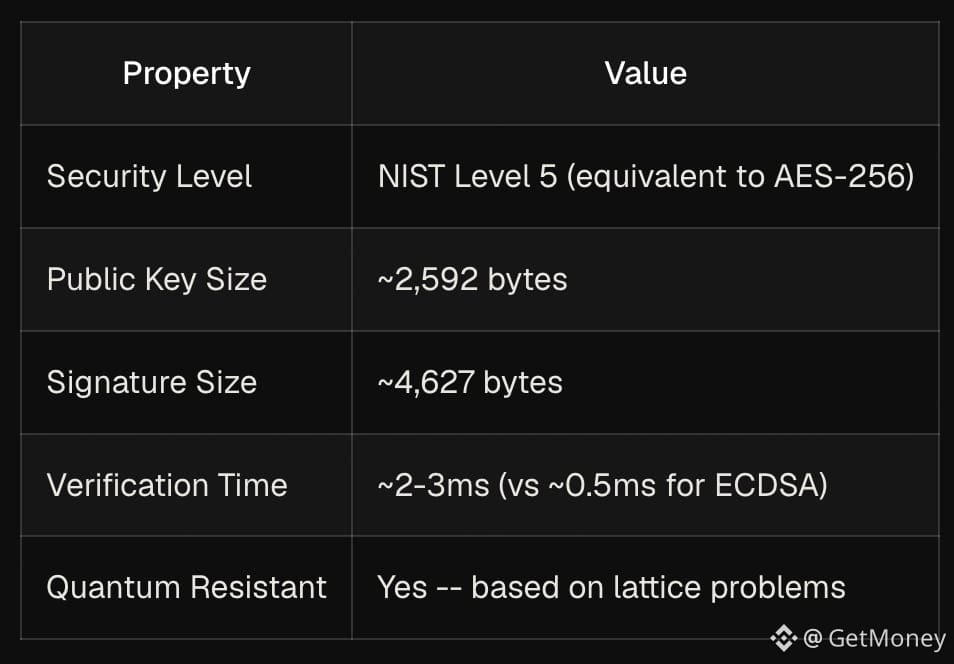
Quantus supports different security configurations, including ML-DSA-65, corresponding to NIST Security Level 3, and ML-DSA-87, corresponding to Level 5.
There is, however, a trade-off. Traditional ECDSA signatures are approximately 65 bytes, whereas ML-DSA signatures are several kilobytes. Public keys are also considerably larger.
This increases the amount of data that must be transmitted, stored and processed when validating transactions.
Quantus therefore has to solve an additional problem: how to maintain an efficient payment network while using substantially larger cryptographic signatures.
B. Secure Network Communications: ML-KEM
Blockchain security is not limited to protecting wallet balances. Communications between network participants must also be protected.
Quantus incorporates ML-KEM, formerly known as CRYSTALS-Kyber, standardized under NIST FIPS 203.
ML-KEM is a post-quantum key encapsulation mechanism used to establish shared encryption keys between communicating parties.
Combined with ML-DSA authentication, this provides a foundation for protecting peer-to-peer network communications against future quantum-enabled attacks.
The distinction is important: ML-DSA protects digital signatures, while ML-KEM establishes encryption keys for secure communications.
C. Proof-of-Work Consensus and Poseidon2
Quantus retains the Proof-of-Work model, making it philosophically closer to Bitcoin than to Proof-of-Stake networks such as Ethereum.
Miners participate in securing the network and receive block rewards. The project does not impose a developer tax on mining rewards.
One of its more unusual design decisions is the use of Poseidon2, an algebraic hash function designed to work efficiently within zero-knowledge proof systems.
Poseidon2 operates over the Goldilocks finite field and is particularly useful for cryptographic operations involving mathematical circuits.
This is important because Quantus relies heavily on zero-knowledge proofs for privacy and transaction aggregation.
Its target block time is approximately 12 seconds, with continuous difficulty adjustment.
However, Poseidon2 should not be confused with the post-quantum signature system. The security of the network depends on several distinct cryptographic components, each serving a different purpose.
D. Wormhole: Privacy and Transaction Scaling
Perhaps the most interesting component of Quantus is its Wormhole mechanism.
Wormhole allows users to move funds between transparent and encrypted account structures using zero-knowledge proofs.
Instead of recording a conventional transfer that publicly identifies both the sender and recipient, the mechanism allows funds to be deposited into a special address and subsequently reintroduced at another address using a cryptographic proof.
The proof demonstrates that the transaction is valid without publicly revealing the relationship between the original and destination accounts.
Quantus uses Plonky2-based zero-knowledge proofs and aggregation techniques to reduce the computational and data costs associated with these operations.
This is particularly relevant because large post-quantum signatures create additional pressure on blockchain throughput.
By aggregating multiple proofs, the network aims to process private transactions more efficiently than it would by handling every cryptographic operation independently.
Its privacy model should nevertheless be understood correctly. Wormhole offers transaction-linking protection, but it should not automatically be equated with fully shielded privacy systems that conceal transaction amounts and other metadata.
3. What Makes Quantus Different?
Quantus is not attempting to compete directly with every blockchain category.
It is not primarily designed to host decentralised applications, complex smart contracts or large DeFi ecosystems.
Its focus is closer to digital money: transferring value, maintaining ownership and protecting transactions against emerging cryptographic threats.
Several features distinguish its approach.
Dual account structures: Users can operate transparent accounts with publicly visible transactions and encrypted accounts using Wormhole. Both are accessible through the same recovery phrase, although they use different derivation paths.Reversible transfers: The network supports delayed transfers that can be cancelled within a designated period.Guardian protection: High-security accounts can designate guardians who may cancel suspicious transactions but cannot independently spend the account's funds.Multisignature: Accounts can require approval from multiple signatories, with support for configurations of up to approximately 100 participants.Recovery mechanisms: Time-locks and additional security arrangements provide alternatives for recovering or protecting accounts.Human-readable address verification: Check-phrases help users identify addresses and reduce the possibility of sending funds to an incorrectly copied destination.Mobile and cold wallets: Quantus provides mobile wallets and an open-source cold-wallet application that can turn a spare smartphone into an offline signing device. Transactions are transferred using QR codes, keeping the signing device disconnected from the internet.
The cold-wallet approach is particularly interesting because it makes hardware-assisted offline signing more accessible without necessarily requiring users to purchase dedicated hardware wallets.
4. Scalability: Can Quantum Security Coexist With Performance?
One of the biggest questions surrounding post-quantum blockchain architecture is whether additional cryptographic security comes at the expense of performance.
Traditional blockchain signatures are relatively small. ML-DSA signatures are substantially larger, increasing the amount of information required to validate transactions and propagate them across the network.
Quantus addresses this through its zero-knowledge architecture.
Its transparent transactions are estimated to operate in the tens of transactions per second, while aggregated encrypted transactions are claimed to reach hundreds of transactions per second under favourable conditions.
These figures should be treated as project-reported or architectural estimates rather than independently established sustained mainnet performance.
The distinction matters because theoretical throughput and actual network performance are not necessarily the same.
Real-world performance depends on network participation, hardware, proof-generation costs, verification requirements and transaction demand.
Quantus is therefore making a different scalability proposition from networks such as Solana. Rather than maximising general-purpose transaction throughput, it seeks to make quantum-resistant value transfers practical through cryptographic efficiency and proof aggregation.
5. QTC: Supply, Mining and Tokenomics
The native cryptocurrency of Quantus is QTC, with a maximum supply of 21 million tokens.
This places its supply ceiling in the same numerical category as Bitcoin, although the two networks have different issuance mechanisms and economic structures.
The distribution model has two principal components:
Approximately 73% of the total supply is designated for mining.Approximately 27% was allocated at genesis to investors, founders, the team and the company.
The majority of the genesis allocation is subject to a one-year lock followed by linear vesting over 36 months, with the vesting arrangements enforced on-chain.
Quantus also uses a gradually declining emission model rather than Bitcoin's fixed four-year halving schedule.
Its approximate reward formula is:
\[ \text{Block Reward} = \frac{\text{Maximum Supply}-\text{Current Supply}}{50,000,000} \]
This produces progressively declining rewards as the circulating supply approaches the maximum.
Transaction fees may also be partially burned under applicable network rules.
The economic argument is that mining incentives can gradually decline while the network maintains a predetermined supply ceiling.
However, the genesis allocation deserves attention. Although vesting reduces the immediate availability of those tokens, future unlocks could influence market supply and price dynamics.
6. The Team, Funding and Governance
Quantus was founded in 2024, with active development beginning towards the end of that year.
Its key figures include co-founder and CEO Christopher Smith and co-founder Joseph Mattia.
Christopher Smith has also been associated with Quantum Canary and the QDay podcast, alongside previous projects including BitMesh, Lunyr and FactoryDAO.
Reported funding totals approximately $2.4 million, with participation and advisory involvement from individuals in the wider cryptocurrency and privacy ecosystem, including Balaji Srinivasan.
Governance is structured around Quantus Improvement Proposals (QIPs), alongside Substrate-style governance mechanisms and a Technical Collective responsible for certain technical decisions.
The stated ambition is progressive decentralisation, although the extent to which governance and development responsibilities are distributed will become clearer as the network matures.
7. Mainnet Progress and Market Position
Reported project and market figures, late November 2026. These are not independently verified live measurements.
Quantus launched its mainnet on 9 September 2026. By late November, it had accumulated approximately two and a half months of operating history.
Project-reported network indicators include:
400,000+
Blocks produced
200+
Network nodes
10,000s
Accounts created
12,000+
Monthly active wallet users, reported
Market trackers have reported QTC trading around the $30 range, with a circulating market capitalisation of approximately $11 million and an all-time high approaching $186 shortly after its initial listings.
These figures are particularly sensitive to the circulating supply because the network is still in its early mining and distribution stages.
Liquidity remains relatively thin, with trading and cross-chain access involving platforms such as Raydium on Solana and NEAR Intents.
The availability of wrapped QTC through these ecosystems is an important development because it creates access to liquidity and users beyond the native Quantus network.
It is worth distinguishing between wrapped assets and native QTC. Wrapped tokens represent cross-chain versions of the underlying asset and introduce additional bridging and custody-related considerations.
8. How Quantus Relates to Bitcoin, Monero, Zcash and Other Blockchains
Quantus is easier to understand when compared with networks that have different priorities.
Bitcoin: Both use Proof-of-Work and have a fixed maximum supply of 21 million units. However, Bitcoin's existing signature infrastructure relies heavily on elliptic-curve cryptography. Quantus was designed around post-quantum signatures from its inception. Bitcoin has the advantage of a substantially longer operating history, greater liquidity and a more established monetary network.
Monero: Monero prioritises financial privacy through confidential transactions and stealth addresses. Quantus also incorporates privacy, but adds a post-quantum security focus. Monero's privacy architecture and operating history are considerably more mature.
Zcash: Zcash uses zero-knowledge proofs to enable shielded transactions. Quantus also uses zero-knowledge technology, particularly through Wormhole, but combines it with a different privacy model and post-quantum cryptographic architecture.
Ethereum: Ethereum is a general-purpose smart-contract platform supporting decentralised applications, financial protocols and token ecosystems. Quantus has a narrower purpose, concentrating on secure digital money rather than competing directly in the smart-contract space.
QRL (Quantum Resistant Ledger): QRL is another blockchain project specifically designed around quantum-resistant cryptography, using hash-based signature technology, particularly XMSS. Quantus takes a different approach through NIST-standardised lattice-based signatures and zero-knowledge proof aggregation.
It is important not to confuse Quantus Network with Quant Network, whose QNT token is associated with enterprise interoperability and Overledger technology. They are separate projects.
9. Security Audits and Outstanding Risks
Quantum resistance is a powerful proposition, but it does not automatically make a blockchain secure.
Quantus has reported external security reviews covering several components of its architecture, including its ML-DSA implementation, hierarchical deterministic wallet, Proof-of-Work mechanisms, Poseidon2 and zero-knowledge circuits.
Firms associated with these reviews include Neodyme, Equilibrium and Eiger. The project has also held an Immunefi audit competition.
However, the existence of audits should not be interpreted as a guarantee that the entire network is free from vulnerabilities. The scope of each audit, findings, remediation and subsequent code changes matter.
There are several risks worth watching.
Cryptographic maturity: ML-DSA is a NIST-standardised algorithm, but the broader implementation and integration of post-quantum systems in a live blockchain remain relatively new.Performance: Large signatures and computationally demanding zero-knowledge proofs could create bottlenecks as network usage increases.Privacy limitations: Wormhole provides additional transaction privacy, but optional privacy and incomplete concealment of transaction metadata mean users should not assume absolute anonymity.Token distribution: The approximately 27% genesis allocation creates potential future selling pressure as vesting progresses.Liquidity: A relatively small market and limited trading venues can result in significant price volatility and difficulties executing large transactions.Adoption: A technically sophisticated blockchain still needs sustained demand. Its long-term success depends on whether users actually choose it for payments and long-term value preservation.Protocol resilience: The security of the complete system depends on the cryptographic algorithms, implementation quality, consensus, networking and economic incentives working together.
Perhaps the most important consideration is that the quantum threat remains a developing technological risk. There is no certainty about when cryptographically relevant quantum computers will become practical. Quantus is making a long-term security bet, rather than responding to an already realised crisis.
10. The Bigger Question: Is Quantus Building for the Next Generation of Money?
The cryptocurrency industry has spent much of its existence competing over transaction speeds, smart-contract capabilities, decentralised finance and ecosystem growth.
Quantus is approaching the problem from another direction.
Its proposition is that the next generation of blockchain infrastructure must consider not only what conventional computers can break today, but also what sufficiently advanced quantum computers might break tomorrow.
That is a meaningful distinction.
Bitcoin demonstrated that decentralised digital money could operate without a central authority. Ethereum expanded the possibilities of blockchain technology through programmable financial infrastructure. Monero and Zcash advanced the conversation around financial privacy.
Quantus is attempting to combine some of these ideas with a different security foundation: post-quantum cryptography designed into the network from genesis.
Its strongest argument is not that quantum computers will necessarily break existing blockchains tomorrow. It is that cryptographic migration is difficult, expensive and potentially disruptive, making early preparation a reasonable engineering decision.
Nevertheless, being early is not the same as being successful. Quantus must demonstrate that its architecture can deliver reliable security, practical transaction speeds, meaningful privacy and sustainable decentralised participation.
My assessment: Quantus is an interesting project because it is addressing a problem that most blockchain networks will eventually have to confront. Its combination of NIST-standardised post-quantum signatures, Proof-of-Work, zero-knowledge technology and a fixed monetary supply gives it a distinct identity. However, its short mainnet history means that its strongest claims still need to be demonstrated through sustained independent scrutiny and real-world adoption.
If the quantum computing threat eventually becomes a defining issue for digital assets, networks that prepared their cryptographic foundations early could have an important advantage. Quantus is positioning itself to be one of them.
Quantus Network: Building a Blockchain for the Quantum Computing Era
Technology • Blockchain • Post-Quantum Cryptography • November 2026
The next major challenge facing blockchain technology may not come from competing networks, scalability limitations or transaction costs. It may come from a technology that is still developing but has the potential to undermine one of the fundamental security assumptions upon which much of the cryptocurrency industry was built: quantum computing.
As quantum computers advance, existing cryptographic systems used to secure digital assets could eventually become vulnerable. This raises an important question: what happens to Bitcoin, Ethereum and other blockchain networks if sufficiently powerful quantum computers become capable of deriving private keys from publicly exposed cryptographic keys?
Quantus Network is attempting to answer that question before it becomes an emergency.
Launched on 9 September 2026, Quantus is a Proof-of-Work Layer-1 blockchain built specifically around post-quantum cryptography. Its native token is QTC. Rather than positioning itself as another general-purpose smart-contract platform, Quantus concentrates on secure peer-to-peer electronic money, privacy and long-term preservation of digital value.
Its central proposition is straightforward: instead of waiting for quantum computers to threaten existing blockchains and then attempting complicated migrations, build a network around cryptographic standards designed to withstand quantum attacks from the beginning.
1. The Quantum Computing Problem
Most established blockchain networks rely on elliptic-curve cryptography to authenticate transactions and protect digital assets.
Bitcoin uses ECDSA and, in newer transaction formats, Schnorr signatures. Ethereum uses ECDSA, while other networks rely on cryptographic systems such as Ed25519.
These systems are considered secure against conventional computers. However, a sufficiently powerful, fault-tolerant quantum computer could use Shor's algorithm to break the mathematical assumptions behind elliptic-curve cryptography.
The implications would be significant. An attacker capable of deriving private keys from exposed public keys could potentially gain control of cryptocurrency wallets without knowing their original passwords or recovery phrases.
The challenge is not simply replacing one cryptographic algorithm with another. Existing networks would need to coordinate upgrades, migrate users, protect dormant wallets and deal with assets whose owners are no longer active.
Quantus approaches this problem differently. It seeks to eliminate the need for a future emergency migration by adopting post-quantum cryptographic standards at the protocol level.
This is particularly relevant as the cryptocurrency industry holds trillions of dollars in assets secured by cryptographic systems that were not originally designed with powerful quantum computers in mind.
2. The Technology Behind Quantus
#Quantus is built using Parity's Substrate framework, a modular blockchain development framework that supports custom blockchain architectures and forkless runtime upgrades.
Its architecture combines four important technological components.
A. Post-Quantum Digital Signatures: ML-DSA
One of Quantus's most important design decisions is its adoption of ML-DSA, formerly known as CRYSTALS-Dilithium.
ML-DSA is a lattice-based digital signature algorithm standardized by the US National Institute of Standards and Technology (NIST) under FIPS 204.
Unlike traditional elliptic-curve signatures, ML-DSA is designed to resist attacks from both conventional and quantum computers.
Quantus supports different security configurations, including ML-DSA-65, corresponding to NIST Security Level 3, and ML-DSA-87, corresponding to Level 5.
There is, however, a trade-off. Traditional ECDSA signatures are approximately 65 bytes, whereas ML-DSA signatures are several kilobytes. Public keys are also considerably larger.
This increases the amount of data that must be transmitted, stored and processed when validating transactions.
Quantus therefore has to solve an additional problem: how to maintain an efficient payment network while using substantially larger cryptographic signatures.
B. Secure Network Communications: ML-KEM
Blockchain security is not limited to protecting wallet balances. Communications between network participants must also be protected.
Quantus incorporates ML-KEM, formerly known as CRYSTALS-Kyber, standardized under NIST FIPS 203.
ML-KEM is a post-quantum key encapsulation mechanism used to establish shared encryption keys between communicating parties.
Combined with ML-DSA authentication, this provides a foundation for protecting peer-to-peer network communications against future quantum-enabled attacks.
The distinction is important: ML-DSA protects digital signatures, while ML-KEM establishes encryption keys for secure communications.
C. Proof-of-Work Consensus and Poseidon2
Quantus retains the Proof-of-Work model, making it philosophically closer to Bitcoin than to Proof-of-Stake networks such as Ethereum.
Miners participate in securing the network and receive block rewards. The project does not impose a developer tax on mining rewards.
One of its more unusual design decisions is the use of Poseidon2, an algebraic hash function designed to work efficiently within zero-knowledge proof systems.
Poseidon2 operates over the Goldilocks finite field and is particularly useful for cryptographic operations involving mathematical circuits.
This is important because Quantus relies heavily on zero-knowledge proofs for privacy and transaction aggregation.
Its target block time is approximately 12 seconds, with continuous difficulty adjustment.
However, Poseidon2 should not be confused with the post-quantum signature system. The security of the network depends on several distinct cryptographic components, each serving a different purpose.
D. Wormhole: Privacy and Transaction Scaling
Perhaps the most interesting component of Quantus is its Wormhole mechanism.
Wormhole allows users to move funds between transparent and encrypted account structures using zero-knowledge proofs.
Instead of recording a conventional transfer that publicly identifies both the sender and recipient, the mechanism allows funds to be deposited into a special address and subsequently reintroduced at another address using a cryptographic proof.
The proof demonstrates that the transaction is valid without publicly revealing the relationship between the original and destination accounts.
Quantus uses Plonky2-based zero-knowledge proofs and aggregation techniques to reduce the computational and data costs associated with these operations.
This is particularly relevant because large post-quantum signatures create additional pressure on blockchain throughput.
By aggregating multiple proofs, the network aims to process private transactions more efficiently than it would by handling every cryptographic operation independently.
Its privacy model should nevertheless be understood correctly. Wormhole offers transaction-linking protection, but it should not automatically be equated with fully shielded privacy systems that conceal transaction amounts and other metadata.
3. What Makes Quantus Different?
Quantus is not attempting to compete directly with every blockchain category.
It is not primarily designed to host decentralised applications, complex smart contracts or large DeFi ecosystems.
Its focus is closer to digital money: transferring value, maintaining ownership and protecting transactions against emerging cryptographic threats.
Several features distinguish its approach.
Dual account structures: Users can operate transparent accounts with publicly visible transactions and encrypted accounts using Wormhole. Both are accessible through the same recovery phrase, although they use different derivation paths.Reversible transfers: The network supports delayed transfers that can be cancelled within a designated period.Guardian protection: High-security accounts can designate guardians who may cancel suspicious transactions but cannot independently spend the account's funds.Multisignature: Accounts can require approval from multiple signatories, with support for configurations of up to approximately 100 participants.Recovery mechanisms: Time-locks and additional security arrangements provide alternatives for recovering or protecting accounts.Human-readable address verification: Check-phrases help users identify addresses and reduce the possibility of sending funds to an incorrectly copied destination.Mobile and cold wallets: Quantus provides mobile wallets and an open-source cold-wallet application that can turn a spare smartphone into an offline signing device. Transactions are transferred using QR codes, keeping the signing device disconnected from the internet.
The cold-wallet approach is particularly interesting because it makes hardware-assisted offline signing more accessible without necessarily requiring users to purchase dedicated hardware wallets.
4. Scalability: Can Quantum Security Coexist With Performance?
One of the biggest questions surrounding post-quantum blockchain architecture is whether additional cryptographic security comes at the expense of performance.
Traditional blockchain signatures are relatively small. ML-DSA signatures are substantially larger, increasing the amount of information required to validate transactions and propagate them across the network.
Quantus addresses this through its zero-knowledge architecture.
Its transparent transactions are estimated to operate in the tens of transactions per second, while aggregated encrypted transactions are claimed to reach hundreds of transactions per second under favourable conditions.
These figures should be treated as project-reported or architectural estimates rather than independently established sustained mainnet performance.
The distinction matters because theoretical throughput and actual network performance are not necessarily the same.
Real-world performance depends on network participation, hardware, proof-generation costs, verification requirements and transaction demand.
Quantus is therefore making a different scalability proposition from networks such as Solana. Rather than maximising general-purpose transaction throughput, it seeks to make quantum-resistant value transfers practical through cryptographic efficiency and proof aggregation.
5. QTC: Supply, Mining and Tokenomics
The native cryptocurrency of Quantus is QTC, with a maximum supply of 21 million tokens.
This places its supply ceiling in the same numerical category as Bitcoin, although the two networks have different issuance mechanisms and economic structures.
The distribution model has two principal components:
Approximately 73% of the total supply is designated for mining.Approximately 27% was allocated at genesis to investors, founders, the team and the company.
The majority of the genesis allocation is subject to a one-year lock followed by linear vesting over 36 months, with the vesting arrangements enforced on-chain.
Quantus also uses a gradually declining emission model rather than Bitcoin's fixed four-year halving schedule.
Its approximate reward formula is:
\[ \text{Block Reward} = \frac{\text{Maximum Supply}-\text{Current Supply}}{50,000,000} \]
This produces progressively declining rewards as the circulating supply approaches the maximum.
Transaction fees may also be partially burned under applicable network rules.
The economic argument is that mining incentives can gradually decline while the network maintains a predetermined supply ceiling.
However, the genesis allocation deserves attention. Although vesting reduces the immediate availability of those tokens, future unlocks could influence market supply and price dynamics.
6. The Team, Funding and Governance
Quantus was founded in 2024, with active development beginning towards the end of that year.
Its key figures include co-founder and CEO Christopher Smith and co-founder Joseph Mattia.
Christopher Smith has also been associated with Quantum Canary and the QDay podcast, alongside previous projects including BitMesh, Lunyr and FactoryDAO.
Reported funding totals approximately $2.4 million, with participation and advisory involvement from individuals in the wider cryptocurrency and privacy ecosystem, including Balaji Srinivasan.
Governance is structured around Quantus Improvement Proposals (QIPs), alongside Substrate-style governance mechanisms and a Technical Collective responsible for certain technical decisions.
The stated ambition is progressive decentralisation, although the extent to which governance and development responsibilities are distributed will become clearer as the network matures.
7. Mainnet Progress and Market Position
Reported project and market figures, late November 2026. These are not independently verified live measurements.
Quantus launched its mainnet on 9 September 2026. By late November, it had accumulated approximately two and a half months of operating history.
Project-reported network indicators include:
400,000+
Blocks produced
200+
Network nodes
10,000s
Accounts created
12,000+
Monthly active wallet users, reported
Market trackers have reported QTC trading around the $30 range, with a circulating market capitalisation of approximately $11 million and an all-time high approaching $186 shortly after its initial listings.
These figures are particularly sensitive to the circulating supply because the network is still in its early mining and distribution stages.
Liquidity remains relatively thin, with trading and cross-chain access involving platforms such as Raydium on Solana and NEAR Intents.
The availability of wrapped QTC through these ecosystems is an important development because it creates access to liquidity and users beyond the native Quantus network.
It is worth distinguishing between wrapped assets and native QTC. Wrapped tokens represent cross-chain versions of the underlying asset and introduce additional bridging and custody-related considerations.
8. How Quantus Relates to Bitcoin, Monero, Zcash and Other Blockchains
Quantus is easier to understand when compared with networks that have different priorities.
Bitcoin: Both use Proof-of-Work and have a fixed maximum supply of 21 million units. However, Bitcoin's existing signature infrastructure relies heavily on elliptic-curve cryptography. Quantus was designed around post-quantum signatures from its inception. Bitcoin has the advantage of a substantially longer operating history, greater liquidity and a more established monetary network.
Monero: Monero prioritises financial privacy through confidential transactions and stealth addresses. Quantus also incorporates privacy, but adds a post-quantum security focus. Monero's privacy architecture and operating history are considerably more mature.
Zcash: Zcash uses zero-knowledge proofs to enable shielded transactions. Quantus also uses zero-knowledge technology, particularly through Wormhole, but combines it with a different privacy model and post-quantum cryptographic architecture.
Ethereum: Ethereum is a general-purpose smart-contract platform supporting decentralised applications, financial protocols and token ecosystems. Quantus has a narrower purpose, concentrating on secure digital money rather than competing directly in the smart-contract space.
QRL (Quantum Resistant Ledger): QRL is another blockchain project specifically designed around quantum-resistant cryptography, using hash-based signature technology, particularly XMSS. Quantus takes a different approach through NIST-standardised lattice-based signatures and zero-knowledge proof aggregation.
It is important not to confuse Quantus Network with Quant Network, whose QNT token is associated with enterprise interoperability and Overledger technology. They are separate projects.
9. Security Audits and Outstanding Risks
Quantum resistance is a powerful proposition, but it does not automatically make a blockchain secure.
Quantus has reported external security reviews covering several components of its architecture, including its ML-DSA implementation, hierarchical deterministic wallet, Proof-of-Work mechanisms, Poseidon2 and zero-knowledge circuits.
Firms associated with these reviews include Neodyme, Equilibrium and Eiger. The project has also held an Immunefi audit competition.
However, the existence of audits should not be interpreted as a guarantee that the entire network is free from vulnerabilities. The scope of each audit, findings, remediation and subsequent code changes matter.
There are several risks worth watching.
Cryptographic maturity: ML-DSA is a NIST-standardised algorithm, but the broader implementation and integration of post-quantum systems in a live blockchain remain relatively new.Performance: Large signatures and computationally demanding zero-knowledge proofs could create bottlenecks as network usage increases.Privacy limitations: Wormhole provides additional transaction privacy, but optional privacy and incomplete concealment of transaction metadata mean users should not assume absolute anonymity.Token distribution: The approximately 27% genesis allocation creates potential future selling pressure as vesting progresses.Liquidity: A relatively small market and limited trading venues can result in significant price volatility and difficulties executing large transactions.Adoption: A technically sophisticated blockchain still needs sustained demand. Its long-term success depends on whether users actually choose it for payments and long-term value preservation.Protocol resilience: The security of the complete system depends on the cryptographic algorithms, implementation quality, consensus, networking and economic incentives working together.
Perhaps the most important consideration is that the quantum threat remains a developing technological risk. There is no certainty about when cryptographically relevant quantum computers will become practical. Quantus is making a long-term security bet, rather than responding to an already realised crisis.
10. The Bigger Question: Is Quantus Building for the Next Generation of Money?
The cryptocurrency industry has spent much of its existence competing over transaction speeds, smart-contract capabilities, decentralised finance and ecosystem growth.
Quantus is approaching the problem from another direction.
Its proposition is that the next generation of blockchain infrastructure must consider not only what conventional computers can break today, but also what sufficiently advanced quantum computers might break tomorrow.
That is a meaningful distinction.
Bitcoin demonstrated that decentralised digital money could operate without a central authority. Ethereum expanded the possibilities of blockchain technology through programmable financial infrastructure. Monero and Zcash advanced the conversation around financial privacy.
Quantus is attempting to combine some of these ideas with a different security foundation: post-quantum cryptography designed into the network from genesis.
Its strongest argument is not that quantum computers will necessarily break existing blockchains tomorrow. It is that cryptographic migration is difficult, expensive and potentially disruptive, making early preparation a reasonable engineering decision.
Nevertheless, being early is not the same as being successful. Quantus must demonstrate that its architecture can deliver reliable security, practical transaction speeds, meaningful privacy and sustainable decentralised participation.
My assessment: Quantus is an interesting project because it is addressing a problem that most blockchain networks will eventually have to confront. Its combination of NIST-standardised post-quantum signatures, Proof-of-Work, zero-knowledge technology and a fixed monetary supply gives it a distinct identity. However, its short mainnet history means that its strongest claims still need to be demonstrated through sustained independent scrutiny and real-world adoption.
If the quantum computing threat eventually becomes a defining issue for digital assets, networks that prepared their cryptographic foundations early could have an important advantage. Quantus is positioning itself to be one of them.
1
1
1
·
--
Tərcüməyə bax
What makes the NEAR–Quantus connection particularly interesting is the difference in their technical focus.
#Quantus is built around post-quantum cryptography, including ML-DSA signatures, while #NEAR focuses on cross-chain interoperability.
One addresses the long-term security implications of quantum computing. The other helps connect blockchain ecosystems.
Security and interoperability could become increasingly important complements.
$QTC $NEAR
{spot}(NEARUSDT)
What makes the NEAR–Quantus connection particularly interesting is the difference in their technical focus.
#Quantus is built around post-quantum cryptography, including ML-DSA signatures, while #NEAR focuses on cross-chain interoperability.
One addresses the long-term security implications of quantum computing. The other helps connect blockchain ecosystems.
Security and interoperability could become increasingly important complements.
$QTC $NEAR
kaymyg
·
--
NEAR, Solana və Quantus arasındakı əlaqə
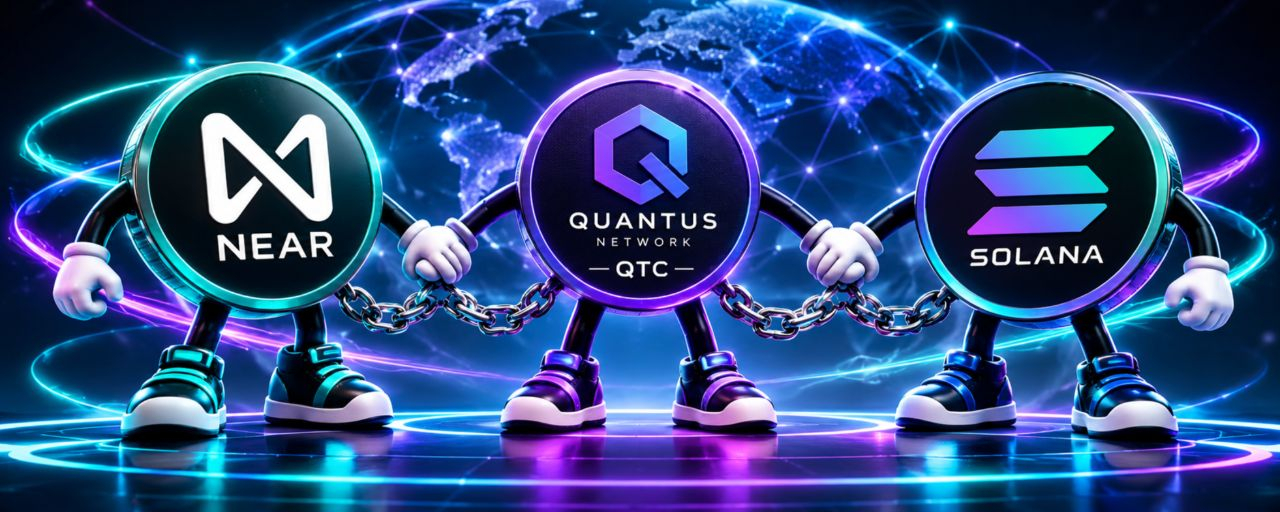
#Near Protocol-un #solana ekosistemi ilə inkişaf etməkdə olan qarşılıqlı fəaliyyət əlaqəsi var, #Quantus Network ($QTC) isə NEAR ilə daha birbaşa texniki və paylama əlaqəsinə malikdir. Bu üç layihə əsasən formal üçtərəfli tərəfdaşlıq vasitəsilə deyil, blokçeynlərarası aktiv köçürmələri, likvidliyə çıxış və ekosistemdə iştirak vasitəsilə əlaqəlidir.
1. NEAR Protocol ↔ Solana
Texniki əlaqə: NEAR Intents aktivlərin və likvidliyin Solana da daxil olmaqla blokçeyn ekosistemləri arasında hərəkət etməsinə imkan verən blokçeynlərarası tranzaksiya marşrutlaşdırmasını təmin edir.
1. NEAR Protocol ↔ Solana
Texniki əlaqə: NEAR Intents aktivlərin və likvidliyin Solana da daxil olmaqla blokçeyn ekosistemləri arasında hərəkət etməsinə imkan verən blokçeynlərarası tranzaksiya marşrutlaşdırmasını təmin edir.
1
12
·
--
Məqalə
NEAR, Solana və Quantus arasındakı əlaqə#Near Protocol-un #solana ekosistemi ilə inkişaf etməkdə olan qarşılıqlı fəaliyyət əlaqəsi var, #Quantus Network ($QTC) isə NEAR ilə daha birbaşa texniki və paylama əlaqəsinə malikdir. Bu üç layihə əsasən formal üçtərəfli tərəfdaşlıq vasitəsilə deyil, blokçeynlərarası aktiv köçürmələri, likvidliyə çıxış və ekosistemdə iştirak vasitəsilə əlaqəlidir.
1. NEAR Protocol ↔ Solana
Texniki əlaqə: NEAR Intents aktivlərin və likvidliyin Solana da daxil olmaqla blokçeyn ekosistemləri arasında hərəkət etməsinə imkan verən blokçeynlərarası tranzaksiya marşrutlaşdırmasını təmin edir.
NEAR, Solana və Quantus arasındakı əlaqə
#Near Protocol-un #solana ekosistemi ilə inkişaf etməkdə olan qarşılıqlı fəaliyyət əlaqəsi var, #Quantus Network ($QTC) isə NEAR ilə daha birbaşa texniki və paylama əlaqəsinə malikdir. Bu üç layihə əsasən formal üçtərəfli tərəfdaşlıq vasitəsilə deyil, blokçeynlərarası aktiv köçürmələri, likvidliyə çıxış və ekosistemdə iştirak vasitəsilə əlaqəlidir.
1. NEAR Protocol ↔ Solana
Texniki əlaqə: NEAR Intents aktivlərin və likvidliyin Solana da daxil olmaqla blokçeyn ekosistemləri arasında hərəkət etməsinə imkan verən blokçeynlərarası tranzaksiya marşrutlaşdırmasını təmin edir.
1. NEAR Protocol ↔ Solana
Texniki əlaqə: NEAR Intents aktivlərin və likvidliyin Solana da daxil olmaqla blokçeyn ekosistemləri arasında hərəkət etməsinə imkan verən blokçeynlərarası tranzaksiya marşrutlaşdırmasını təmin edir.
12
1
38
·
--
Tərcüməyə bax
One of the more interesting blockchain integrations is between NEAR Protocol and Quantus Network.
#Quantus uses #Near Intents to connect its native QTC asset to external blockchain ecosystems. This gives Quantus access to broader liquidity and distribution without abandoning its own network.
NEAR provides the interoperability. Quantus brings post-quantum security.
$NEAR $QTC
#Quantus uses #Near Intents to connect its native QTC asset to external blockchain ecosystems. This gives Quantus access to broader liquidity and distribution without abandoning its own network.
NEAR provides the interoperability. Quantus brings post-quantum security.
$NEAR $QTC
kaymyg
·
--
NEAR, Solana və Quantus arasındakı əlaqə
#Near Protocol-un #solana ekosistemi ilə inkişaf etməkdə olan qarşılıqlı fəaliyyət əlaqəsi var, #Quantus Network ($QTC) isə NEAR ilə daha birbaşa texniki və paylama əlaqəsinə malikdir. Bu üç layihə əsasən formal üçtərəfli tərəfdaşlıq vasitəsilə deyil, blokçeynlərarası aktiv köçürmələri, likvidliyə çıxış və ekosistemdə iştirak vasitəsilə əlaqəlidir.
1. NEAR Protocol ↔ Solana
Texniki əlaqə: NEAR Intents aktivlərin və likvidliyin Solana da daxil olmaqla blokçeyn ekosistemləri arasında hərəkət etməsinə imkan verən blokçeynlərarası tranzaksiya marşrutlaşdırmasını təmin edir.
1. NEAR Protocol ↔ Solana
Texniki əlaqə: NEAR Intents aktivlərin və likvidliyin Solana da daxil olmaqla blokçeyn ekosistemləri arasında hərəkət etməsinə imkan verən blokçeynlərarası tranzaksiya marşrutlaşdırmasını təmin edir.
1
22
·
--
Tərcüməyə bax
My overall opinion: I would currently put #QRL ahead as the more established and defensible choice, while keeping #Quantus under close observation.
Quantus has interesting momentum, but its mining concentration is difficult to overlook. Abelian is also worth watching because of its privacy-oriented approach.
Ultimately, quantum resistance alone does not make a blockchain secure. A genuinely competitive post-quantum blockchain must demonstrate three things: strong cryptography, decentralised consensus and sustainable transaction performance.
kaymyg
·
--
4. A major concern: Quantus and mining centralisation
Despite its growing visibility, Quantus has a notable consensus-security concern. Its miner leaderboard shows one address responsible for 51.6% of recorded blocks (245,700 out of 475,888). Earlier observations also indicated single-pool dominance in the 50–57% range.
If this reflects control of more than half of the active network hashpower, it creates a potential 51% attack risk, including recent block reorganisations, double-spending and temporary transaction censorship.
It does not allow the miner to break post-quantum signatures or simply steal existing coins. However, it raises legitimate questions about decentralisation. Historical snapshots suggest this concentration has been recurring rather than an isolated observation.
1
1
·
--
Tərcüməyə bax
3. Popularity and public attention
#QRL : Remains the most established reference point in discussions about native quantum-resistant blockchains, benefiting from its history since 2018.
#Quantus (QTC): Is generating considerable recent attention among newer projects, following its September 2026 launch, CoinGecko trending visibility and significant price movements. Confusion involving fake QTC tokens on other networks has also contributed to discussion.
Abelian (ABEL): Attracts interest around privacy and post-quantum cryptography, but remains less visible than QRL and Quantus.
Mochimo (MCM): Has an established but relatively small community, with limited mainstream cryptocurrency visibility.
Dilithion (DIL): Has a smaller following, with interest largely concentrated among people exploring post-quantum cryptocurrency alternatives.
Tidecoin (TDC): Has relatively low public visibility and limited discussion compared with the better-known projects.
Popularity takeaway: QRL leads in established recognition, while Quantus appears to be generating the most recent attention among newer entrants.
kaymyg
·
--
2. Throughput and performance
None of these six is recognised as a high-TPS blockchain, and comparable independently verified throughput benchmarks are scarce.
#Quantus ($QTC): Has a publicly reported target block time of approximately 12 seconds, the shortest published target among this group, although this does not establish the highest TPS.
#QRL : Uses hash-based XMSS signatures, prioritising security over high transaction throughput.
Mochimo (MCM): Its proof-of-work architecture prioritises secure transactions rather than competing with high-speed blockchains.
Abelian (ABEL): Its privacy-oriented cryptographic design introduces additional complexity, and it is not known for high transaction throughput.
Dilithion (DIL): Uses RandomX, a CPU-oriented mining algorithm, and is not positioned as a high-throughput network.
Tidecoin (TDC): Publicly comparable TPS and block-time benchmarks are limited, making its speed difficult to rank reliably.
Performance takeaway: Quantus leads on reported block cadence, but there is insufficient comparable evidence to declare an overall TPS winner.
1
1
28
·
--
Tərcüməyə bax
2. Throughput and performance
None of these six is recognised as a high-TPS blockchain, and comparable independently verified throughput benchmarks are scarce.
#Quantus ($QTC): Has a publicly reported target block time of approximately 12 seconds, the shortest published target among this group, although this does not establish the highest TPS.
#QRL : Uses hash-based XMSS signatures, prioritising security over high transaction throughput.
Mochimo (MCM): Its proof-of-work architecture prioritises secure transactions rather than competing with high-speed blockchains.
Abelian (ABEL): Its privacy-oriented cryptographic design introduces additional complexity, and it is not known for high transaction throughput.
Dilithion (DIL): Uses RandomX, a CPU-oriented mining algorithm, and is not positioned as a high-throughput network.
Tidecoin (TDC): Publicly comparable TPS and block-time benchmarks are limited, making its speed difficult to rank reliably.
Performance takeaway: Quantus leads on reported block cadence, but there is insufficient comparable evidence to declare an overall TPS winner.
kaymyg
·
--
Post-kvant blokçeynləri: yaş, sürət, populyarlıq və ümumi gücün müqayisəsi
Post-kvant blokçeyn ekosistemi hələ də inkişaf edir və bir neçə layihə rəqəmsal aktivləri gələcək kvant hesablaması təhdidlərindən qorumaq üçün fərqli yanaşmalardan istifadə edir. Diqqətəlayiq altı yerli layihə QRL, Mochimo (MCM), Quantus (QTC), Dilithion (DIL), Tidecoin (TDC) və Abelian-dır (ABEL).
Hazırda onların heç biri yüksək ötürücülük qabiliyyətinə malik blokçeyn kimi seçilmir. Əsas diqqətləri tranzaksiya sürətindən daha çox kriptoqrafik təhlükəsizliyə yönəlib. Bəs onlar yaş, məhsuldarlıq, populyarlıq və ümumi potensial baxımından necə müqayisə olunur?
1. Yaş və yetkinlik
#QRL : 2018-ci ildə istifadəyə verilib və bununla da kvantadavamlı blokçeyn layihələri arasında ən erkənlərdən biri olub; nisbətən uzun əməliyyat tarixçəsinə malikdir.
#Mochimo (MCM): Təxminən 2018-ci ildə ortaya çıxaraq post-kvant iş sübutu kriptovalyutalarının ilk qabaqcılları sırasında yer alıb.
Abelian (ABEL): Post-kvant kriptoqrafiyası və maliyyə məxfiliyi əsasında qurulmuş daha yeni layihədir.
#Tidecoin (TDC): İctimai görünürlüğü və tarixi məlumatları məhdud olan, nisbətən az tanınmış layihədir.
#Dilithion (DIL): Post-kvant imzalarını prosessor yönümlü iş sübutu ilə birləşdirən, Bitcoin-dən ilhamlanmış daha yeni layihədir.
#Quantus (QTC): Əsas şəbəkəsi 2026-cı ilin sentyabrında istifadəyə verilmiş daha yeni layihədir, lakin qısa müddətdə diqqəti cəlb edib.
1
1
46



·
--
Hamı bazarın düşdüyü gündə belə ayaqda qalan yeganə coin-in adını axtarır — indi isə bu, çoxlarının bir ay əvvəl heç eşitmədiyi kvant coin-idir.
$QTC bu gün CoinGecko-da ən çox axtarılan 8-ci coindir və təxminən $70.79 qiymətində ticarət olunur — cəmi 2.1% ucuzlaşıb. Bu arada, $BTC slides 5.9% düşərək $75,605-ə, $ETH isə 7.7% ucuzlaşaraq $2,229-a enib. Açığı, $QTC ilə bağlı təzə bir xəbər yoxdur — qiymətə təsir edən kvant hücumlarına davamlılıq hekayəsidir, üstəlik mainnet yalnız sentyabrda istifadəyə verilib.
Amma risk də realdır: 21M-lik ümumi təklifin yalnız təxminən 324K-i dövriyyədədir. Buna görə sifariş kitabı zəifdir və tokenlərin kiliddən açılması ilə bağlı təzyiq qiymətə ciddi təsir göstərə bilər. Bu günün maksimumu olan $75.50-ı izləyirəm — үүнийгээ эргүүлэн əldə edər үү, trendийг дагагчид хөөцөлдөх зүйлтэй болно; $70-аас доош унавал хөрвөх чадвар нимгэн учраас уналт хурдасч магадгүй.
Нийлүүлэлтийн ердөө 6% нь гүйлгээнд байгаа coin-д хөрөнгө оруулах уу, эсвэл төсөл ямар ч түүхтэй байсан токен тайлагдах эрсдэл нь татгалзахад хангалттай юу?
#Quantus #CryptoMarket #BinanceSquare
6
·
--
$QTC bu gün günortadan sonra trend siyahısında yüksələn qeyri-adi aktivdir: yüngül həcmdə təxminən 3,7% artaraq 71,82 dollara yaxınlaşıb və 72,71 dollarlıq gündəlik maksimumuna yaxındır. Bu, kiçik həcmli aktivdir, ona görə də diqqət artımın özündən daha çox nəzərə çarpır — treyderlər həqiqətən maraq göstərməsə, trend siyahılarında adətən 700-cü yerlərdə qərarlaşan kriptovalyuta görünmür. $BTC arxa planda daha sabitdir: təxminən 77 989 dollara yaxınlaşaraq 1,8% artıb. Buna görə də bu, bazarın hər şeyi yüksəltməsindən çox, özünəməxsus maraq doğuran bir vəziyyətə bənzəyir. $QTC-nin 70 dollardan yuxarı qalmasını izləyirəm — belə olsa, trend ətrafındakı canlanma yəqin ki, bir qədər də davam edəcək. #Quantus
$QTC bu gün günortadan sonra trend siyahısında yüksələn qeyri-adi aktivdir: yüngül həcmdə təxminən 3,7% artaraq 71,82 dollara yaxınlaşıb və 72,71 dollarlıq gündəlik maksimumuna yaxındır. Bu, kiçik həcmli aktivdir, ona görə də diqqət artımın özündən daha çox nəzərə çarpır — treyderlər həqiqətən maraq göstərməsə, trend siyahılarında adətən 700-cü yerlərdə qərarlaşan kriptovalyuta görünmür. $BTC arxa planda daha sabitdir: təxminən 77 989 dollara yaxınlaşaraq 1,8% artıb. Buna görə də bu, bazarın hər şeyi yüksəltməsindən çox, özünəməxsus maraq doğuran bir vəziyyətə bənzəyir. $QTC-nin 70 dollardan yuxarı qalmasını izləyirəm — belə olsa, trend ətrafındakı canlanma yəqin ki, bir qədər də davam edəcək. #Quantus
3
·
--
Doğrulanıb
Quantus NEAR Intents vasitəsilə QTC Tokenini təqdim etdiKvantaumədavamlı blokçeyn şəbəkəsi Quantus NEAR.com platformu üzərindən, NEAR Intents-in dəstəyi ilə 6 oktyabr 2026-cı ildə özünəməxsus QTC tokenini rəsmi şəkildə təqdim etdi. Bu təqdimat kriptovalyuta bazar kapitalizasiyasında NEAR-ın 20 ən böyükliyə daxil olmasına imkan verən əsas yüksəliş amillərindən biri oldu.
#NEAR #Quantus #QTC #PostQuantum #CryptoNew #BinanceSquare
Quantus NEAR Intents vasitəsilə QTC Tokenini təqdim etdi
Kvantaumədavamlı blokçeyn şəbəkəsi Quantus NEAR.com platformu üzərindən, NEAR Intents-in dəstəyi ilə 6 oktyabr 2026-cı ildə özünəməxsus QTC tokenini rəsmi şəkildə təqdim etdi. Bu təqdimat kriptovalyuta bazar kapitalizasiyasında NEAR-ın 20 ən böyükliyə daxil olmasına imkan verən əsas yüksəliş amillərindən biri oldu.
#NEAR #Quantus #QTC #PostQuantum #CryptoNew #BinanceSquare
#NEAR #Quantus #QTC #PostQuantum #CryptoNew #BinanceSquare
1
120


·
--
🚨 $QUANTUS TƏDQİQAT ELEVEN İLƏ İNSTİTUSİONAL POST-KVANT CƏBƏRLƏMƏ ARXİTEKTURASI ÜÇÜN TƏRƏFDAŞLIQ EDİR 🏦
İnstitusional “ağıllı pul” yerləşdirmə zamanı ölçü götürməzdən əvvəl mükəmməl risk idarəçiliyi və kripto-aqil qəyyumluq tələb edir. Project Eleven və $QUANTUS, Strongpointin vahid nəzarət qatını qurur, protokol səviyyəsində ML-DSA post-kvant kriptoqrafiyasını idarəetmə və açarların idarə edilməsi iş axınlarından ayırır. 🔍
Bu strateji inteqrasiya çoxzəncirli kriptoqrafik parçalanmanı birbaşa hədəfə alır. İnstitusional avadanlıq və özəl-default (default-a görə özəl) və 21 milyonla məhdudlaşdırılmış Layer 1 üzərində siyasət nəzarətini təmin etməklə, 2027-dən əvvəl struktur kapital axını üçün baza aktiv şəkildə qoyulur. 📊 🛡️
💬 Növbəti dövrdə post-kvant təhlükəsizlik institusional alokatorlar üçün əsas struktur tələbi olacaq? 👇
⚠️ Maliyyə məsləhəti deyil. Riskinizi həmişə idarə edin. 🛡️
🏷️ #QUANTUS #Layer1 #Crypto #PostQuantum #Institutional
🏦 🛡️
16

·
--
📰 Əsas şəbəkə cəmi bir ay əvvəl işə düşdü, Quantus isə “post-kvanta + məxfilik” mövqeyi ilə sürətlə diqqət çəkdi və bir çox insan tərəfindən “post-kvanta versiyası Zcash” kimi müqayisə olundu.
Bu blokçeyn PoW istifadə edir, əsas imza mexanizmi ML-DSA (Dilithium)dır; sübutların birləşdirilməsi üçün STARK və Plonky2 tətbiq olunur və daha böyük həcmli post-kvanta imzaları sıxlaşdırmağa çalışır. Sadə desək, onlar kvant hesablamalarının yarada biləcəyi təhlükəsizlik problemlərini başlanğıcdan etibarən arxitekturaya yazmaq istəyirlər, yoxsa sonradan yeniləmə ilə həll etmək.
🔥 Məxfilik hissəsi də maraqlıdır. Quantus Wormhole ünvanlarının məhv edilməsi və aktivlərin yenidən kəsb/yaradılması (re-mint) yolu ilə göndərilən ünvanla yekun qəbul ünvanı arasında birbaşa əlaqəni kəsir; Zcash isə əsasən zk-SNARKs və “shielded pool” (məxfi hovuz) vasitəsilə tranzaksiya məlumatlarını gizlədir. Hədəf istiqaməti oxşardır, amma yanaşmalar fərqlidir.
Layihənin əsas şəbəkəsi 2026-cı il sentyabrın 9-da işə düşüb. Rəsmi açıqlamalara görə artıq 8400-dən çox aktiv hesab var, indiyə qədər 260 mindən çox tranzaksiya həyata keçirilib və NEAR Intents-ə də qoşulub. Maliyyələşdirmə tərəfdə iki raund üzrə cəmi təxminən 2,42 milyon ABŞ dolları toplanıb; Balaji, Babak Nivi, Mert və s. iştirak edib. Arxasında Zcash dairələri ilə əlaqənin olması da layihənin daha çox müzakirə olunmasına səbəb olub.
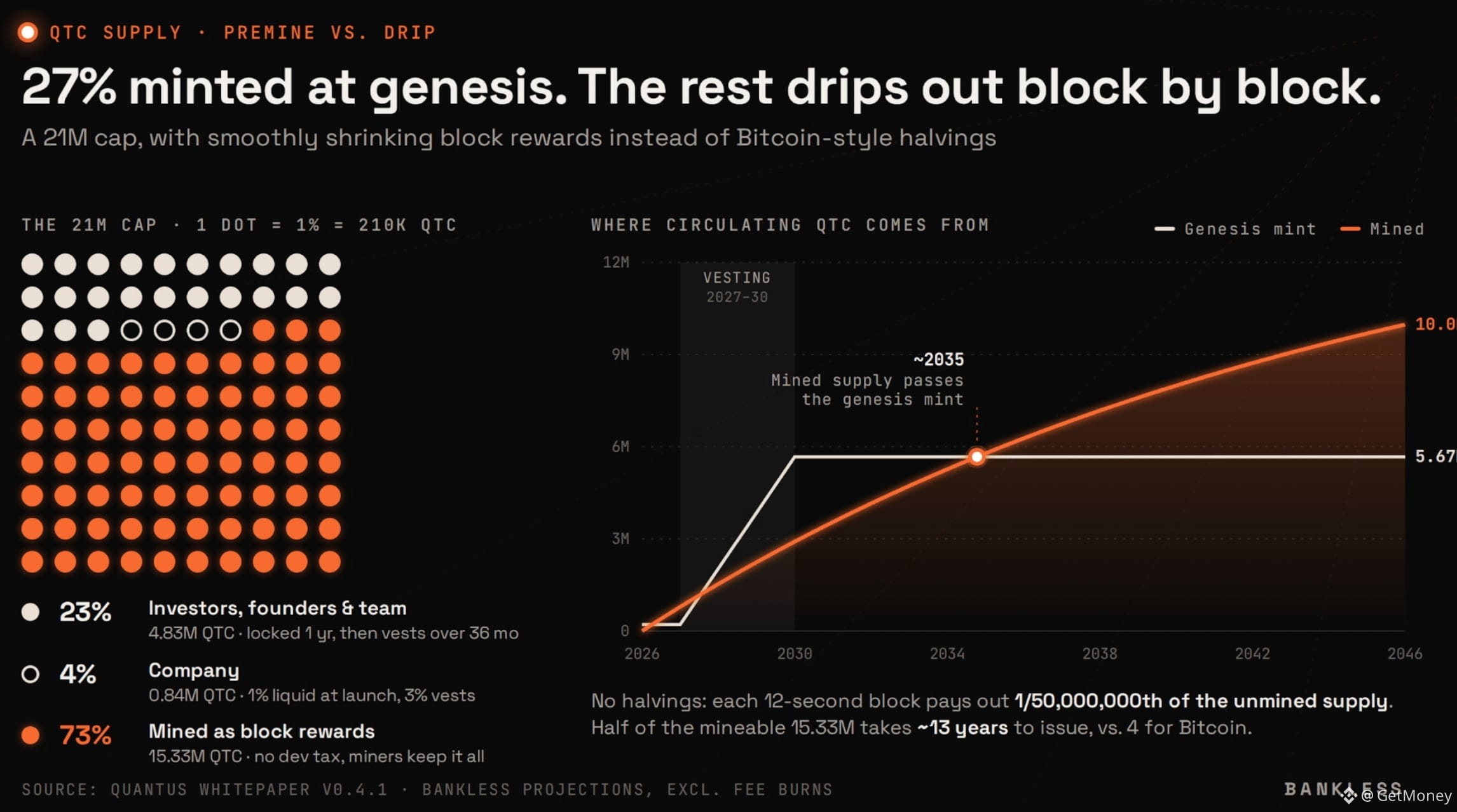
🤔 Amma mübahisə də bir o qədər açıqdır: QTC-nin ümumi təchizatının 27%-i genesis mərhələsində mint edilir; bunun 23%-i investorlara, təsisçilərə və komandaya ayrılır, bir il kilidlənəndən sonra isə 36 ay ərzində xətti şəkildə sərbəst buraxılır. Post-kvanta texnologiya hələ böyük miqyaslı sınaqlarla real şəkildə üzləşməyib, amma token paylanması icma tərəfindən artıq əvvəlcədən yoxlanılır. Siz Quantus-a texniki istiqamətinə görə diqqət edərsiniz, yoxsa yüksək faizli genesis paylanmasını birinci yerdə görərsiniz?
#Quantus #QTC #Zcash #məxfilik_sahəsi
41

·
--
Kvant hesablamaları nəzəri elmdən praktik reallığa doğru sürətlə irəlilədikcə, Web3-ün təməl təhlükəsizliyi qaçılmaz bir problemlə üzləşir. Müasir blokçeynlərin əksəriyyəti ECDSA kimi kriptoqrafik alqoritmlərə əsaslanır və inkişaf etmiş kvant prosessorları gələcəkdə bu alqoritmləri sındıra bilər. Bu ekzistensial zəifliyi birbaşa aradan qaldırmağa çalışan yeni layihə Quantusdur.
Quantus rəqəmsal aktivləri və ağıllı müqavilələri gələcəyin kvant hesablama imkanlarından qorumaq üçün qurulmuş, kvant hücumlarına davamlı Layer-1 şəbəkəsi kimi hazırlanıb. Kvant üstünlüyü əldə edildikdən sonra köhnə sistemləri yenidən qurmaq əvəzinə, Quantus post-kvant kriptoqrafiyasını birbaşa əsas protokol arxitekturasına inteqrasiya edir.
Bu, bu gün bazar üçün niyə vacibdir? Kibertəhlükəsizlik mütəxəssislərinin tez-tez vurğuladığı əsas təhdidlərdən biri şifrələnmiş məlumatların indi toplanıb kvant avadanlıqları yetkinləşdikdən sonra deşifrə edilməsidir. Quantus qlobal təhlükəsizlik çərçivələrinin tövsiyə etdiyi qəfəs əsaslı alqoritmlər kimi yeni nəsil kriptoqrafik standartlardan istifadə etməklə bu riski azaldır və uzunmüddətli məxfiliyi, eləcə də aktivlərin bütövlüyünü təmin edir.
Təməl təhlükəsizlikdən əlavə, Quantus post-kvant alqoritmləri ilə bağlı geniş yayılmış kompromisə — hesablama yükünə — də diqqət yetirir. Kvant hücumlarına davamlı imzalar ənənəvi imzalardan xeyli böyük və mürəkkəbdir, bu da şəbəkənin işini ləngidə bilər. Quantus təhlükəsizliyə xələl gətirmədən yüksək əməliyyat ötürmə qabiliyyətini qorumaq üçün optimallaşdırılmış vəziyyət icrasından və yüngül konsensus dizaynından istifadə edir.
Binance Square icması üçün Quantus kimi layihələri izləmək infrastrukturun hansı istiqamətdə inkişaf etdiyini anlamaq baxımından dəyərli perspektiv yaradır. İnstitusional qəbul artdıqca və tənzimləyici standartlar gələcəyə davamlı təhlükəsizliyə getdikcə daha çox önəm verdikcə, kvant hesablamalarına hazır blokçeynlər Web3 təhlükəsizliyi üçün baza standartını müəyyən edə bilər. Bu gün qabaqlayıcı təhlükəsizlik arxitekturasına diqqət yetirmək investorlara və quruculara sabahın texnoloji dəyişikliklərində istiqamət tapmağa kömək edir. Web3 dünyagörüşünüz kvant keçidinə hazırdırmı?
#Quantus #CryptoSecurity #Web3
80

🦈 İNSTİTUSİONAL MƏBLƏĞLƏR POST-KVANT KRİPTO ÜÇÜN $QUANTUS İNQİLABI İLƏ HAZIRLANIR! ⚡
Ağıllı kapital təkcə növbəti müqavimət dönüşünü izləmək deyil, o struktur infrastruktur dəyişikliklərini səssizcə əvvəlcədən qiymətləndirir. 🏦 $QUANTUS, Project Eleven ilə əsaslı bir institusional tərəfdaşlığı artıq bağlayıb: kvantdan qorunmuş kənarlaşdırma (custody) və müəssisə səviyyəli idarəetməni birbaşa onun 21M hard-cap layer-1 şəbəkəsinə gətirmək üçün.
Əsas idarəetmə və post-kvant şifrələmə həqiqi institusional arxitektura ilə uyğunlaşanda, uzunmüddətli likvidlik diqqət çəkməyə başlayır. 📊 Ənənəvi maliyyə gələcəyə davamlı təhlükəsizlik tələb etdikcə, protokol səviyyəsində sıfır-bilikli məxfilik və ML-DSA imzalarının institusional üçün xüsusi “dövlət yoluna” çevrilməsi böyük fundamental tetikleyicidir.
💡 Ağıllı pul yığımı həmişə pərakəndə (retail) tendensiyanı görməzdən əvvəl infrastruktur mərhələsində sakit şəkildə baş verir. 💬 2027-də institusional axınlar üçün post-kvant təhlükəsizlik dominant mövzuya çevriləcək? 👇
⚠️ Maliyyə məsləhəti deyil. Həmişə riskinizi idarə edin. 🛡️
🏷️ #QUANTUS #Crypto #Layer1 #PostQuantum #SmartMoney
🔥 💎
18

·
--
Quantus (QTC) son 24 saat ərzində kəskin şəkildə 11% ucuzlaşaraq təxminən 90 dollara düşüb — bu qəfil hərəkət treyderlərin 26 milyon dollarlıq bazar dəyəri olan layihəni diqqətlə izləməsinə səbəb olub. Yeni başlayanlar üçün bu cür dəyişkənlik bazar dəyərinə görə təxminən 700-cü yerdə olan kiçik kapitallı altkoinlərdə adi haldır. Belə aktivlərdə likvidlik aşağı olduğundan, hətta orta həcmdə satış təzyiqi qiymətləri sürətlə aşağı sala bilər. 24 saatlıq ticarət həcmi 3,3 milyon dollar təşkil edir. Bu isə enişin kütləvi panik satışlardan deyil, daha çox alıcı dəstəyinin olmamasından qaynaqlandığını göstərir. İnvestisiya etməzdən əvvəl layihənin əsas göstəricilərini mütləq yoxlayın: Quantus hansı problemi həll edir, komanda kimlərdən ibarətdir və tokenomika dayanıqlıdırmı? Qırmızı şam həmişə alış siqnalı deyil, yaşıl şam isə həmişə təhlükəsiz demək deyil. Xüsusilə ilk 100-lükdən kənarda DYOR (öz araşdırmanızı aparın) qızıl qayda olaraq qalır.
#Quantus #KriptovalyutaDəyişkənliyi
Kiçik kapitallı aktiv bir gündə ikirəqəmli faizlə ucuzlaşanda sizin əsas qaydanız nədir — almaq, gözləmək, yoxsa uzaq durmaq?
#Quantus #KriptovalyutaDəyişkənliyi
Kiçik kapitallı aktiv bir gündə ikirəqəmli faizlə ucuzlaşanda sizin əsas qaydanız nədir — almaq, gözləmək, yoxsa uzaq durmaq?
34
·
--
Tərcüməyə bax
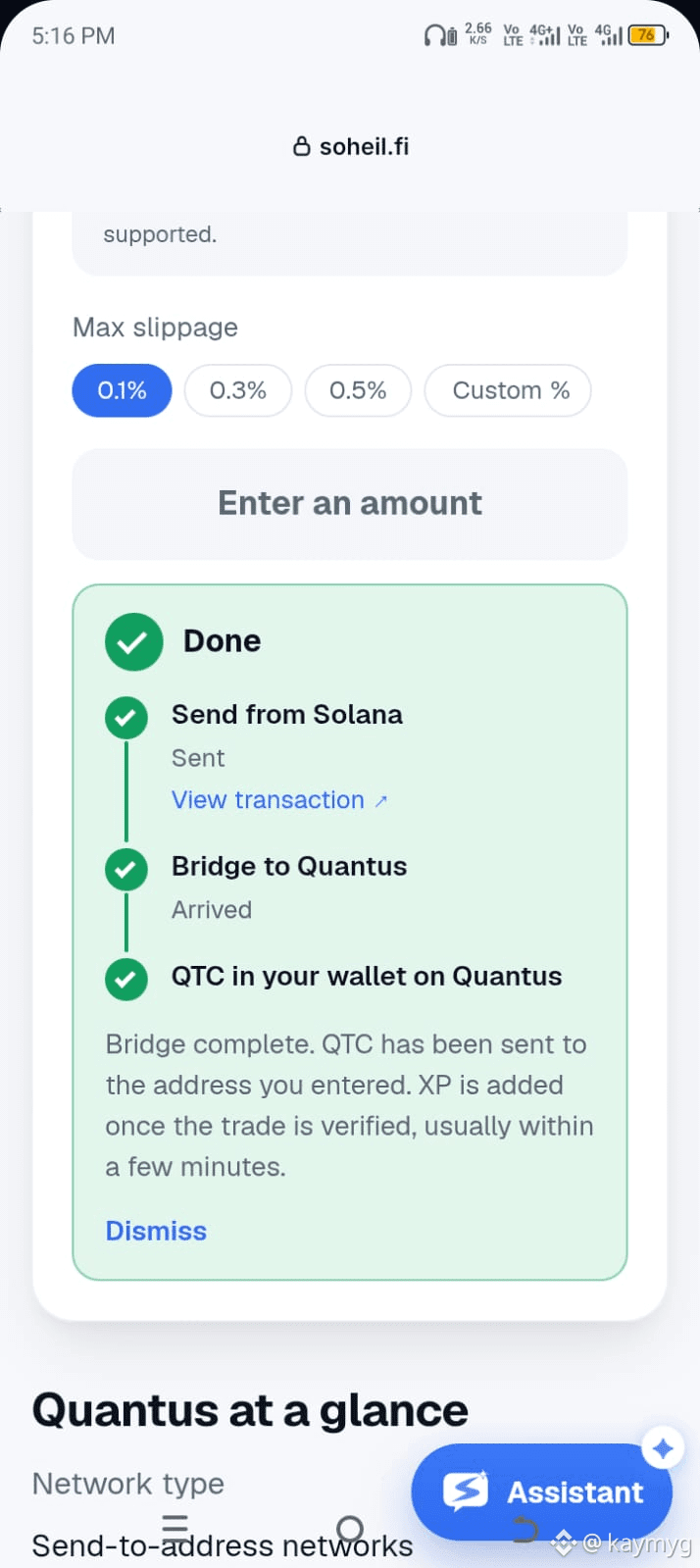
kaymyg
·
--
NEAR, Solana və Quantus arasındakı əlaqə
#Near Protocol-un #solana ekosistemi ilə inkişaf etməkdə olan qarşılıqlı fəaliyyət əlaqəsi var, #Quantus Network ($QTC) isə NEAR ilə daha birbaşa texniki və paylama əlaqəsinə malikdir. Bu üç layihə əsasən formal üçtərəfli tərəfdaşlıq vasitəsilə deyil, blokçeynlərarası aktiv köçürmələri, likvidliyə çıxış və ekosistemdə iştirak vasitəsilə əlaqəlidir.
1. NEAR Protocol ↔ Solana
Texniki əlaqə: NEAR Intents aktivlərin və likvidliyin Solana da daxil olmaqla blokçeyn ekosistemləri arasında hərəkət etməsinə imkan verən blokçeynlərarası tranzaksiya marşrutlaşdırmasını təmin edir.
1. NEAR Protocol ↔ Solana
Texniki əlaqə: NEAR Intents aktivlərin və likvidliyin Solana da daxil olmaqla blokçeyn ekosistemləri arasında hərəkət etməsinə imkan verən blokçeynlərarası tranzaksiya marşrutlaşdırmasını təmin edir.
12
Daha çox kontent araşdırmaq üçün daxil olun
Binance Square-də qlobal kriptovalyuta istifadəçilərinə qoşulun
⚡️ Kriptovalyuta haqqında ən son və faydalı məlumatları əldə edin.
💬 Dünyanın ən böyük kriptovalyuta birjası tərəfindən etibar edilir.
👍 Doğrulanmış yaradıcılardan gələn real məlumatları kəşf edin.
E-poçt/Telefon nömrəsi
Trenddə olan mövzular
1
#CanMarketsReboundAfterThanksgiving?
207,067 baxış
Müzakirə edir: 2,019
2
#TradFiForBeginners
1.2M baxış
Müzakirə edir: 6,247
3
#StellarAdds$80.4MTokenizedFundsInOneDay
4 baxış
Müzakirə edir: 2
4
#CouldSpaceX’sOrbitalDataCentersBoostAIChipDemand?
101,909 baxış
Müzakirə edir: 1,213
5
#SouthKoreaProposesMandatoryDigitalAssetTransactionDisclosure
5,526 baxış
Müzakirə edir: 114
6
#EvolveAtBinanceBlockchainWeek
854,918 baxış
Müzakirə edir: 10,613
7
#KoreaFSCSeeksPowerToSuspendCryptoListings
23,107 baxış
Müzakirə edir: 346
8
#SouthKoreaPlansToRequireTetherCircleLocalReserves
21,432 baxış
Müzakirə edir: 246
9
#UKFCAReportedlyPlansDeFiAuthorizationRules
16,130 baxış
Müzakirə edir: 143
10
#ZcashDevelopersUrgeZECMoveToIronwood
35,900 baxış
Müzakirə edir: 177