
#macrochannel
macrochannel
25 baxış
Müzakirə edir: 2
Populyar
Sonuncu
Məqalə
Tərcüməyə bax
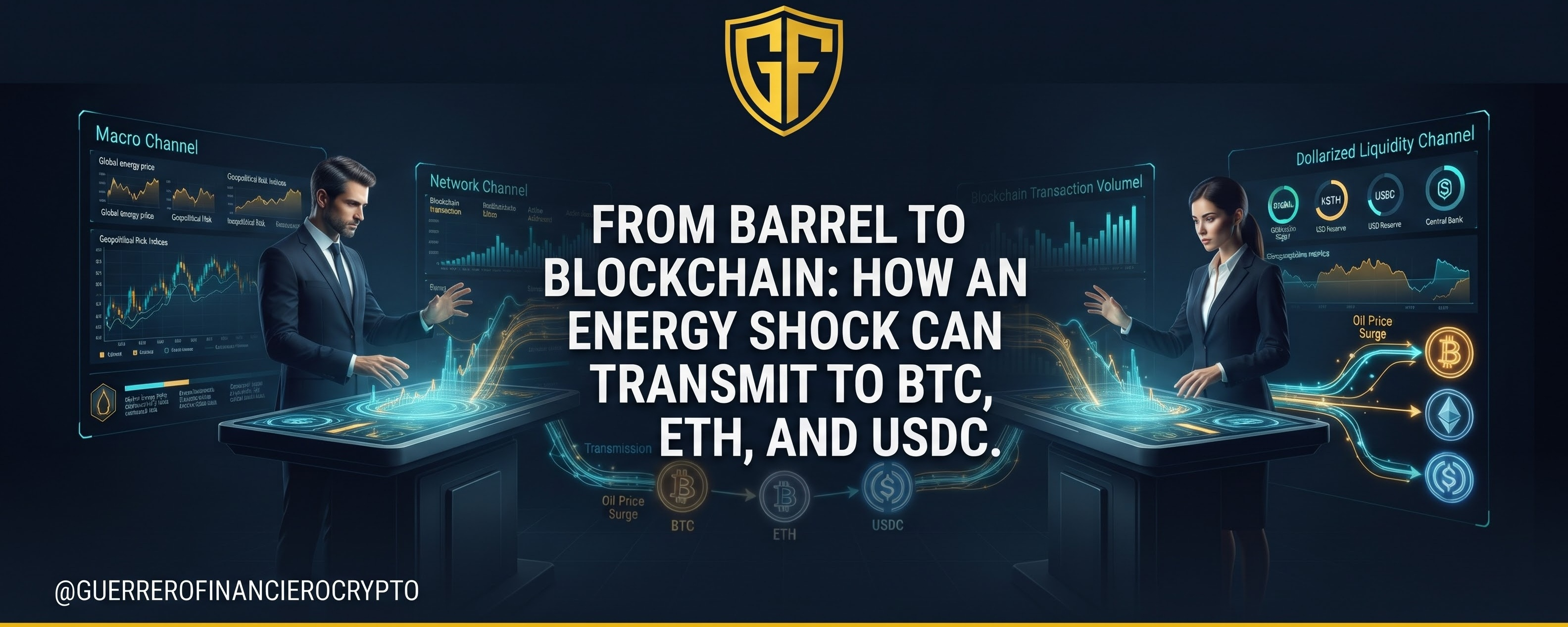
FROM BARREL TO BLOCKCHAIN: HOW AN ENERGY SHOCK CAN TRANSMIT TO BTC, ETH, AND USDCFOLLOW-UP CAPSULE #31 — "FROM BARREL TO BLOCKCHAIN: HOW AN ENERGY SHOCK CAN TRANSMIT TO BTC, ETH, AND USDC."
Author: @GUERREROFINANCIEROCRYPTO
What Changed Since Morning?
Following Morning Journal #54 on the shift in Hormuz friction from crude transit toward refining, freight, and insurance, this follow-up separates how different layers of the digital ecosystem absorb those variables: macro and global liquidity sensitivity in BTC, macro plus on-chain network activity in ETH, and dollarized liquidity demand in USDC, without assuming a mechanical price correlation with crude oil.
1. International Event: Assessments from the IEA (November 19, 2026) and CSIS (November 24, 2026) indicate that energy friction around the Strait of Hormuz spans refining bottlenecks, diesel, gasoline, jet fuel, maritime freight rates, and insurance premiums, even where crude transit shows partial recovery.
2. Traditional Market: When costs to refine and transport energy rise, transmission into traditional markets runs through inflation expectations across transport, production, and consumer goods, shaping interest rate pricing, yields, and US dollar dynamics.
3. Transmission Mechanism: Inside the digital ecosystem, this shock is observed across three distinct channels—macro, dollarized liquidity, and network activity—framed against verified Binance Spot against USDT data (snapshot at November 25, 2026, 04:06 UTC): BTC/USDT at 59,182.02 USDT (-1.84% over 24h vs. 60,289.94 USDT open; equivalent volume 1,129,628,635.89 USDT), ETH/USDT at 1,658.10 USDT (-2.18% over 24h vs. 1,695.08 USDT open; equivalent volume 460,044,567.38 USDT), and USDC/USDT at 1.00121 USDT (0.00% over 24h vs. 1.00116 USDT open; equivalent volume 1,955,641,122.63 USDT).
4. Specific Asset and Objective Boundary:
BTC: Evaluated primarily through the macro and global liquidity channel (inflation expectations, US dollar, yields, and rolling correlation with risk assets), distinguishing that Bitcoin is the network/protocol and $BTC is the native cryptocurrency, without directional price predictions.
ETH: Evaluated by combining macro conditions with native network activity (fees, transactions, decentralized applications, Layer-2 usage, and ETH/BTC dynamics), avoiding attributing every move solely to geopolitics or energy.
USDC: Evaluated as a stablecoin and USD liquidity gauge inside the digital ecosystem (demand for dollar liquidity, transfer volume, and stability around 1.00121 USDT), without higher usage or volume implying a directional bullish or bearish signal for BTC or $ETH .
Risk Management and Execution Discipline
1. Assess each asset through its actual transmission channel (macro for BTC, macro plus network activity for ETH, and dollarized liquidity for $USDC ) rather than trading a mechanical oil-price correlation.
2. Monitor liquidity, spreads, and leverage ahead of session shifts or macroeconomic releases.
3. Keep margin buffers conservative and ground execution in capital preservation.
Closing Note
The impact around Hormuz weighs more heavily on refining, freight, and insurance than on the isolated barrel, with distinct readings across liquidity and network activity. Is the pressure on crude oil or across the entire delivery chain? Follow the next installments of the radar to see how it evolves.
#PildorasTacticas #GuerreroFinanciero #BinanceSquare #Write2Earn #BTC #ETH #USDC #Liquidity #RiskManagement #MacroChannel #NetworkActivity #DollarLiquidity #Energy #Inflation
Educational and institutional risk-management. Does not constitute direct financial advice. Do your own research (DYOR
FROM BARREL TO BLOCKCHAIN: HOW AN ENERGY SHOCK CAN TRANSMIT TO BTC, ETH, AND USDC
FOLLOW-UP CAPSULE #31 — "FROM BARREL TO BLOCKCHAIN: HOW AN ENERGY SHOCK CAN TRANSMIT TO BTC, ETH, AND USDC."
Author: @GUERREROFINANCIEROCRYPTO
What Changed Since Morning?
Following Morning Journal #54 on the shift in Hormuz friction from crude transit toward refining, freight, and insurance, this follow-up separates how different layers of the digital ecosystem absorb those variables: macro and global liquidity sensitivity in BTC, macro plus on-chain network activity in ETH, and dollarized liquidity demand in USDC, without assuming a mechanical price correlation with crude oil.
1. International Event: Assessments from the IEA (November 19, 2026) and CSIS (November 24, 2026) indicate that energy friction around the Strait of Hormuz spans refining bottlenecks, diesel, gasoline, jet fuel, maritime freight rates, and insurance premiums, even where crude transit shows partial recovery.
2. Traditional Market: When costs to refine and transport energy rise, transmission into traditional markets runs through inflation expectations across transport, production, and consumer goods, shaping interest rate pricing, yields, and US dollar dynamics.
3. Transmission Mechanism: Inside the digital ecosystem, this shock is observed across three distinct channels—macro, dollarized liquidity, and network activity—framed against verified Binance Spot against USDT data (snapshot at November 25, 2026, 04:06 UTC): BTC/USDT at 59,182.02 USDT (-1.84% over 24h vs. 60,289.94 USDT open; equivalent volume 1,129,628,635.89 USDT), ETH/USDT at 1,658.10 USDT (-2.18% over 24h vs. 1,695.08 USDT open; equivalent volume 460,044,567.38 USDT), and USDC/USDT at 1.00121 USDT (0.00% over 24h vs. 1.00116 USDT open; equivalent volume 1,955,641,122.63 USDT).
4. Specific Asset and Objective Boundary:
BTC: Evaluated primarily through the macro and global liquidity channel (inflation expectations, US dollar, yields, and rolling correlation with risk assets), distinguishing that Bitcoin is the network/protocol and $BTC is the native cryptocurrency, without directional price predictions.
ETH: Evaluated by combining macro conditions with native network activity (fees, transactions, decentralized applications, Layer-2 usage, and ETH/BTC dynamics), avoiding attributing every move solely to geopolitics or energy.
USDC: Evaluated as a stablecoin and USD liquidity gauge inside the digital ecosystem (demand for dollar liquidity, transfer volume, and stability around 1.00121 USDT), without higher usage or volume implying a directional bullish or bearish signal for BTC or $ETH .
Risk Management and Execution Discipline
1. Assess each asset through its actual transmission channel (macro for BTC, macro plus network activity for ETH, and dollarized liquidity for $USDC ) rather than trading a mechanical oil-price correlation.
2. Monitor liquidity, spreads, and leverage ahead of session shifts or macroeconomic releases.
3. Keep margin buffers conservative and ground execution in capital preservation.
Closing Note
The impact around Hormuz weighs more heavily on refining, freight, and insurance than on the isolated barrel, with distinct readings across liquidity and network activity. Is the pressure on crude oil or across the entire delivery chain? Follow the next installments of the radar to see how it evolves.
#PildorasTacticas #GuerreroFinanciero #BinanceSquare #Write2Earn #BTC #ETH #USDC #Liquidity #RiskManagement #MacroChannel #NetworkActivity #DollarLiquidity #Energy #Inflation
Educational and institutional risk-management. Does not constitute direct financial advice. Do your own research (DYOR
2
116
Daha çox kontent araşdırmaq üçün daxil olun
Binance Square-də qlobal kriptovalyuta istifadəçilərinə qoşulun
⚡️ Kriptovalyuta haqqında ən son və faydalı məlumatları əldə edin.
💬 Dünyanın ən böyük kriptovalyuta birjası tərəfindən etibar edilir.
👍 Doğrulanmış yaradıcılardan gələn real məlumatları kəşf edin.
E-poçt/Telefon nömrəsi
Trenddə olan mövzular
1
#EvolveAtBinanceBlockchainWeek
1.6M baxış
Müzakirə edir: 16,980
2
#ColdcardFlawLeadsToTheftOfAtLeast1789BTC
19,461 baxış
Müzakirə edir: 223
3
#ChainflipVaultTheftHaltsProtocol
22,752 baxış
Müzakirə edir: 355
4
#VitalikWantsWalletChipDesignsOpened
32,536 baxış
Müzakirə edir: 416
5
#MalaysiaFirstBitcoinETFToListOnDecember2
12,986 baxış
Müzakirə edir: 162
6
#SECIssuesNoActionLetterOnMoleculeModel
2,349 baxış
Müzakirə edir: 31
7
#ClaudeAccusedOfDroppingUserPreferences
10,209 baxış
Müzakirə edir: 105
8
#DowJonesAdds591.99Points
18,431 baxış
Müzakirə edir: 105
9
#AnzaUrgesSolanaNodesUpgradeAgave
10,368 baxış
Müzakirə edir: 168
10
#EthereumGlamsterdamKeepsStorageFeeChange
55,016 baxış
Müzakirə edir: 531