
Arbitrage is one of the oldest investment strategies, and it involves monitoring market activity and identifying price fluctuations in different assets. By spotting arbitrage opportunities, traders can profitably trade stocks and other commodities.

Introduction:
In the world of finance, traders use various strategies to make profits from price differences in financial instruments. One such strategy is called "arbitrage trading." In this essay, we will explore what arbitrage trading is, the types of arbitrage trading, the risks associated with it, and conclude with some insights.
What is arbitrage trading?
Arbitrage trading is a method of trading that seeks to generate revenue by concurrently purchasing an asset in one market and selling it in another. This is most often done between identical assets that are traded on different exchanges. In theory, the price difference between these financial instruments should be zero since they are the same asset.
The primary challenge for an arbitrage trader, or arbitrageur, is not only identifying these pricing discrepancies but also executing trades quickly. As other arbitrage traders are likely to also recognize this price difference (the spread), the window of opportunity for profit typically closes very quickly.
Furthermore, since arbitrage trades generally involve low risk, the returns are correspondingly low. This implies that arbitrage traders not only need to act expeditiously but also require significant capital to make it worthwhile.
You may be wondering what types of arbitrage trading are available to cryptocurrency traders. There are a variety of approaches that can be exploited, so let's dive right in.
Types of arbitrage trading:
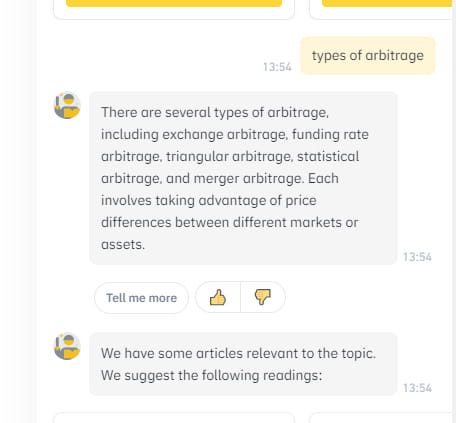
there are a multitude of arbitrage strategies utilized by traders in various markets worldwide, there are several distinct types that are particularly popular amongst cryptocurrency traders.
Exchange arbitrage
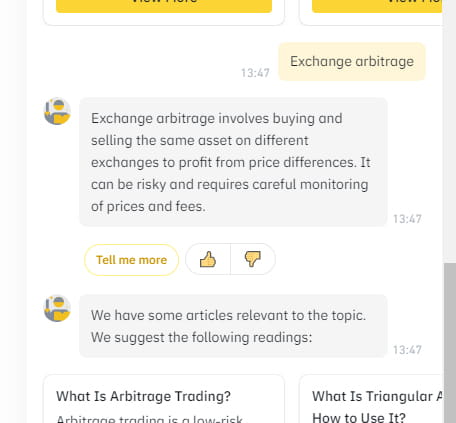
The most commonly utilized type of arbitrage trading is exchange arbitrage, which involves a trader purchasing a particular cryptocurrency asset on one exchange and then selling it on another.
Given the dynamic nature of cryptocurrency pricing, it's common to observe differences in the prices of the same asset on different exchanges. Arbitrage traders seek to capitalize on these discrepancies by exploiting the small differences between them. As a result, these inefficiencies in the market can provide a means of generating profit. Moreover, the fact that prices remain relatively consistent across various trading venues contributes to the overall efficiency of the underlying market.
So, how exactly does exchange arbitrage work in practice? Suppose there's a noticeable difference in the price of Bitcoin between two exchanges, such as Binance and another. In this case, an arbitrage trader would seek to purchase Bitcoin from the exchange with the lower price and then sell it on the exchange with the higher price. Timing and execution are both critical factors, as Bitcoin's maturity as a market often results in a very limited window of opportunity for exchange arbitrage strategies.
Funding rate arbitrage
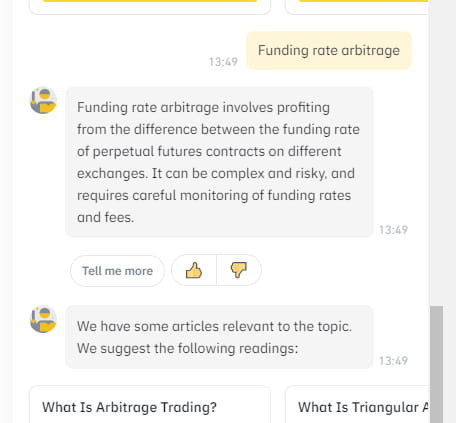
Funding rate arbitrage is another commonly used strategy by cryptocurrency derivatives traders. It involves purchasing a cryptocurrency and then hedging its price movement with a futures contract in the same cryptocurrency that has a lower funding rate than the cost of purchasing the cryptocurrency. The cost includes any fees that may be incurred from the position.
For instance, if you own some ether and you want to hedge your price exposure, you could sell a futures contract for the same value as your ether investment. If the funding rate for that contract pays you 2%, you would receive 2% for owning Ethereum without any price risk. This creates a profitable arbitrage opportunity.
Triangular arbitrage
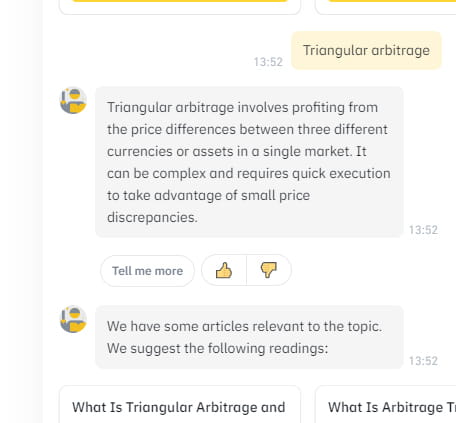
Triangular arbitrage is a commonly used strategy in the cryptocurrency market where a trader exploits a price discrepancy between three different cryptocurrencies. This involves exchanging them for one another in a loop to profit from the price difference.
For instance, let's say there's a price difference between Bitcoin, Ethereum, and Binance Coin (BNB). An arbitrage trader can buy Bitcoin with BNB, then buy Ethereum with Bitcoin, and finally sell Ethereum for BNB. If the relative value between Ethereum and Bitcoin doesn't match the value each of those currencies has with BNB, then there is an opportunity for arbitrage.
This type of arbitrage requires careful timing and execution, as well as a good understanding of the market and the currencies involved. Triangular arbitrage can be lucrative, but it can also be risky, especially if the trader is not experienced or the market is volatile.
Statistical arbitrage
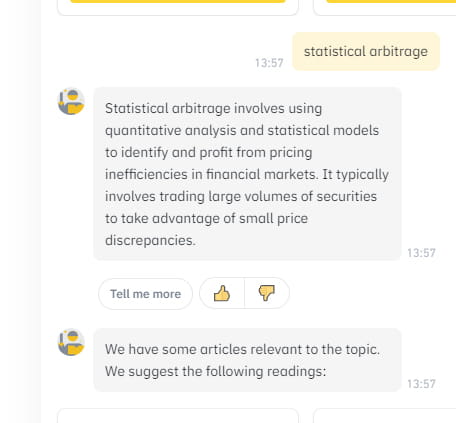
Statistical arbitrage, also known as pairs trading, is a type of trading strategy that involves identifying pairs of assets with a high correlation between them and taking advantage of any temporary price divergences between the two.
This strategy is often used by traders who are looking to profit from short-term market inefficiencies, and it relies heavily on statistical analysis and mathematical models to identify potential trades.
In the context of cryptocurrency trading, statistical arbitrage can be particularly useful when trading pairs of cryptocurrencies that are highly correlated, such as BTC/ETH or LTC/BTC. By identifying patterns in the price movements of these assets, traders can look for opportunities to buy one asset and sell the other in anticipation of a future price convergence.
Merger arbitrage
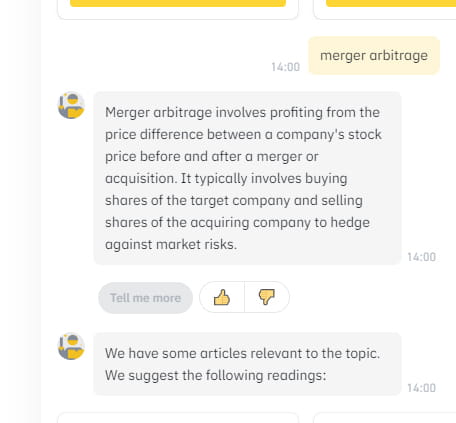
Merger arbitrage is a type of investment strategy that seeks to profit from the price movements of companies involved in a merger or acquisition. The goal of this strategy is to buy shares of the target company at a discount to the offer price, and then sell them for a profit after the merger is completed. This strategy involves a lot of research and analysis of the companies involved, as well as an understanding of the merger process and the risks involved. The key to success with merger arbitrage is to identify companies that are likely to be involved in a merger or acquisition, and to buy and sell their shares at the right times in order to maximize returns.
What are the risks involved in Arbitrage trading ?
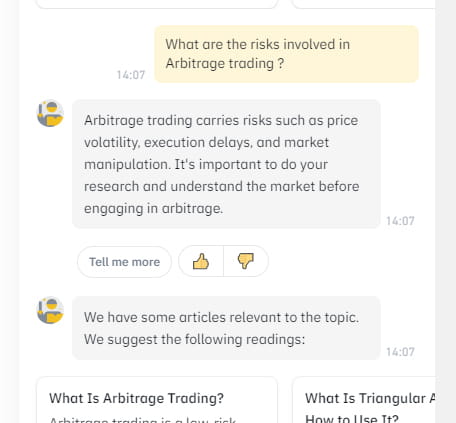
Arbitrage trading carries several risks, including market risk, execution risk, and liquidity risk. Market risk refers to the possibility that the prices of the assets being traded will move against the trader, resulting in losses. Execution risk refers to the risk that the trade may not be executed at the desired price due to market conditions or technical issues. Liquidity risk refers to the possibility that the trader may not be able to buy or sell an asset at the desired price due to a lack of market liquidity.
Additionally, there is counterparty risk, which refers to the possibility that the other party in the trade may not fulfill their obligations, such as failing to deliver the asset being traded or failing to pay for it. There is also regulatory risk, as arbitrage trading may be subject to changes in regulations, which can affect the profitability of the trade.
Furthermore, there is operational risk, which refers to the risk of loss resulting from inadequate or failed internal processes, systems, human errors, or external events. Lastly, there is systemic risk, which refers to the risk that the market itself may experience significant volatility or disruption that affects all participants, including arbitrage traders.
Conclusion
arbitrage trading can be a profitable trading strategy if executed properly. However, it is essential to understand the risks associated with this strategy and to have a thorough understanding of the financial instruments being traded. As with any trading strategy, it is important to do your due diligence and conduct thorough research before investing.
#askbinancesensei #trading #educational #Binance #dyor
Source: Binance Sensei / binance academy
image Source:
If you enjoy our content and want to show your support, please like, share, and follow us for more high-quality updates.
Disclaimer
The views and opinions expressed by the author, or any people mentioned in this article, are for informational purposes only, and they do not constitute financial, investment, or other advice. Investing in or trading crypto assets comes with a risk of financial loss.