

Ask anyone in crypto about control and you get one answer: self-custody. Traditional banks work the opposite way. Their business is holding someone else's money and answering to regulators. When a two-century-old bank starts testing blockchain rails, the question isn't who keeps a private key. It's how control splits among the bank, the tech vendor, and government supervisors. #Web3Banking
Look at KeyBank (KeyCorp). Based in Cleveland with roots going back to 1825 and 1849, the bank reported about $191 billion in assets as of June 30, 2026 (Confirmed, KeyCorp, 2026). Many people ask if KeyBank sells Bitcoin yet, which misses what is happening. Retail crypto trading is just a storefront. #KeyBank is looking at the plumbing behind its balance sheet. A July 2025 report mentioned plans for third-party Bitcoin trading and custody, though we found no proof that service ever launched (Not found as of November 2026; not found does not mean non-existent). The real move is quieter: tokenized deposits.
A tokenized deposit is not a new coin or a private stablecoin. It is the same dollar sitting in your checking account, wrapped as a digital token that moves 24/7 between approved banks. No waiting for wire cutoffs or Monday morning openings. Money moves and settles right away under rules programmed on the network.
KeyBank is not relying on a single vendor. It has joined three separate efforts:
Cari Network: Founded in 2025 by former Comptroller of the Currency Gene Ludwig, Cari is a private, permissioned Layer 2 running on ZKsync's Prividium stack, anchored to Ethereum and built for tokenized deposits. KeyBank joined as one of six design-partner banks in September 2025. On September 2, 2026, Cari announced an initial $32.5 million bank-led funding tranche; Pulse 2.0 reported all six design partners, including KeyBank, participated (Reported, Pulse 2.0, September 2026). There are no public volume numbers yet since it remains in pilot and pre-production, though a November 6, 2026 report notes about 30 banks have signed on, around 50 more are in talks, and design partners are expected to go live by year-end (Reported, GARP, November 2026).
FIS Project Keystone: Announced on April 30, 2026 with Citizens, Fifth Third, Huntington, and M&T, using FIS's Lyriq platform to issue and settle regulated digital deposits run together by the member banks (Confirmed, FIS, April 2026).
The Clearing House: Backed by 25 U.S. financial institutions, its on-chain money initiative picked Quant as its tech partner on September 24, 2026 (Confirmed, The Clearing House, September 2026).
This measured pace matches what CEO Chris Gorman told CNBC in July 2025; he acknowledged stablecoins have potential, but warned that deposit flight is a medium-term risk to watch, and raised concerns over transparency and anti-money-laundering controls (Reported, CNBC, July 2025).
To see what runs inside Cari Network, look at ZKsync and Prividium. ZKsync is an Ethereum Layer 2 that bundles transactions off the main chain and generates math proofs showing each batch followed the rules. On top of that sits Prividium, a commercial licensed product that promises user privacy, role-based compliance and auditing, Ethereum settlement, and 24/7 uptime (Vendor claim, ZKsync official documentation).
Because it runs like a Validium, transaction details and account balances stay off-chain in a database controlled by the operator. Ethereum receives only state roots and STARK proofs. The operator runs the sequencer, the prover, and the database, screening requests through an RPC Proxy tied to enterprise logins (such as Okta) with selective disclosure for auditors. In plain terms, Prividium gains privacy and access control over Ethereum L1 by giving up public data availability, open entry, censorship resistance, and independent exit.
For a regular bank customer, that is a clear trade. Your account activity stays hidden from outsiders, yet you still trust the bank and its auditors. Put a Prividium-style chain next to public Ethereum L1 and a standard bank ledger, and here is how the keys split across five areas, based on what we observed:
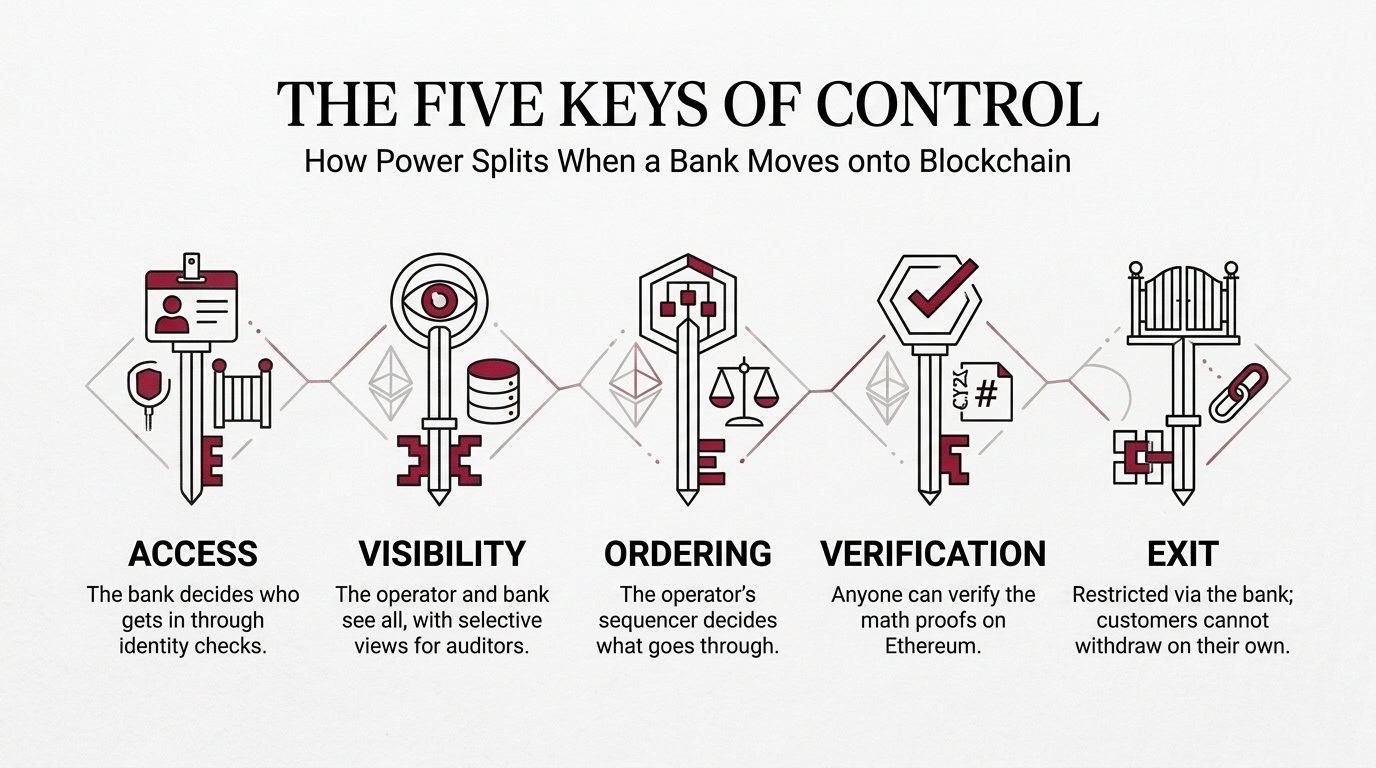
Access (the bank): Ethereum L1 is open to anyone, while a legacy ledger is closed. On this rail, the bank decides who gets in through identity checks.
Visibility (the operator, the bank, and the regulator): Public Ethereum shows every transaction, and an internal bank ledger hides everything outside. Here the operator and bank see the full picture; while auditors get selective views.
Ordering (the operator). No single party controls transaction order on Ethereum L1, and a bank handles everything in-house. On Prividium, the operator's sequencer decides what goes through or gets blocked.
Verification (anyone on the public network): Unlike a closed internal ledger, anyone can verify the proofs posted to Ethereum, even though they cannot see private balances or re-run transactions as on L1.
Exit (the operator and bank backing): ZKsync's own docs warn that if a user gets blocklisted or data goes offline, funds can get stuck on Layer 2. Your money is not stolen because it remains backed as a regulated bank deposit, but you cannot pull it out on your own without going through the bank.
The bank and the operator hold the keys to daily operations, regulators hold the oversight key, and customers walk away with a math verification key.
European banks such as Deutsche Bank have explored both fund tokenization (DAMA 2) and institutional custody (Confirmed and Reported, 2025–2026). U.S. regional banks are taking a different path: closed peer networks where vetted institutions settle directly under shared rules. If this model wants credibility outside banking circles, KeyBank's team still needs to answer three practical questions:
Governance: On a network shared by dozens of banks, how do rule changes or account freezes happen: by member vote, or at the operator's sole discretion?
Interoperability: How will tokenized deposits on separate rails like Cari Network and Project Keystone connect with each other?
Customer verification: If a dispute breaks out with the operator, what can a customer or a court verify on its own?
Solid answers on governance, interoperability, and independent audits would go a long way toward making these rails worth trusting.
We at @DAO Labs write to keep the Web3 community informed.
Disclaimer: Independent research based on public sources. No affiliation, sponsorship, or endorsement from any organization mentioned. For informational purposes only; not financial, legal, or investment advice.
Sources
KeyCorp, Get to Know Key — Company Overview (data as of June 30, 2026): https://www.key.com/about/company-information/key-company-overview.html
ZKsync Docs, Prividium™ Overview, Architecture, Features & Transaction Filtering (2026): https://docs.zksync.io/zk-stack/prividium/overview and https://docs.zksync.io/zk-stack/prividium/architecture
FIS via Business Wire, Project Keystone and Lyriq platform (April 30, 2026): https://www.businesswire.com/news/home/20260430729662/en/FIS-and-Leading-Financial-Institutions-to-Build-Their-Own-Digital-Tokenized-Money-Network
The Clearing House / PR Newswire, Quant selected for On-Chain Money Initiative (September 24, 2026): https://www.prnewswire.com/news-releases/the-clearing-house-partners-with-quant-to-advance-the-on-chain-money-initiative-302888598.html
Pulse 2.0 / GARP / FF News, Coverage on Cari Network and $32.5M tranche (September and November 2026): https://pulse2.com/cari-raises-32-5-million-from-banks-to-scale-tokenized-deposit-network/ and https://www.garp.org/risk-intelligence/technology/ormer-regulator-rallies-261106
CNBC / coverage of Chris Gorman remarks (July 2025): https://www.cnbc.com/video/2025/07/23/watch-cnbcs-full-interview-with-keycorp-ceo-chris-gorman.html
Deutsche Bank / Unchained, Project DAMA and institutional custody (2025–2026): https://corporates.db.com/more/latest-news/deutsche-bank-launches-digital-asset-custody-solution-for-institutional-and-corporate-clients