

Crypto was born as a way around the system. So it feels strange to say this, but I believe the next big growth wave will come from clear rules, not from rebellion. Here is my case, with what actually happened in 2026.
Quick Facts
US GENIUS Act (2025) set federal rules for payment stablecoins.
The CLARITY Act passed the House 294-134 but stalled in the Senate in September 2026.
The EU's MiCA transition period ended on 1 July 2026.
Cambodia adopted a licensing Prakas and issued a joint NBC-SERC statement in 2026.
01 Big Money Needs Rules
Pension funds, banks and insurers manage trillions, but they can only buy what their rules allow. Clear laws tell them who regulates what, how assets are held and what happens if something fails. Without that, they stay out.
02 Where the Rules Stand in 2026

Progress is real but uneven:
United States: the GENIUS Act became law in 2025 for stablecoins. The CLARITY Act for market structure cleared the House and a Senate committee, but a Senate procedural vote failed 49-50 on 15 September 2026.
European Union: MiCA is fully in force; by June 2026 only about 210 of more than 1,200 previously registered firms had full authorisation.
Cambodia: a SERC licensing framework and a joint NBC-SERC statement, with a wider law in drafting.
03 Rules Reshape Market Structure
When rules arrive, weak players leave and strong ones consolidate. MiCA is a clear example: hundreds of firms could not meet the bar. That is painful in the short term, but it leaves a smaller group of trusted platforms with deeper liquidity.
04 Why Regulated Exchanges Pull Ahead
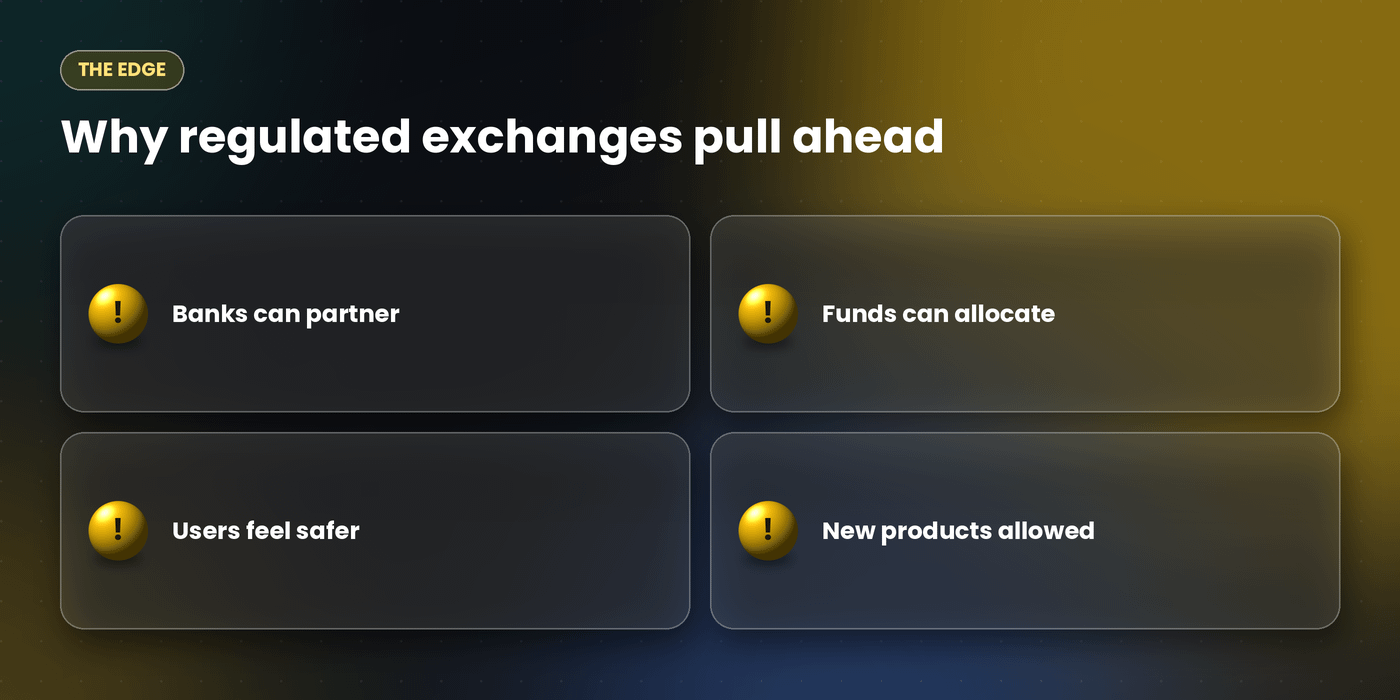
A licence is more than a badge. It lets an exchange partner with banks, list new products and serve institutions. Binance offers its TradFi perpetuals through an entity regulated in Abu Dhabi, and its US stock product runs through a regulated broker. Those products only exist because of regulation.
05 How Compliance Unlocks Users
For ordinary people, rules mean recourse: clear custody, proof of reserves and someone to complain to. In my sessions, the first question newcomers ask is "Is it legal here?" When the answer becomes a simple yes, many more will join.
06 The Other Side
Regulation can also slow things down. The US bill stalled, and the EU rules forced some exchanges, including Binance, to step back from parts of Europe. Rules help only when they are clear and workable.
Bottom Line
The industry should not fear regulation. Done well, it is the bridge that brings institutional money and the next billion users into crypto. I would rather build on clear rules than live in a grey zone.
This article is for information only and is not financial advice.