Did AI just break the math that protects Bitcoin?
This week AI labs dropped math papers: OpenAI published nine manuscripts Nov 24, claiming a matrix-multiplication exponent of 2.25; Google followed Nov 25 with six Cogentic papers on integer factorization; Anthropic and OpenAI both claimed proofs of Valiant's 1979 VP ≠ VNP conjecture.
Then the rumor: theorist Scott Aaronson wrote Nov 25 that sources say AI labs are holding back cryptographic discoveries, possibly a polynomial-time factoring algorithm. He stressed he has NOT seen details and has no confirmation; neither lab has confirmed or denied anything. Nature headlined: "Has AI just cracked Internet encryption?"
Most headlines skip this: $BTC does not use RSA. Bitcoin wallets run on ECDSA and Schnorr over secp256k1, so factoring would not crack them. Exposed instead: Arweave's RSA proofs, some zk-logins, MPC custody.
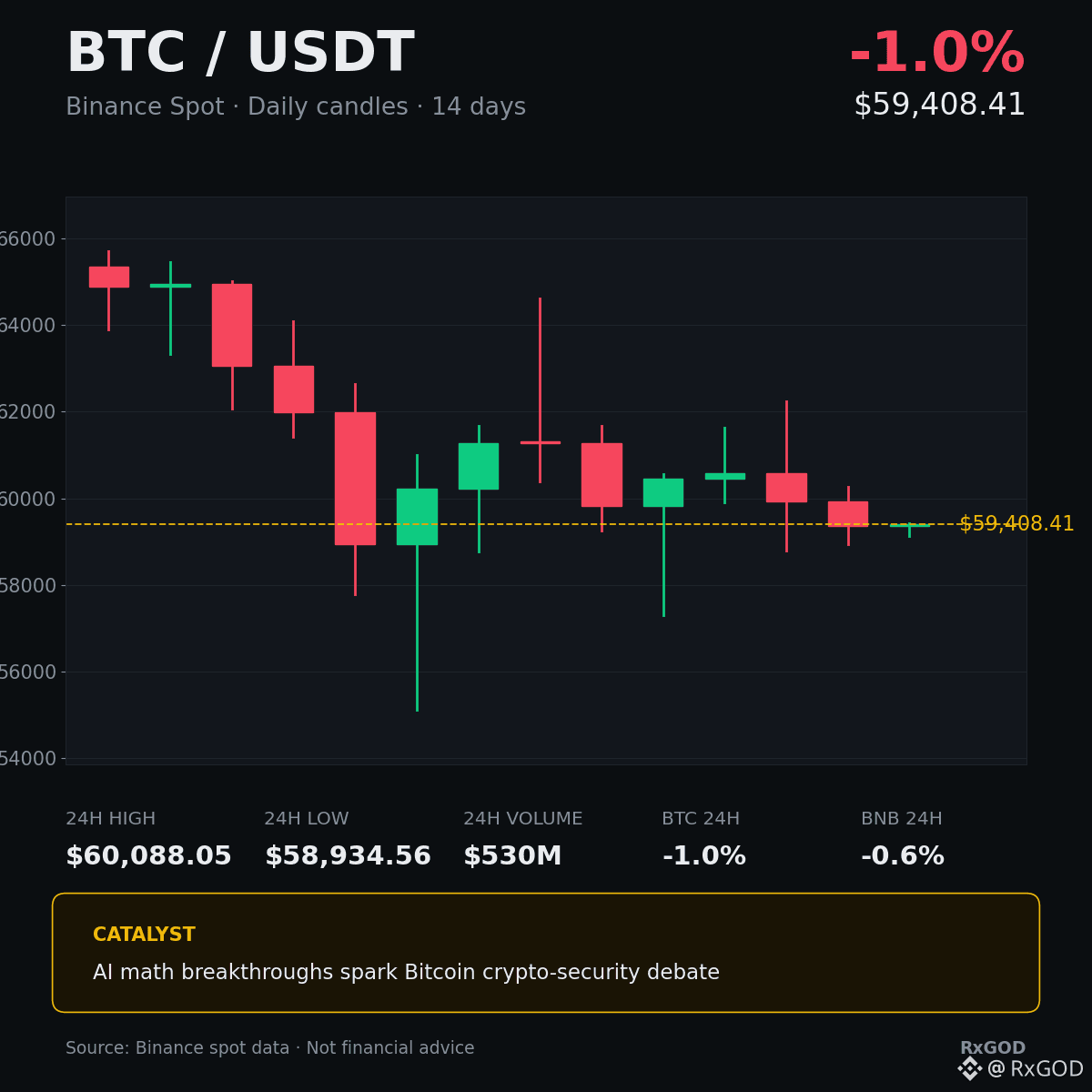
The deeper worry is real: Glassnode puts 7.12 million BTC — 35.4% of supply — in addresses vulnerable if elliptic-curve crypto ever broke. The Ethereum Foundation rates AI a bigger threat than quantum, doubling its post-quantum team. The market is shrugging: BTC $59,408, -0.96% in 24h, at 40% of its 14-day band ($55,130–$65,696). Fear & Greed 11 — Extreme Fear.
Honest read: VP ≠ VNP is about computational limits, not a break, and the factoring rumor is unverified — but AI's math pace is a variable holders can't ignore. Will AI crack Bitcoin's cryptography within five years, or is this another quantum-style scare? If ECC ever fell, would you move to a quantum-resistant address or sell first?
Not financial advice — DYOR.
#Bitcoin #AICrypto #ExtremeFear #CryptoNews