
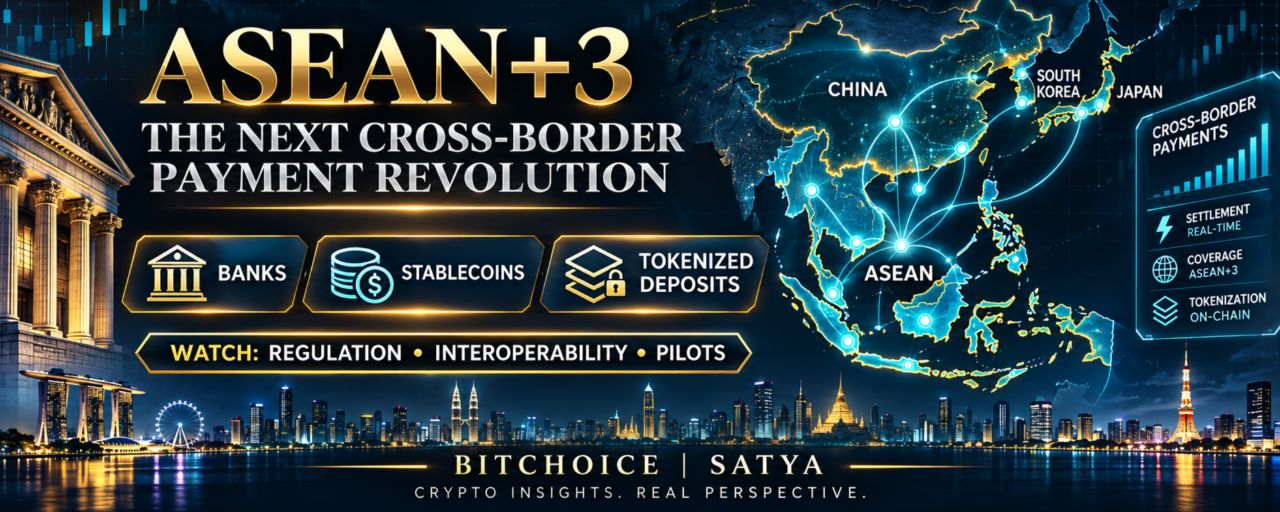

ASEAN+3: THE NEXT CROSS-BORDER PAYMENT REVOLUTION
Can Asia reshape the infrastructure of international money transfers?
November 28, 2026 | BITCHOICE | SATYA
A significant development in global digital finance is taking shape in Asia.
On November 25-26, finance and central bank deputies from ASEAN, China, Japan and South Korea met in Kyoto and agreed to establish a dedicated regional initiative under AMRO.
The objective is to improve cross-border payment connectivity and advance cooperation on digital asset regulation.
The decision deserves attention from both traditional financial institutions and the cryptocurrency industry.
01 | WHAT HAS ACTUALLY CHANGED?
ASEAN+3 has established a formal mechanism for continued cooperation on digital payments.
The AMRO Cross-Border Digital Payments Program will bring together policymakers to examine retail and wholesale payment connectivity and regulatory approaches to digital assets.
This is an important institutional step, but it is not the launch of a unified cryptocurrency payment network.
No specific blockchain or native token has been selected.
02 | WHY ASIA IS A CRITICAL MARKET
Asian economies are deeply connected through manufacturing, international trade, tourism and remittances.
Yet international payments can still involve multiple intermediaries, currency conversion costs and operational delays.
Greater interoperability between national payment systems could reduce these inefficiencies.
Businesses could benefit from faster settlement and improved working capital management, while consumers could gain access to more convenient international transfers.
03 | THE INFRASTRUCTURE ALREADY EXISTS
The region is not starting from zero.
Existing initiatives include cross-border QR payments, local currency settlement arrangements and domestic instant payment systems.
Project Nexus, developed through the BIS Innovation Hub, provides a model for connecting national instant payment networks through shared technical standards.
The new ASEAN+3 initiative could complement these developments by addressing remaining regulatory and operational barriers.
04 | WHERE DO STABLECOINS FIT?
Stablecoins represent one possible technological approach to international payments.
They can support continuous settlement, programmable transfers and potentially more efficient liquidity management.
However, their adoption depends on regulatory approval, reliable reserves, redemption mechanisms, custody and compliance.
Authorities must also consider the implications for monetary sovereignty and financial stability.
Stablecoins will compete with tokenized bank deposits and improved conventional payment systems.
Blockchain is an option, not an inevitable outcome.
05 | WHO COULD CAPTURE THE ECONOMIC VALUE?
The potential beneficiaries extend across multiple industries:
Banks and regulated payment institutions.
Fintech infrastructure providers.
Stablecoin issuers.
Blockchain settlement networks.
Foreign exchange and liquidity providers.
Compliance and interoperability services.
The strongest business models may belong to providers capable of reducing payment costs while satisfying institutional regulatory requirements.
06 | DOES THIS CREATE DEMAND FOR XRP OR XLM?
XRP Ledger and Stellar are relevant examples of blockchain infrastructure designed to support financial transfers and asset issuance.
However, neither network has been officially selected for the ASEAN+3 initiative.
Even if public blockchain infrastructure becomes part of a future solution, native token demand will depend on the technical architecture and economic design of that system.
Payment volume does not automatically translate into proportional token demand.
Investors should distinguish technological relevance from confirmed institutional adoption.
07 | WHAT SHOULD WE MONITOR NEXT?
The most important developments will be:
Official working group recommendations.
Stablecoin regulatory frameworks.
Local currency settlement expansion.
Technical interoperability standards.
Confirmed infrastructure partnerships.
Pilot programs and production deployments.
Actual settlement volumes and transaction costs.
These indicators will help separate political announcements from economically meaningful implementation.
BITCHOICE PERSPECTIVE
The ASEAN+3 initiative is another indication that international financial infrastructure is evolving.
The long-term opportunity is not simply about moving money onto blockchains.
It is about making different financial systems interoperable while preserving trust, regulatory compliance and economic efficiency.
The winners will be determined by real adoption and sustainable value capture, not speculative narratives.
PAYMENT CONNECTIVITY DOES NOT GUARANTEE TOKEN DEMAND.
DATA OVER HYPE.
Sources:
Japan Ministry of Finance, November 26, 2026.
AMRO, Cross-Border Payments Program and policy research.
BIS Innovation Hub, Project Nexus.
Reuters, November 26, 2026.
BITCHOICE | SATYA
CRYPTO INSIGHTS. REAL PERSPECTIVE.
#DigitalPayments #Stablecoins #Tokenization #ASEAN $USDT $USDC
