

Building a More Connected Liquidity Infrastructure on TRON
The development of decentralized finance is not just about creating more trading platforms. It is about building infrastructure that makes liquidity easier to access, capital more efficient and decentralized financial services more useful.
This is where SUN.io's development deserves attention.
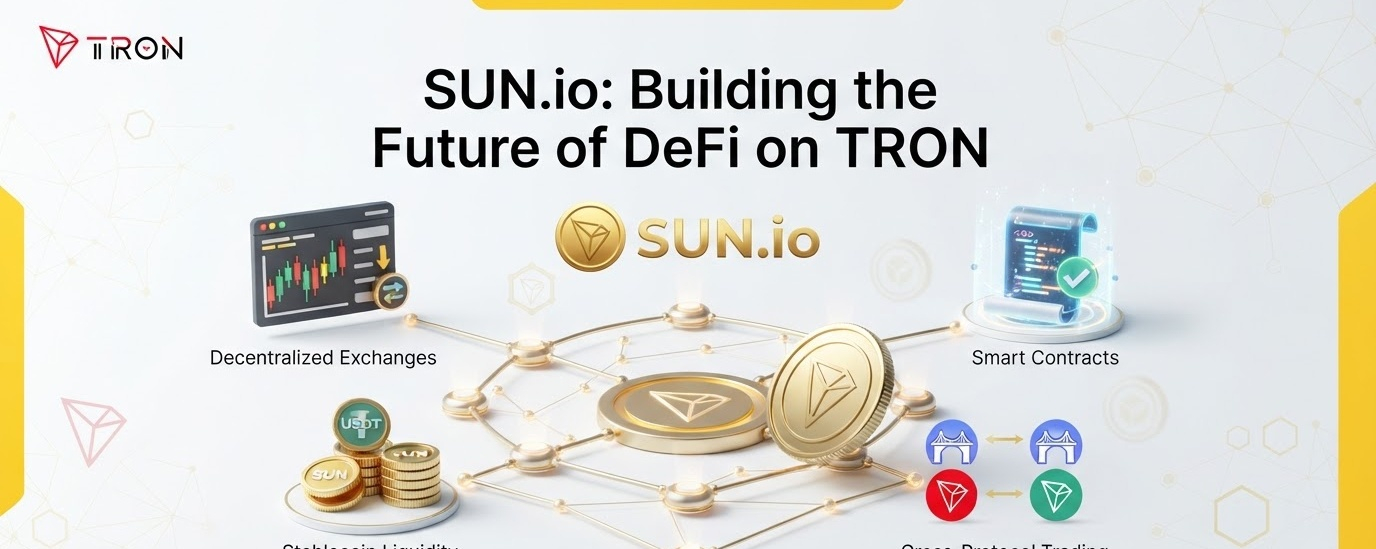
SUN.io has evolved beyond its original identity as a token-swapping platform. Its expanding DeFi architecture now brings together decentralized trading, stablecoin exchanges, liquidity provision, governance and token incentive mechanisms within the TRON ecosystem.
1. SunSwap V4: Improving Decentralized Trading
One of the most important developments is the introduction of SunSwap V4 in March 2026.
Its architecture incorporates Hooks, Singleton and Flash Accounting. These features expand the possibilities for customized trading mechanisms, improve transaction execution and help optimize resource consumption.
This matters because the future of decentralized exchanges will depend not only on available liquidity but also on how efficiently that liquidity can be accessed and utilized.
2. Universal Router: Connecting Liquidity Across Protocols
SUN.io's Universal Router represents another important step.
Instead of requiring users to manually navigate different liquidity pools, the router can identify optimal trading paths across supported protocols and execute multi-hop swaps within a single transaction.
The October 2026 router upgrade also introduced Permit2, providing a more streamlined token-authorization experience.
This is an important improvement in reducing friction for DeFi users.
3. Stablecoin Liquidity and Financial Utility
Stablecoin trading remains an important part of the TRON DeFi ecosystem.
Through SunCurve and its Peg Stability Module, SUN.io supports stablecoin exchange mechanisms designed to provide efficient swaps and, where applicable, lower slippage.
These services are particularly relevant in an ecosystem where stablecoins play an important role in transferring value and accessing decentralized financial applications.
4. SUN Tokenomics and Community Governance
SUN's role extends beyond market trading.
Through veSUN, users who lock SUN can participate in governance decisions, influence liquidity mining allocations and access eligible protocol fee-sharing mechanisms.
SUN.io also operates a recurring buyback-and-burn programme funded by revenue from its ecosystem products.
By October 2026, the platform had completed 52 buyback-and-burn rounds, with cumulative burns exceeding 685 million SUN.
The important distinction is that token burns are only one part of the broader economic model. Sustainable value creation also depends on actual product usage, trading activity and continued demand for liquidity services.
5. Measuring Real DeFi Activity
The network data provides another perspective on the platform's development.
According to TRONSCAN, on November 26, 2026, SUN.io recorded approximately:
- $499.09 million in total value locked.
- $53.04 million in daily trading volume.
- 9,450 transactions.
- 3,003 active accounts.
- 27,400 liquidity pools.
These figures offer a useful snapshot of the infrastructure's activity and scale.
My Perspective
What makes SUN.io interesting is the direction of its development.
It is building an interconnected DeFi environment where trading, liquidity management, stablecoin exchange, governance and token economics support different parts of the same ecosystem.
For me, the most important measure of its progress will be whether these improvements translate into sustained liquidity, stronger user participation and greater demand for decentralized financial services on TRON.
SUN.io's long-term opportunity is not simply to process more swaps. It is to become an increasingly useful part of the financial infrastructure supporting TRON's DeFi economy.
That is the development worth watching.