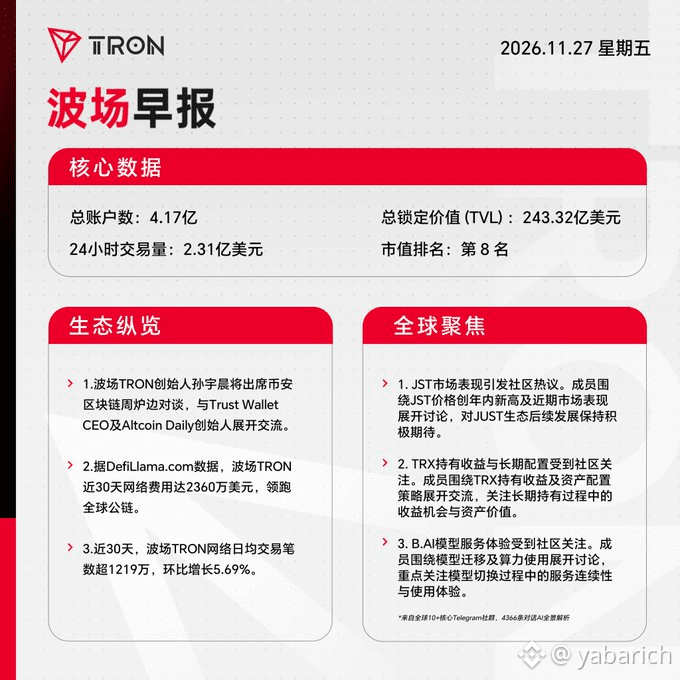
𝗧𝗥𝗢𝗡 𝗗𝗔𝗜𝗟𝗬 𝗕𝗥𝗜𝗘𝗙 — 𝗡𝗢𝗩𝗘𝗠𝗕𝗘𝗥 𝟮𝟳, 𝟮𝟬𝟮𝟲: 𝗖𝗔𝗡 𝟰𝟭𝟳 𝗠𝗜𝗟𝗟𝗜𝗢𝗡 𝗔𝗖𝗖𝗢𝗨𝗡𝗧𝗦 𝗧𝗥𝗔𝗡𝗦𝗟𝗔𝗧𝗘 𝗜𝗡𝗧𝗢 𝗦𝗨𝗦𝗧𝗔𝗜𝗡𝗔𝗕𝗟𝗘 𝗡𝗘𝗧𝗪𝗢𝗥𝗞 𝗘𝗖𝗢𝗡𝗢𝗠𝗜𝗖𝗦?
TRON's latest daily report highlights the convergence of expanding network participation, recurring transaction activity, decentralized finance and AI-powered services.
What stands out is the relationship between transaction growth and network fee generation.
Over the past 30 days, TRON reportedly generated $23.6 million in network fees while processing more than 12.19 million transactions per day on average.
For an established blockchain, sustainable competitiveness increasingly depends on the ability to translate technical capacity and ecosystem adoption into recurring economic activity.
The November 27 report provides an opportunity to examine that relationship alongside developments involving JUST, TRX and B.AI.
𝗧𝗥𝗢𝗡'𝗦 𝗟𝗔𝗧𝗘𝗦𝗧 𝗡𝗘𝗧𝗪𝗢𝗥𝗞 𝗗𝗔𝗧𝗔 𝗔𝗡𝗗 𝗘𝗖𝗢𝗦𝗬𝗦𝗧𝗘𝗠 𝗗𝗘𝗩𝗘𝗟𝗢𝗣𝗠𝗘𝗡𝗧𝗦
According to the November 27 morning report:
• Total accounts: 417 million. • Reported total value locked: $24.332 billion. • Reported 24-hour trading volume: $231 million. • Market capitalization ranking: 8th. • Network fees over the past 30 days: $23.6 million. • Average daily transactions over the past 30 days: More than 12.19 million. • Average daily transaction growth versus the preceding period: 5.69%.
The report also highlights several important ecosystem developments:
• TRON founder Justin Sun will participate in a Binance Blockchain Week panel alongside Trust Wallet's CEO and the founder of Altcoin Daily.
• Community discussions surrounding JST focus on its recent market performance, reported yearly price high and expectations for the JUST ecosystem.
• TRX holders are increasingly discussing holding returns, asset allocation strategies and long-term economic utility.
• B.AI community discussions focus on model migration, computing resource utilization and service continuity when switching between AI models.
These developments reflect several complementary areas of blockchain adoption: financial infrastructure, asset management, user accessibility and artificial intelligence.
Cross-checking the report against public blockchain data reveals:
• TRONSCAN total accounts: 417,114,884. • Daily active accounts: 4,995,433. • Average daily active accounts over 30 days: 4,833,563. • Average daily transactions over 30 days: 12.19 million. • DefiLlama's 30-day TRON chain fees: $23.71 million.
The independently checked transaction and account figures broadly support the morning report.
However, DefiLlama reports a DeFi TVL of $4.388 billion as of November 26, significantly different from the $24.332 billion TVL presented in the morning report.
The two figures should not be treated as directly comparable without confirming their respective calculation methodologies.
Sources: https://tronscan.org/data/charts/txn/daily-txn https://tronscan.io/blockchain/accounts https://defillama.com/chain/tron https://defillama.com/fees/chain/tron
𝗠𝗬 𝗣𝗘𝗥𝗦𝗢𝗡𝗔𝗟 𝗩𝗜𝗘𝗪: 𝗧𝗥𝗢𝗡'𝗦 𝗧𝗥𝗔𝗡𝗦𝗔𝗖𝗧𝗜𝗢𝗡 𝗖𝗢𝗠𝗣𝗢𝗦𝗜𝗧𝗜𝗢𝗡 𝗥𝗘𝗩𝗘𝗔𝗟𝗦 𝗠𝗢𝗥𝗘 𝗧𝗛𝗔𝗡 𝗜𝗧𝗦 𝗧𝗢𝗧𝗔𝗟 𝗩𝗢𝗟𝗨𝗠𝗘
I believe transaction composition provides a particularly valuable perspective on TRON's economic development.
According to TRONSCAN, on November 25, 2026, the network processed 12,521,807 transactions, distributed across the following activities:
• TRX transfers: 4,073,519 — 32.55%. • Resource delegation and reclamation: 3,881,317 — 30.99%. • USDT transfers: 2,348,121 — 18.75%. • Staking and unstaking: 1,750 — 0.01%. • Voting: 1,377 — 0.01%. • Other transactions: 2,215,723 — 17.69%.
Three important observations emerge from these figures.
First, TRX transfers and resource delegation activities collectively represented approximately 63.54% of daily transactions.
Second, USDT transfers accounted for nearly one-fifth of network activity, reinforcing the relevance of stablecoin infrastructure.
Third, resource delegation alone generated approximately 3.88 million transactions, highlighting the importance of TRON's resource-based operating model.
Using the morning report's 30-day figures:
• Estimated monthly transactions: 365.7 million. • Monthly network fees: $23.6 million. • Average daily network fees: approximately $786,667. • Aggregate network fees per recorded transaction: approximately $0.0645. • Annualized network fees at an unchanged rate: approximately $287.13 million.
The aggregate fee-to-transaction ratio is not the actual fee charged for an individual transaction. Different transaction types consume different resources, and some transactions use previously allocated resources.
The annualized figure is a simple extrapolation, not a revenue forecast or guaranteed annual result.
This relationship between network activity and resource economics is particularly relevant to JustLend DAO's Energy Rental services, TRX staking and GasFree.
As transaction demand increases, these services could benefit from demand for more efficient resource allocation, although the relationship must be evaluated using actual service utilization and revenue data.
𝗙𝗥𝗢𝗠 𝗡𝗘𝗧𝗪𝗢𝗥𝗞 𝗚𝗥𝗢𝗪𝗧𝗛 𝗧𝗢 𝗔 𝗠𝗢𝗥𝗘 𝗖𝗢𝗠𝗣𝗟𝗘𝗧𝗘 𝗧𝗥𝗢𝗡 𝗘𝗖𝗢𝗡𝗢𝗠𝗬
The broader ecosystem developments highlighted in today's report suggest that TRON's next growth phase could involve several complementary economic mechanisms.
JUST:
The long-term significance of JST depends on sustainable protocol activity, governance participation and transparent revenue-backed token economics rather than short-term price performance alone.
TRX:
Staking and resource allocation provide potential economic utility beyond asset ownership, although returns remain exposed to market conditions and operational considerations.
USDD:
Decentralized stablecoin infrastructure can support payments, collateralized borrowing and additional capital management opportunities.
B.AI:
Reliable model migration and service continuity are essential for businesses that depend on AI infrastructure. Access to multiple models becomes more valuable when users can switch between them without unnecessary operational disruption.
BitTorrent:
Distributed storage and AI inference represent complementary infrastructure opportunities within the broader ecosystem.
The indicators I would prioritize throughout December include:
• Growth in recurring active accounts. • Stablecoin transfer volumes and transaction frequency. • Network resource utilization and delegation activity. • JustLend organic borrowing demand and protocol revenue. • JST buyback and burn transparency. • USDD supply, collateralization and peg stability. • B.AI model migration reliability. • Sustainable demand for decentralized computing services.
Importantly, TRON's 417 million cumulative accounts should not be interpreted as 417 million unique or active users.
The latest daily active account figure of approximately 4.995 million provides a more direct indication of recent participation, although it still measures blockchain accounts rather than individual people.
In my assessment, TRON's November 27 daily report highlights a network whose economic relevance increasingly extends beyond transaction throughput.
Its competitive advantage will depend on connecting stablecoin liquidity, resource efficiency, decentralized financial applications and emerging AI infrastructure with genuine recurring demand.
Account growth measures network reach.
Transaction composition reveals practical utility.
Network fees demonstrate economic activity.
Sustainable protocol revenue measures the ability to monetize that activity.
The next milestone for TRON should not simply be reaching 420 million accounts.
It should be demonstrating that growing participation translates into a more productive, accessible and economically sustainable blockchain ecosystem.
@TRON DAO @BitTorrent_Official @USDD - Decentralized USD @Justin Sun孙宇晨 #TRONEcoStar