

Tokenized bank deposits, regulated stablecoins, and central bank digital currencies (CBDCs) all enable digital, programmable value transfer, yet they differ fundamentally in who owes the holder (issuer liability), how finality and liquidity clear (settlement), and which legal framework governs them (regulation). In Hong Kong, the HKMA treats tokenized deposits and stablecoins as distinct private-money instruments alongside CBDCs as public money, with live pilots and licensing regimes operating side by side.
Side-by-Side Comparison
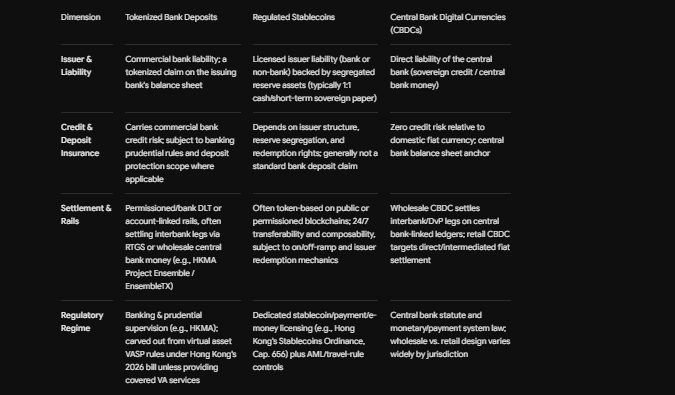
1. Issuer Liability & Balance-Sheet Economics
Tokenized Deposits: A tokenized deposit is a digital representation of a traditional bank deposit. The customer holds a claim on the issuing commercial bank, and the underlying funds remain part of the bank's general balance sheet—supporting maturity transformation, liquidity management, and credit creation.
Stablecoins: Regulated fiat-referenced stablecoins represent a redemption claim structured around the issuer and a ring-fenced or segregated reserve pool designed to maintain par value. Rather than funding general commercial lending like a deposit, reserve assets are held in high-liquidity, low-risk instruments to meet par redemptions.
CBDCs: A CBDC is a direct liability of the central bank. For wholesale use, it serves as a risk-free interbank settlement asset; in retail design, central banks weigh disintermediation risks to commercial bank deposits.
2. Settlement Mechanics & Interoperability
Programmability vs. Finality: All three instruments can support automated workflows or smart-contract conditions, but settlement finality depends on the underlying ledger and clearing bridge.
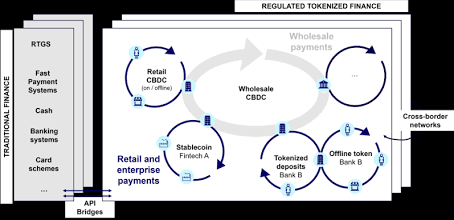
Tokenized Deposits: Often operate within bank-controlled or consortium environments and rely on interoperability standards and interbank rails—such as Real Time Gross Settlement (RTGS) or wholesale settlement layers in Hong Kong's Project Ensemble—so a token issued by one bank settles cleanly against another bank or tokenized asset.
Stablecoins: Excel at continuous, 24/7 peer-to-peer and on-chain movement across public blockchains and digital asset venues, though moving between on-chain tokens and bank accounts still depends on reliable on/off-ramp liquidity and redemption rails.
CBDCs: Wholesale CBDCs focus on interbank clearing, cross-border payment corridors, and Delivery-versus-Payment (DvP) settlement for tokenized securities and assets alongside tokenized deposits.
3. Regulatory Boundaries (Including Hong Kong)
Avoiding Duplicate or Mismatched Rules: Treating tokenized bank deposits as virtual assets would subject regulated bank money to crypto-intermediary rules designed for non-bank tokens. Excluding tokenized deposits from the virtual asset definition keeps them anchored in banking law while regulated stablecoins sit under dedicated stablecoin issuer licensing (such as Hong Kong's Stablecoins Ordinance, Cap. 656) and broader virtual asset services sit under Cap. 615.
Customer Choice and Market Fit: Rather than forcing a single winner, regulators and market infrastructure builders increasingly treat these forms of money as complementary across use cases—institutional DvP and corporate treasury on bank/wholesale rails, open-network liquidity and cross-border digital transfers via regulated stablecoins, and sovereign settlement anchoring via central bank money.