

In-house custom silicon—such as Google TPUs, AWS Trainium, Microsoft Maia, and Meta MTIA—poses a gradual, structural threat to Nvidia's pricing power and share of inference workloads, rather than an immediate collapse of its core business. While Nvidia still commands roughly 70%–85% of AI chip revenue, custom ASIC accelerators are growing faster in unit volume as hyperscalers seek lower cost-per-token and freedom from third-party markups.

How Custom Silicon Challenges Nvidia
Margin Capture & Cost Efficiency: Paying high premiums for merchant GPUs transfers substantial margin from cloud providers to Nvidia. For predictable, high-volume inference tasks, purpose-built chips reduce cost per token and establish a lower internal price floor for cloud services.
Inference Workload Migration: Training demands maximum flexibility, raw compute, and ultra-fast interconnects, where GPUs excel. Inference—where model architectures are fixed and run at massive scale—is the primary battleground where custom silicon targets efficiency gains.
Software Abstraction Over Time: Frameworks like JAX/XLA and AWS Neuron reduce reliance on CUDA for teams willing to standardize inside a single cloud provider's stack.
Strategic Ecosystem Deals: Major AI labs and cloud players increasingly diversify compute across multiple architectures—pairing custom chips with merchant GPUs and alternative accelerators—rather than relying on a single vendor.
Major Hyperscaler Programs vs. Nvidia
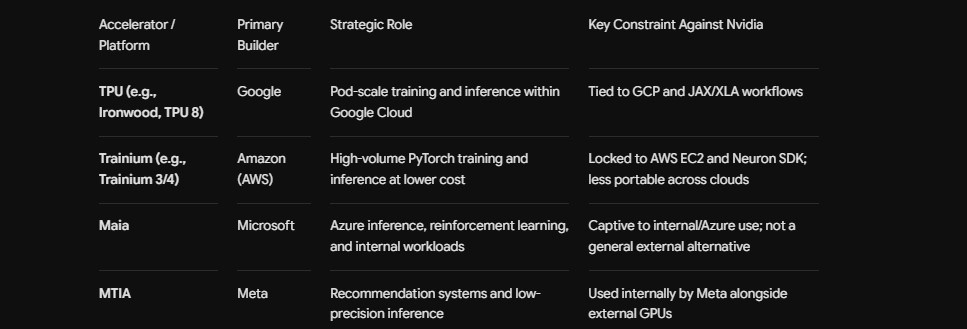
Why Nvidia's Moat Remains Resilient
Captive vs. Portable Compute: Hyperscaler chips are largely built for internal scale or single-cloud lock-in. Enterprises, startups, and multi-cloud builders using standard frameworks (such as vLLM, SGLang, or TensorRT-LLM) still favor GPUs for portability and broad software compatibility.
Rack-Scale Systems & Networking: Nvidia competes as a full-stack system vendor—combining GPUs, high-bandwidth memory, NVLink/NVSwitch interconnects, and networking—rather than selling standalone chips in isolation.
Rapid Architecture Cadence: Continuous generational upgrades (from Hopper to Blackwell and Vera Rubin) reset performance-per-watt benchmarks and keep merchant GPUs at the frontier for cutting-edge models.
Co-Design Beneficiaries: Most hyperscalers rely on custom chip design partners—especially Broadcom and Marvell—and foundry capacity at TSMC, meaning custom silicon shifts value across the chip supply chain rather than eliminating specialized semiconductor demand.