

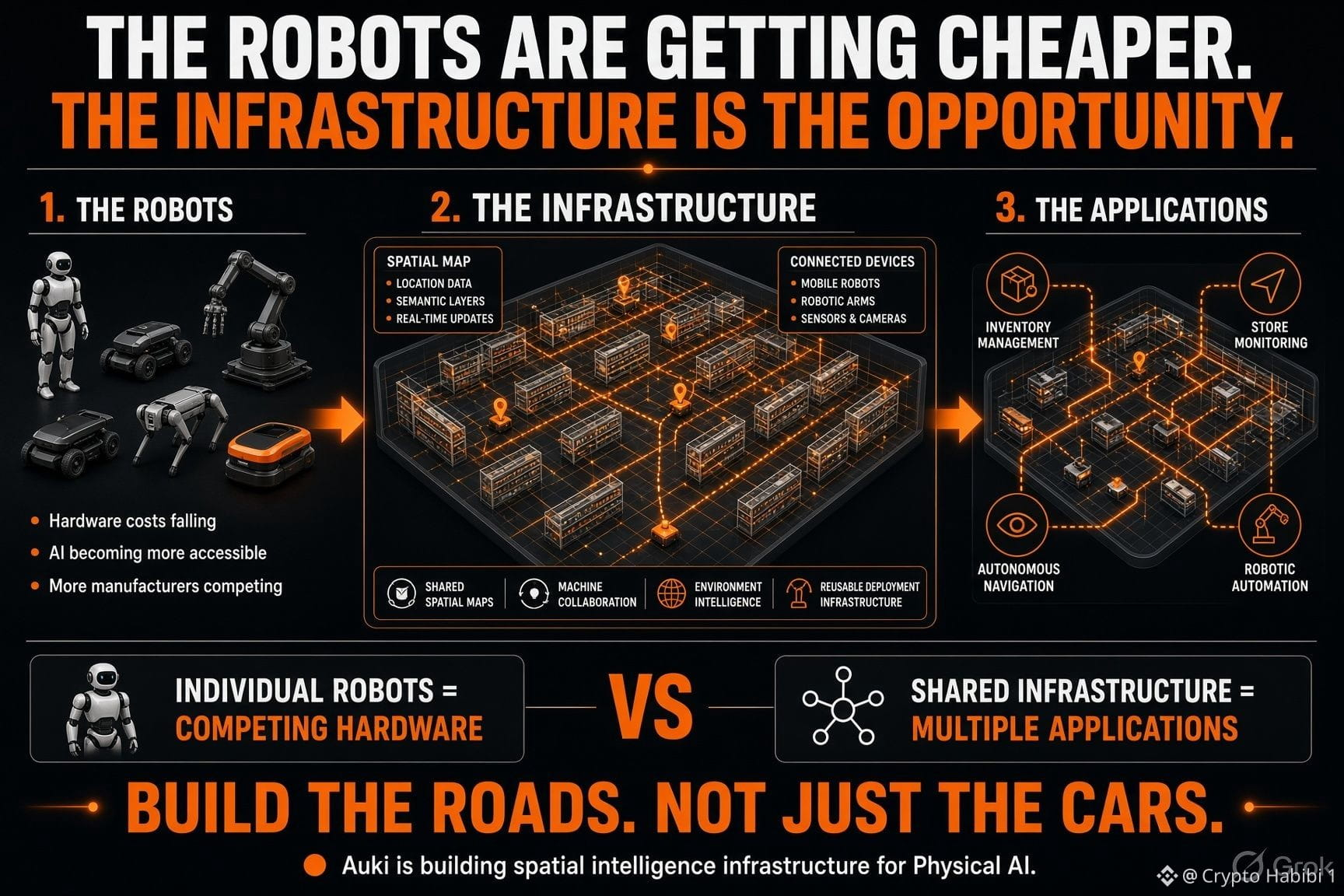
Everyone is focused on who will build the smartest robot. But there's another question worth asking: what happens when advanced robots become widely available and multiple manufacturers can offer similar capabilities? Hardware costs are coming down, AI models are becoming more efficient, and robotic capabilities are spreading across the industry. As competition increases, the margins on individual machines could get squeezed. The bigger opportunity may lie in the infrastructure that allows these machines to operate effectively in the real world. Robots need more than intelligence. They need to understand their surroundings, access accurate spatial information, navigate environments and collaborate with other machines. Businesses also need practical ways to deploy, coordinate and maintain them. This is where $AUKI 's vision becomes interesting. By building spatial intelligence infrastructure, shared maps and systems that allow different devices to work with the same environments, Auki is positioning itself beyond any single robot manufacturer. Think about a supermarket that's already digitally mapped. That same spatial infrastructure could support inventory management, navigation, monitoring and eventually multiple robotic applications. The initial investment in mapping the environment could create value across several services. The robots may become cheaper, but the infrastructure connecting them to the physical world could become increasingly valuable. Everyone wants to build the next great robot. Auki is working on the roads those robots will need to travel. And that could be a very interesting place to be as Physical AI scales.
انضم إلى مُستخدمي العملات الرقمية حول العالم على Binance Square
⚡️ احصل على أحدث المعلومات المفيدة عن العملات الرقمية.
💬 موثوقة من قبل أكبر منصّة لتداول العملات الرقمية في العالم.
👍 اكتشف الرؤى الحقيقية من صنّاع المُحتوى الموثوقين.
البريد الإلكتروني / رقم الهاتف