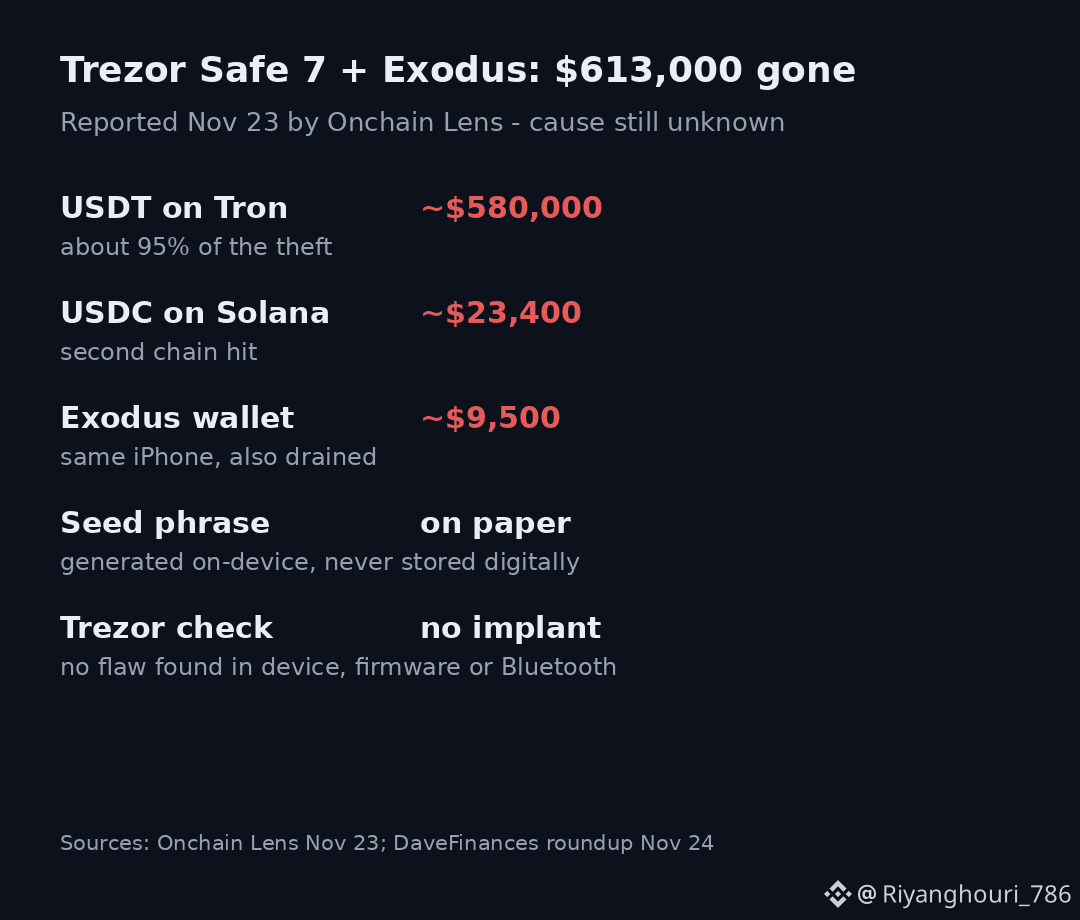
Somebody just lost $613,000 from a Trezor Safe 7 and an Exodus wallet - and the part that should worry you is what investigators did NOT find.
Onchain Lens reported it on Nov 23: about $580,000 in USDT on Tron, $23,400 in USDC on Solana, and another $9,500 out of Exodus. The victim had used the Trezor for two months, connected by Bluetooth to an iPhone 17 Pro Max. Sealed box, recovery phrase generated on the device itself, written down on paper - never stored digitally. And still the money is gone.
Trezor says its checks found no hardware implant and no flaw in the device, firmware or Bluetooth. No cause has been established at all. The stolen funds were traced through addresses funded via Binance, with later transfers touching a Bybit-labelled address - but that tells us where the money went, not how it was taken.
Here's my honest take: this is the case that breaks the simple story we all tell ourselves. 'Buy a hardware wallet and you're safe' only holds if the rest of your setup is clean. A hardware wallet guards keys from the internet - it can't protect you if the phone it's paired with is compromised, or if the seed phrase was exposed somewhere between the paper and the device. Two wallets, one phone, no established way in - that shared phone is the thread I'd be pulling on first.
I'm not telling anyone to ditch their Trezor. I'm saying audit the thing around it: the phone, the apps, anything that ever touched your seed. When was the last time you actually checked what has access to yours? $USDT