
Let's be honest. Keeping up with crypto these days is exhausting.
Every week, there's a new project claiming to be the next big thing. One day it's AI tokens, the next it's restaking, Layer 2s, modular blockchains, or some new technology that's supposedly going to change everything.
We've seen this movie before. Big promises, endless marketing, influencers talking about massive potential, and eventually, the excitement fades.
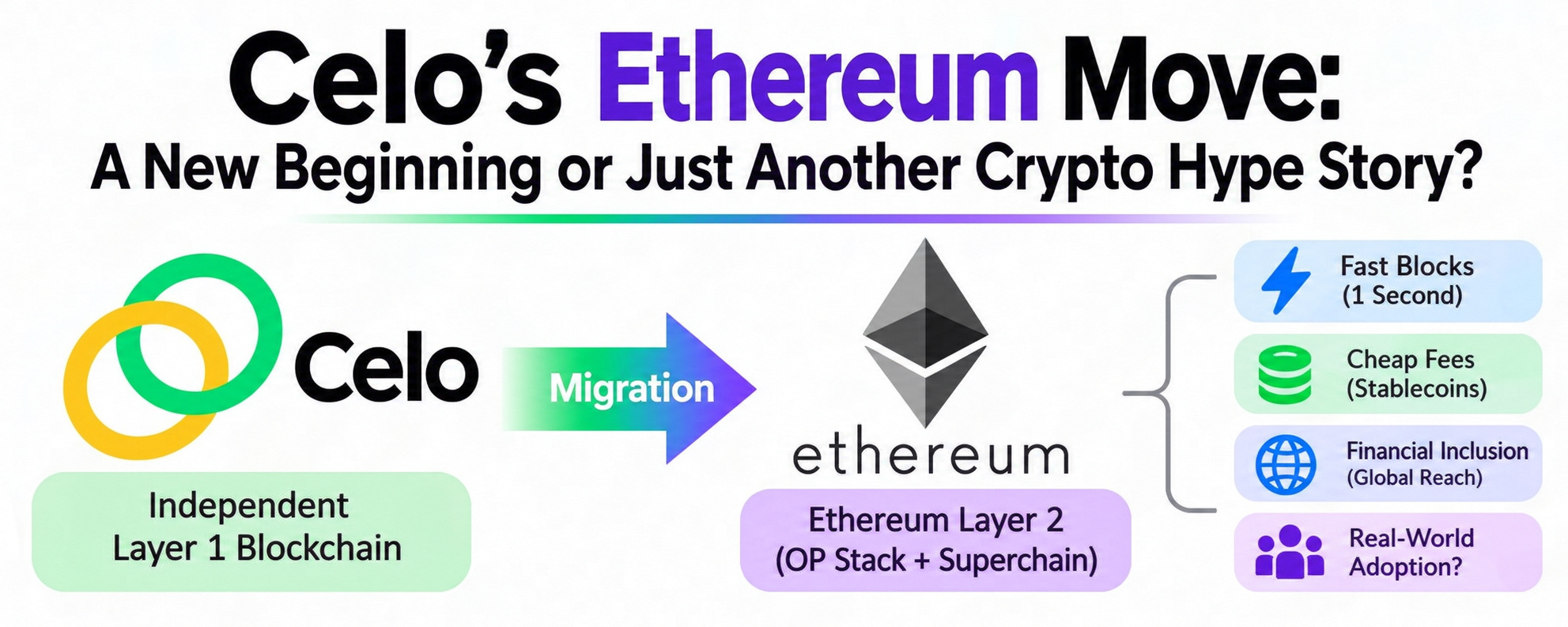
That's probably why I wasn't particularly impressed when I heard Celo had moved to Ethereum as a Layer 2 and joined the Superchain.
My first thought was: what's actually new here?
I understand the technical reasoning behind the move. Being part of Ethereum's ecosystem has its advantages, and the OP Stack provides a solid foundation. But let's not pretend that becoming another Ethereum rollup automatically makes a project revolutionary.
Fast transactions and cheap fees are no longer something only a handful of networks can offer. Almost every new chain promises the same thing.
So, what is Celo really bringing to the table?
That's the question I'd rather focus on instead of getting carried away by another round of crypto marketing.
Celo Had a Different Vision in the Beginning
I remember when Celo first started getting attention around 2020.
Its vision was actually quite interesting. Instead of building another blockchain purely for traders and DeFi enthusiasts, Celo wanted to make financial services accessible to people who were largely left out of the traditional banking system.
The idea was simple: make sending and receiving money as easy as sending a message on your phone.
It had mobile-friendly wallets, phone-number-based payments, local currency ambitions, and a broader mission of financial inclusion.
Honestly, I liked that approach.
But looking at the ecosystem today, things have changed quite a bit.
Most of the attention now revolves around USDT, USDC, stablecoin transfers, and DeFi. Celo's own Mento stablecoins, including cUSD, don't seem to be at the center of the conversation anymore.
And that makes me wonder: what happened to the original vision?
There's nothing wrong with using USDT or USDC. They're useful, and there's clearly demand for digital dollars, especially in emerging markets.
But if the original idea was to build a better financial system for people around the world, simply becoming another network for transferring dollar-backed stablecoins doesn't feel like the breakthrough we were promised.
Perhaps Celo has found a more practical direction. That's fair.
But I'd like to see more evidence that this direction is actually improving people's everyday financial lives.
Moving to Ethereum Makes Sense, but It's Not a Magic Fix
In March 2025, Celo completed its transition from an independent Layer 1 blockchain to an Ethereum Layer 2 built on the OP Stack.
I can understand why the team made this decision.
Running an independent blockchain comes with its own challenges. You have to maintain your infrastructure, build trust in your security model, attract developers, and compete with much larger ecosystems.
Moving to Ethereum gives Celo access to a much stronger network of developers, liquidity, and infrastructure.
That's a sensible move.
However, there's another side to it.
Celo is now dependent on Ethereum's settlement and security assumptions. Its optimistic rollup architecture also introduces withdrawal and finality considerations that weren't part of its previous independent-chain model.
It also uses EigenDA for data availability, which adds another infrastructure dependency.
I'm not saying these decisions are necessarily bad. But I don't think we should ignore the trade-offs either.
Ethereum has a strong security track record, but no blockchain is completely immune to technical problems.
Celo is gaining important advantages, but it's also inheriting new dependencies.
The interesting part is that some of the features users actually care about have remained intact. Transactions are still designed around one-second blocks, and users can pay gas fees in stablecoins rather than having to hold CELO.
That's genuinely useful.
But from an investor's perspective, it also raises another question: if users don't need CELO to use the network, what exactly drives demand for the token?
Impressive Numbers, but Who Is Actually Using Celo?
This is probably where I become most cautious.
Celo has shared some pretty impressive adoption figures over the past year. Billions of transactions, billions in stablecoin volume, and hundreds of thousands of daily active users.
On paper, that looks great.
But I've followed crypto long enough to know that big numbers don't always tell the full story.
A transaction isn't necessarily a person. One wallet can make hundreds of transactions, and automated activity can push network statistics much higher.
The same goes for wallet downloads.
Opera's MiniPay has helped Celo reach users across multiple countries, particularly in emerging markets. I think that's one of the most interesting developments in the ecosystem.
But downloads alone don't tell me much.
What I'd really like to know is how many people are still using MiniPay regularly. How many are receiving money, paying for services, or sending funds to family members?
Are people actually relying on it, or are they simply trying it out because of promotions and incentives?
There's a big difference.
I'd much rather see a smaller number of people consistently using Celo for everyday payments than millions of wallets that become inactive after the initial excitement disappears.
For me, that's what real adoption should look like.
Stablecoins Are a Real Opportunity, but the Hard Part Is Still Ahead
To be fair, Celo is working in a market that has genuine potential.
Sending money internationally is still unnecessarily expensive in many parts of the world. Traditional banking isn't always accessible, and people living in countries with unstable currencies often look for ways to protect their savings.
Stablecoins can help.
Being able to send USDT or USDC almost instantly, without paying ridiculous transaction fees, is useful. Especially for people who regularly receive money from abroad.
This is where Celo's mobile-first approach could actually make a difference.
The growing interest in stablecoin infrastructure from companies like Stripe and its Bridge platform is also worth watching.
It suggests that stablecoin payments are becoming more than just a crypto trading tool.
But there's something I think gets overlooked.
Having the technology available doesn't mean people will automatically use it.
A small business owner in Nigeria or the Philippines isn't going to care whether a payment runs on an Ethereum Layer 2 or the OP Stack.
They care about whether the money arrives safely, whether they can convert it into local currency, and whether the whole process is easier than using their existing payment system.
That's where the real challenge begins.
You need reliable on-ramps, off-ramps, banking partners, regulatory clarity, and, most importantly, trust.
And stablecoins themselves carry risks. USDT and USDC depend on centralized issuers and their respective reserves and policies.
So yes, the opportunity is real. But I wouldn't confuse growing interest in stablecoins with proof that Celo has already solved the global payments problem.
The CELO Token Is a Different Story
Now, here's something I think deserves more attention.
Celo's network is increasingly focused on stablecoin payments. Users can pay transaction fees in assets like USDT and USDC, which means they don't actually need CELO for everyday transactions.
From a user perspective, that's a good thing.
Nobody sending money to their family wants to worry about buying another cryptocurrency just to cover gas fees.
But what does that mean for CELO holders?
The token still has governance and staking utility. The CELOccelerate economic model also introduces fee-funded buybacks and burns intended to connect network activity with token value.
That's an interesting approach.
However, I'm not completely convinced it solves the bigger question.
If people can use the network without holding CELO, then token demand depends much more heavily on staking, governance, supply dynamics, and the effectiveness of the buyback mechanism.
That's a very different investment proposition from a token that users actually need to access the network.
And considering CELO's price history, investors have every reason to be cautious.
The token once traded above $10 during the 2021 bull market. Since then, it has suffered a massive decline.
Of course, price performance alone doesn't tell us whether a project has a future. But it does remind us how quickly market sentiment can change.
I wouldn't assume that an Ethereum migration and a fresh narrative are enough to bring back investor confidence.
### The Infrastructure Is Interesting, but Ordinary Users Don't Care
There's another thing worth remembering.
Most people don't care about the technical architecture behind a payment network.
They don't wake up wondering whether their wallet is running on an OP Stack rollup, whether data availability comes from EigenDA, or whether a sequencer is centralized.
They just want their money to arrive.
That's why I think Celo's biggest challenge isn't necessarily technological anymore.
It's about making the experience reliable enough that people don't even have to think about the blockchain behind it.
There are still infrastructure concerns, too. The sequencer setup and the reliance on EigenDA introduce additional trust and operational considerations.
These things may improve over time, but they shouldn't be ignored.
The migration itself was a major undertaking, and future upgrades will also need to be handled carefully.
In crypto, a project can have excellent technology and still struggle because of poor execution.
Celo needs to get the execution right.
I'm Interested, but I'm Not Buying the Hype
I don't think Celo is a bad project.
Actually, I think its original focus on mobile payments and financial accessibility is more interesting than most of the narratives currently circulating in crypto.
The Ethereum migration could help it grow. Stablecoins are becoming increasingly relevant, and mobile-first financial applications have genuine potential in emerging markets.
But I'm not ready to call Celo a breakthrough.
We've seen too many projects confuse infrastructure improvements with real-world adoption. Building a faster blockchain is relatively straightforward compared with changing how millions of people manage, receive, and spend their money.
Celo has an interesting opportunity, particularly through MiniPay, mobile-first payments, and stablecoin infrastructure in emerging markets.
But the real test isn't another partnership announcement or another billion-dollar transaction-volume milestone.
It's whether people continue using the network when incentives disappear.
It's whether small businesses actually accept stablecoin payments.
It's whether someone can receive money from abroad, convert it into local currency, and spend it without unnecessary complications.
And it's whether Celo can build an ecosystem where the technology becomes almost invisible to the people using it.
That's what genuine adoption looks like.
For now, I'm keeping Celo on my watchlist, but I'm not buying into the excitement blindly.
The vision still makes sense. The technology is interesting. The Ethereum migration could prove to be a smart strategic decision.
But the crypto industry has taught me one important lesson: a good narrative doesn't guarantee a good investment, and impressive technology doesn't automatically create real demand.
I'd rather wait for the evidence than chase another hyp
e cycle.
Because at the end of the day, I don't care how many buzzwords a project can fit into its announcement.
I care whether it actually makes someone's life easier.
And that's the real test Celo still needs to pass.