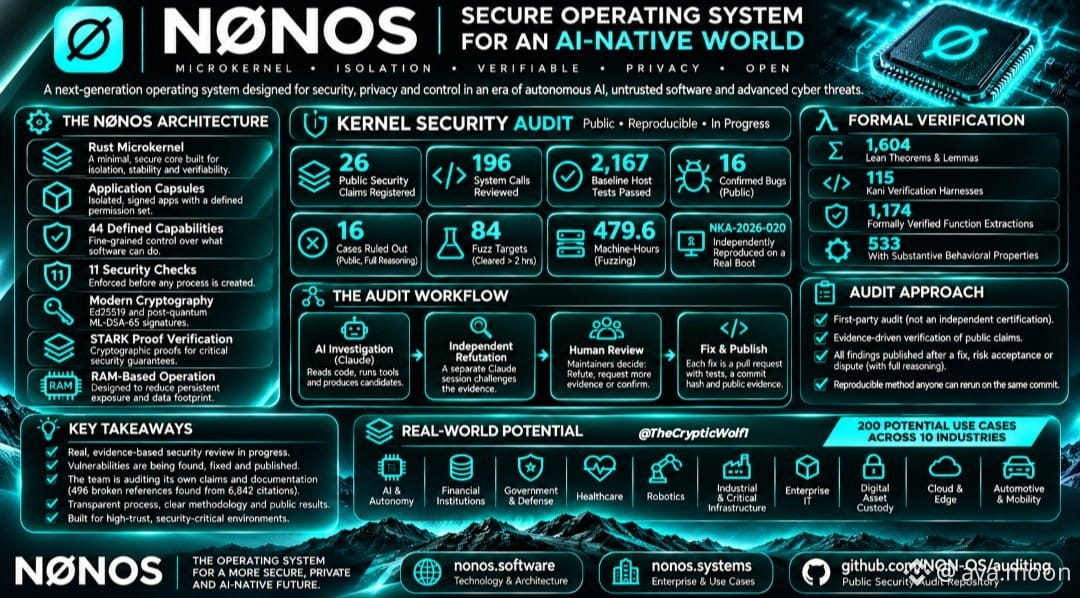
$NOX is building next-gen OS security architecture that most people are sleeping on.
Coming from a cybersec background, what catches my eye about @nonossystems isn't hype — it's the technical depth:
• Rust microkernel foundation
• STARK proof verification baked in
• Signed + isolated app capsules
• 11 security checks before any process spawns
• Ed25519 + post-quantum ML-DSA-65 signatures
• RAM-based ops to minimize persistent attack surface
The core philosophy: limit what compromised code can touch, not just try to catch it after the fact.
What's rare is they're actually auditing in public. 7 days in:
• 26 security claims under verification
• 196 syscall entry points reviewed
• 2,167 baseline tests passed
• 16 bugs found and documented publicly
• 84 fuzz targets running 2+ hours each
• 479.6 machine hours of fuzzing
• Real boot reproduction of edge cases
They're using @claudeai to challenge findings but humans control all fixes. Every patch needs tests + commit hash before it's marked resolved.
Under the hood: 1,604 Lean theorems, 115 Kani harnesses, 1,174 formally verified functions (533 with real behavioral proofs).
The play isn't just crypto. They've mapped 200 use cases across 10 sectors: AI agents, custody, finance, robotics, healthcare, critical infrastructure.
Not confirmed deployments yet — but the TAM is massive if execution lands.
This is a first-party audit. More work ahead. But I'd rather bet on a team actively hunting for vulnerabilities than one pretending they don't exist.
In a world where AI agents operate at machine speed, controlling access at the OS layer could be the difference between secure systems and catastrophic exploits.
That's why I'm long $NOX.