
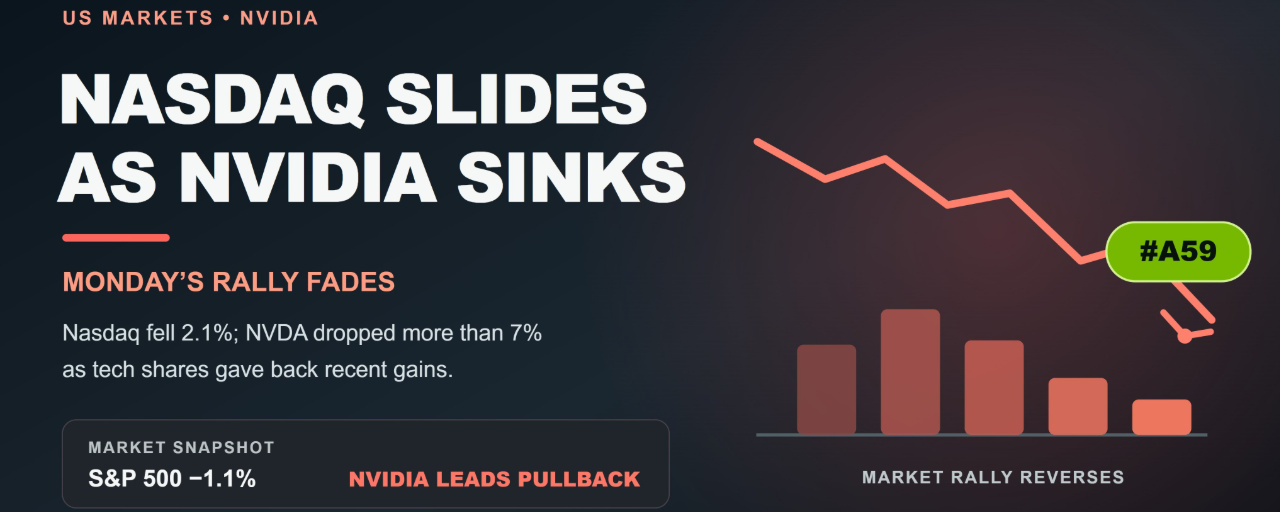

sourch ; CNBC Updated Tue, Nov 24 202610:29 AM EST
The Nasdaq $NDAQ.US

Composite fell on Tuesday, giving back some of the sharp gains from the previous session that were sparked by Jensen Huang’s return as Nvidia CEO.
The tech-heavy was 2.1% lower, while the S&P 500 fell 1.1%. The Dow Jones Industrial Average traded around the flatline, bolstered by gains in stocks such as Amgen, Nike and Salesforce.
Nvidia $NVDAB
shares reversed course following their 31% surge on Monday, a move that led a rally in chip stocks. The stock was down more than 7%.
Tom Hulick, CEO of Strategy Asset Managers, told CNBC’s “Squawk Box Europe” on Tuesday that Huang was probably the right person to lead Nvidia “for now.” However, he added that the company still has “a lot of things to worry about” regarding corporate governance.
Meanwhile, Anthropic $ANTB

shares fell 9%, breaking below its IPO price and adding pressure to the broader market.
Other stocks linked to AI fell alongside Nvidia and Anthropic. Chipmaker Micron Technology dropped more than 10%, as did Advanced Micro Devices, while Broadcom declined 3%. Additionally, Alphabet shed more than 1%, while Oracle lost more than 3%.
Contributing to the downbeat investor sentiment, the U.S. is preparing to increase tariffs on dozens of countries, including China. That’s according to The Wall Street Journal, which cited people familiar with the plans.
The market saw a massive rally on Monday, with the Nasdaq and S&P 500 seeing their best session since April 9, 2025, when President Donald Trump announced a reprieve on tariffs.
Monday’s market action was a sharp reversal from Friday’s steep sell-off, which saw the S&P 500 and Dow close in correction as the AI trade suffered and Nvidia tanked.
Mark Haefele, Chief Investment Officer at UBS Global Wealth Management, said in a note Tuesday morning that his team does not believe the volatility in global tech names is “a signal that the structural AI investment story has broken.”
“Cloud growth, rising usage, and continued demand for computing capacity remain supportive,” he said. “But we do expect greater differentiation between established platforms with visible monetization and strong balance sheets, and companies dependent on debt, scarce capacity, or continued speculative growth.”