
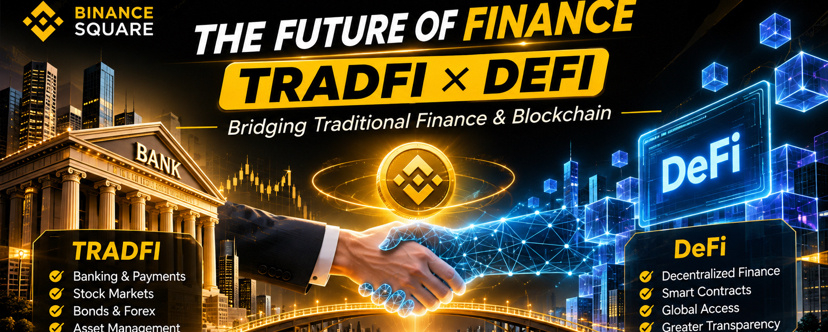

🌍 **TRADFI × DEFI: THE NEXT FINANCIAL REVOLUTION — WHEN TRADITIONAL FINANCE MEETS BLOCKCHAIN!**
💡 What if the future of finance isn't about choosing between TradFi and DeFi, but bringing the best of both worlds together?
For decades, Traditional Finance (TradFi) has been the backbone of the global economy. Banks, stock markets, bonds, and payment systems have shaped the way billions of people save, invest, and manage their money.
But the financial landscape is evolving.
Blockchain technology is challenging traditional financial infrastructure and introducing new possibilities for a more transparent, accessible, and efficient financial ecosystem.
Let's explore why this transformation matters.
🔶 **1. TRADFI — THE FOUNDATION OF GLOBAL FINANCE**
Traditional Finance (TradFi) refers to the established financial system operating through centralized institutions such as banks, brokerage firms, and financial organizations.
Its key components include:
• Banking: Deposits, loans, and payment services.
• Stock Markets: Trading shares of publicly listed companies.
• Bonds: Debt instruments issued by governments and corporations.
• Forex: The global foreign exchange market.
• Asset Management: Professional investment and portfolio management.
TradFi's greatest strengths are its established infrastructure, regulatory frameworks, institutional experience, and connection to the real-world economy.
However, it also faces challenges, including complex procedures, intermediary costs, limited accessibility, and settlement inefficiencies.
🔶 **2. DEFI — FINANCE WITHOUT TRADITIONAL INTERMEDIARIES**
Decentralized Finance (DeFi) uses blockchain technology and smart contracts to provide financial services without relying entirely on traditional intermediaries.
Some of its major applications include:
• Decentralized Exchanges (DEXs).
• Lending and Borrowing.
• Liquidity Providing.
• Yield Farming.
• Stablecoins.
DeFi introduces a new financial model built around transparency, programmability, global accessibility, and greater user control over digital assets.
Nevertheless, it comes with risks, including smart contract vulnerabilities, market volatility, liquidity issues, and security threats.
Innovation creates opportunities, but understanding risk remains essential.
🔶 **3. TOKENIZATION — BUILDING A BRIDGE BETWEEN TWO FINANCIAL WORLDS**
One of the most exciting developments in modern finance is Real-World Asset (RWA) tokenization.
Tokenization involves representing ownership rights or interests in real-world assets through digital tokens on a blockchain.
Imagine financial assets such as government bonds, investment funds, or real estate being represented digitally.
This technology has the potential to:
✅ Improve accessibility to financial assets.
✅ Enable more efficient asset transfers and settlement.
✅ Increase transparency through on-chain records.
✅ Connect traditional financial markets with blockchain infrastructure.
Of course, tokenization does not eliminate legal requirements, underlying asset risks, or ownership complexities.
Its real value lies in creating new possibilities for financial infrastructure.
🔶 **4. BINANCE AND THE EVOLVING DIGITAL FINANCE ECOSYSTEM**
The growth of digital assets is creating new opportunities for individuals and institutions to explore blockchain-powered financial services.
Binance has become one of the major platforms in the digital asset industry, contributing to crypto adoption, market accessibility, and blockchain education.
Meanwhile, BNB Chain provides blockchain infrastructure for decentralized applications, smart contracts, and a growing on-chain ecosystem.
$BNB is closely connected to this ecosystem, serving as a utility token with multiple functions across BNB Chain and the broader Binance ecosystem.
As blockchain adoption continues to evolve, infrastructure, security, and real-world utility will remain essential to long-term growth.
💛 **5. MY PERSPECTIVE: WHAT DOES THE FUTURE HOLD?**
I believe the future of finance will not necessarily be a battle in which TradFi defeats DeFi or DeFi replaces TradFi.
Instead, the biggest opportunity may come from collaboration.
TradFi brings institutional experience, established financial infrastructure, and regulatory frameworks.
DeFi brings programmability, transparency, open access, and technological innovation.
When these strengths complement each other, they could help shape a financial system that is more connected, efficient, and accessible.
🚀 **THE FUTURE OF FINANCE IS NOT JUST DIGITAL. IT'S CONNECTED.**
👇 **LET'S DISCUSS!**
Which development do you believe will have the greatest impact on the financial industry over the next five years?
1️⃣ The expansion of DeFi.
2️⃣ Real-World Asset (RWA) tokenization.
3️⃣ Greater institutional adoption of digital assets.
4️⃣ The integration of TradFi and blockchain technology.
Share your thoughts in the comments. The future of finance deserves more than one perspective!