
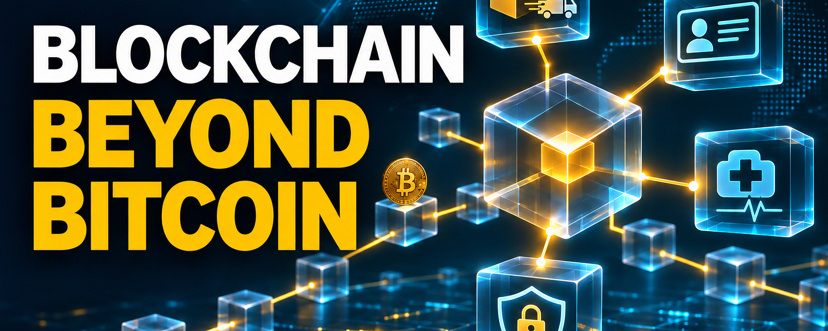

When people talk about blockchain, Bitcoin usually comes to mind first. That’s understandable. Bitcoin introduced blockchain technology to the world, but the technology itself has a much wider purpose.
What makes blockchain interesting isn’t simply its connection to cryptocurrency. It’s the way it allows information to be recorded, verified, and shared without depending entirely on one central organization.
But where can this actually make a difference?
First, what makes blockchain different?
Think of a traditional database as a system controlled and maintained by one organization. That organization manages the records and decides who can update or access them.
A blockchain works differently. Records are organized into blocks and linked together using cryptography. Depending on the network, multiple participants maintain and verify the shared record through a consensus mechanism.
Once information is confirmed and added, changing historical records can become extremely difficult.
This doesn’t mean blockchain is impossible to manipulate. Its security depends on the network’s design, consensus mechanism, and how participants interact with it.
1. Supply chains: Knowing where products come from
Imagine buying a product and being able to trace its journey from the manufacturer to the shop.
Blockchain-based systems can help companies record each stage of that journey. Manufacturers, transport companies, distributors, and retailers can share records without relying on completely separate databases.
This could improve traceability and make certain types of fraud easier to identify.
However, there’s an important limitation: blockchain cannot automatically guarantee that the information entered into the system is true. Reliable data collection is still essential.
2. Healthcare: Sharing information more carefully
Healthcare is another area where blockchain is being explored.
Hospitals and healthcare providers often use different information systems. Sharing records securely and maintaining a reliable history of access can be challenging.
Blockchain could help coordinate permissions and maintain records of data access.
But storing complete medical records directly on a public blockchain would raise serious privacy concerns. A more practical approach may involve keeping sensitive information in secure systems while using blockchain for verification and permission management.
3. Digital identity: More control over personal information
Online services frequently ask people to prove their identity.
Blockchain-based identity systems could help individuals manage certain credentials and share only the information required for a particular service.
For example, someone might need to prove they meet an age requirement without revealing their entire identity.
This technology is still developing, and privacy, recovery, legal recognition, and ease of use remain important challenges.
4. Financial services: Faster and more accessible transactions
One of the most practical areas for blockchain is financial services.
Traditional international transfers can involve several institutions, intermediaries, and processing stages.
Some blockchain-based payment networks aim to make cross-border transfers faster and potentially more efficient.
Financial institutions are also exploring blockchain for settlement, tokenized assets, and other financial applications.
Still, not every blockchain payment is cheaper or faster. Fees, network congestion, regulation, and the payment system being compared all matter.
So, is blockchain the solution to everything?
Definitely not.
Blockchain can introduce complexity where a traditional database would work perfectly well.
Some networks consume significant amounts of energy, while others use much less. Scalability, regulation, privacy, and user experience are also ongoing challenges.
The most important question isn’t whether an organization can use blockchain.
It’s whether blockchain solves a real problem better than the alternatives.
My final thoughts
I believe blockchain’s long-term importance will not be measured only by the price of Bitcoin or the number of cryptocurrencies available.
Its real value may come from applications that ordinary people rarely notice: more transparent supply chains, better coordination between institutions, improved digital verification, and new ways of transferring value.
The technology still has a long way to go, but its potential deserves attention beyond the crypto market.
Let’s discuss:
If you could choose one industry to benefit most from blockchain over the next five years, which would it be?
Banking and financial services
Healthcare
Supply chain and logistics
Digital identity and cybersecurity
I’d be interested to hear your reasoning.
#blockchain #cryptoeducation #Bitcoin #BinanceSquare #Technology