

I've noticed that market participants have become increasingly careful about celebrating a green candle. Many people now wait for confirmation, check what is happening across other markets, and try to understand whether a move represents a genuine change or simply a reaction to a headline. I've developed a similar habit. Markets have a way of making temporary relief look like long-term confidence, and the difference is not always obvious at first.
That is why NVIDIA's latest development caught my attention.
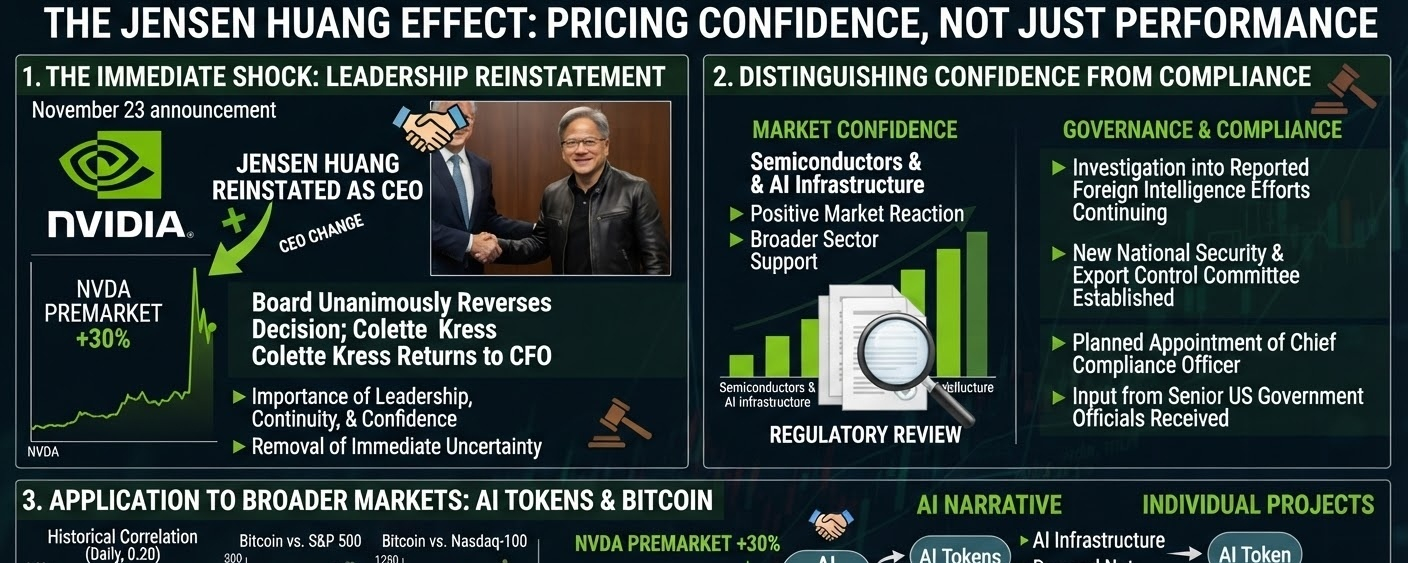
On November 23, the company's board unanimously reinstated Jensen Huang as CEO, reversing its earlier decision to accept his resignation. Colette Kress, who had temporarily taken over the position, returned to her role as CFO. The announcement pushed NVIDIA shares approximately 30% higher in premarket trading.
What interests me is not just the size of that reaction. It is what the reaction reveals about the importance investors attach to leadership, continuity, and confidence in a company's direction.
NVIDIA is not simply another technology company benefiting from interest in artificial intelligence. Huang has been closely involved in its chip roadmap, major customer relationships, and expansion across the AI infrastructure ecosystem. When someone with that level of influence leaves, investors have to reconsider more than a management position. They also have to question whether the company's existing direction can continue without disruption.
His return appears to have removed some of that immediate uncertainty. The market was quick to respond, and the recovery also supported other semiconductor companies and businesses providing AI computing infrastructure. But I would be careful about interpreting one strong trading session as confirmation that every concern has disappeared.
There is another side to this decision that deserves attention. NVIDIA's board says it received input from senior US government officials and concluded that Huang's return poses no national security risk. However, the independent investigation into reported foreign intelligence efforts targeting him is still continuing. The company has also established a national security and export control committee and announced plans to appoint a Chief Compliance Officer.
That distinction matters. Restoring leadership can improve operational confidence, but it does not automatically resolve governance, regulatory, or compliance questions. Investors need to understand both sides rather than allowing the positive announcement to replace the remaining facts.
I find this particularly relevant when looking at crypto markets. We often discuss Bitcoin, AI tokens, infrastructure projects, and traditional technology stocks as separate opportunities. In reality, their market participants can share similar liquidity conditions and risk preferences.
Research published by CME Group has shown that Bitcoin's relationship with equities has changed over time. Its historical daily correlation with the S&P 500 and Nasdaq-100 was around 0.20 across the full period studied, but reached considerably higher levels during certain market-stress periods. This does not mean NVIDIA's recovery will automatically push Bitcoin higher. It does show why developments in traditional markets can influence how crypto participants assess overall risk.
There is also a difference between an AI narrative becoming stronger and an individual crypto project becoming more valuable. Better confidence in NVIDIA's future may support expectations around computing infrastructure, but that does not guarantee demand for every AI-related token. Actual users, network activity, revenue models, token utility, liquidity, and supply distribution still matter. A project should not receive additional credibility simply because its narrative shares a popular industry name.
What I take from this event is that markets are constantly pricing confidence alongside financial performance. Sometimes a leadership decision can change expectations faster than underlying business conditions can change. That creates opportunities, but it also creates situations where people enter positions before they have fully understood what has actually improved.
For everyday crypto participants, the useful lesson is not to follow every movement in traditional finance or treat every major corporate announcement as a trading signal. It is to understand where confidence comes from, what risks remain, and whether the market reaction is supported by lasting improvements.
I've learned that the hardest part of following markets is not finding the next headline. It is separating what has genuinely changed from what people simply hope will change. NVIDIA's decision is a good reminder that clarity, governance, and continuity deserve as much attention as price movements, especially when markets are moving quickly.