

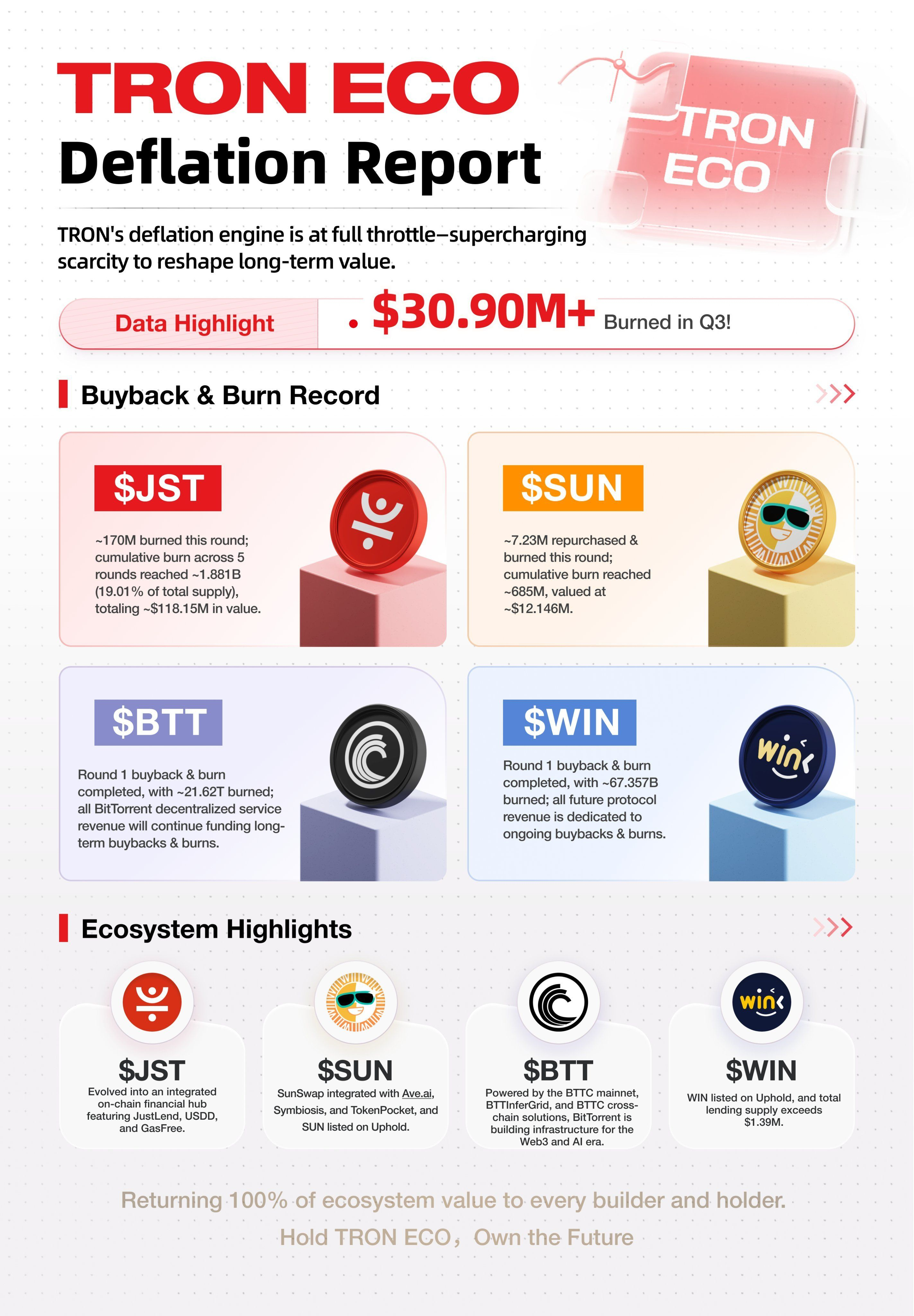
Moving a token mechanism from announcement to completed execution is where real credibility begins. With WIN buyback and burn Round 1 now complete—permanently removing 67,357,364,510 WIN (valued at roughly $3.59 million) from circulation—the program has moved into active operation backed by verifiable on-chain records.
For WINkLink and the broader TRON ecosystem, completing Round 1 marks a practical step grounded in real execution and transparency.
➤ Putting the Buyback and Burn Mechanism into Practice
A token mechanism means much more once its steps are carried out on-chain rather than left on paper:
Active execution: Funded by 100% of WINkLink's service revenue, the buyback and burn cycle moved from design into an actual completed round.Permanent supply reduction: The 67.35 billion burned WIN tokens are permanently removed from supply via the token contract rather than temporarily locked.Verifiable records: Public on-chain transaction records let anyone inspect and verify how the round was executed.
Still, completing one round is an early step in a multi-round plan that depends on ongoing follow-through.
➤ Why Execution and Transparency Matter Long Term
In Web3, promises are easy to make, while consistent execution and open records are harder to fake:
Clear accountability: Public on-chain records give community members concrete data to inspect. Credible follow-through: Turning announced mechanics into completed rounds reinforces project reliability. Long-term orientation: Keeps attention focused on steady delivery rather than short-lived hype.
Even so, long-term value still depends on sustained utility, reliable oracle service, and healthy ecosystem demand.
➤ What Round 1 Means for the TRON Ecosystem
Reaching a completed first round gives WIN and WINkLink a tangible reference point as future rounds unfold. Across TRON, seeing infrastructure projects document on-chain actions clearly helps set a healthier standard for transparency.
➤ My Personal Perspective
I think completing Round 1 of the WIN buyback and burn is a solid milestone because it turns a stated mechanism into verifiable on-chain action. Having permanent supply reduction backed by public records makes it much easier for the community to follow what actually happened.
For me, the real value lies in treating Round 1 as a starting point for steady, repeatable execution across future rounds.
Now that WIN buyback and burn Round 1 is complete, what do you check first in the on-chain records—and what matters most to you as future rounds roll out?
#WIN #WINkLink #TRON #Web3 #DeFi #TRONEcoStar
October brought new developments across WBTC, from exploring a multi-custodian model to expanding wallet access and examining Bitcoin’s role in DeFi. Bringing Bitcoin into on-chain financial environments requires steady progress on custody architecture, user access, and practical utility, connecting individual updates into a clearer picture of how tokenized BTC is evolving.
➤ Exploring a Multi-Custodian Model for Resilience
As institutional custody evolves, how reserves are structured and overseen becomes central to long-term confidence:
Single-provider risk: Exploring a multi-custodian model speaks directly to reducing reliance on any single custodian and spreading operational responsibility.Structural durability: A broader custody setup can help strengthen resilience over time as tokenized Bitcoin sees wider institutional and on-chain use.Verifiable alignment: Pairing custody evolution with clear reserve visibility keeps the focus on backing integrity rather than assumptions.
➤ Expanding Wallet Access and Everyday Usability
Infrastructure only creates value if users and builders can reach it without unnecessary friction:
Broader access: Expanding wallet access, including integrations like NOW Wallet and Ledger, makes it easier for holders to move, view, and interact with WBTC across supported environments. Lower friction: Simpler wallet paths reduce setup hurdles for both newer participants and experienced multi-chain users.Practical workflows: Smooth wallet support underpins everything from basic transfers to active participation in on-chain markets.
➤ Examining Bitcoin’s Role in DeFi
Bitcoin’s core appeal has long centered on scarcity and security, while DeFi focuses on programmability and capital utility:
Beyond passive holding: Looking closely at Bitcoin’s role in DeFi highlights how BTC can act as collateral, liquidity, or a base asset on-chain rather than sitting idle.Matching use to risk: Lending, liquidity provision, and holding each carry distinct mechanics and risk profiles that participants need to weigh carefully. Long-term positioning: Deciding what role BTC plays in a portfolio depends on time horizon, risk tolerance, and operational discipline.
➤ My Personal Perspective
In my view, the most notable takeaway from October is how custody resilience, wallet reach, and DeFi utility reinforce one another rather than sitting in separate silos.
Better wallet access means little if custody is fragile, and strong infrastructure still depends on clear, sensible use cases for BTC on-chain. Watching how these pieces mature together gives a much more grounded view than chasing short-term headlines alone.
Looking back at October’s WBTC themes, which area do you pay closer attention to—multi-custodian custody evolution, broader wallet access, or how Bitcoin is used in DeFi?