

Board audit and compliance committees evaluate internal controls and financial reporting risks by testing management’s assertions independently rather than accepting financial schedules or assurance summaries at face value. They rely on a structured cycle of risk mapping, internal and external audit oversight, control deficiency tracking, and direct access to whistleblowers and legal or forensic specialists when red flags emerge.

1. Mapping High-Risk Accounts, Estimates, and Regulatory Exposures
Committees start by identifying where financial statements are most vulnerable to error, judgment bias, or regulatory non-compliance:
Complex Estimates & Judgments: Revenue recognition (such as multi-element contracts, channel rebates, or variable consideration), inventory valuation and obsolescence reserves, goodwill or asset impairments, tax provisions, and contingent liabilities receive extra scrutiny because they rely on assumptions rather than simple invoices.
Non-Routine & High-Risk Transactions: Quarter-end manual journal entries, related-party deals, restructuring charges, acquisitions, and cross-border transactions (such as customs, transfer pricing, or export-control-sensitive shipments) carry elevated misstatement and compliance risk.
IT & Automated Control Dependencies: Modern financial reporting depends heavily on ERP configurations, automated subledger-to-GL postings, change management, and access permissions. If IT general controls are weak, automated application controls cannot be trusted automatically.
2. Leveraging Internal Audit, External Auditors, and Compliance Teams
An effective committee acts as an independent hub across multiple lines of defense:
External Auditors: The committee oversees external auditor appointment, compensation, independence, and audit scope. It reviews critical audit matters, disagreements with management, unadjusted audit differences, and management letter points on internal control over financial reporting (ICFR).
Internal Audit: Committees review and approve the risk-based internal audit plan, verify that internal audit has unrestricted access to records and personnel, and track whether management actually closes out remediation items on schedule.
Compliance & Legal Functions: Where financial risk intersects with regulatory or legal exposure—such as sanctions, export controls, anti-bribery, tax authority inquiries, or whistleblower reports—the committee coordinates with general counsel, compliance leaders, and, when necessary, independent outside counsel or forensic accountants.
3. Classifying Control Deficiencies & Monitoring Remediation
When a control fails or is missing, committees evaluate both likelihood and magnitude to classify the severity of the issue:
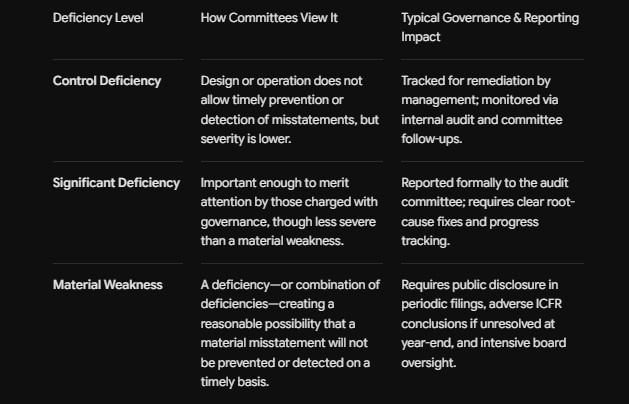
Committees press management on root causes (such as understaffed accounting teams, rushed close calendars, or weak approval workflows) and test whether compensating controls actually work before treating a deficiency as closed.
4. Probing Culture, "Tone at the Top," and Executive Sessions
Policies and flowcharts mean little if executives can override controls or pressure staff to hit targets:
Private Executive Sessions: Committees routinely hold closed-door sessions with the external auditor, internal audit head, and chief compliance officer—without the CEO or CFO present—to surface candid concerns about management pressure, cooperation, or control overrides.
Whistleblower & Ethics Channels: They review anonymous hotline reports, investigation outcomes, and non-retaliation safeguards to see whether early warnings about accounting shortcuts or compliance breaches reached oversight before becoming public crises.
Close & Reconciliation Discipline: Committees look for signs of strain during financial closes—such as late reconciliations, recurring unexplained variances, manual workarounds, or high turnover in accounting, tax, or internal control roles.