

Under the IRS Instructions for Form 8949, you are normally required to list every capital asset sale or disposition on its own separate row. However, the IRS provides two primary exceptions (Exception 1 and Exception 2) that allow you to skip listing individual trades on Form 8949 or summarize them into consolidated lines.
Quick Comparison: Exception 1 vs. Exception 2
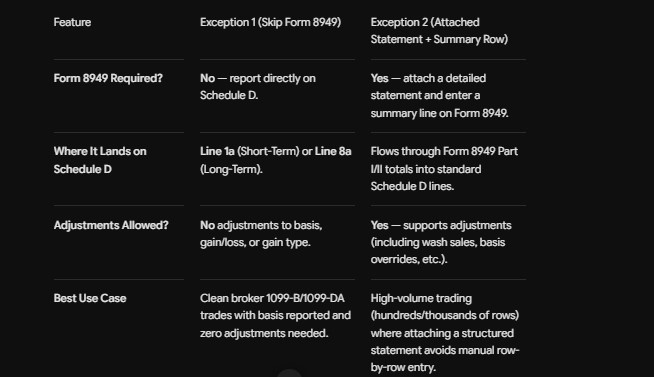
Exception 1: Skipping Form 8949 Entirely (Direct to Schedule D)
Exception 1 lets you bypass Form 8949 completely and report qualifying transactions directly on Schedule D, Line 1a (short-term) or Line 8a (long-term).
To qualify for Exception 1, all of the following conditions must be met:
Basis Reported to IRS: Your Form 1099-B, Form 1099-DA, or substitute statement shows that cost or other basis was reported to the IRS.
No Adjustments Needed: You do not need to make any adjustment to the basis, the type of gain or loss (short-term vs. long-term), or the gain/loss amount itself—and there are no wash-sale or non-covered adjustments required.
No Special Deferrals or Collectibles: The transaction is not from collectibles, and you are not electing or terminating a Qualified Opportunity Fund (QOF) deferral.
Practical Takeaway: If you harvested a clean loss on a covered position where the broker reported cost basis accurately and you had no wash sales or basis tweaks, you don't need Form 8949 for that trade—it can go straight onto Schedule D Line 1a or 8a.
Exception 2: Summarizing High-Volume Trades via an Attached Statement
When you have many transactions (such as frequent equity trades or active crypto/tax-loss harvesting lots) and cannot use Exception 1—for instance, because basis wasn't reported to the IRS or you have adjustments—Exception 2 lets you avoid typing every individual trade onto Form 8949 rows.
How Exception 2 works under IRS rules:
Attach a Complete Transaction Statement: Prepare an attached statement (often exported from tax software or broker records) that contains all the same required data points as Form 8949 Parts I and II—property description, acquisition/disposition dates, proceeds, basis, adjustments, codes, and gain/loss—in a similar format.
Enter Summary Totals on Form 8949 with Code M: Instead of listing each individual trade on separate rows of Form 8949, enter a summary row referencing the attached statement:
Column (a): Enter the broker's name followed by "see attached statement".
Columns (b) and (c): Leave blank.
Column (f): Enter code M (along with any other applicable adjustment codes, such as wash-sale or basis codes).
Columns (d), (e), (g), and (h): Enter the applicable totals (separate rows per broker if you have multiple brokers).
Critical "Don'ts" for Exception 2
Never write "Available upon request" in place of listing transaction details on Form 8949 or an attached statement.
Do not drop a single summary total onto Form 8949 without the underlying itemized statement attached to the return (or e-filed via your tax software's PDF attachment feature).
Can You Use Both Exceptions Together?
Yes. If part of your trading activity qualifies for Exception 1 (clean reported basis, zero adjustments) and another portion involves adjustments or un-reported basis that fits Exception 2, you can apply both to the appropriate portions of your return.