#willmarketsstageathanksgivingreliefrally?
The rollout of IRS Form 1099-DA permanently transforms how digital asset tax-loss harvesting is tracked, reported, and audited. While Form 1099-DA gives the IRS automated data-matching tools similar to traditional stock trading (Form 1099-B), it also creates critical reporting gaps that crypto investors must manage proactively.
Key Impacts on Crypto Tax-Loss Harvesting
1. Automated IRS Data Matching & Mandatory Reporting
Brokers (including custodial platforms like Coinbase, Kraken, and Gemini) issue Form 1099-DA directly to you and the IRS.
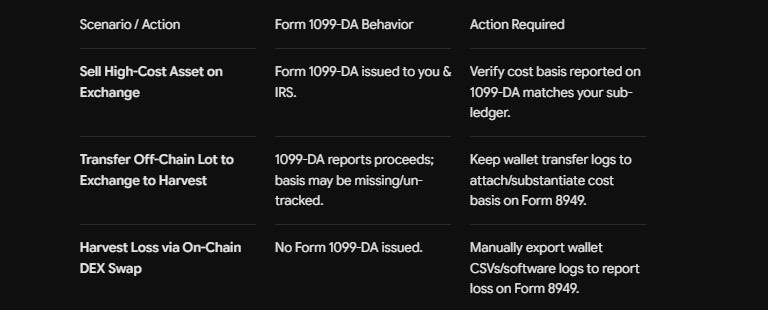
The Audit Risk: The IRS uses automated screening to match 1099-DA gross proceeds against Form 8949. If you harvest a loss on an exchange, but fail to report it—or report a different cost basis—automated IRS discrepancy notices (such as CP2000) will be triggered automatically.
2. Phased Basis Reporting & The "Zero-Basis" Trap
Form 1099-DA reporting phased in over two stages:
Tax Year 2025: Brokers reported gross proceeds only.
Tax Year 2026 & Beyond: Brokers report gross proceeds AND cost basis for "covered" digital assets acquired on their platform.
The Transfer Gap: If you purchase crypto on Exchange A (or a hardware wallet) and transfer it to Exchange B to harvest a loss, Exchange B does not know your original purchase cost. Exchange B will report the gross proceeds on Form 1099-DA without cost basis. You must manually substantiate your true acquisition cost on Form 8949 to claim the loss—otherwise, the IRS may assume a $0 cost basis and treat the entire sale as taxable profit.
3. Shift to Mandatory Wallet-by-Wallet Basis (Rev. Proc. 2024-28)
Universal cost basis tracking across your entire global portfolio is no longer permitted. You must calculate cost basis strictly within each specific wallet or exchange account.
When harvesting losses, you cannot sell tokens on an exchange and retroactively claim the higher cost basis of tokens stored on your Ledger hardware wallet. You must either sell from the wallet that actually holds the high-cost lot, or transfer those specific lots to the exchange prior to executing the sale.
4. Decentralized Finance (DeFi) Remains Off-Form
Centralized exchanges issue 1099-DA forms, but non-custodial DEXs (e.g., Uniswap) and self-hosted wallets are exempt.
Losses harvested on a DEX do not generate a Form 1099-DA. You remain 100% legally required to maintain on-chain transaction records and report those losses on Form 8949.
5. Wash-Sale Status
The 61-day wash-sale rule (IRC §1091) currently applies only to "stocks and securities". Directly held crypto tokens (classified as property) are not currently subject to statutory wash-sale rules. However:
Crypto ETFs & Stocks: Crypto Spot ETFs (like IBIT) and crypto stocks (like Coinbase) are securities and generate standard Form 1099-B/1099-DA returns subject to strict wash-sale disallowance.
Economic Substance: The IRS can disallow paper transactions executed with zero economic risk purely to manufacture tax deductions.
Operational Playbook for Tax-Loss Harvesting