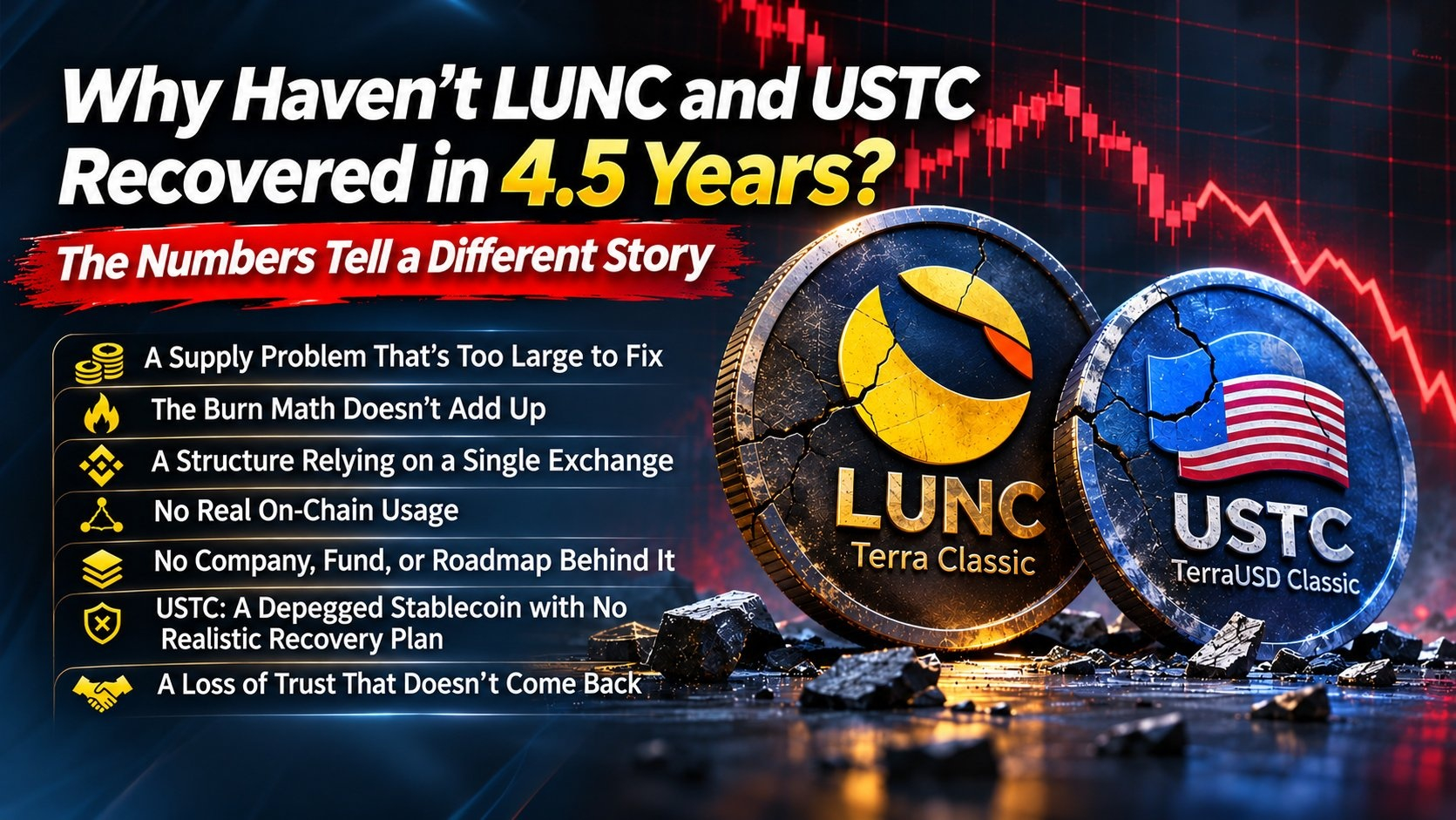

In May 2022, an ecosystem worth approximately $40 billion collapsed to zero within a few days. Four and a half years later, the community is still saying, "The burns are continuing; one day it will come back." But the numbers tell a different story. Let's look at the facts, not emotions.
1️⃣ The Supply Problem Is Too Large to Solve
Before the collapse, approximately 350 million LUNA were in circulation. Following unlimited minting to rescue UST, the supply surged to 6.9 trillion within just a few days.
Today, the total supply is still approximately 6.45 trillion LUNC.
Since May 2022, approximately 464 billion LUNC have been burned, representing just 6.7% of the original supply.
That's the result of 4.5 years of the "burn movement."
2️⃣ The Burn Math Doesn't Add Up
Approximately 39.8 billion LUNC were burned over the past 12 months. That's just 0.62% of the total supply annually.
At this rate, cutting the supply in half would take approximately 112 years.
In August 2026, the on-chain burn tax was increased from 0.5% to 1.5%. Monthly burns increased, but not by 200%—only by approximately 60%. That's because on-chain transaction volume also declines when the tax increases.
In short, burns are not a price-driving engine. At best, they're a marketing tool.
3️⃣ A Structure Standing on One Leg: Binance
A significant portion of all LUNC burned to date has come from Binance's monthly burns. The exchange has burned approximately 88 billion LUNC in total.
In November 2026, Binance did not conduct its monthly burn. This broke a 44-month consecutive streak that had continued since March 2023.
The impact of these burns on total supply was already very small. What matters more is what this reveals: LUNC's narrative depends largely on the goodwill of a single exchange. When a project's liquidity and "deflationary narrative" depend on one actor, what you have is not an ecosystem but a dependency.
4️⃣ No Real On-Chain Utility
What determines price in the long term? Demand. What creates demand? Utility.
Terra Classic's total value locked (TVL) in DeFi is below $1 million, at approximately $817,000.
Daily trading volume on decentralized exchanges is around $5,000.
For comparison: Before the collapse, Terra was the second-largest DeFi blockchain, with TVL exceeding $20 billion.
Today, almost all LUNC trading takes place not on-chain but in the order books of centralized exchanges. In other words, LUNC is trading as a speculative instrument rather than as a network token.
5️⃣ No Company, Fund, or Roadmap Behind It
Terraform Labs moved to a new chain (Terra 2.0 / LUNA). The Classic chain was left to the community and validators.
That is not necessarily a bad thing on its own. But the reality is:
– No sustainable development budget
– No institutional partners
– Governance continues to revolve around proposals and discussions
– Upgrades generally do not introduce new products; they are barely enough to keep the existing structure running
The community's efforts deserve recognition, but a structure built on voluntary contributions cannot support a supply of 6 trillion tokens.
6️⃣ USTC: A Failed Stablecoin With a Repeg Plan
USTC's situation is even more difficult.
Approximately 6 billion USTC are still in circulation. Repegging this supply to $1 would require roughly $6 billion in real collateral.
That money does not exist. Without new external capital, a $1 repeg is mathematically impossible.
During this process:
– New USTC minting was halted in 2023
– Numerous repeg proposals were introduced, but none delivered lasting results
– A USTC staking proposal was approved in April 2026
– KuCoin, OKX, and Bybit delisted USTC
The price remains at a tiny fraction of $1. Every "repeg proposal" announcement triggers a 30–60% spike, only for those gains to disappear afterward.
This is not a recovery. It's news-driven volatility.
7️⃣ Lost Trust Doesn't Come Back
Do Kwon pleaded guilty to fraud charges in the United States in August 2025 and was sentenced to 15 years in prison in December 2025. Legal proceedings in South Korea are also ongoing.
News about lawsuits and investigations related to the 2022 collapse still occasionally moves prices. But these developments concern the project's past, not its fundamentals.
Trust is the hardest thing to regain in crypto. This is especially true when the concept of an "algorithmic stablecoin" has become almost forbidden in the eyes of regulators following this collapse.
8️⃣ So Why Is It Still Alive?
Because:
– Its low unit price fuels the retail investor fantasy of "What if it reaches $1?"
– It remains listed on major exchanges and still has liquidity
– It has a strong and loyal community
– Every burn or proposal announcement creates short-term trading opportunities
But none of these factors generate lasting value.
📌 Conclusion
The reason LUNC and USTC have failed to recover is not bad luck. It's mathematics:
– 6.45 trillion in supply
– 0.6% annual burn rate
– Less than $1 million in TVL
– Dependence on a single exchange
– A stablecoin with no collateral
They may be tradable in the short term. There is volatility and a steady flow of news.
But as of today, the expectation that they will "return to their former glory in the long term" is not supported by the numbers.
Believing in a project and looking at the numbers are two different things. The market always rewards the latter.