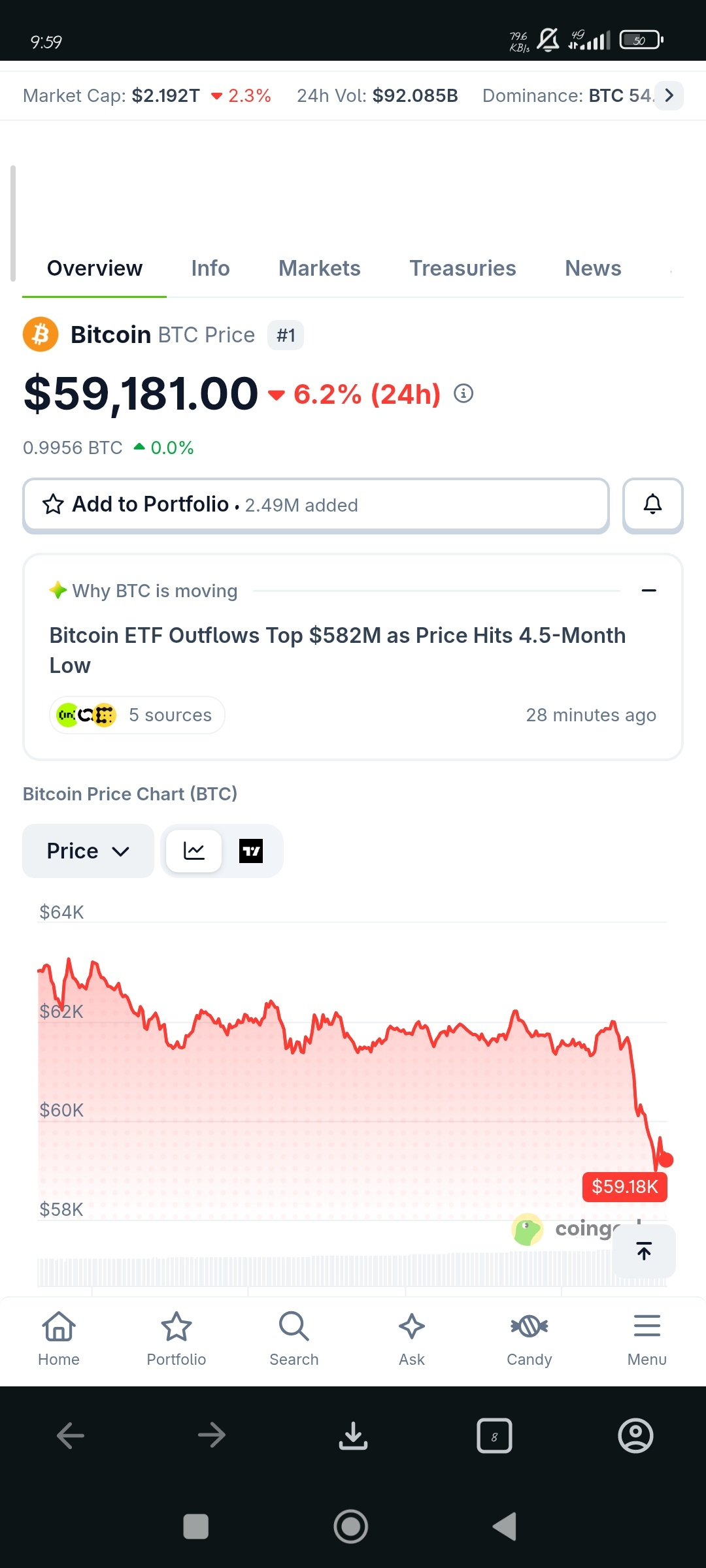

$BTC is no longer influenced only by individual traders and retail investors. Institutional investors now have another route to gain exposure to Bitcoin through financial products known as Spot Bitcoin ETFs.
These funds have made Bitcoin accessible to investors who prefer traditional financial markets over directly purchasing and holding cryptocurrency.
But there's an important question: What happens when money starts flowing OUT of these funds?
Let's understand why Bitcoin ETF inflows and outflows matter, how they work, and what they can tell us about the broader crypto market.
1. What Exactly Is a Spot Bitcoin ETF?
A Spot Bitcoin Exchange-Traded Fund (ETF) is an investment fund that trades on a traditional stock exchange and holds actual Bitcoin to provide investors with exposure to its price.
Instead of purchasing Bitcoin directly through a cryptocurrency exchange, investors can buy shares of the ETF through their regular brokerage accounts.
For example, BlackRock's iShares Bitcoin Trust (IBIT) allows investors to gain Bitcoin exposure without personally managing crypto wallets or private keys.
In simple terms:
- Investors purchase ETF shares.
- The fund holds Bitcoin to back those shares.
- The value of the shares generally tracks Bitcoin's market price.
This creates a bridge between traditional financial markets and cryptocurrency.
2. How Do ETF Inflows Affect Bitcoin?
ETF inflows occur when more capital enters these funds through net share creations than leaves through redemptions.
When demand for ETF shares increases, authorised participants facilitate the creation of additional shares.
Depending on the fund's settlement arrangements, this can require the fund to acquire additional Bitcoin.
This creates another potential source of demand in the Bitcoin spot market.
Why does this matter?
Bitcoin has a limited supply. When additional buying demand enters the market, it can contribute to upward price pressure, particularly when available liquidity is limited.
However, ETF inflows do not guarantee that Bitcoin's price will increase. Other market participants may be selling at the same time.
3. What Happens When ETF Investors Start Withdrawing Money?
This is where things become particularly interesting.
ETF outflows occur when redemptions exceed new share creations.
When investors exit these funds, authorised participants facilitate the redemption of ETF shares.
Depending on the fund's structure, the fund may sell Bitcoin to provide the cash required for redemption, or transfer Bitcoin directly.
This can introduce additional selling pressure into the spot market.
When substantial outflows continue over several trading sessions, investors may begin questioning whether institutional demand is weakening.
But there's an important distinction:
An ETF outflow does not necessarily mean every institutional investor is abandoning Bitcoin. It reflects net activity within a particular group of investment products.
4. Can ETF Outflows Trigger a Bitcoin Price Decline?
Yes, they can contribute to downward pressure, but they are not the only factor determining Bitcoin's price.
Consider a situation where:
- Spot Bitcoin ETFs experience significant net outflows.
- Broader financial markets become less willing to take risks.
- Retail investors become nervous about falling prices.
- Leveraged traders begin facing liquidation.
These factors can reinforce one another.
ETF redemptions may contribute to spot-market selling, while liquidations can add further selling pressure through derivatives markets.
This is why institutional flows deserve attention when analysing major Bitcoin movements.
However, we must remember that correlation does not automatically establish causation. Bitcoin prices can also influence ETF flows, rather than ETF flows always driving Bitcoin prices.
5. Do ETF Outflows Always Signal a Bearish Market?
Absolutely not.
A single day of negative ETF flows is not enough to establish a long-term bearish trend.
Investors may withdraw money because of:
- Short-term profit booking.
- Portfolio rebalancing.
- Changes in risk appetite.
- Concerns about interest rates and economic conditions.
- Shifting capital between different investment products.
Sometimes, outflows can occur during a temporary market correction without changing the longer-term investment outlook.
That's why analysing several days or weeks of net flows is generally more useful than reacting to one day's figures.
6. What Should Bitcoin Investors Watch?
Instead of focusing exclusively on Bitcoin's price, investors can monitor several indicators together:
ETF Net Flows: Are institutional investment products consistently attracting capital or experiencing withdrawals?
Bitcoin Spot Volume: Is genuine buying or selling activity increasing?
Futures Liquidations: Are leveraged traders contributing to additional market volatility?
Macroeconomic Conditions: Are interest rate expectations and broader financial market conditions encouraging or discouraging risk-taking?
Looking at these indicators together can provide a more complete picture of market conditions.
Final Thoughts
Spot Bitcoin ETFs have created an important connection between traditional finance and cryptocurrency.
Their inflows and outflows provide useful information about demand through regulated investment products.
But they should never be treated as standalone signals for predicting Bitcoin's next move.
A declining ETF flow does not automatically mean Bitcoin is losing its long-term potential, just as strong inflows do not guarantee a price rally.
The real advantage comes from understanding how institutional activity interacts with liquidity, investor sentiment and broader market conditions.
In a market as volatile as cryptocurrency, understanding the forces behind price movements is often more valuable than simply watching the price itself.
Cryptoscope | Understanding the forces behind the crypto market.