🌐 UQUID × TRON: FROM STABLECOIN LIQUIDITY TO REAL-WORLD COMMERCE — WHAT Q3 2026 REVEALS
The real test of stablecoin adoption is not how much value sits on a blockchain. It is how much of that value becomes useful in everyday economic activity.
TRON has established a substantial presence in global stablecoin infrastructure.
But the next stage of adoption requires something beyond token issuance and transfers.
It requires real commercial use.
UQUID offers an interesting case study of how stablecoin liquidity can connect with consumer purchases, digital services, ticketing, and enterprise payments.
Its H1 2026 results, together with preliminary Q3 estimates, point toward a broader transition:
STABLECOIN HOLDINGS → PAYMENT INFRASTRUCTURE → MERCHANT TRANSACTIONS → REAL ECONOMIC UTILITY
The important question is whether this activity can continue expanding without depending on speculative trading demand.
🔹 1. FROM STABLECOIN TRANSFERS TO ACTUAL SPENDING
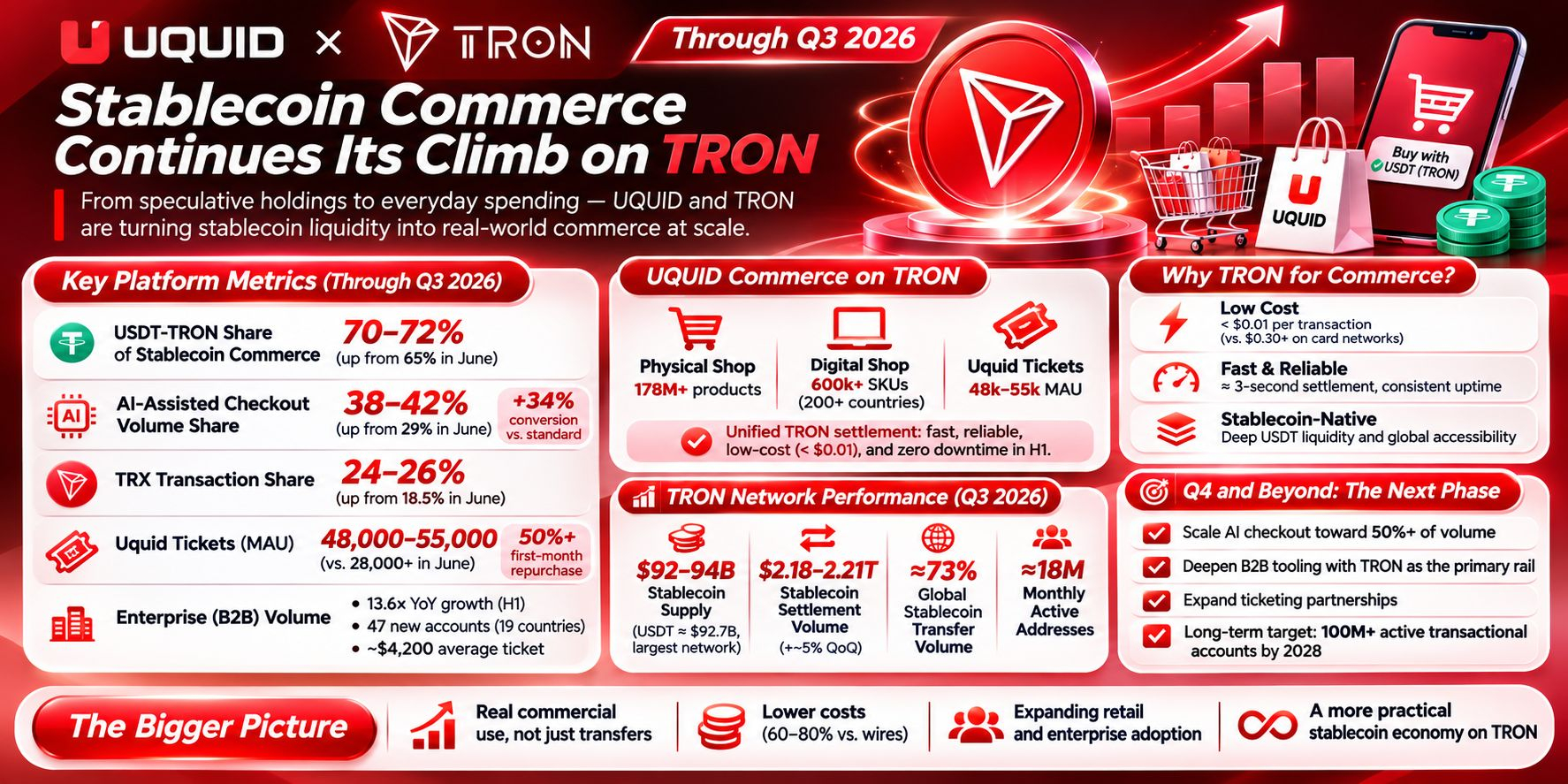
According to the supplied UQUID analysis, USDT on TRON accounted for approximately 52% of stablecoin commerce on the platform in January 2026.
By June, that share had reportedly increased to 65%.
The Q3 analysis estimates that USDT-TRON's share reached approximately 70–72% by September.
These Q3 figures should be treated as estimates rather than independently verified final results.
Nevertheless, the proposed trajectory highlights an important distinction.
A blockchain can process enormous stablecoin transfer volumes without necessarily demonstrating equivalent growth in retail payments.
Commerce-related activity provides a different signal.
It reflects users choosing digital assets to purchase goods and services rather than simply transferring funds between wallets or exchanges.
THE MORE IMPORTANT ADOPTION METRIC IS NOT JUST HOW MUCH STABLECOIN VALUE MOVES, BUT HOW OFTEN THAT VALUE IS USED TO COMPLETE REAL TRANSACTIONS.
🔹 2. UQUID'S THREE COMMERCE VERTICALS CREATE MULTIPLE PAYMENT USE CASES
UQUID's reported commerce infrastructure spans three major categories.
🛍️ PHYSICAL COMMERCE
A marketplace offering access to more than 178 million products.
💻 DIGITAL COMMERCE
Approximately 600,000 digital product SKUs across more than 200 countries.
🎫 TICKETING
Uquid Tickets, connecting digital payments with event-related transactions.
These categories matter because they represent different purchasing behaviors.
Physical products involve fulfillment and logistics.
Digital products emphasize rapid delivery and global accessibility.
Ticketing introduces event-based demand, recurring community participation, and potentially smaller transaction sizes.
Together, they create opportunities for stablecoins to function as payment instruments across multiple commercial environments.
For TRON, the strategic opportunity is to provide a common settlement network for these different activities.
THE VALUE OF A PAYMENT NETWORK INCREASES WHEN USERS CAN APPLY THE SAME ASSETS ACROSS MORE EVERYDAY USE CASES.
🔹 3. AI-ASSISTED CHECKOUT: CAN INTELLIGENCE IMPROVE STABLECOIN COMMERCE?
One of the more interesting developments in the UQUID analysis is the reported expansion of AI-assisted checkout.
The supplied figures indicate that AI-assisted checkout represented 29% of platform volume in June.
The Q3 estimate places that share at approximately 38–42% by September.
The report also references a 34% conversion improvement compared with conventional browsing and purchasing.
These are platform-reported or estimated figures, not independently established causal results.
Still, they raise an important question.
Can AI reduce the friction between product discovery and completed payment?
Traditional online shopping often requires users to navigate multiple steps:
SEARCH → COMPARE → SELECT → CHECKOUT → PAYMENT
AI-assisted workflows may simplify parts of this journey through product recommendations, conversational discovery, and guided purchasing.
When combined with stablecoin settlement, this creates a potential relationship:
AI-ASSISTED DISCOVERY → LOWER CHECKOUT FRICTION → STABLECOIN PAYMENT
However, higher conversion rates alone do not prove that AI caused the improvement.
A rigorous evaluation would need comparable user groups, consistent measurement periods, and controls for customer intent and purchasing behavior.
AI CAN IMPROVE THE COMMERCE EXPERIENCE, BUT ITS ECONOMIC VALUE SHOULD BE MEASURED THROUGH VERIFIED CONVERSION, RETENTION, AND TRANSACTION OUTCOMES.
🔹 4. ENTERPRISE COMMERCE MAY BE THE MOST IMPORTANT LONG-TERM OPPORTUNITY
Consumer payments generate visibility.
Enterprise payments can generate substantial settlement volume.
According to UQUID's reported H1 figures, its enterprise segment recorded:
📊 13.6× year-over-year growth.
🌍 47 new enterprise accounts across 19 countries.
💰 Average enterprise transaction sizes around $4,200.
These figures suggest that enterprise activity may contribute disproportionately to platform settlement volume.
A single $4,200 procurement transaction can represent the value of many smaller consumer purchases.
But transaction size is only part of the economic story.
Enterprise adoption also depends on payment reliability, accounting requirements, approval workflows, liquidity availability, and compliance.
UQUID's analysis references multi-signature treasury tooling and procurement-related payment efficiencies.
These features could make stablecoin settlement more useful for businesses operating across borders.
However, the reported 13.6× growth rate should be interpreted carefully.
Large percentage increases can arise from relatively small starting bases.
To evaluate the durability of enterprise growth, the most useful additional indicators would include absolute settlement volume, repeat-order frequency, customer retention, and revenue per enterprise account.
THE REAL OPPORTUNITY IS NOT SIMPLY ATTRACTING MORE BUSINESS ACCOUNTS. IT IS BECOMING A RELIABLE PART OF THEIR RECURRING PAYMENT OPERATIONS.
🔹 5. WHY TRON'S SETTLEMENT INFRASTRUCTURE MATTERS
TRON's role in this relationship is primarily infrastructural.
Its stablecoin ecosystem provides liquidity and transaction capabilities that can support commercial applications.
The supplied Q3 research references approximately $92–94 billion in stablecoin supply and roughly $2.18–2.21 trillion in quarterly stablecoin transfer or settlement activity, depending on the reporting source and methodology.
These network-level metrics demonstrate substantial scale.
But they should not be interpreted as UQUID commerce volume.
Likewise, network-wide stablecoin transfers can include exchange activity, treasury movements, DeFi transactions, and other transfers unrelated to retail purchases.
The connection between TRON and UQUID is therefore best understood through infrastructure utilization.
TRON provides the settlement environment.
UQUID connects that environment with merchants and customers.
NETWORK SCALE CREATES CAPACITY. COMMERCIAL APPLICATIONS TURN THAT CAPACITY INTO PRACTICAL UTILITY.
🔹 6. PAYMENT COSTS: WHY THE FULL ECONOMIC COMPARISON MATTERS
Low blockchain transaction fees can be particularly valuable for smaller payments and high-frequency transfers.
The supplied UQUID analysis describes TRON network fees as averaging below $0.01.
However, the network transaction fee is not necessarily the total cost of a commercial payment.
Businesses may also face conversion spreads, payment processing charges, custody costs, compliance expenses, and operational overhead.
The report cites potential cross-border savings of 60–80% compared with traditional wire transfers, alongside enterprise procurement savings.
These figures should be treated as reported comparisons that depend on the underlying assumptions.
For example, a $4,200 enterprise order may benefit substantially from reducing intermediary and foreign-exchange costs.
But that saving cannot be attributed entirely to the difference between a blockchain fee and a traditional card transaction fee.
THE MOST USEFUL COMPARISON IS TOTAL END-TO-END SETTLEMENT COST, NOT BLOCKCHAIN GAS FEES ALONE.
That distinction is essential for evaluating stablecoin commerce as a serious alternative payment infrastructure.
🔹 7. WHAT Q4 AND BEYOND SHOULD PROVE
The supplied analysis identifies several areas for future expansion.
These include broader AI-assisted purchasing, deeper enterprise payment functionality, and additional ticketing partnerships.
It also references a long-term ambition to support more than 100 million active transactional accounts by 2028.
That figure should be treated as a target, not an established forecast.
The strongest evidence of progress would come from measurable outcomes:
1️⃣ VERIFIED COMMERCE VOLUME
How much stablecoin settlement is associated with completed purchases rather than general transfers?
2️⃣ REPEAT CUSTOMER ACTIVITY
Do users return to make additional purchases after their first transaction?
3️⃣ ENTERPRISE RETENTION
Are corporate customers integrating stablecoin payments into recurring procurement workflows?
4️⃣ AI CHECKOUT EFFECTIVENESS
Does AI-assisted purchasing improve conversion and customer value under comparable testing conditions?
5️⃣ NET PAYMENT ECONOMICS
Are merchants and customers achieving meaningful savings after all costs?
These indicators would provide a stronger foundation for evaluating the relationship between TRON's infrastructure growth and UQUID's commercial adoption.
🌐 FINAL PERSPECTIVE: THE NEXT STABLECOIN MILESTONE IS REAL ECONOMIC UTILITY
UQUID's reported H1 performance and estimated Q3 trajectory illustrate a potentially important development in blockchain adoption.
Stablecoins are increasingly being positioned not only as digital assets to hold or transfer, but also as instruments for purchasing products and services.
TRON's role is to provide the underlying settlement infrastructure.
UQUID's role is to connect that infrastructure with practical commercial demand.
The combination creates opportunities across consumer commerce, digital products, ticketing, and enterprise payments.
But the long-term success of this model should be judged through verified transactions, repeat usage, and sustainable economics.
A BLOCKCHAIN DOES NOT BECOME IMPORTANT TO COMMERCE SIMPLY BECAUSE IT PROCESSES BILLIONS IN TRANSFERS.
IT BECOMES IMPORTANT WHEN BUSINESSES AND CONSUMERS CONSISTENTLY CHOOSE IT TO EXCHANGE REAL VALUE.
That is the most compelling opportunity behind UQUID × TRON.
💚 FROM STABLECOIN LIQUIDITY TO EVERYDAY SPENDING.
🌐 FROM BLOCKCHAIN TRANSFERS TO GLOBAL COMMERCE.
🤖 FROM AI-ASSISTED DISCOVERY TO MORE ACCESSIBLE PAYMENTS.
🏦 FROM EXPERIMENTAL TRANSACTIONS TO RECURRING BUSINESS UTILITY.
THE NEXT CHAPTER OF STABLECOIN ADOPTION WILL BE WRITTEN NOT ONLY ON BLOCKCHAIN EXPLORERS, BUT ALSO THROUGH THE PURCHASES PEOPLE AND BUSINESSES MAKE EVERY DAY.
🔗 TRON: https://trondao.org
🛍️ UQUID: https://uquid.com
@Justin Sun孙宇晨 @TRON DAO #TRONEcoStar