

Spot trading is the most basic way to buy and sell digital assets such as Bitcoin or Ethereum. If you are new to crypto, understanding how the spot market works is a sensible first step before you look at anything more complex.
What spot trading means
In spot trading, you buy or sell an asset at the current market price, and the trade settles straight away. When you buy 0.01 BTC on a spot market, you own that Bitcoin. You are not borrowing money and you are not trading a contract on a future price.
This is what separates it from margin trading and futures, where you borrow funds or trade contracts, and where losses can be larger than the money you first put in. With a spot purchase, the most you can lose is what you paid for it.
How a spot trade works
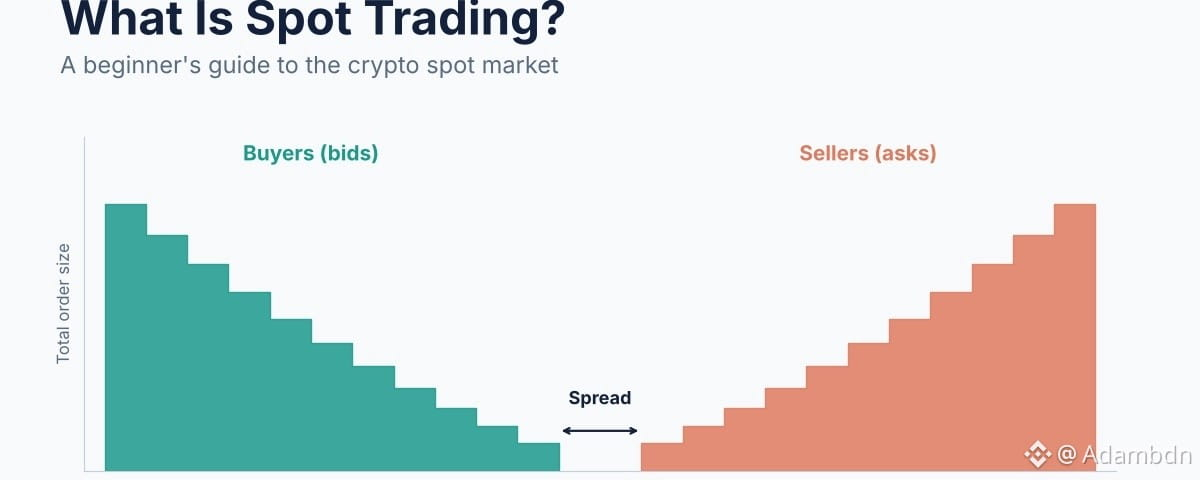
Exchanges list assets as trading pairs, such as BTC/USDT. The first asset is what you are buying, and the second is what you pay with. Buyers and sellers place orders in an order book, and the exchange matches them. The bid is the highest price a buyer is currently willing to pay, and the ask is the lowest price a seller is willing to accept. The gap between them is the spread.
You will mostly meet two order types:
Market order: buys or sells immediately at the best available price. Regulators note that this type of order is expected to execute, but the price is not guaranteed. On crypto exchanges, the gap between the price you expected and the price you got is called slippage, and it tends to be larger when trading volume is low.
Limit order: lets you set the price you are willing to pay or accept. It protects you from paying more than your chosen price, but it only executes if the market reaches that price.
A simple example (illustration only)
Say a coin is priced at $100 and you have $200 to spend. To keep it simple, we ignore fees.
Market order: you buy about 2 units straight away at roughly $100 each.
Limit order: you place a buy order at $95. If the price drops to $95, your order fills. If it never does, you buy nothing.
After buying 2 units at $100:
If the price rises to $120, your holding is worth $240, a gain of $40.
If the price falls to $70, your holding is worth $140, a loss of $60.
If the asset became worthless, you would lose the $200 you paid, but no more.
These numbers are invented to show how the mechanics work. They are not a prediction.
What it costs
Exchanges usually charge a fee on each trade, often a small percentage of the trade value. Some use different rates for orders that add to the order book (maker) and orders that remove from it (taker). The spread is also a cost, because buyers pay the ask and sellers receive the bid. Fees vary between platforms, so read an exchange's fee page before you trade.
The main risks to understand
Price volatility. The SEC's investor guidance describes crypto asset investments as volatile, with a real chance of losing money.
Custody risk. Your coins can be held by you (self-custody) or by a third party such as an exchange. If the security of your crypto is compromised, you could permanently lose access to it. Exchange failures and security breaches have happened in the past.
Scams. Regulators list claims of high guaranteed returns and little or no risk as red flags. No one can guarantee profit.
Account security. Use a strong, unique password and two-factor authentication.
Rules and taxes. These differ by country, so check what applies where you live.
Simple habits for beginners
Learn the basics before you put in money.
Only use money you can afford to lose.
Start small, and learn how orders, fees and withdrawals work.
Keep a record of your trades.
Don't trade because of hype or fear of missing out.
The takeaway
Spot trading is a straightforward way to buy and sell crypto, but simple does not mean risk-free. Knowing how orders, fees and custody work helps you make clearer decisions.
Glossary
Spot market: where assets are bought and sold for immediate settlement.
Trading pair: two assets quoted against each other, such as BTC/USDT.
Order book: the live list of buy and sell orders on an exchange.
Bid / ask: the highest price buyers offer / the lowest price sellers accept.
Spread: the gap between the bid and the ask.
Market order: an order to trade immediately at the best available price.
Limit order: an order to trade only at your chosen price or better.
Slippage: the difference between the expected price and the executed price.
Maker / taker: orders that add to the order book / orders that take from it.
Custody: how and where your crypto is stored and who controls access to it.
Liquidity: how easily an asset can be traded without moving its price.
This article is for general education only and is not financial advice. Digital assets are volatile and you can lose money. Do your own research and consider your own circumstances before you trade.
Sources
U.S. Securities and Exchange Commission, Investor.gov. "Crypto Asset-Related Investments." https://www.investor.gov/introduction-investing/investing-basics/investment-products/crypto-asset-related-investments (volatility, custody, doing your own research)
SEC and CFTC. "Investor Alert: Watch Out for Fraudulent Digital Asset and 'Crypto' Trading Websites." https://www.investor.gov/introduction-investing/general-resources/news-alerts/alerts-bulletins/investor-alerts/investor-alert-watch-out-fraudulent-digital-asset-and-crypto-trading-websites (red flags such as guaranteed high returns)
U.S. Securities and Exchange Commission, Investor.gov. "Types of Orders." https://www.investor.gov/introduction-investing/investing-basics/how-stock-markets-work/types-orders (market and limit orders)