
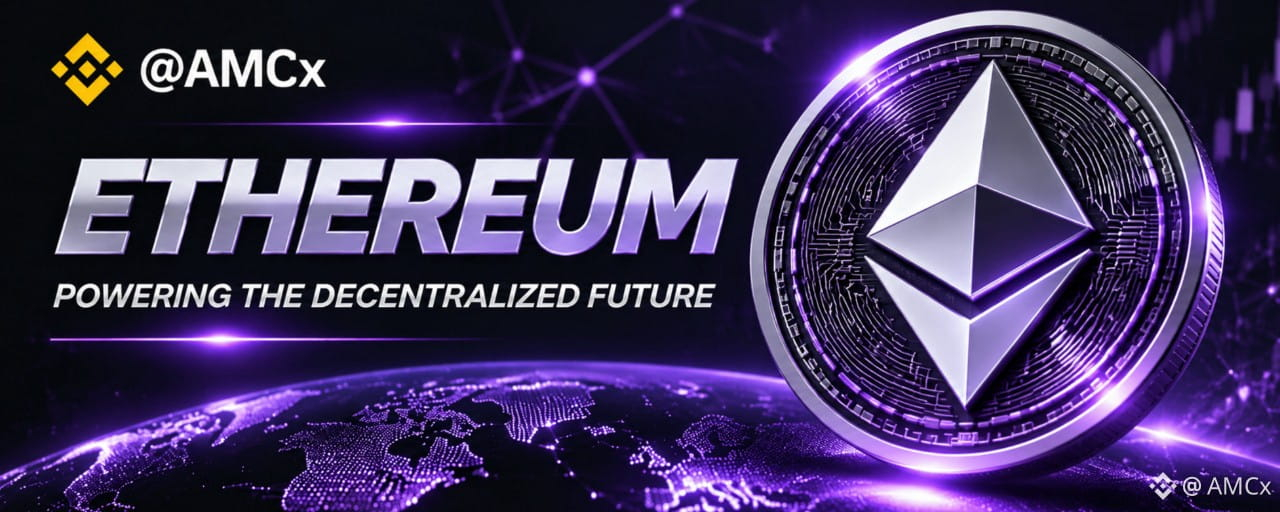
Ethereum remains one of the most important blockchain ecosystems in the cryptocurrency industry. As the second-largest cryptocurrency by market capitalization, Ethereum continues to play a major role in decentralized finance (DeFi), NFTs, smart contracts, and Web3 infrastructure.
But Ethereum is not standing still. Its developers are working on major network improvements designed to make the blockchain faster, more scalable, secure, and efficient.
So, what is happening with Ethereum, and what can the community expect next?
1. Understanding Ethereum's Position
Ethereum was launched in 2015 by Vitalik Buterin and a team of co-founders.
Unlike Bitcoin, which primarily focuses on decentralized digital money, Ethereum was designed as a programmable blockchain that allows developers to create decentralized applications (dApps) using smart contracts.
Today, Ethereum supports a massive ecosystem that includes:
Decentralized Finance (DeFi).
Non-Fungible Tokens (NFTs).
Decentralized Applications (dApps).
Stablecoins and tokenized assets.
Layer 2 scaling networks.
Web3 gaming and digital identity.
ETH is the native cryptocurrency used to pay transaction fees, participate in staking, and support the Ethereum ecosystem.
2. Ethereum's Latest Developments in 2026
Ethereum continues to focus on improving its underlying infrastructure.
Following the Pectra and Fusaka upgrades, the network has been working toward its next major upgrade: Glamsterdam.
Glamsterdam is designed to improve Ethereum's Layer 1 scalability and transaction processing.
Two important technologies are central to this upgrade:
A. Enshrined Proposer-Builder Separation (ePBS)
This aims to improve how blocks are constructed and selected, reducing certain trust dependencies in block production.
B. Block-Level Access Lists (BALs)
These are designed to help Ethereum process transactions more efficiently by identifying which parts of the blockchain state a block needs to access.
Together, these improvements aim to support parallel execution and greater network capacity.
However, Glamsterdam is still undergoing testing. In November 2026, developers were addressing compatibility issues discovered during testing, and the Hoodi testnet rollout had been postponed.
3. Ethereum's Next Major Upgrade: Hegotá
After Glamsterdam, Ethereum developers are preparing for another important upgrade called Hegotá, currently planned for 2027.
One of its major proposed features is Fork-Choice Enforced Inclusion Lists (FOCIL).
FOCIL aims to strengthen censorship resistance by helping ensure that valid transactions are included in blocks, even when individual block builders would prefer to exclude them.
Another area under consideration is native account abstraction, which could make Ethereum wallets more flexible and user-friendly.
These improvements could help Ethereum become a stronger foundation for the next generation of decentralized applications.
4. Ethereum's Long-Term Vision: Quantum Resistance
One of the most interesting areas of Ethereum's long-term development is preparation for quantum computing.
The Ethereum Foundation has identified post-quantum security as an important strategic priority.
Its protocol team is targeting quantum resistance across Ethereum's execution, consensus, and data layers by December 2029.
This is an ambitious development objective, not a completed upgrade.
The goal is to ensure Ethereum remains secure as computing technology continues to advance.
5. Layer 2: The Key to Ethereum's Expansion
Ethereum's future is not limited to its main network.
Layer 2 ecosystems are becoming increasingly important because they can process transactions more efficiently while using Ethereum as their security and settlement foundation.
Networks such as Arbitrum, Optimism, Base, and zkSync are part of this expanding ecosystem.
By improving Layer 2 scalability and interoperability, Ethereum aims to support millions of users and a much broader range of applications.
6. What Could Drive Ethereum's Growth?
Several factors could influence Ethereum's long-term adoption:
Greater institutional participation.
Growth in decentralized finance.
Expansion of tokenized real-world assets.
Increased Layer 2 adoption.
Improvements in transaction efficiency.
More developer activity and decentralized applications.
Stronger security and network decentralization.
However, these developments do not guarantee ETH price appreciation. Market demand, competition, regulation, and broader economic conditions remain important factors.
7. Challenges Ethereum Still Faces
Despite its strong ecosystem, Ethereum must continue addressing several challenges:
Network Competition: Other blockchain networks continue competing for developers, users, and liquidity.
Transaction Costs: Ethereum Layer 1 fees can still become expensive during periods of high demand.
Ecosystem Fragmentation: The growth of multiple Layer 2 networks creates challenges for interoperability and user experience.
Security: Smart contract vulnerabilities and ecosystem risks remain important concerns.
Ethereum's ability to address these challenges will play an important role in its future development.
Final Thoughts: Is Ethereum Ready for Its Next Chapter?
Ethereum is evolving from a smart contract platform into an increasingly sophisticated blockchain infrastructure for the global digital economy.
With Glamsterdam under development, Hegotá on the horizon, and long-term research into quantum-resistant security, Ethereum has several important milestones ahead.
Its future will depend not only on ETH's market performance but also on the strength of its technology, developers, applications, and global adoption.
The next chapter of Ethereum could be one of the most important periods in its evolution.
ETH — Powering the Decentralized Future.
AMCx | Exploring the Future of Crypto.
#Ethereum #ETH #Web3 #Blockchain #DeFi #Crypto #BinanceSquare #AMCx $ETH
