

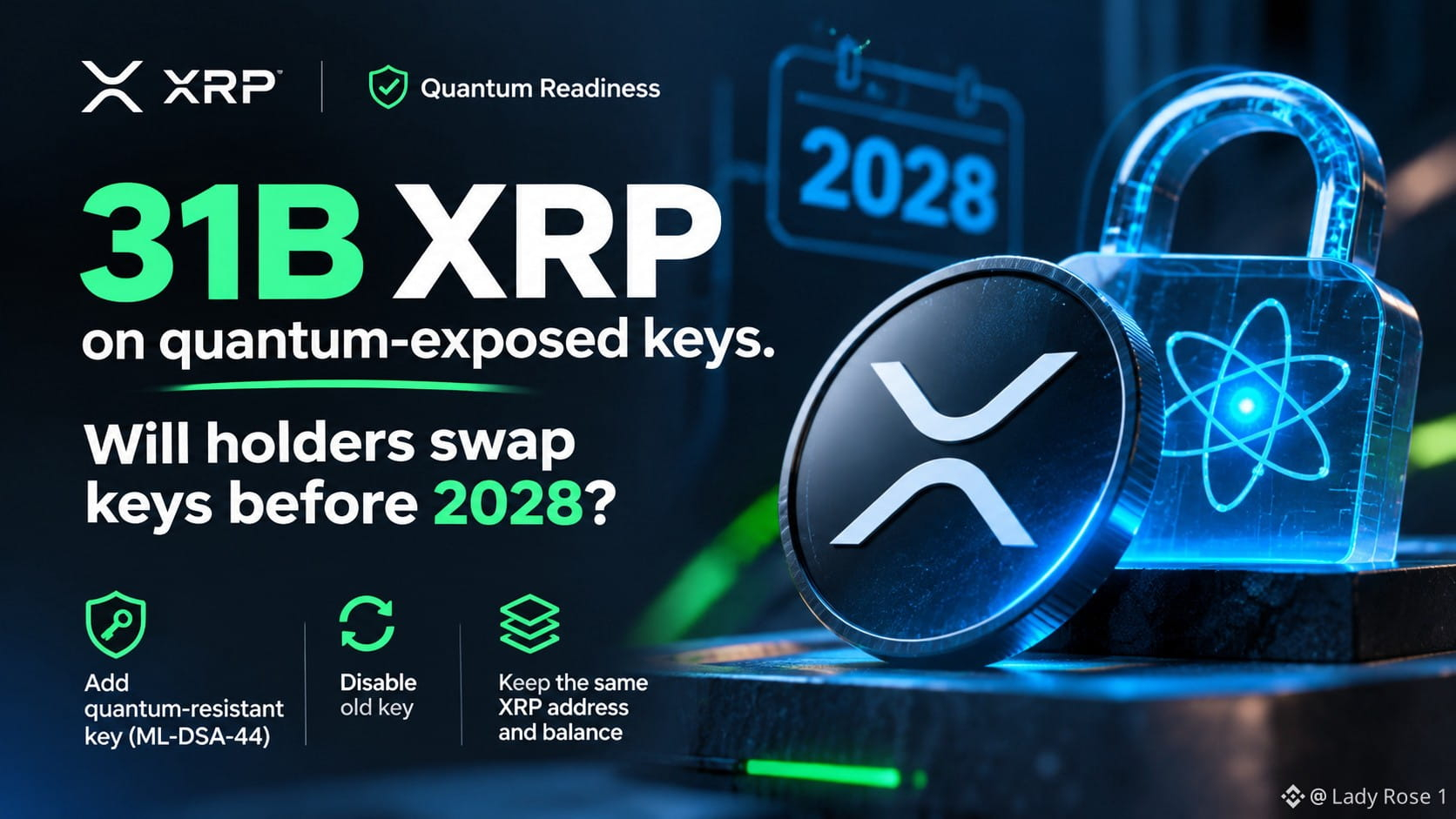
31.4 billion $XRP held across 561 accounts. That's a significant amount of value to consider when looking at quantum security. And there's a much bigger picture. An analysis of the top 1,000 XRPL accounts in November 2026 identified 561 accounts using single-key signatures, holding approximately 31.4 billion XRP. The reason this matters comes down to how account security works. Once an XRPL account signs a transaction, its public key becomes visible on-chain. A sufficiently powerful quantum computer could eventually use Shor's algorithm to derive the corresponding private key, putting those funds at risk. A broader analysis of approximately 7.81 million XRPL accounts estimated that 76.8 billion XRP could be quantum-exposed. The proposed solution is already taking shape. The XRPL Quantum amendment would allow account owners to: • Add a quantum-resistant ML-DSA-44 signing key. • Disable their existing classical key. • Keep their current $XRP address and balances. The migration is particularly important for exchanges, institutional wallets and active holders, who will need to coordinate the transition once the feature becomes available. Then there's another side of the problem: lost keys, forgotten wallets and accounts whose owners are no longer able to authorize changes. The proposed timeline targets preparation ahead of 2028, with a migration study planned for the first half of 2027. Personally, I think the real test will be adoption. Building quantum-resistant technology is one thing. Getting an entire ecosystem to migrate successfully is another.
انضم إلى مُستخدمي العملات الرقمية حول العالم على Binance Square
⚡️ احصل على أحدث المعلومات المفيدة عن العملات الرقمية.
💬 موثوقة من قبل أكبر منصّة لتداول العملات الرقمية في العالم.
👍 اكتشف الرؤى الحقيقية من صنّاع المُحتوى الموثوقين.
البريد الإلكتروني / رقم الهاتف