


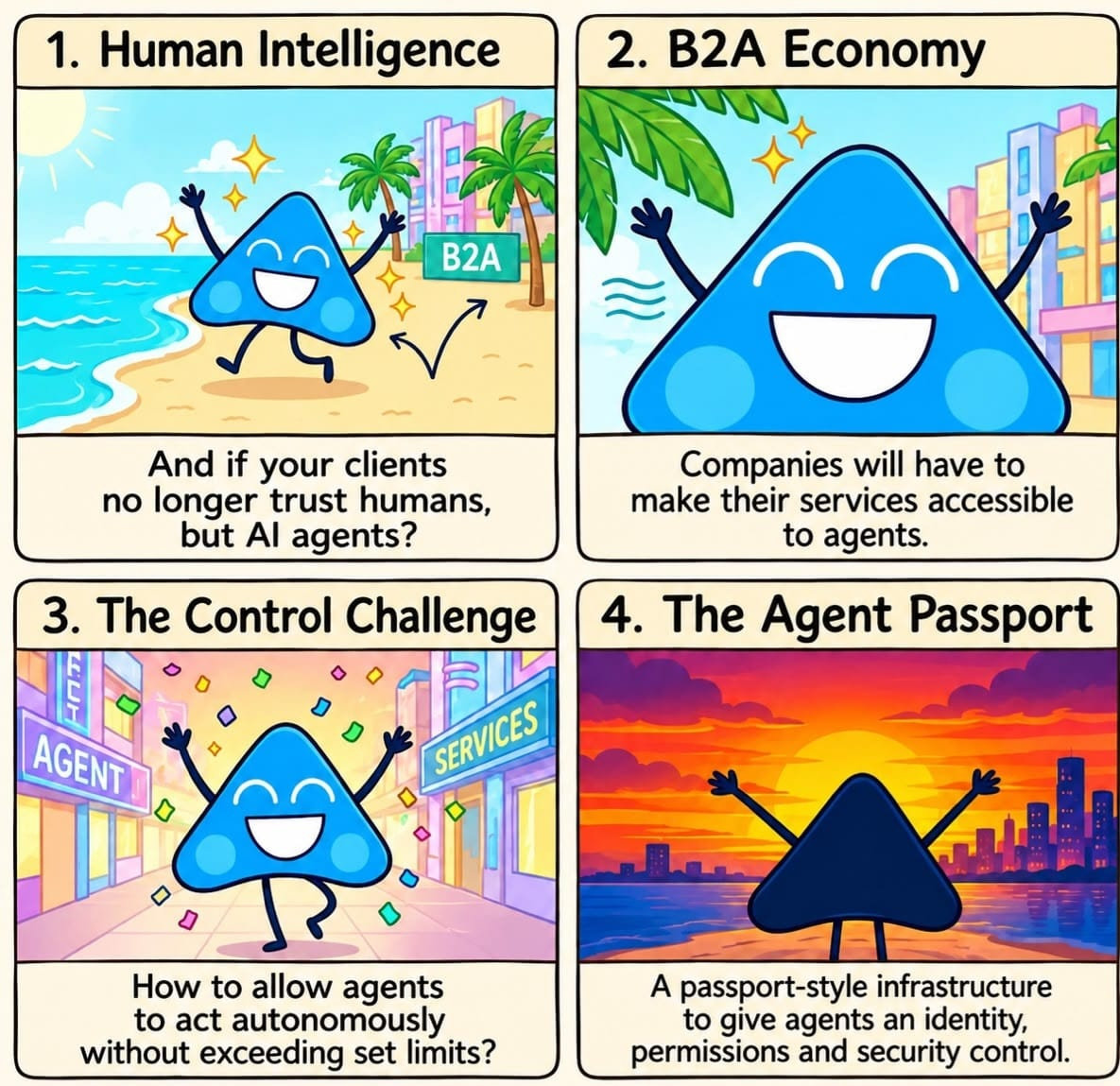
In its recent article on the B2A (Business-to-Agent) economy, a16z highlights a transformation that could profoundly reshape the relationship between businesses and their customers.
Until now, the Internet has primarily been designed for human users.
We visit websites, compare offers, fill out forms and make payments.
But imagine a shift: instead of doing all of this ourselves, we simply give a mission to an AI agent.
It handles the rest.
An agent could search for the best provider, compare several services, check the terms, choose an offer and complete a purchase.
For a business, this means a new type of actor could soon be making purchasing decisions on its behalf.
The commercial relationship would no longer be limited to human interactions.
This is where the concept of B2A makes complete sense.
Businesses will no longer only need to think about attracting human visitors.
They will also need to make their services accessible to agents, facilitate their interactions and enable automated transactions.
The next distribution challenge could be becoming an agent's choice.
But this evolution raises an essential question:
How do you allow agents to carry out transactions at scale without losing control over their actions and spending?
Because finding a service is one thing.
Being able to access it, pay and act in a reliable and secure way is another.
This is precisely one of the challenges Kite is addressing.
With $Kite Agent Passport, the ambition is to provide agents with infrastructure that allows them to interact with services and carry out economic operations within a controlled framework.
It is no longer just about the ability to execute instructions, but about the ability to genuinely participate in a digital economy.
The next generation of digital commerce may be built around this transition.
And Kite is positioning itself on one of its essential layers.
Bullish on @KITE AI 中文 🪁