
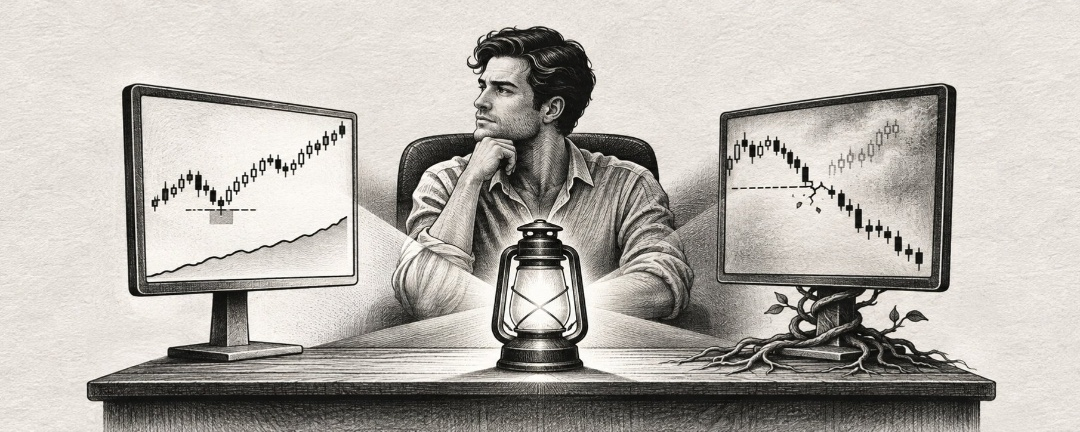

Hope is the most dangerous emotion in trading because it feels like a virtue while acting like a vice.
You bought a stock at $50 after careful analysis indicated it was fundamentally undervalued and technically oversold. The company had solid earnings and good management, and you felt confident about your research. The stock climbed to $60, validating your thesis and making you feel smart. Then earnings came out slightly below expectations, and the stock dropped to $45. Your predetermined stop loss was at $47, but you didn't take it because you hoped it would recover. After all, the fundamentals hadn't really changed, and surely the market was overreacting.
Then it went to $40. Then $35. Then $30. Each day, you find new reasons to hope: maybe the next earnings will be better, maybe an analyst will upgrade the stock, or maybe the whole sector is due for a bounce. What started as a well-researched trade based on sound analysis has become a desperate wish that the market will somehow validate your original decision, or at least get back to even, so you can exit without a loss.
If this scenario sounds painfully familiar, you're not alone. Hope might be the most complex and dangerous emotion that traders face, precisely because it masquerades as something positive while slowly destroying your account.
The Paradox of Hope in Trading.
Hope presents a unique challenge for traders because in almost every other area of life, hope is considered positive and essential. Hope motivates us to pursue difficult goals, sustains us through challenging times, and helps us maintain optimism in the face of setbacks. In these contexts, hope costs nothing and provides significant psychological benefits even when things don't work out as planned.
Trading turns this equation upside down. In the markets, hope has a direct financial cost that increases every moment you hold onto a losing position. When you hope that a declining stock will recover, you're not maintaining a positive attitude; you're actively losing money with each tick lower. When you hope your analysis will eventually be proven right, you risk turning a small, manageable loss into a large one that hurts financially, mentally, and emotionally.
The paradox deepens when you consider that some level of hope is absolutely necessary for trading success. Without hope, you wouldn't have the confidence to enter trades based on your analysis or persist through the inevitable learning curve every trader faces. The challenge lies in learning to harness hope's motivational power while preventing it from clouding your judgment about individual trades.
This dual nature makes hope particularly insidious. When greed takes over, you usually know you're being greedy. When fear paralyzes you, you're aware that you're afraid. But when hope keeps you in a losing trade, you often feel like you're being patient, disciplined, or faithful to your analysis. The voice of hope sounds reasonable and measured, making arguments that seem logical even as they lead you toward a big financial loss. Strong conviction in a losing trade is not a positive emotion.
Understanding Hope's Two Faces
To manage hope effectively, you must first understand the fundamental difference between its constructive and destructive forms. These two faces of hope can look remarkably similar on the surface, but they lead to completely different outcomes in your trading.
Constructive hope is grounded in evidence and realistic expectations. It's the hope that your carefully researched stock will eventually reflect its fair value, but it comes with predetermined time limits and exit strategies. It's the hope that your proven trading system will continue to work over time, even though individual trades may fail. This type of hope acknowledges uncertainty and prepares for multiple outcomes. It says, "I hope this trade works out, but if it doesn't, I know exactly when and how I'll exit."
Constructive hope also maintains perspective on the bigger picture. It focuses on long-term results rather than individual trade outcomes, sustaining you through difficult periods without preventing you from taking necessary losses.
Destructive hope, on the other hand, is characterized by wishful thinking that ignores evidence and avoids planning for adverse outcomes. Hope keeps you in losing trades long after your original analysis has been proven wrong. This type of hope has no time limits, no exit strategies, and no acknowledgment that things might not work out as desired.
Destructive hope often becomes more intense as losses mount. Instead of accepting that a trade isn't working, this type of hope doubles down on optimism, finding increasingly desperate reasons why the position should recover. It goes from "I hope this works" to "It has to work" to "I can't afford this not to work."
The difference between constructive and destructive hope often comes down to timing and planning. Constructive hope does its work before and between trades, motivating you to research opportunities and maintain confidence. Destructive hope takes over during trades, particularly losing ones, and prevents you from executing your predetermined exit strategies.
The Psychology Behind Trading Hope
To understand why hope can be so destructive in trading, you need to understand what's happening in your brain when you're holding onto losing positions. Hope activates the same neural pathways involved in addiction, creating chemical rewards that make it difficult to abandon losing positions. When you hope for a trade to recover, your brain releases dopamine in anticipation of that recovery, even though the recovery may never come.
Cognitive dissonance plays a major role in how hope develops and persists. When reality conflicts with your beliefs or expectations, your brain experiences psychological discomfort and works to resolve the conflict. If you believe you're a good trader but your current position is losing money, hope offers a convenient solution: it suggests the position will eventually become profitable.
Hope also functions as a coping mechanism that helps you avoid the immediate emotional pain of realizing losses. Taking a loss requires you to confront the reality that you were wrong and that you lost money. Hope allows you to postpone this confrontation indefinitely by maintaining the fiction that the loss isn't real as long as you haven't closed the position.
The sunk cost fallacy amplifies hope by making you focus on what you've already invested rather than what you're likely to gain or lose going forward. The more money you've lost on a position, the harder it becomes to close it because hope whispers that walking away now would mean all those losses were for nothing.
The Hope-Denial Spectrum
One of the most important skills you can develop is recognizing where you fall on the spectrum from healthy optimism to dangerous denial. Hope doesn't suddenly become destructive. It gradually transforms from reasonable expectation into desperate wishful thinking.
The spectrum begins with reasonable optimism, which is healthy and necessary for trading. When you enter a well-researched trade, it's reasonable to be optimistic about the outcome. This optimism is grounded in evidence, acknowledges the possibility of being wrong, and includes specific plans for adverse scenarios.
As a trade moves against you, reasonable optimism can shift into stubborn hope. You start ignoring new information that contradicts your thesis while giving extra weight to any positive developments. The shift is subtle but important: you're no longer updating your analysis based on new information but filtering information to support your existing hope.
Stubborn hope can escalate into desperate hope as losses mount. At this stage, you're no longer hoping based on analysis; you're hoping because you need the trade to work out. Your reasons become increasingly emotional and less logical: "I can't afford to lose this much money" or "This position has to recover because I've already lost so much."
The final stage is complete denial, where you refuse to acknowledge that the position is a loser. You stop monitoring the position closely, avoid looking at your account balance, or convince yourself that the loss doesn't count because you haven't closed the position yet.
Each stage represents a deeper departure from rational trading. The key is learning to recognize where you are on this spectrum in real time, particularly during the transition from reasonable optimism to stubborn hope, where you still have the most control.
When Hope Becomes Averaging Down
One of the most dangerous manifestations of hope is when it leads to averaging down, buying more of a position as the price declines. Hope makes averaging down feel logical by reframing declining prices as opportunities rather than warnings. If your analysis was right at $50, surely it's even more right at $45.
The mathematics of averaging down can be seductive. If you bought 100 shares at $50 and another 100 at $45, your average cost is now $47.50. Hope focuses on the smaller recovery needed to break even, while ignoring the possibility that the stock might continue to decline.
Averaging down also offers psychological benefits that hopeful people want. It gives you something active to do instead of passively watching your position lose money. This sense of taking control can be emotionally satisfying, even when the action is making the situation worse.
The danger becomes clear when averaging down fails. The increasingly attractive average price seems to justify each additional purchase, but each addition increases your total exposure. What started as a manageable 5% position can easily become 10%, 15%, or even 20% of your account.
Hope makes averaging down particularly dangerous because it changes your relationship with the position. Instead of viewing declining prices as evidence that your original analysis might have been wrong, hope reframes them as opportunities to improve your average cost. This prevents objective evaluation of whether your original reasons for buying are still valid. Dollar-cost averaging is for investors in indexes over decades, not traders on a daily chart looking for profits on an individual trade. Averaging down in a losing trade due to hope is one of the most destructive behaviors that keep traders unprofitable and their capital trapped on the wrong side of the trend.
Setting Hope Boundaries
Just as you set financial boundaries through position sizing and stop losses, you need psychological boundaries that prevent hope from overriding rational decision-making. These hope boundaries serve as circuit breakers that trigger when hope begins transforming from a helpful emotion into a destructive force.
Time-based boundaries are among the most effective limits. Before entering any trade, establish a maximum holding periodif it's not working as expected. When your time stop limit is reached, close the position regardless of your emotions about its potential.
Stop-loss boundaries provide another crucial constraint. Predetermine the maximum amount you're willing to lose on any single trade, and close the position when that loss is reached. This boundary should be set before entering the trade, when you're thinking clearly and objectively.
Evidence-based boundaries help prevent hope from overriding objective analysis. Before entering a trade, identify specific technical or fundamental changes that would invalidate your original thesis. When these predetermined conditions are met, close the position regardless of your hope for recovery.
confidence that consistent execution of a sound approach will lead to profitability over time.
The most successful traders maintain tremendous hope and optimism about their long-term prospects while being absolutely ruthless in managing individual positions. They hope their systems will continue working and that they'll continue improving as traders. But they never let hope prevent them from taking necessary stops, managing risk appropriately, or admitting when individual trades aren't working.
As you continue developing your trading skills, pay attention to the quality and direction of your hope. Notice when it's motivating productive behavior like research and planning, and when it's encouraging passive behavior like holding losing positions or avoiding difficult decisions. The more aware you become of hope's influence, the better you can channel it toward activities that actually improve your trading results.
Key Strategies for Managing Hope
*Set predetermined time limits for all trades: Close positions when time limits are reached, regardless of hope for recovery
*Establish maximum loss limits before entering trades: Exit when loss limits are hit, no matter how much you hope for a turnaround
*Create specific invalidation criteria for each trade: Predetermine what evidence would prove your analysis wrong
*Schedule regular position reviews with a fresh-eyed evaluation: Ask whether you would initiate each position if starting today
*Write detailed pre-trade plans, including exit strategies like profit targets and trailing stops: Refer back to original analysis when hope clouds judgment
*Keep a trading journal to identify patterns: Track instances when hope overrode rational decision-making
*Use automated stops and alerts to remove emotions: Let technology execute predetermined exit strategies
*Focus hope on process improvement rather than trade outcomes: Hope for better skills, not individual position recovery
*Convert hopes into specific scenario planning: Prepare concrete responses for different market conditions
#WhatWillDriveCryptoandStocks’NextRebound? #Anthropic’s6xIPODemandSignalsPotentialRecordRaise #JaneStreetNearlyOctuplesFidelityBitcoinETFHoldings #USPPIMissMayEaseBTCPressure #BitcoinCoreDisclosesTorTrafficVulnerability