
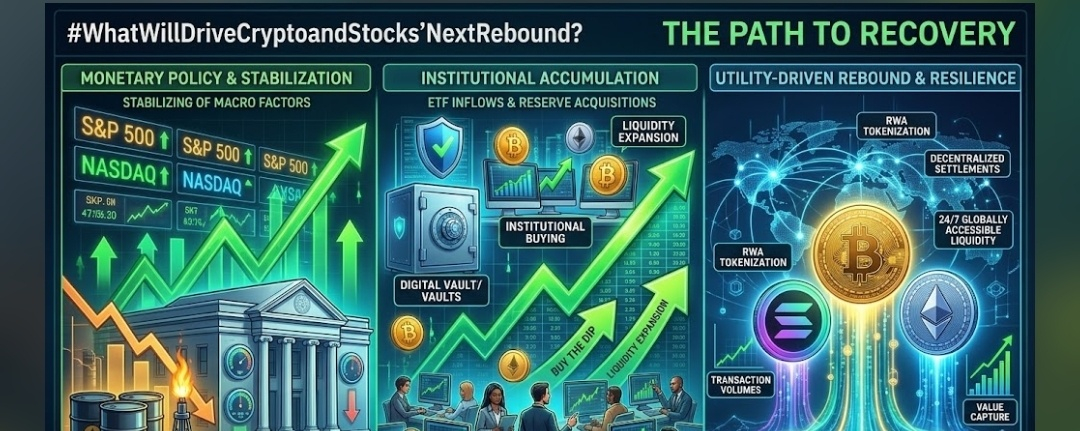

#WhatWillDriveCryptoandStocks’NextRebound?
The trading floor in Lower Manhattan was quiet in the way it only gets when algorithms stop firing and human traders hold their breath.
Across screens tracking the S&P 500, Nasdaq, Bitcoin, and Solana, green candles had been replaced by jagged red declines. The compounding friction of Middle Eastern escalations, spiked shipping insurance in the Gulf, and sticky energy costs had forced capital into defensive trenches. Cash felt safe, but sitting in cash was an admission of paralysis.
Marcus, a veteran macro strategist managing cross-asset flows, scrolled past the sensationalist headlines and leaned into the underlying mechanics. He had lived through the Dot-Com purge, the 2008 liquidity freeze, the 2020 pandemic crash, and multiple crypto drawdowns. Every major rebound in modern market history was never sparked by sudden peace or euphoria—it was born out of exhausted sellers, shifting macro levers, and returning liquidity.
The question buzzing through institutional desks, social feeds, and retail channels was singular: #WhatWillDriveCryptoandStocks’NextRebound?
To Marcus, the roadmap was coming into focus through three distinct phases:
Phase 1: The Energy Ceiling and Monetary Recalibration
The catalyst that broke markets wasn't corporate insolvency; it was inflation anxiety driven by oil and transport bottlenecks. The first domino for the rebound would fall when crude stabilized.
Once energy benchmarks capped their peak, the aggressive central bank hawkishness would lose its justification. The moment central bankers signaled that interest rate trajectories were hitting a terminal plateau, sovereign bond yields would ease. For equities—especially tech, AI infrastructure, and high-growth innovators—cheaper borrowing and predictable discount rates are the rocket fuel that unlocks institutional capital.
Phase 2: The Institutional ETF Siphon
On Marcus’s lower monitor, the flow meters for spot Bitcoin and Ethereum ETFs were ticking. The leveraged speculative traders had already been liquidated in cascading stop-losses. What remained was cold accumulation.
Sovereign wealth funds and multi-strategy asset managers don't buy rallies; they scale into exhaustion zones. The reversal would not begin with retail viral hype, but with net-positive ETF inflows turning from days into consecutive weeks. As major asset managers soaked up the liquid supply of Bitcoin and staked high-speed Layer-1s like Solana, the liquidity drain would create a supply shock. Any sudden wave of demand would trigger a rapid short squeeze, violently pulling prices upward.
Phase 3: The Flight to Borderless and Scalable Utility
Late in the afternoon, Marcus observed settlement data on decentralized ledgers. While conventional banking rails hesitated during cross-border trade disruptions, tokenized real-world assets (RWAs), on-chain treasuries, and high-speed settlement platforms executed trades 24/7 without a single failed clearance.
Public sentiment had viewed crypto as speculative beta to the stock market. But as governments implemented capital restrictions and debt expanded, the narrative would pivot: Bitcoin as sovereign digital gold, and scalable networks as frictionless global transaction rails.
As the closing bell rang and dusk settled over New York, Marcus watched the sell orders thin out on the order books. The panic had spent its force. The ingredients for the next rebound were already aligning: stabilizing energy, peak interest-rate policy, quiet institutional accumulation, and the proven endurance of decentralized technology.
Markets do not wait for clear skies to rise; they rebound the moment the storm proves it cannot knock the foundation down.